
Items related to The Programmer's Guide to SCSI
Synopsis
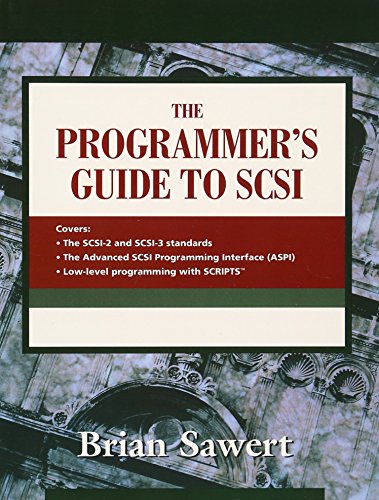
The Programmer's Guide to SCSI offers a concise tutorial and reference to the Small Computer Systems Interface (SCSI), the standard interface for high-performance computer peripherals. Geared specifically for programmers who are writing drivers or creating applications that support SCSI devices, this book presents comprehensive SCSI hardware and software information within the context of software development. It will help you find your way through this complex topic and ease your learning curve by providing expert advice, tips, and techniques for more effective SCSI programming.
"synopsis" may belong to another edition of this title.
About the Author
Brian Sawert has worked with SCSI for years, developing applications and drivers for SCSI devices ranging from optical drives to scanners. He has acquired vast experience with SCSI devices at a range of companies, including Lockheed Missiles and Space Company, Flagstaff Engineering, Trantor Systems, Ltd., and Laguna Data Systems. He has contributed articles on SCSI and ASPI to Dr. Dobb's Journal and Windows/DOS Developer's Journal.
0201185385AB04062001From the Back Cover
The Programmer's Guide to SCSI offers a concise tutorial and reference to the Small Computer Systems Interface (SCSI), the standard interface for high-performance computer peripherals. Geared specifically for programmers who are writing drivers or creating applications that support SCSI devices, this book presents comprehensive SCSI hardware and software information within the context of software development. It will help you find your way through this complex topic and ease your learning curve by providing expert advice, tips, and techniques for more effective SCSI programming.
The Programmer's Guide to SCSI covers both high- and low-level programming topics. Specifically, you will find coverage of:
- SCSI in general, including an explanation of its design philosophy, evolution, and transaction model
- SCSI-2 features, including faster transfers, wider data paths, and other specialized capabilities
- SCSI-3, including Fast-20 and Fast-40 SCSI, serial SCSI, fibre channel, P1394, and plug-and-play SCSI
- The Advanced SCSI Programming Interface (ASPI) and the ASPI32 extensions under Windows 95 andWindows NT
- The Windows NT built-in SCSI Pass-Through Interface
- Low-level programming using SCRIPTS
- SCSI target mode programming
- SCSI support under different UNIX implementations
- SCSI debugging and troubleshooting
In addition, this book develops an ASPI class library and uses it to create a SCSI snooper application under Windows. The library can also be extended for use in your own projects.
This book's clear presentation of SCSI eliminates wading through densely packed hardware documentation and lets you approach the topic with better direction to gain a fuller understanding.
0201185385B04062001From the Inside Flap
In the years since the Small Computer Systems Interface (SCSI) first appeared, it has gained wide acceptance as the interface standard for high-performance computer peripherals. Once confined to mainframes and high-end workstations, SCSI devices are now supported by most desktop operating systems running on personal computers.
There is a reason for this near universal support. The SCSI standard was designed as a high-performance interface to a wide range of devices types. Disk drives, optical and tape drives, scanners, and printers all come equipped with SCSI interfaces. As faster machines become more common, the demand for faster peripherals follows. SCSI technology offers a way to meet this demand.
Though manufacturers and end users have embraced the Small Computer Systems Interface, information about programming SCSI devices is still scarce. This book attempts to fill that gap by describing SCSI from a programmer's point of view. Intended Audience
This book is intended as a tutorial and a reference for programmers writing software to support SCSI peripherals. Whether you are writing low-level code for a SCSI device driver or high-level code for an application, you will find information you can use.
Maybe you have waded through the details of the ANSI specification documents. Maybe you have tried to decipher another programmer's source code. There is no doubt that learning the fundamentals of SCSI programming through trial and error can be a source of endless frustration. Our goal is to plant a few guideposts to steer you in the right direction, so as to flatten the learning curve for this complex but fascinating technology.
The presentation is slanted toward software development. Information about signal characteristics, timing protocols, and hardware details only appear when they directly relate to a programming task. We assume that if you are reading this book, you're more comfortable with a keyboard than a soldering iron. We also assume some experience with C, C++, and assembly language. How This Book Is Organized
This book begins with an overview of SCSI. We describe the design philosophy behind the standard, and how it has evolved to incorporate new features and capabilities. We also describe variations of the SCSI standard that offer faster transfers, wider data paths, or other features.
Anyone working with SCSI must understand some fundamental concepts. How do SCSI devices communicate? How are commands executed and data transferred? What roles do the initiator and the target play? We address these questions by describing the SCSI transaction model. This provides a foundation for a more detailed discussion of the elements of a SCSI transaction.
Next we present a layered approach to SCSI programming, starting with high-level programming interfaces. We explore the Advanced SCSI Programming Interface (ASPI) under DOS and Windows, and ASPI32 extensions under Windows 95 and NT.
Windows NT offers its own built-in SCSI support. We explore how it works by examining the Windows NT device model and how the ASPI layer uses it.
Then we tackle more advanced material as we look at low-level programming using common SCSI I/O processors and scripting languages such as Symbios Logic's SCRIPTS. We demonstrate both initiator and target operations.
SCSI enjoys wide support on UNIX systems. Unfortunately, the specifics of SCSI support differ greatly between UNIX implementations. The UNIX chapter highlights SCSI support under different systems, then focuses on SCSI under Linux. This platform is widely available, and open enough to encourage experimentation.
Last of all, we develop a SCSI class library and use it to develop a sample application under Windows. This should encourage you to use and extend the library for your own projects.
The final chapter offers advice in troubleshooting and debugging. Appendix B lists SCSI resources in print and electronic form. What You Will Need
The sample code in this book was designed for portability. We developed most of the code using Microsoft Visual C++. The SCRIPTS sample code uses Borland's C++ compiler and Turbo Assembler. Either should port with little effort. The sample application uses Microsoft's Foundation Classes library, also available with other compilers. The Linux code uses the compiler that comes with the operating system.
We recommend using an Iomega Zip drive as a test device for the sample code. Some of the samples demonstrate disk drive operations. When testing these, it's nice to have something besides your system disk to work with.
Zip drives come in SCSI or parallel port versions. The parallel port device uses an ASPI compatible driver.
The low-level code uses the Symbios Logic SCRIPTS compiler and host adapters equipped with 53C8XX family processors. The compiler is available from the Symbios Logic FTP site. The code should be compatible with other adapters in the same family. If your host adapter uses a chip from another manufacturer, you will not be able to use this code. If you wish to contact Symbios Logic, refer to the manufacturer listing in Appendix B.
The ASPI code will work with almost any host adapter that comes with an ASPI compatible driver. For more advanced work, you may wish to purchase the ASPI Developer's Kit from Adaptec. To contact Adaptec, refer to the manufacturer listing in Appendix B.
For any serious work with SCSI, you will need a copy of the ANSI SCSI-2 specification document. Though we cover SCSI fundamentals in this book, and probe the depths of some programming issues, we can't duplicate all the details that the specification covers. Consider this book a supplement to the ANSI document, which is available from Global Engineering Documents. You'll find them listed in Appendix B. Acknowledgments
This book would not have been possible without contributions from many people. Kathleen Tibbetts, formerly an editor at Addison-Wesley, had faith in the project from the beginning.
Pamela Thompson at Earle Associates and Lauren Uddenberg at Symbios Logic went above and beyond the call of duty to provide support and information about Symbios products.
Thanks go to Mike Berhan and Dan Polfer of Adaptec for reviewing the ASPI-related material. Thanks also to John Lohmeyer, chairman of the T10 Technical Committee, for his comments and critiques of the material covering the SCSI specifications.
Special thanks go to contributing authors Larry Martin and Gary Field. Larry shares his invaluable programming experience in the chapters on ASPI, Windows device support, and SCSI target mode. Gary, who maintains the SCSI FAQ for the comp.periphs.scsi newsgroup, shares his considerable knowledge of UNIX support for SCSI in a chapter devoted to the subject.
Most important, I wish to acknowledge the inspiration and encouragement that my wife, Mary, provided throughout this project. 0201185385P04062001
"About this title" may belong to another edition of this title.
Search results for The Programmer's Guide to SCSI

Stock Image
The Programmer's Guide to SCSI
Seller: World of Books (was SecondSale), Montgomery, IL, U.S.A.
Seller rating 5 out of 5 stars

Condition: Very Good. This work teaches the fundamentals of programming SCSI (Small Computer Systems Interface) devices including disk drives, optical and tape drives, scanners and printers. It covers both low and high level programming, plus Windows NT device driver model and the Advanced SCSI Programming Interface. Seller Inventory # 00100980292
Stock Image
A Programmer's Guide to SCSI
Published by
Pearson Education, Limited, 1998
ISBN 10: 0201185385
ISBN 13: 9780201185386
Used
Softcover
Seller: Better World Books: West, Reno, NV, U.S.A.
Seller rating 5 out of 5 stars
Condition: Very Good. Pap/Cdr. Pages intact with possible writing/highlighting. Binding strong with minor wear. Dust jackets/supplements may not be included. Stock photo provided. Product includes identifying sticker. Better World Books: Buy Books. Do Good. Seller Inventory # 51100693-6
Stock Image
A Programmer's Guide to SCSI
Published by
Pearson Education, Limited, 1998
ISBN 10: 0201185385
ISBN 13: 9780201185386
Used
Softcover
Seller: Better World Books, Mishawaka, IN, U.S.A.
Seller rating 5 out of 5 stars
Condition: Very Good. Pap/Cdr. Pages intact with possible writing/highlighting. Binding strong with minor wear. Dust jackets/supplements may not be included. Stock photo provided. Product includes identifying sticker. Better World Books: Buy Books. Do Good. Seller Inventory # 51100693-6
Stock Image
The Programmer's Guide to SCSI
Seller: World of Books Inc, Montgomery, IL, U.S.A.
Seller rating 4 out of 5 stars

Condition: Very Good. This work teaches the fundamentals of programming SCSI (Small Computer Systems Interface) devices including disk drives, optical and tape drives, scanners and printers. It covers both low and high level programming, plus Windows NT device driver model and the Advanced SCSI Programming Interface. Seller Inventory # CIN0201185385VG
Stock Image
The Programmer's Guide to SCSI [With Contains Sample Code, a Software Development Kit.]
Published by
Addison-Wesley Professional, 1998
ISBN 10: 0201185385
ISBN 13: 9780201185386
Used
Paperback
Seller: ThriftBooks-Atlanta, AUSTELL, GA, U.S.A.
Seller rating 5 out of 5 stars
Paperback. Condition: As New. No Jacket. Pages are clean and are not marred by notes or folds of any kind. ~ ThriftBooks: Read More, Spend Less. Seller Inventory # G0201185385I2N00
Seller Image
The Programmer's Guide to SCSI
Published by
Addison-Wesley Professional, 1998
ISBN 10: 0201185385
ISBN 13: 9780201185386
Used
paperback
Seller: WeBuyBooks, Rossendale, LANCS, United Kingdom
Seller rating 5 out of 5 stars
paperback. Condition: Very Good. Most items will be dispatched the same or the next working day. A copy that has been read, but is in excellent condition. Pages are intact and not marred by notes or highlighting. The spine remains undamaged. Seller Inventory # rev3814482355
Buy Used
US$ 25.82
US$ 9.49 shipping
Ships from United Kingdom to U.S.A.
Ships from United Kingdom to U.S.A.
Quantity: 1 available
Stock Image
The Programmer*s Guide To Scsi
Published by
Addison-Wesley Professional, 1998
ISBN 10: 0201185385
ISBN 13: 9780201185386
New
Softcover
Seller: Romtrade Corp., STERLING HEIGHTS, MI, U.S.A.
Seller rating 5 out of 5 stars
Condition: New. This is a Brand-new US Edition. This Item may be shipped from US or any other country as we have multiple locations worldwide. Seller Inventory # ABBB-109807
Stock Image
The Programmer*s Guide To Scsi
Published by
Addison-Wesley Professional, 1998
ISBN 10: 0201185385
ISBN 13: 9780201185386
New
Softcover
Seller: Basi6 International, Irving, TX, U.S.A.
Seller rating 5 out of 5 stars
Condition: Brand New. New. US edition. Expediting shipping for all USA and Europe orders excluding PO Box. Excellent Customer Service. Seller Inventory # ABEOCT25-63990
Stock Image
The Programmer's Guide to SCSI
Seller: Majestic Books, Hounslow, United Kingdom
Seller rating 4 out of 5 stars
Condition: Used. pp. 320. Seller Inventory # 7573125
Buy Used
US$ 49.16
US$ 8.61 shipping
Ships from United Kingdom to U.S.A.
Ships from United Kingdom to U.S.A.
Quantity: 1 available
Stock Image
The Programmer's Guide to SCSI
Seller: Books Puddle, Woodside, NY, U.S.A.
Seller rating 4 out of 5 stars
Condition: Used. pp. 320. Seller Inventory # 26274778