
Items related to Networked Virtual Environments: Design and Implementation...
Synopsis
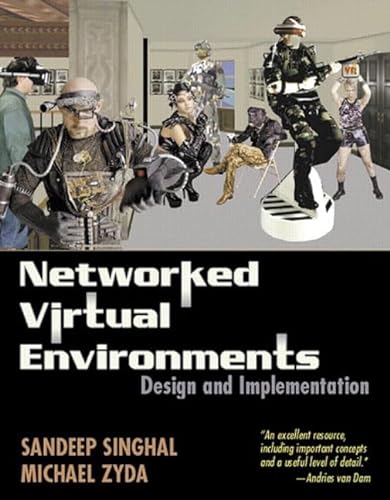
Represents seminal work on networked virtual environments, offering a comprehensive examination of net-VEs. Covers the underlying technologies and provides a detailed roadmap for designing and building interactive 3D virtual environments. DLC: Interactive multimedia.
"synopsis" may belong to another edition of this title.
About the Author
Sandeep Singhal is CTO of ReefEdge, Inc.--a wireless applications and infrastructure company based in Fort Lee, New Jersey. He was formerly Chief Architect and a Senior Technical Staff Member for IBM's Pervasive Computing Division, where he was responsible for product design to support network connectivity from a broad range of sub-PC devices to Web servers and application infrastructure. He previously worked as a Research Staff Member in IBM's T. J. Watson Research Center and as a Software Engineer for the National Aeronautics and Space Administration (NASA). He is also an adjunct assistant professor on the graduate faculty at North Carolina State University in Raleigh.
Sandeep's interests include network protocol design for large-scale collaborative and real-time systems, object-oriented software engineering, and network computing for pervasive computing devices. His credits include dozens of publications, including Networked Virtual Environments (Addison-Wesley, 1999), and ten issued patents. He served for the Defense Advanced Research Projects Agency (DARPA) on an advisory board defining a long-term networked virtual environment research agenda and participated in a National Research Council effort to link military and entertainment applications of simulation technology. Sandeep also played a key role in defining and implementing the Defense Department's High Level Architecture (HLA) for distributed simulation.
Sandeep has participated in the WAP Forum since February of 1998. He currently chairs the User Agent Profile drafting committee and the Architectural Consistency Group at the WAP Forum. He is a member of the W3C Mobile Access Interest Group and is actively working toward converging WAP technologies with the larger Web.
Sandeep holds M.S. and Ph.D degrees in computer science from Stanford University, as well as B.S. degrees in computer science and in mathematical sciences and a B.A. in mathematics from Johns Hopkins University.
Michael Zyda is a professor in the Department of Computer Science at the Naval Postgraduate School in Monterey, California, where he performs research on net-VEs. He was a member of the National Research Council's Committee on Virtual Reality Research and Development, and also has served as Chair of the National Research Council Committee on Modeling and Simulation: Linking Entertainment and Defense.
0201325578AB04062001
From the Back Cover
Networked virtual environments (net-VEs) offer a three-dimensional, virtual "space" in which users around the world can interact in real-time. Net-VE applications--already in use by the military and aerospace and entertainment industries--are used to enhance engineering design, scientific research, and electronic commerce. This emerging, rapidly proliferating field is propelled by globalization and increasingly sophisticated networking capabilities.
Written by two of the field's leading pioneers, this book represents seminal work on networked virtual environments. Offering a comprehensive examination of net-VEs, the text covers the underlying technologies and provides a step-by-step roadmap for designing and building interactive 3D virtual environments. In particular, the authors focus on strategies for overcoming limitations that can impede real-time interactive system development and describe numerous practical techniques for creating successful, real-world net-VE applications.
You will find in-depth coverage of important topics, such as:
* Basic challenges in net-VE design
* Relevant networking principles and Internet communication protocols
* How to organize the communications infrastructure
* How to manage dynamic shared states
* System design for real-time, multiuser interaction
* How to ensure real-time response and scalability by managing limited bandwidth and computational resources
* Emerging techniques and standards for deploying net-VEs over the Internet
Moving beyond the state of the art, Networked Virtual Environments points to future developments that will make net-VEs a pervasive form of professional and personal telecommunications. Authoritative, technically detailed, and comprehensive, this book will help you understand and participate in this exciting field. 0201325578B04062001
From the Inside Flap
Networked virtual environments (net-VEs) allow multiple users to interact in real-time even though those users may be located around the world. These environments usually aim to provide a sense of realism and an immersive experience by incorporating realistic 3D graphics and stereo sound. Increasingly used for military and industrial team training, collaborative design and engineering, and multiplayer games, Net-VEs' envisioned future commercial applications include virtual shopping malls and showrooms, on-line tradeshows and conferences, remote customer support, and distance learning. In many respects, net-VEs form the foundation for a new generation of standard applications.
In recent years, we have seen a growing interest in the design and implementation of net-VEs. Several companies are deploying interactive environments for entertainment. Other commercial applications are being prototyped, and military training systems are growing in size, scope, and complexity. The research frontier into net-VEs is moving quickly, as new research efforts have been initiated at several universities and commercial laboratories. Finally, open standards for the delivery of net-VEs over the Internet are beginning to emerge.
The net-VE developer must possess expertise in a variety of areas, including network protocol design and implementation, parallel and distributed systems, graphics and rendering, asynchronous and multithreaded systems design and engineering, database development, and user interface design. Furthermore, net-VEs pose several problems of their own: managing consistent distributed information; guaranteeing real-time interactivity; and contending with limited network bandwidth, processing, and rendering resources. Increasing numbers of computer scientists are beginning to develop infrastructures for net-VEs, develop net-VE applications on these infrastructures, and use net-VEs in day-to-day work. Rather than starting anew, these developers and users can be more effective in their work by learning the tried-and-true techniques used by existing systems, as well as the emerging techniques being pioneered in the research lab.
This book aims to teach the design and implementation of net-VEs. It employs an "outside-in" approach that assumes that the reader has minimal experience with developing distributed applications. The book is organized into three parts. The first chapters of the book introduce net-VEs. They explore the basic challenges facing the net-VE developer and provide a historical perspective based on military, industrial, and research systems. Then, they offer a review of networking principles, with particular attention to Internet communication protocols.
The second part of the book discusses each of the components of a net-VE in detail. These chapters describe how to organize the communication infrastructure, manage distributed states, and design the system to support multiuser interactions, produce high-quality graphics, and ensure real-time response.
The third part of the book describes some of the more recent developments in the area of net-VEs. The final chapters concentrate on techniques for supporting large numbers of simultaneous users by managing limited bandwidth and computational resources. They also describe the emerging standards that enable net-VEs to be deployed on the Internet and analyze the additional considerations that Internet deployment requires. The book concludes with a discussion of the significant trends and needs in the net-VE technology area.
This book is aimed at several audiences.
Commercial net-VE infrastructure and application developers: The book enables practitioners to develop new net-VE systems by building on the knowledge gained from previous efforts. It can be used both as a front-to-back tutorial and as a topical reference. University students: This book can serve as the primary text for a one-semester or one-quarter course in networking virtual environments at the advanced undergraduate or graduate level. The book also makes an excellent supplemental text for traditional graphics, networking, or distributed systems courses. In these latter courses, this book exposes students to a real-world application for the core course material and offers insight into an area that bridges several different areas of computer science. Researchers: This book provides insight into the state-of-the-art of net-VEs. The discussion can also serve as a starting point for defining and exploring new techniques. The references with each chapter cover much of the significant literature in the field.
0201325578P04062001
Excerpt. © Reprinted by permission. All rights reserved.
Networked virtual environments (net-VEs) allow multiple users to interact in real-time even though those users may be located around the world. These environments usually aim to provide a sense of realism and an immersive experience by incorporating realistic 3D graphics and stereo sound. Increasingly used for military and industrial team training, collaborative design and engineering, and multiplayer games, Net-VEs' envisioned future commercial applications include virtual shopping malls and showrooms, on-line tradeshows and conferences, remote customer support, and distance learning. In many respects, net-VEs form the foundation for a new generation of standard applications.
In recent years, we have seen a growing interest in the design and implementation of net-VEs. Several companies are deploying interactive environments for entertainment. Other commercial applications are being prototyped, and military training systems are growing in size, scope, and complexity. The research frontier into net-VEs is moving quickly, as new research efforts have been initiated at several universities and commercial laboratories. Finally, open standards for the delivery of net-VEs over the Internet are beginning to emerge.
The net-VE developer must possess expertise in a variety of areas, including network protocol design and implementation, parallel and distributed systems, graphics and rendering, asynchronous and multithreaded systems design and engineering, database development, and user interface design. Furthermore, net-VEs pose several problems of their own: managing consistent distributed information; guaranteeing real-time interactivity; and contending with limited network bandwidth, processing, and rendering resources. Increasing numbers of computer scientists are beginning to develop infrastructures for net-VEs, develop net-VE applications on these infrastructures, and use net-VEs in day-to-day work. Rather than starting anew, these developers and users can be more effective in their work by learning the tried-and-true techniques used by existing systems, as well as the emerging techniques being pioneered in the research lab.
This book aims to teach the design and implementation of net-VEs. It employs an "outside-in" approach that assumes that the reader has minimal experience with developing distributed applications. The book is organized into three parts. The first chapters of the book introduce net-VEs. They explore the basic challenges facing the net-VE developer and provide a historical perspective based on military, industrial, and research systems. Then, they offer a review of networking principles, with particular attention to Internet communication protocols.
The second part of the book discusses each of the components of a net-VE in detail. These chapters describe how to organize the communication infrastructure, manage distributed states, and design the system to support multiuser interactions, produce high-quality graphics, and ensure real-time response.
The third part of the book describes some of the more recent developments in the area of net-VEs. The final chapters concentrate on techniques for supporting large numbers of simultaneous users by managing limited bandwidth and computational resources. They also describe the emerging standards that enable net-VEs to be deployed on the Internet and analyze the additional considerations that Internet deployment requires. The book concludes with a discussion of the significant trends and needs in the net-VE technology area.
This book is aimed at several audiences.
* Commercial net-VE infrastructure and application developers: The book enables practitioners to develop new net-VE systems by building on the knowledge gained from previous efforts. It can be used both as a front-to-back tutorial and as a topical reference.
* University students: This book can serve as the primary text for a one-semester or one-quarter course in networking virtual environments at the advanced undergraduate or graduate level. The book also makes an excellent supplemental text for traditional graphics, networking, or distributed systems courses. In these latter courses, this book exposes students to a real-world application for the core course material and offers insight into an area that bridges several different areas of computer science.
* Researchers: This book provides insight into the state-of-the-art of net-VEs. The discussion can also serve as a starting point for defining and exploring new techniques. The references with each chapter cover much of the significant literature in the field.
"About this title" may belong to another edition of this title.
Search results for Networked Virtual Environments: Design and Implementation...

Stock Image
Networked Virtual Environments: Design and Implementation (Siggraph Series)
Seller: ThriftBooks-Atlanta, AUSTELL, GA, U.S.A.
Seller rating 5 out of 5 stars

Hardcover. Condition: As New. No Jacket. Pages are clean and are not marred by notes or folds of any kind. ~ ThriftBooks: Read More, Spend Less. Seller Inventory # G0201325578I2N00
Stock Image
Networked Virtual Environments: Design and Implementation (ACM Press Books)
Seller: Wonder Book, Frederick, MD, U.S.A.
Seller rating 5 out of 5 stars
Condition: Good. Signed Copy . Signed by Zyda on title page. Owner's name on page edges. Seller Inventory # SB15D-01765
Stock Image
Networked Virtual Environments: Design and Implementation (Siggraph Series)
Published by
Addison-Wesley (edition ), 1999
ISBN 10: 0201325578
ISBN 13: 9780201325577
Used
Hardcover
Seller: BooksRun, Philadelphia, PA, U.S.A.
Seller rating 5 out of 5 stars
Hardcover. Condition: Fair. The item might be beaten up but readable. May contain markings or highlighting, as well as stains, bent corners, or any other major defect, but the text is not obscured in any way. Seller Inventory # 0201325578-7-1
Stock Image
Networked Virtual Environments: Design and Implementation (Siggraph Series)
Seller: Phatpocket Limited, Waltham Abbey, HERTS, United Kingdom
Seller rating 5 out of 5 stars
Condition: Good. Your purchase helps support Sri Lankan Children's Charity 'The Rainbow Centre'. Ex-library, so some stamps and wear, but in good overall condition. Our donations to The Rainbow Centre have helped provide an education and a safe haven to hundreds of children who live in appalling conditions. Seller Inventory # Z1-T-040-01114
Buy Used
US$ 32.98
US$ 14.11 shipping
Ships from United Kingdom to U.S.A.
Ships from United Kingdom to U.S.A.
Quantity: 1 available
Stock Image
Networked Virtual Environments: Design and Implementation (Siggraph Series)
Published by
Addison-Wesley Longman, Amsterdam, 1999
ISBN 10: 0201325578
ISBN 13: 9780201325577
Used
Hardcover
Seller: Buchmarie, Darmstadt, Germany
Seller rating 5 out of 5 stars
Condition: Good. Ältere Ausgabe. Auflage: 1999. Seller Inventory # 3797509_b78
Buy Used
US$ 24.12
US$ 117.61 shipping
Ships from Germany to U.S.A.
Ships from Germany to U.S.A.
Quantity: 1 available
Stock Image
Networked Virtual Environments: Design and Implementation (Siggraph Series) Sandeep Singhal
Published by
Addison-Wesley Longman, Amsterdam, 1999
ISBN 10: 0201325578
ISBN 13: 9780201325577
Used
Hardcover
Seller: BUCHSERVICE / ANTIQUARIAT Lars Lutzer, Wahlstedt, Germany
Seller rating 5 out of 5 stars
Condition: gut. Networked Virtual Environments: Design and Implementation (Siggraph Series) In englischer Sprache. pages. Seller Inventory # BN619035
Buy Used
US$ 207.66
US$ 44.75 shipping
Ships from Germany to U.S.A.
Ships from Germany to U.S.A.
Quantity: 1 available