
Items related to On to C++
Synopsis
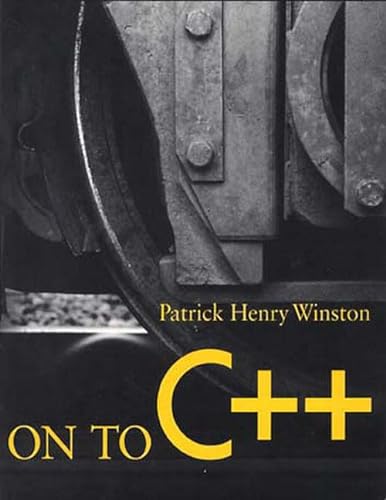
This book is a concise, yet clear introduction to the C++ programming language. A practicing programmer can use this book to learn the essentials of the langauge without a lot of time-consuming overhead. Key concepts and techniques are learned in their natural order as features are added to a short, yet representative C++ program.
"synopsis" may belong to another edition of this title.
About the Author
About Patrick Henry Winston
Well-known author Patrick Henry Winston teaches computer science and directs the Artificial Intelligence Laboratory at theMassachusetts Institute of Technology.
0201580438AB04062001
From the Back Cover
0201580438B04062001
From the Inside Flap
The introduction to On To C++ follows. Additionalinformation about this book, along with access to software, is availablevia ascent/booksHow On To C++ Teaches You C++
The purpose of this book is to help you learn the essentials ofC++ programming. In this section, you learn why you shouldknow C++ and how this book is organized.
The C++ programming language is related toC. Because ++ is C's increment operator, and because thedevelopers of C++ viewed C++ as an incremental augmentation of C,rather than as a completely different language, they decided to use C and++ in C++'s name.
In the vernacular of programming, an object is a packet ofinformation stored in a chunk of computer memory. Every objectis associated with a data type, and the data type determines whatcan be done to an object. All programming languages havebuilt-in data types, such as the integer data type and thecharacter data type.
An object-oriented programming language encourages you todesign programs around data types and data-type hierarchies that youdefine yourself. Typically, you define data types and data-typehierarchies so that you can describe individual nails,horseshoes, horses, kingdoms, or whatever else happens to come upnaturally in your application.
In contrast, procedure-oriented programming languages encourage youto think in terms of procedures, instead of in terms of data types anddata-type hierarchies.
In this book, you learn more about what object-oriented means andwhy many programmers prefer object-oriented languages. For now, itsuffices to know that C++ is an object-oriented programming language,whereas most other programming languages are procedure-orientedprogramming languages.
C++ became a popular object-oriented programming language because its parentlanguage, C, was already popular. C, in turn, became popular by virtueof attractive characteristics, such as the following:C is easy to learn.C programs are fast.C programs are concise.C compilers -- programs that translate C programs intomachine instructions -- are usually fast and concise.C compilers and C programs run on all sorts of computers,from small personal computers to huge supercomputers.Unix, a popular operating system, happens to be written in C.There are two principal reasons to learn C++:The productivity of C++ programmersgenerally exceeds the productivity of C programmers. Hence, C++programmers are in demand.The supply of powerful off-the-shelf C++ software modules,both free and for sale, is increasing rapidly. The supply ofoff-the-shelf C modules, most of which you can incorporate intoC++ programs, is already huge.
Also, because C++ is the most widely used object-oriented programminglanguage, you often hear programmers debate the merits of otherobject-oriented languages in terms of advantages and disadvantages relative toC++.Four principles determined this introductory book's organization and style:
The book should get you up and running in the language quickly.The book should answer your basic questions explicitly.The book should encourage you to develop a personal library ofsolutions to standard programming problems.The book should deepen your understanding of the art of goodprogramming practice.
To get you up and running in C++ quickly, the sections in thisbook generally supply you with the most useful approach to eachprogramming need, be it to display characters on your screen, todefine a new function, or to read information from a file.
To answer your basic questions explicitly, this book is dividedinto parts that generally focus on one issue, which is plainlyannounced in the title of the section. Accordingly, you seetitles such as the following:How To Write Arithmetic ExpressionsHow To Define Simple FunctionsHow To Create Classes and ObjectsHow To Benefit from Data AbstractionHow To Design Class HierarchiesHow To Organize a Multiple-File Program
To encourage you to develop a personal library of solutions tostandard programming problems, this book introduces many useful,productivity-increasing, general-purpose, templatelikepatterns -- sometimes called cliches by experiencedprogrammers---that you can fill in to achieve particular-purposegoals.
Cliches are introduced because learning to program involves more thanlearning to use programming-language primitives, just as learning tospeak a human language involves more than learning to use vocabulary words.
To deepen your understanding of the art of good programmingpractice, this book emphasizes the value of such ideas as dataabstraction and procedure abstraction, along withprinciples such asthe explicit-representation principle,the no-duplication principle, the local-view principle,the look-up principle,the need-to-know principle,and the keep-it-simple principle.
In this book, single-idea segments, analogous to slides, are arranged insections that are analogous to slide shows. The segments come in severalvarieties: basic segments explain essential ideas; sidetripsegments introduce interesting, but skippable, ideas; practice segmentsprovide opportunities to experiment with new ideas; and highlightssegments summarize important points.
Finally, the book develops a simple, yet realistic C++ program, which yousee in many versions as your understanding of the language increases. Inits ultimate version, the program reads information from a file describinga railroad train, computes the load-bearing volume of each box car and tankcar using formulas drawn from descriptions of boxes and cylinders, anddisplays a car-by-car report. Programs similar to the one developed canhelp you to manage a railroad, either model or real.Highlights
C++ is an object-oriented programming language.Object-oriented programming languages emphasize user-defined datatypes and data-typehierarchies, rather than computations to perform.C++ descends from C, an already-popular programminglanguage; thus, heredity is the most conspicuous reason why C++ itselfenjoys considerable popularity.This book gets you up and running in C++ quickly; itanswers your basic questions explicitly; it equips you withprogram patterns that you can adapt to your own purposes; and itdeepens your understanding of the art of good programmingpractice. 0201580438P04062001
"About this title" may belong to another edition of this title.
Search results for On to C++

Stock Image
On to C++
Seller: World of Books (was SecondSale), Montgomery, IL, U.S.A.
Seller rating 5 out of 5 stars

Condition: Good. Item in very good condition! Textbooks may not include supplemental items i.e. CDs, access codes etc. Seller Inventory # 00078473050
Stock Image
On to C++
Seller: BookHolders, Towson, MD, U.S.A.
Seller rating 5 out of 5 stars
Condition: Good. [ No Hassle 30 Day Returns ][ Ships Daily ] [ Underlining/Highlighting: NONE ] [ Writing: NONE ] [ Edition: first ] Publisher: Addison Wesley Pub Date: 5/10/1994 Binding: Paperback Pages: 305 first edition. Seller Inventory # 6940924
Stock Image
On to C++
Seller: ThriftBooks-Atlanta, AUSTELL, GA, U.S.A.
Seller rating 5 out of 5 stars
Paperback. Condition: Good. No Jacket. Pages can have notes/highlighting. Spine may show signs of wear. ~ ThriftBooks: Read More, Spend Less. Seller Inventory # G0201580438I3N00
Stock Image
On to C++
Seller: ThriftBooks-Dallas, Dallas, TX, U.S.A.
Seller rating 5 out of 5 stars
Paperback. Condition: Very Good. No Jacket. May have limited writing in cover pages. Pages are unmarked. ~ ThriftBooks: Read More, Spend Less. Seller Inventory # G0201580438I4N00
Stock Image
On to C++
Seller: Wonder Book, Frederick, MD, U.S.A.
Seller rating 5 out of 5 stars
Condition: Good. Good condition. A copy that has been read but remains intact. May contain markings such as bookplates, stamps, limited notes and highlighting, or a few light stains. Seller Inventory # V02N-01498
Stock Image
On to C++
Seller: Wonder Book, Frederick, MD, U.S.A.
Seller rating 5 out of 5 stars
Condition: Very Good. Very Good condition. A copy that may have a few cosmetic defects. May also contain light spine creasing or a few markings such as an owner's name, short gifter's inscription or light stamp. Seller Inventory # Q17E-01083
Stock Image
On to C Plus Plus
Published by
Pearson Education, Limited, 1994
ISBN 10: 0201580438
ISBN 13: 9780201580433
Used
Softcover
Seller: Better World Books, Mishawaka, IN, U.S.A.
Seller rating 5 out of 5 stars
Condition: Good. 2nd Ed. Pages intact with minimal writing/highlighting. The binding may be loose and creased. Dust jackets/supplements are not included. Stock photo provided. Product includes identifying sticker. Better World Books: Buy Books. Do Good. Seller Inventory # 4513967-6
Stock Image
On to C++
Seller: World of Books Inc, Montgomery, IL, U.S.A.
Seller rating 4 out of 5 stars

Hardback. Condition: Good. A concise introduction to the C++ programming language. Key concepts and techniques are introduced in their logical order. The short, yet representative program used demonstrates the ability of C++ classes to capture knowledge about naturally-occurring categories. Seller Inventory # CIN0201580438G
Stock Image
On to C++
Published by
Pearson Education (US), United States, Upper Saddle River, 1994
ISBN 10: 0201580438
ISBN 13: 9780201580433
Used
Paperback
Seller: WorldofBooks, Goring-By-Sea, WS, United Kingdom
Seller rating 5 out of 5 stars
Paperback. Condition: Very Good. This book is a concise, yet clear introduction to the C++ programming language. Practicing programmers can use this book to learn the essentials of the language without a lot of time-consuming overhead. Key concepts and techniques are learned in their natural order as features are added to a short, yet representative C++ program. Also available: On to C and On to Java. The book has been read, but is in excellent condition. Pages are intact and not marred by notes or highlighting. The spine remains undamaged. Seller Inventory # GOR001578811
Buy Used
US$ 3.82
US$ 7.42 shipping
Ships from United Kingdom to U.S.A.
Ships from United Kingdom to U.S.A.
Quantity: 1 available
Stock Image
On to C Plus Plus
Published by
Pearson Education, Limited, 1994
ISBN 10: 0201580438
ISBN 13: 9780201580433
Used
Softcover
Seller: Better World Books Ltd, Dunfermline, United Kingdom
Seller rating 5 out of 5 stars
Condition: Very Good. 2nd Ed. Former library copy. Pages intact with possible writing/highlighting. Binding strong with minor wear. Dust jackets/supplements may not be included. Includes library markings. Stock photo provided. Product includes identifying sticker. Better World Books: Buy Books. Do Good. Seller Inventory # 56017084-20
Buy Used
US$ 6.68
US$ 6.63 shipping
Ships from United Kingdom to U.S.A.
Ships from United Kingdom to U.S.A.
Quantity: 1 available