
Items related to The End Of Science: Facing The Limits Of Knowledge...
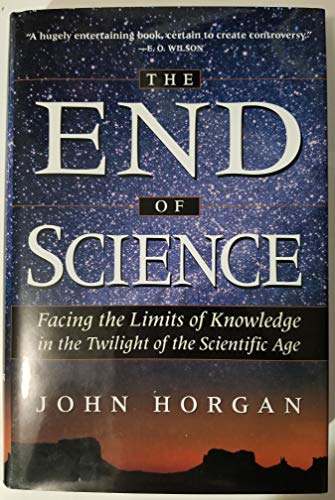
The End Of Science: Facing The Limits Of Knowledge In The Twilight Of The Scientific Age (Helix Books) - Softcover
Synopsis
As staff writer for Scientific American, John Horgan has a window on contemporary science unsurpassed in all the world. Who else routinely interviews the likes of Lynn Margulis, Roger Penrose, Francis Crick, Richard Dawkins, Freeman Dyson, Murray Gell-Mann, Stephen Jay Gould, Stephen Hawking, Thomas Kuhn, Chris Langton, Karl Popper, Stephen Weinberg, and E.O. Wilson, with the freedom to probe their innermost thoughts?In The End Of Science, Horgan displays his genius for getting these larger-than-life figures to be simply human, and scientists, he writes, ”are rarely so human...so at ther mercy of their fears and desires, as when they are confronting the limits of knowledge.”This is the secret fear that Horgan pursues throughout this remarkable book: Have the big questions all been answered? Has all the knowledge worth pursuing become known? Will there be a final ”theory of everything” that signals the end? Is the age of great discoverers behind us? Is science today reduced to mere puzzle solving and adding detains to existing theories?Horgan extracts surprisingly candid answers to there and other delicate questions as he discusses God, Star Trek, superstrings, quarks, plectics, consciousness, Neural Darwinism, Marx's view of progress, Kuhn's view of revolutions, cellular automata, robots, and the Omega Point, with Fred Hoyle, Noam Chomsky, John Wheeler, Clifford Geertz, and dozens of other eminent scholars. The resulting narrative will both infuriate and delight as it mindles Horgan's smart, contrarian argument for ”endism” with a witty, thoughtful, even profound overview of the entire scientific enterprise.Scientists have always set themselves apart from other scholars in the belief that they do not construct the truth, they discover it. Their work is not interpretation but simple revelation of what exists in the empirical universe. But science itself keeps imposing limits on its own power. Special relativity prohibits the transmission of matter or information as speeds faster than that of light; quantum mechanics dictates uncertainty; and chaos theory confirms the impossibility of complete prediction. Meanwhile, the very idea of scientific rationality is under fire from Neo-Luddites, animal-rights acitivists, religious fundamentalists, and New Agers alike.As Horgan makes clear, perhaps the greatest threat to science may come from losing its special place in the hierarchy of disciplines, being reduced to something more akin to literaty criticism as more and more theoreticians engage in the theory twiddling he calls ”ironic science.” Still, while Horgan offers his critique, grounded in the thinking of the world's leading researchers, he offers homage too. If science is ending, he maintains, it is only because it has done its work so well.
"synopsis" may belong to another edition of this title.
About the Author
John Horgan is a senior writer at Scientific American.
Reviews
Scientific American columnist Horgan here interviews an impressive array of scientists and philosophers, who seem sharply divided over the prospects and possibilities of science. Among the pessimists, molecular biologist Gunther Stent suggests that science is reaching a point of incremental, diminishing returns as it comes up against the limits of knowledge; philosopher Thomas Kuhn sees science as a nonrational process that does not converge with truth; Vienna-born thinker Paul Feyerabend objects to science's pretensions to certainty and its potential to stamp out the diversity of human thought and culture. More optimistic are particle physicist Edward Witten, pioneer of superstring theory (which posits a universe of 10 dimensions); robotics engineer Hans Moravec, who envisions superintelligent creative robots; and physicist Roger Penrose, who theorizes that quantum effects percolating through the brain underlie consciousness. Other interviewees are Francis Crick, Noam Chomsky, David Bohm, Karl Popper, Murray Gell-Mann, Sheldon Glashow, Ilya Prigogine and Clifford Geertz. Despite the dominant doomsaying tone, this colloquium leaves much room for optimism.
Copyright 1996 Reed Business Information, Inc.
A Scientific American journalist, Horgan interviewed such popular scientists as Stephen Gould, Daniel Dennett, and John Wheeler and posed the tough question: Is pure science in sight of completely understanding the universe, thereby foreclosing any further revolutionary scientific discoveries? A question most resonant in physics, it provokes titles such as Steven Weinberg's Dreams of a Final Theory (1992) and vexes theorists of cosmology, biology, and chaos and complexity. In his interviews, Horgan plays up the scientists' personalities and demeanors to enliven particular abstractions, such as the string theory of particle physics or the inflation model of the infinitesimally young universe. That these notions are untestable doesn't deter optimism in great days ahead, but are these smart people just having fun with unprovable ideas? Some of Horgan's interlocutors believe yes, and the debate will ventilate best in libraries that have steadily stocked the best science books of recent years. Gilbert Taylor
Rich in provocative ideas and insightful anecdotes, this book investigates a serious question concerning empirical inquiry: Is there a limit to the discovery of theories about nature? The ongoing success of scientific research suggests that a final (ultimate), comprehensive, testable, and effective theory explaining the unity of all reality may soon be forthcoming. Exploring this possibility, Horgan, who writes the interview column for Scientific American, introduces the reader to a wide spectrum of opinion, from Francis Crick, Karl Popper, Stephen Hawking, Richard Dawkins, Stanley Miller, Margin Minksy, Frank Tippler, and Edward Wilson, among others. His probing interviews discuss engaging themes ranging from language, neuroscience, and evolution to quantum physics, complexity and chaos, and cosmology. This celebration of curiosity and speculation as well as of science and reason is a unique contribution to appreciating the human quest for understanding. Recommended for both academic and public science collections.?H. James Birx, Canisius Coll., Buffalo, N.Y.
Copyright 1996 Reed Business Information, Inc.
"About this title" may belong to another edition of this title.
Search results for The End Of Science: Facing The Limits Of Knowledge...

Stock Image
The End Of Science: Facing The Limits Of Knowledge In The Twilight Of The Scientific Age (Helix Books)
Published by
Addison-Wesley (edition First Edition), 1996
ISBN 10: 0201626799
ISBN 13: 9780201626797
Used
Paperback
First Edition
Seller: BooksRun, Philadelphia, PA, U.S.A.
Seller rating 5 out of 5 stars

Paperback. Condition: Very Good. First Edition. With dust jacket. It's a well-cared-for item that has seen limited use. The item may show minor signs of wear. All the text is legible, with all pages included. It may have slight markings and/or highlighting. Seller Inventory # 0201626799-8-1-29
Stock Image
The End of Science
Published by
INGRAM PUBLISHER SERVICES US, 1996
ISBN 10: 0201626799
ISBN 13: 9780201626797
Used
Hardcover
Seller: World of Books (was SecondSale), Montgomery, IL, U.S.A.
Seller rating 5 out of 5 stars
Hardback. Condition: Good. }As staff writer for Scientific American, John Horgan has a window on contemporary science unsurpassed in all the world. Who else routinely interviews the likes of Lynn Margulis, Roger Penrose, Francis Crick, Richard Dawkins, Freeman Dyson, Murray Gell-Mann, Stephen Jay Gould, Stephen Hawking, Thomas Kuhn, Chris Langton, Karl Popper, Stephen Weinberg, and E.O. Wilson, with the freedom to probe their innermost thoughts?In The End Of Science, Horgan displays his genius for getting these larger-than-life figures to be simply human, and scientists, he writes, are rarely so human.so at ther mercy of their fears and desires, as when they are confronting the limits of knowledge.This is the secret fear that Horgan pursues throughout this remarkable book: Have the big questions all been answered? Has all the knowledge worth pursuing become known? Will there be a final theory of everything that signals the end? Is the age of great discoverers behind us? Is science today reduced to mere puzzle solving and adding detains to existing theories?Horgan extracts surprisingly candid answers to there and other delicate questions as he discusses God, Star Trek, superstrings, quarks, plectics, consciousness, Neural Darwinism, Marxs view of progress, Kuhns view of revolutions, cellular automata, robots, and the Omega Point, with Fred Hoyle, Noam Chomsky, John Wheeler, Clifford Geertz, and dozens of other eminent scholars. The resulting narrative will both infuriate and delight as it mindles Horgans smart, contrarian argument for endism with a witty, thoughtful, even profound overview of the entire scientific enterprise.Scientists have always set themselves apart from other scholars in the belief that they do not construct the truth, they discover it. Their work is not interpretation but simple revelation of what exists in the empirical universe. But science itself keeps imposing limits on its own power. Special relativity prohibits the transmission of matter or information as speeds faster than that of light; quantum mechanics dictates uncertainty; and chaos theory confirms the impossibility of complete prediction. Meanwhile, the very idea of scientific rationality is under fire from Neo-Luddites, animal-rights acitivists, religious fundamentalists, and New Agers alike.As Horgan makes clear, perhaps the greatest threat to science may come from losing its special place in the hierarchy of disciplines, being reduced to something more akin to literaty criticism as more and more theoreticians engage in the theory twiddling he calls ironic science. Still, while Horgan offers his critique, grounded in the thinking of the worlds leading researchers, he offers homage too. If science is ending, he maintains, it is only because it has done its work so well. }. Seller Inventory # 00092482257
Stock Image
The End of Science
Published by
INGRAM PUBLISHER SERVICES US, 1996
ISBN 10: 0201626799
ISBN 13: 9780201626797
Used
Hardcover
Seller: World of Books (was SecondSale), Montgomery, IL, U.S.A.
Seller rating 5 out of 5 stars
Hardback. Condition: Very Good. }As staff writer for Scientific American, John Horgan has a window on contemporary science unsurpassed in all the world. Who else routinely interviews the likes of Lynn Margulis, Roger Penrose, Francis Crick, Richard Dawkins, Freeman Dyson, Murray Gell-Mann, Stephen Jay Gould, Stephen Hawking, Thomas Kuhn, Chris Langton, Karl Popper, Stephen Weinberg, and E.O. Wilson, with the freedom to probe their innermost thoughts?In The End Of Science, Horgan displays his genius for getting these larger-than-life figures to be simply human, and scientists, he writes, are rarely so human.so at ther mercy of their fears and desires, as when they are confronting the limits of knowledge.This is the secret fear that Horgan pursues throughout this remarkable book: Have the big questions all been answered? Has all the knowledge worth pursuing become known? Will there be a final theory of everything that signals the end? Is the age of great discoverers behind us? Is science today reduced to mere puzzle solving and adding detains to existing theories?Horgan extracts surprisingly candid answers to there and other delicate questions as he discusses God, Star Trek, superstrings, quarks, plectics, consciousness, Neural Darwinism, Marxs view of progress, Kuhns view of revolutions, cellular automata, robots, and the Omega Point, with Fred Hoyle, Noam Chomsky, John Wheeler, Clifford Geertz, and dozens of other eminent scholars. The resulting narrative will both infuriate and delight as it mindles Horgans smart, contrarian argument for endism with a witty, thoughtful, even profound overview of the entire scientific enterprise.Scientists have always set themselves apart from other scholars in the belief that they do not construct the truth, they discover it. Their work is not interpretation but simple revelation of what exists in the empirical universe. But science itself keeps imposing limits on its own power. Special relativity prohibits the transmission of matter or information as speeds faster than that of light; quantum mechanics dictates uncertainty; and chaos theory confirms the impossibility of complete prediction. Meanwhile, the very idea of scientific rationality is under fire from Neo-Luddites, animal-rights acitivists, religious fundamentalists, and New Agers alike.As Horgan makes clear, perhaps the greatest threat to science may come from losing its special place in the hierarchy of disciplines, being reduced to something more akin to literaty criticism as more and more theoreticians engage in the theory twiddling he calls ironic science. Still, while Horgan offers his critique, grounded in the thinking of the worlds leading researchers, he offers homage too. If science is ending, he maintains, it is only because it has done its work so well. }. Seller Inventory # CIN0201626799VG
Stock Image
The End of Science
Published by
INGRAM PUBLISHER SERVICES US, 1996
ISBN 10: 0201626799
ISBN 13: 9780201626797
Used
Hardcover
Seller: World of Books (was SecondSale), Montgomery, IL, U.S.A.
Seller rating 5 out of 5 stars
Hardback. Condition: Fair. }As staff writer for Scientific American, John Horgan has a window on contemporary science unsurpassed in all the world. Who else routinely interviews the likes of Lynn Margulis, Roger Penrose, Francis Crick, Richard Dawkins, Freeman Dyson, Murray Gell-Mann, Stephen Jay Gould, Stephen Hawking, Thomas Kuhn, Chris Langton, Karl Popper, Stephen Weinberg, and E.O. Wilson, with the freedom to probe their innermost thoughts?In The End Of Science, Horgan displays his genius for getting these larger-than-life figures to be simply human, and scientists, he writes, are rarely so human.so at ther mercy of their fears and desires, as when they are confronting the limits of knowledge.This is the secret fear that Horgan pursues throughout this remarkable book: Have the big questions all been answered? Has all the knowledge worth pursuing become known? Will there be a final theory of everything that signals the end? Is the age of great discoverers behind us? Is science today reduced to mere puzzle solving and adding detains to existing theories?Horgan extracts surprisingly candid answers to there and other delicate questions as he discusses God, Star Trek, superstrings, quarks, plectics, consciousness, Neural Darwinism, Marxs view of progress, Kuhns view of revolutions, cellular automata, robots, and the Omega Point, with Fred Hoyle, Noam Chomsky, John Wheeler, Clifford Geertz, and dozens of other eminent scholars. The resulting narrative will both infuriate and delight as it mindles Horgans smart, contrarian argument for endism with a witty, thoughtful, even profound overview of the entire scientific enterprise.Scientists have always set themselves apart from other scholars in the belief that they do not construct the truth, they discover it. Their work is not interpretation but simple revelation of what exists in the empirical universe. But science itself keeps imposing limits on its own power. Special relativity prohibits the transmission of matter or information as speeds faster than that of light; quantum mechanics dictates uncertainty; and chaos theory confirms the impossibility of complete prediction. Meanwhile, the very idea of scientific rationality is under fire from Neo-Luddites, animal-rights acitivists, religious fundamentalists, and New Agers alike.As Horgan makes clear, perhaps the greatest threat to science may come from losing its special place in the hierarchy of disciplines, being reduced to something more akin to literaty criticism as more and more theoreticians engage in the theory twiddling he calls ironic science. Still, while Horgan offers his critique, grounded in the thinking of the worlds leading researchers, he offers homage too. If science is ending, he maintains, it is only because it has done its work so well. }. Seller Inventory # 00109376124
Stock Image
The End Of Science: Facing The Limits Of Knowledge In The Twilight Of The Scientific Age (Helix Books)
Seller: New Legacy Books, Annandale, NJ, U.S.A.
Seller rating 5 out of 5 stars
paperback. Condition: Good. The pages show normal wear. There is light highlighting or handwriting through out the book. Fast shipping and order satisfaction guaranteed. A portion of your purchase benefits Non-Profit Organizations, First Aid and Fire Stations! Seller Inventory # mon0000174424
Stock Image
The End Of Science: Facing The Limits Of Knowledge In The Twilight Of The Scientific Age (Helix Books)
Published by
Addison-Wesley (edition First Edition), 1996
ISBN 10: 0201626799
ISBN 13: 9780201626797
Used
Paperback
First Edition
Seller: BooksRun, Philadelphia, PA, U.S.A.
Seller rating 5 out of 5 stars
Paperback. Condition: Fair. First Edition. The item might be beaten up but readable. May contain markings or highlighting, as well as stains, bent corners, or any other major defect, but the text is not obscured in any way. Seller Inventory # 0201626799-7-1
Seller Image
The End Of Science: Facing The Limits Of Knowledge In The Twilight Of The Scientific Age (Helix Books)
Seller: Greenworld Books, Arlington, TX, U.S.A.
Seller rating 5 out of 5 stars
Condition: very_good. Fast Free Shipping â" Very Good condition book with a firm cover and clean pages. Shows normal use and some light wear or limited notes markings. A solid, nice copy to enjoy. Seller Inventory # GWV.0201626799.VG
Stock Image
The End of Science : Facing the Limits of Knowledge in the Twentieth Century
Seller: Better World Books, Mishawaka, IN, U.S.A.
Seller rating 5 out of 5 stars
Condition: Good. Second Printing. Pages intact with minimal writing/highlighting. The binding may be loose and creased. Dust jackets/supplements are not included. Stock photo provided. Product includes identifying sticker. Better World Books: Buy Books. Do Good. Seller Inventory # GRP82674951
Seller Image
The End Of Science: Facing The Limits Of Knowledge In The Twilight Of The Scientific Age (Helix Books)
Seller: -OnTimeBooks-, Phoenix, AZ, U.S.A.
Seller rating 5 out of 5 stars
Condition: good. A copy that has been read, remains in good condition. All pages are intact, and the cover is intact. The spine and cover show signs of wear. Pages can include notes and highlighting and show signs of wear, and the copy can include "From the library of" labels or previous owner inscriptions. 100% GUARANTEE! Shipped with delivery confirmation, if you're not satisfied with purchase please return item! Ships via media mail. Seller Inventory # OTV.0201626799.G
Stock Image
The End Of Science: Facing The Limits Of Knowledge In The Twilight Of The Scientific Age (Helix Books)
Seller: Wonder Book, Frederick, MD, U.S.A.
Seller rating 5 out of 5 stars
Condition: Good. Good condition. A copy that has been read but remains intact. May contain markings such as bookplates, stamps, limited notes and highlighting, or a few light stains. Seller Inventory # A09J-00309