
Items related to Electronic Commerce: A Manager's Guide
Synopsis
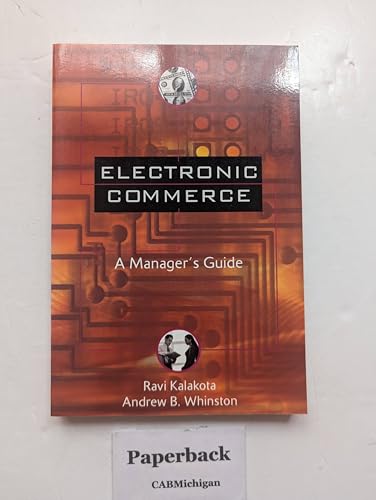
Taking a practical look at electronic commerce from the manager's perspective, this text integrates presentations of the present and future conduct of online business with existing and proposed networking technology and infrastructure. The work introduces the key players, and their capabilities and limitations in the convergence and the growth of the Internet and electronic commerce. It also describes the use of computer networks to buy and sell products, information and services.
"synopsis" may belong to another edition of this title.
About the Author
Dr. Ravi Kalakota is a pioneer in the area of e-commerce. He is the CEO of e-Business Strategies, a technology research and consulting practice, and has consulted extensively with start-ups and Fortune 1000 companies.
Andrew B. Whinston is the Cullen Chair Professor of Information Systems, Computer Science and Economics, IC2 Fellow, and Director of the Center for Information Systems Management at the University of Texas at Austin. His recent research interests are Internet pricing and application of client/server computing to support groups working collaboratively.
0201880679AB04022003From the Back Cover
How do you manage electronic commerce? What is the technology behind electronic commerce? Electronic Commerce: A Manager's Guide is the ideal starting point for business managers and professionals involved with electronic commerce, as well as professionals/users who want to keep abreast of the latest trends and issues in management practices affected by electronic commerce technology. Authors Ravi Kalakota and Andrew Whinston take a down-to-earth approach to a very important business subject, with insightful examples to show how ideas have been put into practice.
Highlights- Provides a clear overview of what electronic commerce is all about.
- Specifies the business uses and technology directions of the World Wide Web
- Clarifies management issues facing Internet Service Providers.
- Explains firewalls, transaction security, and electronic payment methods.
- Describes electronic commerce applications and challenges in banking, retailing, and publishing.
- Covers electronic commerce applications internally within the corporation -- supply-chain management, manufacturing, and finance.
From the Inside Flap
Electronic Commerce: A Manager's Guide is a companion to our earlier tome: Frontiers of Electronic Commerce. The widespread success of the first book bears witness to the need for more easily understood, independent information about what is happening in the fast-changing world of electronic commerce. Why Is Electronic Commerce Important?
As we approach the year 2000, we can no longer look to the past as a guide to the future. In the face of strong market forces created by electronic commerce and mounting competition, corporations can no longer plod along historical tracks or seek the preservation of the status quo. Companies are discovering that old solutions do not work with new problems. The business parameters have changed, and so have the risks and payoffs.
However, in order to figure out the answers, we need to understand why, where, and when electronic commerce is important. Electronic commerce is becoming critical in three interrelated dimensions: customer-to-business interactions, intra-business interactions, and business-to-business interactions.
In the customer-to-business dimension, electronic commerce is enabling the customer to have an increasing say in what products are made, how products are made (movement from make-to-stock to a build-to-order model) and how services are delivered (movement from a slow order fulfillment process with little understanding of what is taking place inside the firm, to a faster and more open processes with customers having greater control).
Electronic commerce is also a catalyst for dramatic changes in internal organizational functioning, as evidenced by the rapid proliferation of Intranets. It is facilitating an organizational model that is fundamentally different from the past, one that is characterized by the shift from a hierarchical command-and-control organization to the information-based organization. The emerging forms of techno-organizational structure involve changes in managerial responsibilities, communication and information flows, and work-group structures.
Electronic commerce is also impacting business-to-business interactions. Electronic commerce facilitates the network form of organization where small flexible firms rely on other "partner" companies for component supplies and product distribution to meet changing customer demand more effectively. Hence, an end-to-end relationship management solution (often called integrated or extended supply-chain management) is a desirable goal that is needed to manage the chain of networks linking customers, workers, suppliers, distributors, and even competitors. The management of "online transactions" in the supply chain assumes a central role.
In the face of market changes, corporations can no longer be insular in nature. In order to be successful, management has to come to grips with the changes taking place in the various market spaces. In the same vein, managers cannot operate effectively without some major regauging of mindset, attitudes, skills, and knowledge. What Makes This Book Different?
In this book readers will find a well-researched analytical evaluation of the management issues and concerns affecting electronic commerce in the service provider businesses, banking, retail, electronic publishing, and Intranet applications. The analytical approach to understanding management issues presented in this book differs considerably from the anecdotes, testimonials, and case studies so commonly found in the popular press.
Instead of a dry summary of the facts, we tried to state clearly our opinions on all the major issues. We have done this because all organizations, large and small, will be (or already are) making major electronic commerce-related investment decisions to stay in business and be competitive. Making investment decisions is difficult and we believe it is helpful to hear an opinion rather than just a set of dry facts.To Whom Is This Book Addressed?
This book provides a broad audience with a quick introduction to the major issues and topics in electronic commerce. We assume that the audience has no prior exposure to electronic commerce except an appreciation that it is an important topic in shaping the future of business.
More specifically, the book is targeted at business managers and professionals involved with online applications, as well as informatin technology professionals and users who want to keep abreast of the latest management trends and issues. This book unravels the management implications of electronic commerce for executives of those organizations that are participating in or looking to participate in designing, building, or managing electronic commerce applications. It is equally useful for board members, investors, attorneys, accountants, consultants, and others who are intimately involved in managing new online ventures.
In a nutshell, this book bridges a knowledge gap that currently exists between the technical experts who are implementing electronic commerce applications and management who have to make operational and strategic decisions about electronic commerce technology and its business applications.How Is This Book Organized?
Chapter 1 defines electronic commerce, explains the industry framework, and outlines some broad management issues that are of concern. Chapter 2 examines the Internet and the Internet Access Provider industry. Chapters 3 and 4 introduce the World Wide Web, and discuss the various business applications that are suitable for it, as well as the technology behind it. Chapter 3 offers an explanation of how the Web is being used to develop public Internet and private Intranet applications. Chapter 4 explains the technology behind the Web and the new directions of Web technology. Chapter 5 discusses the important topic of security by elaborating on firewalls and transaction and data security methods used on the Web. Chapter 6 looks at the emerging electronic payment systems--electronic cash, electronic checks, encrypted credit cards, and smart cards--which enable buying and selling on the Internet. Since many of the new electronic payment mechanisms are based on fool-proof transaction security, readers are urged to read Chapter 5 before reading Chapter 6.
Chapters 7 (online banking), 8 (online retailing), and 9 (online publishing) explain how key industries--banking, retailing, and publishing--are being reshaped by electronic commerce and discuss the crucial management issues in these industries.
Chapters 10 (Intranets and supply-chain management), 11 (Intranets and Customer Asset Management), 12 (Intranets and manufacturing), and 13 (Intranets and corporate finance) focus on applications of electronic commerce that are suitable for implementation on the Intranets. The epilogue summarizes the main points of the book.Acknowledgments
There are many people who deserve our thanks for helping with this book. We thank our unknown reviewers and others who helped immensely during the arduous process, in particular: Joseph Bailey, Julie Crawford, Lucien N. Dancanet, David Klur, Edward J. Krall, Susan Kutor, Steve Matthesen, and Marcia Robinson, and of course our editors, Tom Stone and Debbie Lafferty, whose names almost, but not quite, fit into our ordering. Acting on all of the comments we received was painful, but has made this a better book. Of course, we bear the blame for any errors, not these intrepid folks.
Ravi Kalakota
University of Rochester
kalakota@uhura.cc.rochester
Andrew B. Whinston
University of Texas at Austin
abw@uts.cc.utexas
0201880679P04062001
"About this title" may belong to another edition of this title.
Search results for Electronic Commerce: A Manager's Guide

Seller Image
Electronic Commerce: A Manager's Guide
Published by
Addison-Wesley Professional, 1997
ISBN 10: 0201880679
ISBN 13: 9780201880670
Used
Softcover
Seller: Zoom Books Company, Lynden, WA, U.S.A.
Seller rating 5 out of 5 stars

Condition: very_good. Book is in very good condition and may include minimal underlining highlighting. The book can also include "From the library of" labels. May not contain miscellaneous items toys, dvds, etc. . We offer 100% money back guarantee and 24 7 customer service. Seller Inventory # ZBV.0201880679.VG
Seller Image
Electronic Commerce: A Manager's Guide
Published by
Addison-Wesley Professional, 1997
ISBN 10: 0201880679
ISBN 13: 9780201880670
Used
Softcover
Seller: ZBK Books, Carlstadt, NJ, U.S.A.
Seller rating 5 out of 5 stars
Condition: very_good. Fast & Free Shipping â" Very Good condition book with a firm cover and clean pages. Shows normal use and some light wear or limited notes markings. A solid, nice copy to enjoy. Seller Inventory # ZWV.0201880679.VG
Stock Image
Electronic Commerce: A Manager's Guide
Published by
Addison-Wesley Professional, 1997
ISBN 10: 0201880679
ISBN 13: 9780201880670
Used
paperback
Seller: HPB-Red, Dallas, TX, U.S.A.
Seller rating 5 out of 5 stars
paperback. Condition: Good. Connecting readers with great books since 1972! Used textbooks may not include companion materials such as access codes, etc. May have some wear or writing/highlighting. We ship orders daily and Customer Service is our top priority! Seller Inventory # S_472729116
Stock Image
Electronic Commerce: A Manager's Guide
Published by
Addison-Wesley Professional, 1996
ISBN 10: 0201880679
ISBN 13: 9780201880670
Used
paperback
Seller: Books From California, Simi Valley, CA, U.S.A.
Seller rating 4 out of 5 stars

paperback. Condition: Very Good. Seller Inventory # mon0003060892
Stock Image
Electronic Commerce : A Manager's Guide
Published by
Pearson Education, Limited, 1996
ISBN 10: 0201880679
ISBN 13: 9780201880670
Used
Softcover
Seller: Better World Books: West, Reno, NV, U.S.A.
Seller rating 5 out of 5 stars
Condition: Very Good. Pages intact with possible writing/highlighting. Binding strong with minor wear. Dust jackets/supplements may not be included. Stock photo provided. Product includes identifying sticker. Better World Books: Buy Books. Do Good. Seller Inventory # 58200584-75
Stock Image
Electronic Commerce: A Manager's Guide
Seller: AwesomeBooks, Wallingford, United Kingdom
Seller rating 5 out of 5 stars
Paperback. Condition: Very Good. Electronic Commerce: A Manager's Guide This book is in very good condition and will be shipped within 24 hours of ordering. The cover may have some limited signs of wear but the pages are clean, intact and the spine remains undamaged. This book has clearly been well maintained and looked after thus far. Money back guarantee if you are not satisfied. See all our books here, order more than 1 book and get discounted shipping. Seller Inventory # 7719-9780201880670
Buy Used
US$ 4.40
US$ 5.46 shipping
Ships from United Kingdom to U.S.A.
Ships from United Kingdom to U.S.A.
Quantity: 2 available
Stock Image
Electronic Commerce : A Manager's Guide
Published by
Pearson Education, Limited, 1996
ISBN 10: 0201880679
ISBN 13: 9780201880670
Used
Softcover
Seller: Better World Books, Mishawaka, IN, U.S.A.
Seller rating 5 out of 5 stars
Condition: Good. Pages intact with minimal writing/highlighting. The binding may be loose and creased. Dust jackets/supplements are not included. Stock photo provided. Product includes identifying sticker. Better World Books: Buy Books. Do Good. Seller Inventory # 39094728-6
Stock Image
Electronic Commerce : A Manager's Guide
Published by
Pearson Education, Limited, 1996
ISBN 10: 0201880679
ISBN 13: 9780201880670
Used
Softcover
Seller: Better World Books Ltd, Dunfermline, United Kingdom
Seller rating 5 out of 5 stars
Condition: Good. Pages intact with minimal writing/highlighting. The binding may be loose and creased. Dust jackets/supplements are not included. Stock photo provided. Product includes identifying sticker. Better World Books: Buy Books. Do Good. Seller Inventory # 39094728-6
Buy Used
US$ 6.22
US$ 6.62 shipping
Ships from United Kingdom to U.S.A.
Ships from United Kingdom to U.S.A.
Quantity: 1 available
Stock Image
Electronic Commerce: A Manager's Guide
Seller: Bahamut Media, Reading, United Kingdom
Seller rating 4 out of 5 stars
Paperback. Condition: Very Good. This book is in very good condition and will be shipped within 24 hours of ordering. The cover may have some limited signs of wear but the pages are clean, intact and the spine remains undamaged. This book has clearly been well maintained and looked after thus far. Money back guarantee if you are not satisfied. See all our books here, order more than 1 book and get discounted shipping. Seller Inventory # 6545-9780201880670
Buy Used
US$ 5.84
US$ 9.24 shipping
Ships from United Kingdom to U.S.A.
Ships from United Kingdom to U.S.A.
Quantity: 2 available
Stock Image
Electronic Commerce: A Manager's Guide
Published by
Addison-Wesley Professional, 1997
ISBN 10: 0201880679
ISBN 13: 9780201880670
Used
Softcover
Seller: medimops, Berlin, Germany
Seller rating 5 out of 5 stars
Condition: good. Befriedigend/Good: Durchschnittlich erhaltenes Buch bzw. Schutzumschlag mit Gebrauchsspuren, aber vollständigen Seiten. / Describes the average WORN book or dust jacket that has all the pages present. Seller Inventory # M00201880679-G
Buy Used
US$ 5.06
US$ 11.25 shipping
Ships from Germany to U.S.A.
Ships from Germany to U.S.A.
Quantity: 1 available