
Items related to The Rich Get Richer and the Poor Get Prison: Ideology,...
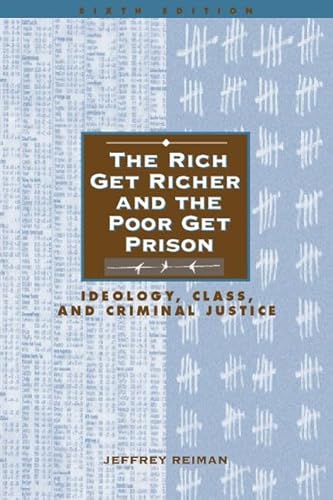
The Rich Get Richer and the Poor Get Prison: Ideology, Class, and Criminal Justice (6th Edition) - Softcover
Synopsis
What if our criminal justice system is biased against the poor from start to finish - from the definition of what constitutes a crime through the process of arrest, trial, and sentencing? The author argues that actions of well-off people - refusal to make workplaces safe, refusal to curtail deadly pollution, promotion of unnecessary surgery, prescription of unnecessary drugs, etc. - cause occupational and environmental hazards to innocent members of the public and produce as much death, destruction, and financial loss as so-called crimes of the poor. However, these crimes of the well-off are rarely treated as severely as those of the poor. Reiman documents the extent of anti-poor bias in arrest, conviction, and sentencing practices and shows that the bias is conjoined with a general refusal to remedy the causes of crime - poverty, poor education, and discrimination. As a result, the criminal justice system fails to reduce crime. The author uses numerous studies and examples to illustrate his points, and difficult concepts are explained in a non-technical manner. The book is a useful counter to the uproar about crime. It provokes thought and discussion, even among people who disagree with its content. For anyone interested in issues of class, social deviance, ethics, or criminal justice.
"synopsis" may belong to another edition of this title.
From the Back Cover
What if our criminal justice system is biased against the poor from start to finish - from the definition of what constitutes a crime through the process of arrest, trial, and sentencing?
The author argues that actions of well-off people - refusal to make workplaces safe, refusal to curtail deadly pollution, promotion of unnecessary surgery, prescription of unnecessary drugs, etc. - cause occupational and environmental hazards to innocent members of the public and produce as much death, destruction, and financial loss as so-called crimes of the poor. However, these crimes of the well-off are rarely treated as severely as those of the poor. Reiman documents the extent of anti-poor bias in arrest, conviction, and sentencing practices and shows that the bias is conjoined with a general refusal to remedy the causes of crime - poverty, poor education, and discrimination. As a result, the criminal justice system fails to reduce crime. The author uses numerous studies and examples to illustrate his points, and difficult concepts are explained in a non-technical manner. The book is a useful counter to the uproar about crime. It provokes thought and discussion, even among people who disagree with its content.
For anyone interested in issues of class, social deviance, ethics, or criminal justice.
"About this title" may belong to another edition of this title.
Search results for The Rich Get Richer and the Poor Get Prison: Ideology,...

Stock Image
The Rich Get Richer and the Poor Get Prison: Ideology, Class, and Criminal Justice
Seller: World of Books (was SecondSale), Montgomery, IL, U.S.A.
Seller rating 5 out of 5 stars

Paperback. Condition: Very Good. The basic premise of this text is that the Criminal Justice system is biased against the poor from start to finish - from the definition of what constitutes a crime through the process of arrest, trial, and sentencing. Seller Inventory # 00084225429
Seller Image
The Rich Get Richer and the Poor Get Prison: Ideology, Class, and Criminal Justice (6th Edition)
Seller: Greenworld Books, Arlington, TX, U.S.A.
Seller rating 5 out of 5 stars
Condition: very_good. Fast Free Shipping â" Very Good condition book with a firm cover and clean pages. Shows normal use and some light wear or limited notes markings. A solid, nice copy to enjoy. Seller Inventory # GWV.0205305571.VG
Seller Image
The Rich Get Richer and the Poor Get Prison: Ideology, Class, and Criminal Justice (6th Edition)
Seller: -OnTimeBooks-, Phoenix, AZ, U.S.A.
Seller rating 5 out of 5 stars
Condition: good. A copy that has been read, remains in good condition. All pages are intact, and the cover is intact. The spine and cover show signs of wear. Pages can include notes and highlighting and show signs of wear, and the copy can include "From the library of" labels or previous owner inscriptions. 100% GUARANTEE! Shipped with delivery confirmation, if you're not satisfied with purchase please return item! Ships via media mail. Seller Inventory # OTV.0205305571.G
Stock Image
The Rich Get Richer and the Poor Get Prison: Ideology, Class, and Criminal Justice (6th Edition)
Seller: ThriftBooks-Phoenix, Phoenix, AZ, U.S.A.
Seller rating 5 out of 5 stars
Paperback. Condition: Good. No Jacket. Pages can have notes/highlighting. Spine may show signs of wear. ~ ThriftBooks: Read More, Spend Less. Seller Inventory # G0205305571I3N00
Stock Image
The Rich Get Richer and the Poor Get Prison: Ideology, Class, and Criminal Justice (6th Edition)
Seller: ThriftBooks-Reno, Reno, NV, U.S.A.
Seller rating 5 out of 5 stars
Paperback. Condition: Good. No Jacket. Pages can have notes/highlighting. Spine may show signs of wear. ~ ThriftBooks: Read More, Spend Less. Seller Inventory # G0205305571I3N00
Stock Image
The Rich Get Richer and the Poor Get Prison: Ideology, Class, and Criminal Justice (6th Edition)
Seller: ThriftBooks-Atlanta, AUSTELL, GA, U.S.A.
Seller rating 5 out of 5 stars
Paperback. Condition: Good. No Jacket. Pages can have notes/highlighting. Spine may show signs of wear. ~ ThriftBooks: Read More, Spend Less. Seller Inventory # G0205305571I3N00
Stock Image
The Rich Get Richer and the Poor Get Prison: Ideology, Class, and Criminal Justice (6th Edition)
Seller: ThriftBooks-Dallas, Dallas, TX, U.S.A.
Seller rating 5 out of 5 stars
Paperback. Condition: Good. No Jacket. Pages can have notes/highlighting. Spine may show signs of wear. ~ ThriftBooks: Read More, Spend Less. Seller Inventory # G0205305571I3N00
Stock Image
The Rich Get Richer and the Poor Get Prison: Ideology, Class, and Criminal Justice
Seller: World of Books Inc, Montgomery, IL, U.S.A.
Seller rating 4 out of 5 stars

Paperback. Condition: Very Good. The basic premise of this text is that the Criminal Justice system is biased against the poor from start to finish - from the definition of what constitutes a crime through the process of arrest, trial, and sentencing. Seller Inventory # CIN0205305571VG
Stock Image
The Rich Get Richer and the Poor Get Prison: Ideology, Class, and Criminal Justice (6th Edition)
Seller: Shadetree Rare Books, Chatham, VA, U.S.A.
Seller rating 4 out of 5 stars
Soft cover. Condition: Very Good. 5th or later Edition. VERY GOOD SOFTCOVER. Seller Inventory # T0744
Stock Image
The Rich Get Richer and the Poor Get Prison: Ideology, Class, and Criminal Justice (6th Edition)
Seller: Thylacine Books, Fort Worth, TX, U.S.A.
Seller rating 5 out of 5 stars
Soft cover. Condition: As New. No Jacket. 5th or later Edition. dj: none. book: as new Language: eng. Seller Inventory # 29336