
Items related to No Way Out: Precarious Living in the Shadow of Poverty...
Synopsis
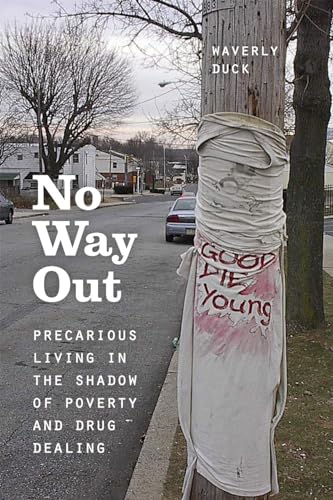
In 2005 Waverly Duck was called to a town he calls Bristol Hill to serve as an expert witness in the sentencing of drug dealer Jonathan Wilson. Convicted as an accessory to the murder of a federal witness and that of a fellow drug dealer, Jonathan faced the death penalty, and Duck was there to provide evidence that the environment in which Jonathan had grown up mitigated the seriousness of his alleged crimes. Duck’s exploration led him to Jonathan’s church, his elementary, middle, and high schools, the juvenile facility where he had previously been incarcerated, his family and friends, other drug dealers, and residents who knew him or knew of him. After extensive ethnographic observations, Duck found himself seriously troubled and uncertain: Are Jonathan and others like him a danger to society? Or is it the converse—is society a danger to them?
Duck’s short stay in Bristol Hill quickly transformed into a long-term study—one that forms the core of No Way Out. This landmark book challenges the common misconception of urban ghettoes as chaotic places where drug dealing, street crime, and random violence make daily life dangerous for their residents. Through close observations of daily life in these neighborhoods, Duck shows how the prevailing social order ensures that residents can go about their lives in relative safety, despite the risks that are embedded in living amid the drug trade. In a neighborhood plagued by failing schools, chronic unemployment, punitive law enforcement, and high rates of incarceration, residents are knit together by long-term ties of kinship and friendship, and they base their actions on a profound sense of community fairness and accountability. Duck presents powerful case studies of individuals whose difficulties flow not from their values, or a lack thereof, but rather from the multiple obstacles they encounter on a daily basis.
No Way Out explores how ordinary people make sense of their lives within severe constraints and how they choose among unrewarding prospects, rather than freely acting upon their own values. What emerges is an important and revelatory new perspective on the culture of the urban poor.
"synopsis" may belong to another edition of this title.
About the Author
Waverly Duck is assistant professor of sociology at the University of Pittsburgh.
"About this title" may belong to another edition of this title.
Search results for No Way Out: Precarious Living in the Shadow of Poverty...

Stock Image
No Way Out: Precarious Living in the Shadow of Poverty and Drug Dealing
Published by
The University of Chicago Press, 2015
ISBN 10: 022629806X
ISBN 13: 9780226298061
Used
Paperback
Seller: World of Books (was SecondSale), Montgomery, IL, U.S.A.
Seller rating 5 out of 5 stars

Paperback. Condition: Good. In 2005 Waverly Duck was called to a town he calls Bristol Hill to serve as an expert witness in the sentencing of drug dealer Jonathan Wilson. Convicted as an accessory to the murder of a federal witness and that of a fellow drug dealer, Jonathan faced the death penalty, and Duck was there to provide evidence that the environment in which Jonathan had grown up mitigated the seriousness of his alleged crimes. Duck's exploration led him to Jonathan's church, his elementary, middle, and high schools, the juvenile facility where he had previously been incarcerated, his family and friends, other drug dealers, and residents who knew him or knew of him. After extensive ethnographic observations, Duck found himself seriously troubled and uncertain: Are Jonathan and others like him a danger to society? Or is it the converse-is society a danger to them? Duck's short stay in Bristol Hill quickly transformed into a long-term study-one that forms the core of No Way Out. This landmark book challenges the common misconception of urban ghettoes as chaotic places where drug dealing, street crime, and random violence make daily life dangerous for their residents. Through close observations of daily life in these neighborhoods, Duck shows how the prevailing social order ensures that residents can go about their lives in relative safety, despite the risks that are embedded in living amid the drug trade. In a neighborhood plagued by failing schools, chronic unemployment, punitive law enforcement, and high rates of incarceration, residents are knit together by long-term ties of kinship and friendship, and they base their actions on a profound sense of community fairness and accountability. Duck presents powerful case studies of individuals whose difficulties flow not from their values, or a lack thereof, but rather from the multiple obstacles they encounter on a daily basis. No Way Out explores how ordinary people make sense of their lives within severe constraints and how they choose among unrewarding prospects, rather than freely acting upon their own values. What emerges is an important and revelatory new perspective on the culture of the urban poor. Seller Inventory # 00106389694
Seller Image
No Way Out: Precarious Living in the Shadow of Poverty and Drug Dealing
Published by
University of Chicago Press, 2015
ISBN 10: 022629806X
ISBN 13: 9780226298061
Used
Softcover
Seller: Zoom Books Company, Lynden, WA, U.S.A.
Seller rating 5 out of 5 stars
Condition: very_good. Book is in very good condition and may include minimal underlining highlighting. The book can also include "From the library of" labels. May not contain miscellaneous items toys, dvds, etc. . We offer 100% money back guarantee and 24 7 customer service. Seller Inventory # ZBV.022629806X.VG
Stock Image
No Way Out: Precarious Living in the Shadow of Poverty and Drug Dealing
Published by
University of Chicago Press (edition 1), 2015
ISBN 10: 022629806X
ISBN 13: 9780226298061
Used
Paperback
Seller: BooksRun, Philadelphia, PA, U.S.A.
Seller rating 5 out of 5 stars
Paperback. Condition: Very Good. 1. It's a well-cared-for item that has seen limited use. The item may show minor signs of wear. All the text is legible, with all pages included. It may have slight markings and/or highlighting. Seller Inventory # 022629806X-11-1
Seller Image
No Way Out: Precarious Living in the Shadow of Poverty and Drug Dealing
Published by
University of Chicago Press, 2015
ISBN 10: 022629806X
ISBN 13: 9780226298061
Used
Softcover
Seller: Greenworld Books, Arlington, TX, U.S.A.
Seller rating 5 out of 5 stars
Condition: good. Fast Free Shipping â" Good condition. It may show normal signs of use, such as light writing, highlighting, or library markings, but all pages are intact and the book is fully readable. A solid, complete copy that's ready to enjoy. Seller Inventory # GWV.022629806X.G
Seller Image
No Way Out: Precarious Living in the Shadow of Poverty and Drug Dealing
Published by
University of Chicago Press, 2015
ISBN 10: 022629806X
ISBN 13: 9780226298061
Used
Softcover
Seller: Greenworld Books, Arlington, TX, U.S.A.
Seller rating 5 out of 5 stars
Condition: very_good. Fast Free Shipping â" Very Good condition book with a firm cover and clean pages. Shows normal use and some light wear or limited notes markings. A solid, nice copy to enjoy. Seller Inventory # GWV.022629806X.VG
Stock Image
No Way Out: Precarious Living in the Shadow of Poverty and Drug Dealing
Published by
The University of Chicago Press, 2015
ISBN 10: 022629806X
ISBN 13: 9780226298061
Used
Paperback
Seller: World of Books Inc, Montgomery, IL, U.S.A.
Seller rating 4 out of 5 stars

Paperback. Condition: Good. In 2005 Waverly Duck was called to a town he calls Bristol Hill to serve as an expert witness in the sentencing of drug dealer Jonathan Wilson. Convicted as an accessory to the murder of a federal witness and that of a fellow drug dealer, Jonathan faced the death penalty, and Duck was there to provide evidence that the environment in which Jonathan had grown up mitigated the seriousness of his alleged crimes. Duck's exploration led him to Jonathan's church, his elementary, middle, and high schools, the juvenile facility where he had previously been incarcerated, his family and friends, other drug dealers, and residents who knew him or knew of him. After extensive ethnographic observations, Duck found himself seriously troubled and uncertain: Are Jonathan and others like him a danger to society? Or is it the converse-is society a danger to them? Duck's short stay in Bristol Hill quickly transformed into a long-term study-one that forms the core of No Way Out. This landmark book challenges the common misconception of urban ghettoes as chaotic places where drug dealing, street crime, and random violence make daily life dangerous for their residents. Through close observations of daily life in these neighborhoods, Duck shows how the prevailing social order ensures that residents can go about their lives in relative safety, despite the risks that are embedded in living amid the drug trade. In a neighborhood plagued by failing schools, chronic unemployment, punitive law enforcement, and high rates of incarceration, residents are knit together by long-term ties of kinship and friendship, and they base their actions on a profound sense of community fairness and accountability. Duck presents powerful case studies of individuals whose difficulties flow not from their values, or a lack thereof, but rather from the multiple obstacles they encounter on a daily basis. No Way Out explores how ordinary people make sense of their lives within severe constraints and how they choose among unrewarding prospects, rather than freely acting upon their own values. What emerges is an important and revelatory new perspective on the culture of the urban poor. Seller Inventory # CIN022629806XG
Stock Image
No Way Out: Precarious Living in the Shadow of Poverty and Drug Dealing
Published by
University of Chicago Press, 2015
ISBN 10: 022629806X
ISBN 13: 9780226298061
Used
Paperback
Seller: ThriftBooks-Atlanta, AUSTELL, GA, U.S.A.
Seller rating 5 out of 5 stars
Paperback. Condition: Good. No Jacket. Pages can have notes/highlighting. Spine may show signs of wear. ~ ThriftBooks: Read More, Spend Less. Seller Inventory # G022629806XI3N00
Stock Image
No Way Out: Precarious Living in the Shadow of Poverty and Drug Dealing
Published by
University of Chicago Press, 2015
ISBN 10: 022629806X
ISBN 13: 9780226298061
Used
Paperback
Seller: ThriftBooks-Reno, Reno, NV, U.S.A.
Seller rating 5 out of 5 stars
Paperback. Condition: Very Good. No Jacket. May have limited writing in cover pages. Pages are unmarked. ~ ThriftBooks: Read More, Spend Less. Seller Inventory # G022629806XI4N00
Stock Image
No Way Out: Precarious Living in the Shadow of Poverty and Drug Dealing
Published by
University of Chicago Press, 2015
ISBN 10: 022629806X
ISBN 13: 9780226298061
Used
Paperback
Seller: ThriftBooks-Atlanta, AUSTELL, GA, U.S.A.
Seller rating 5 out of 5 stars
Paperback. Condition: As New. No Jacket. Pages are clean and are not marred by notes or folds of any kind. ~ ThriftBooks: Read More, Spend Less. Seller Inventory # G022629806XI2N00
Stock Image
No Way Out: Precarious Living in the Shadow of Poverty and Drug Dealing
Published by
University of Chicago Press, 2015
ISBN 10: 022629806X
ISBN 13: 9780226298061
Used
Paperback
Seller: ThriftBooks-Dallas, Dallas, TX, U.S.A.
Seller rating 5 out of 5 stars
Paperback. Condition: Very Good. No Jacket. May have limited writing in cover pages. Pages are unmarked. ~ ThriftBooks: Read More, Spend Less. Seller Inventory # G022629806XI4N00