
Items related to Slumming: Sexual and Racial Encounters in American...
Slumming: Sexual and Racial Encounters in American Nightlife, 1885-1940 (Historical Studies of Urban America) - Hardcover
Book 15 of 82: Historical Studies of Urban America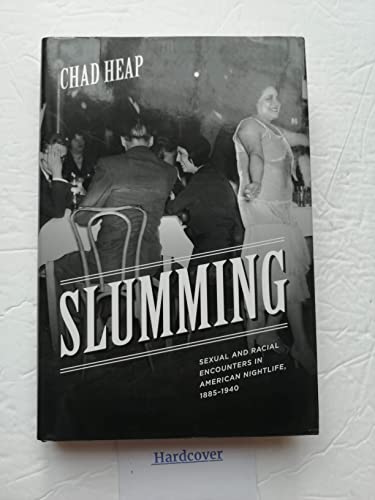
Synopsis
During Prohibition, “Harlem was the ‘in’ place to go for music and booze,” recalled the African American chanteuse Bricktop. “Every night the limousines pulled up to the corner,” and out spilled affluent whites, looking for a good time, great jazz, and the unmatchable thrill of doing something disreputable.
That is the indelible public image of slumming, but as Chad Heap reveals in this fascinating history, the reality is that slumming was far more widespread—and important—than such nostalgia-tinged recollections would lead us to believe. From its appearance as a “fashionable dissipation” centered on the immigrant and working-class districts of 1880s New York through its spread to Chicago and into the 1930s nightspots frequented by lesbians and gay men, Slumming charts the development of this popular pastime, demonstrating how its moralizing origins were soon outstripped by the artistic, racial, and sexual adventuring that typified Jazz-Age America. Vividly recreating the allure of storied neighborhoods such as Greenwich Village and Bronzeville, with their bohemian tearooms, rent parties, and “black and tan” cabarets, Heap plumbs the complicated mix of curiosity and desire that drew respectable white urbanites to venture into previously off-limits locales. And while he doesn’t ignore the role of exploitation and voyeurism in slumming—or the resistance it often provoked—he argues that the relatively uninhibited mingling it promoted across bounds of race and class helped to dramatically recast the racial and sexual landscape of burgeoning U.S. cities.
Packed with stories of late-night dance, drink, and sexual exploration—and shot through with a deep understanding of cities and the habits of urban life—Slumming revives an era that is long gone, but whose effects are still felt powerfully today.
"synopsis" may belong to another edition of this title.
About the Author
Chad Heap is associate professor of American studies at the George Washington University.
Reviews
Heap’s enthralling history defines “slumming” broadly, to encompass the activities of Victorian social reformers, who enjoyed dropping in on immigrant households, and the “Negro vogue” and “pansy and lesbian craze” of the nineteen-thirties. He concentrates on Chicago and New York, where anti-vice committees documented salaciousness from the red-light districts of the Lower East Side to the “bohemian thrill-age” of the Village and the cross-dressing “sex morons” farther north. His evidence suggests that immigrants, bohemians, blacks, and gays provided the city’s best live entertainment; according to Heap, they also provided a backdrop of degradation against which whiteness and heterosexuality defined themselves. The racial, social, and sexual implications of each slumming fad, “from the best intentioned to the most horrifyingly exploitative,” are assiduously parsed, perhaps to mitigate the inherent titillation of the material.
Copyright ©2008 Click here to subscribe to The New Yorker
"About this title" may belong to another edition of this title.
Search results for Slumming: Sexual and Racial Encounters in American...

Stock Image
Slumming: Sexual and Racial Encounters in American Nightlife, 1885-1940
Published by
University of Chicago Press, 2009
ISBN 10: 0226322432
ISBN 13: 9780226322438
Used
Hardcover
Seller: ThriftBooks-Atlanta, AUSTELL, GA, U.S.A.
Seller rating 5 out of 5 stars

Hardcover. Condition: Good. No Jacket. Pages can have notes/highlighting. Spine may show signs of wear. ~ ThriftBooks: Read More, Spend Less. Seller Inventory # G0226322432I3N00
Stock Image
Slumming: Sexual and Racial Encounters in American Nightlife, 1885-1940 (Historical Studies of Urban America)
Published by
University of Chicago Press, 2009
ISBN 10: 0226322432
ISBN 13: 9780226322438
Used
Hardcover
Seller: Studibuch, Stuttgart, Germany
Seller rating 5 out of 5 stars
hardcover. Condition: Gut. 420 Seiten; 9780226322438.3 Gewicht in Gramm: 1. Seller Inventory # 869831
Buy Used
US$ 8.08
US$ 69.88 shipping
Ships from Germany to U.S.A.
Ships from Germany to U.S.A.
Quantity: 1 available
Stock Image
Slumming: Sexual and Racial Encounters in American Nightlife, 1885-1940 (Historical Studies of Urban America)
Published by
University of Chicago Press, 2009
ISBN 10: 0226322432
ISBN 13: 9780226322438
Used
Hardcover
Seller: YESIBOOKSTORE, MIAMI, FL, U.S.A.
Seller rating 5 out of 5 stars
hardcover. Condition: As New. Seller Inventory # 0226322432-VB