
Items related to New Developments in Productivity Analysis (Volume 63)...
New Developments in Productivity Analysis (Volume 63) (National Bureau of Economic Research Studies in Income and Wealth) - Hardcover
Book 3 of 18: National Bureau of Economic Research Studies in Income and Wealth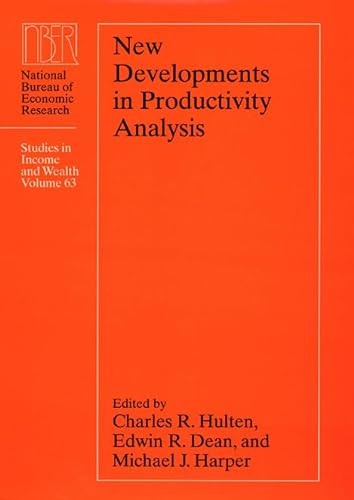
Synopsis
The productivity slowdown of the 1970s and 1980s and the resumption of productivity growth in the 1990s have provoked controversy among policymakers and researchers. Economists have been forced to reexamine fundamental questions of measurement technique. Some researchers argue that econometric approaches to productivity measurement usefully address shortcomings of the dominant index number techniques while others maintain that current productivity statistics underreport damage to the environment. In this book, the contributors propose innovative approaches to these issues. The result is a state-of-the-art exposition of contemporary productivity analysis.
Charles R. Hulten is professor of economics at the University of Maryland. He has been a senior research associate at the Urban Institute and is chair of the Conference on Research in Income and Wealth of the National Bureau of Economic Research. Michael Harper is chief of the Division of Productivity Research at the Bureau of Labor Statistics. Edwin R. Dean, formerly associate commissioner for Productivity and Technology at the Bureau of Labor Statistics, is adjunct professor of economics at The George Washington University.
"synopsis" may belong to another edition of this title.
About the Authors
Charles R. Hulten is professor of economics at the University of Maryland and a research associate of the National Bureau of Economic Research.
Charles R. Hulten is a professor of economics at the University of Maryland. He has been a senior research associate at the Urban Institute and is chair of the Conference on Research in Income and Wealth of the National Bureau of Economic Research.
Edwin R. Dean, formerly an associate commissioner for Productivity and Technology at the Bureau of Labor Statistics, is an adjunct professor of economics at The George Washington University.
Michael J. Harper is the chief of the Division of Productivity Research at the Bureau of Labor Statistics.
Michael Harper is associate commissioner for productivity and technology at the U.S. Bureau of Labor Statistics.
From the Back Cover
The standard of living in the United States has increased dramatically over the course of the last century. This increase is due in part to advances in technology which increased the productivity of the nation's resources. While the pace of innovation has been relatively persistent, however, the growth in productivity has not. This problem, and what might be done to solve it, has provoked controversy among policymakers and researchers. Economists have been forced to reexamine fundamental questions of measurement technique, not only at the level of firms and plants, but also at high levels of aggregation. Some researchers argue that econometric approaches to productivity measurement usefully address shortcomings of the dominant index number techniques while others maintain that current productivity statistics underreport damage to the environment. In this book, the contributors propose innovative approaches to these issues through groundbreaking essays. The result is a state-of-the-art exposition of contemporary productivity analysis.
From the Inside Flap
The standard of living in the United States has increased dramatically over the course of the last century. This increase is due in part to advances in technology which increased the productivity of the nation's resources. While the pace of innovation has been relatively persistent, however, the growth in productivity has not. This problem, and what might be done to solve it, has provoked controversy among policymakers and researchers. Economists have been forced to reexamine fundamental questions of measurement technique, not only at the level of firms and plants, but also at high levels of aggregation. Some researchers argue that econometric approaches to productivity measurement usefully address shortcomings of the dominant index number techniques while others maintain that current productivity statistics underreport damage to the environment. In this book, the contributors propose innovative approaches to these issues through groundbreaking essays. The result is a state-of-the-art exposition of contemporary productivity analysis.
"About this title" may belong to another edition of this title.
Search results for New Developments in Productivity Analysis (Volume 63)...

Stock Image
New Developments in Productivity Analysis
Published by
University of Chicago Press, 2001
ISBN 10: 0226360628
ISBN 13: 9780226360621
Used
Hardcover
First Edition
Seller: Better World Books, Mishawaka, IN, U.S.A.
Seller rating 5 out of 5 stars

Condition: Very Good. 1st Edition. Pages intact with possible writing/highlighting. Binding strong with minor wear. Dust jackets/supplements may not be included. Stock photo provided. Product includes identifying sticker. Better World Books: Buy Books. Do Good. Seller Inventory # 5053883-6
Stock Image
New Developments in Productivity Analysis
Published by
University of Chicago Press, 2001
ISBN 10: 0226360628
ISBN 13: 9780226360621
Used
Hardcover
First Edition
Seller: Better World Books: West, Reno, NV, U.S.A.
Seller rating 5 out of 5 stars
Condition: Very Good. 1st Edition. Former library copy. Pages intact with possible writing/highlighting. Binding strong with minor wear. Dust jackets/supplements may not be included. Includes library markings. Stock photo provided. Product includes identifying sticker. Better World Books: Buy Books. Do Good. Seller Inventory # 19262299-75
Stock Image
New Developments in Productivity Analysis
Published by
University of Chicago Press, Chicago, Illinois, 2001
ISBN 10: 0226360628
ISBN 13: 9780226360621
New
Hardcover
Seller: James Lasseter, Jr, Brooksville, FL, U.S.A.
Seller rating 5 out of 5 stars
Hardcover. Condition: New. Dust Jacket Condition: New. BRAND NEW BOOK, STILL IN ORIGINAL PUBLISHERS SHRINKWRAP. 632 pages; 6" x9". 31 line drawings, 64 tables. A very nice mint condition volume. Seller Inventory # 002609
Stock Image
New Developments in Productivity Analysis (Volume 63) (National Bureau of Economic Research Studies in Income and Wealth)
Published by
University of Chicago Press, 2001
ISBN 10: 0226360628
ISBN 13: 9780226360621
New
Hardcover
Seller: Read&Dream, SAINT LOUIS, MO, U.S.A.
Seller rating 4 out of 5 stars

Condition: New. Seller Inventory # 4JSHAO0047PZ
Stock Image
New Developments in Productivity Analysis (National Bureau of Economic Research Studies in Income and Wealth)
Seller: Revaluation Books, Exeter, United Kingdom
Seller rating 5 out of 5 stars
Hardcover. Condition: Brand New. 1st edition. 632 pages. 9.00x6.25x1.50 inches. In Stock. Seller Inventory # 0226360628
Buy New
US$ 136.81
US$ 16.54 shipping
Ships from United Kingdom to U.S.A.
Ships from United Kingdom to U.S.A.
Quantity: 1 available