
Items related to Petrarch: A Critical Guide to the Complete Works
Synopsis
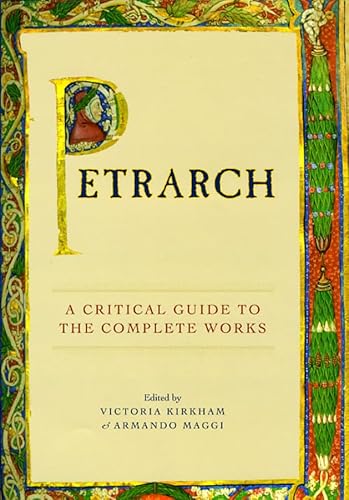
Although Francesco Petrarca (1304–74) is best known today for cementing the sonnet’s place in literary history, he was also a philosopher, historian, orator, and one of the foremost classical scholars of his age. Petrarch: A Critical Guide to the Complete Works is the only comprehensive, single-volume source to which anyone—scholar, student, or general reader—can turn for information on each of Petrarch’s works, its place in the poet’s oeuvre, and a critical exposition of its defining features.
A sophisticated but accessible handbook that illuminates Petrarch’s love of classical culture, his devout Christianity, his public celebrity, and his struggle for inner peace, this encyclopedic volume covers both Petrarch’s Italian and Latin writings and the various genres in which he excelled: poem, tract, dialogue, oration, and letter. A biographical introduction and chronology anchor the book, making Petrarch an invaluable resource for specialists in Italian, comparative literature, history, classics, religious studies, the Middle Ages, and the Renaissance.
"synopsis" may belong to another edition of this title.
About the Author
Victoria Kirkham is professor emerita of Romance languages at the University of Pennsylvania. She is the author of three books, most recently of Fabulous Vernacular: Boccaccio’s Filocolo and the Art of Medieval Fiction. Armando Maggi is professor of Romance languages and a member of the Committee on the History of Culture at the University of Chicago. He is the author of several books, including Satan’s Rhetoric and In the Company of Demons, both published by the University of Chicago Press.
Excerpt. © Reprinted by permission. All rights reserved.
PETRARCH
A Critical Guide to the Complete WorksTHE UNIVERSITY OF CHICAGO PRESS
Copyright © 2009 The University of ChicagoAll right reserved.
ISBN: 978-0-226-43741-5
Contents
List of Illustrations...............................................................................................................................................................................................................................................ixAcknowledgments.....................................................................................................................................................................................................................................................xiNote on Bibliographical Forms and Abbreviations.....................................................................................................................................................................................................................xiiiChronology of Petrarch's Life and Works Victoria Kirkham...........................................................................................................................................................................................................xvA Life's Work Victoria Kirkham.....................................................................................................................................................................................................................................11 The Self in the Labyrinth of Time (Rerum vulgarium fragmenta) Teodolinda Barolini...............................................................................................................................................................................332 The Poem of Memory (Triumphi) Fabio Finotti.....................................................................................................................................................................................................................633 Petrarch's Damned Poetry and the Poetics of Exclusion (Rime disperse) Justin Steinberg..........................................................................................................................................................................854 The Rebirth of the Romans as Models of Character (De viris illustribus) Ronald G. Witt..........................................................................................................................................................................1035 Petrarch's Philological Epic (Africa) Simone Marchesi...........................................................................................................................................................................................................1136 The Beginnings of Humanistic Oratory: Petrarch's Coronation Oration (Collatio laureationis) Dennis Looney.......................................................................................................................................................1317 Petrarch the Courtier: Five Public Speeches (Arenga facta Venecijs, Arringa facta Mediolani, Arenga facta in civitate Novarie, Collatio brevis coram Iohanne Francorum rege, Orazione per la seconda ambasceria veneziana) Victoria Kirkham.....................1418 The Unforgettable Books of Things to Be Remembered (Rerum memorandarum libri) Paolo Cherchi.....................................................................................................................................................................1519 Pastoral as Personal Mythology in History (Bucolicum carmen) Stefano Carrai.....................................................................................................................................................................................16510 "You Will Be My Solitude": Solitude as Prophecy (De vita solitaria) Armando Maggi...............................................................................................................................................................................17911 A Humanistic Approach to Religious Solitude (De otio religioso) Susanna Barsella................................................................................................................................................................................19712 The Burning Question: Crisis and Cosmology in the Secret (Secretum) David Marsh.................................................................................................................................................................................21113 Petrarch's Personal Psalms (Psalmi penitentiales) E. Ann Matter.................................................................................................................................................................................................21914 The Place of the Itinerarium (Itinerarium ad sepulchrum domini nostri Yhesu Christi) Theodore J. Cachey Jr......................................................................................................................................................22915 On the Two Faces of Fortune (De remediis utriusque fortune) Timothy Kircher.....................................................................................................................................................................................24516 The Art of Invective (Invective contra medicum) Stefano Cracolici...............................................................................................................................................................................................25517 The Economy of Invective and a Man in the Middle (De sui ipsius et multorum ignorantia) William J. Kennedy......................................................................................................................................................26318 A Poetic Journal (Epystole) Giuseppe Velli......................................................................................................................................................................................................................27719 The Book without a Name: Petrarch's Open Secret (Liber sine nomine) Ronald L. Martinez..........................................................................................................................................................................29120 The Uncollected Poet (Lettere disperse) Lynn Lara Westwater.....................................................................................................................................................................................................30121 Petrarch's Epistolary Epic: Letters on Familiar Matters (Rerum familiarum libri) Giuseppe F. Mazzotta...........................................................................................................................................................30922 Letters of Old Age: Love between Men, Griselda, and Farewell to Letters (Rerum senilium libri) David Wallace....................................................................................................................................................32123 To Write As Another: The Testamentum (Testamentum) Armando Maggi................................................................................................................................................................................................333Notes...............................................................................................................................................................................................................................................................347Bibliography........................................................................................................................................................................................................................................................479List of Contributors................................................................................................................................................................................................................................................521Index...............................................................................................................................................................................................................................................................527
Chapter One
THE SELF IN THE LABYRINTH OF TIME Rerum vulgarium fragmenta
Teodolinda Barolini
Petrarch's enduring collection of lyric poetry, the Rerum vulgarium fragmenta (Fragments of Vernacular Matters; called variously Canzoniere, Rime, and Rime sparse but properly and authorially only Rerum vulgarium fragmenta)), is-like all of Petrarch's work-obsessed with time: the medium that fragments us, makes us multiple and metamorphic, robs us of ontological stillness and wholeness. The Fragmenta, which thematizes fragmentation or multiplicity in its very title, conjures the existence of the self in time; we are beings subject to constant incremental change and to radical ontological instability. Aristotle defines time in the Physics-"For time is just this, number of motion in respect of 'before' and 'after'" (Physics 4.11.219b1)-in a passage cited by Dante in the Convivio: "Lo tempo, secondo che dice Aristotele nel quarto de la Fisica, 'numero di movimento, secondo prima e poi'" (Time, according to Aristotle in the fourth book of the Physics, is "number of movement, according to before and after" [Convivio 4.2.6]). Asking "does [the 'now'] always remain one and the same or is it always other and other?" (Physics 4.10.218a9-10), Aristotle writes, "if the 'now' were not different but one and the same, there would not have been time" (Physics 4.11.218b27-28). Time, therefore, comports difference, change, instability, absence of identity, oneness, and being: Petrarch's chosen themes. Hence, although it is not usual to associate Petrarch's lyric sequence, consisting mainly of love poetry, with a philosophical text like Aristotle's Physics, it is appropriate: time is a philosophical-indeed, a metaphysical-problem, and to the degree that time is the chief focus and concern of his poetry, Petrarch is a metaphysical poet. Metaphysical concerns, defined as first principles and ultimate grounds, such as being and time, are Petrarch's abiding concerns. The problems that tugged at him ceaselessly-in particular, the nature of time and the existence of the self in time-are metaphysical in nature, and these are the problems that he dramatized in his work.
Let us begin by considering what we see when we pick up a copy of Petrarch's poetry book today. We see 366 poems of varied lyrical genres, all interspersed: 317 sonnets, 29 canzoni, 9 sestine, 7 ballate, and 4 madrigali (for the allocation of these poems throughout the text, see the appendix "Metrical and Thematic Sets in the Rerum vulgarium fragmenta" at the end of this essay). In most editions the 366 poems are-correctly-divided into two parts, with part 2 beginning about two-thirds of the way through the text, at poem 264, the canzone I' vo pensando. In many editions the two parts incorrectly bear headings that were added early in the editorial tradition: the heading "In vita di madonna Laura" (During the life of Lady Laura) and the heading "In morte di madonna Laura" (After the death of Lady Laura). Later on the beginning of part 2 was moved in order to accommodate the narrative story line told by the invented rubrics. From Pietro Bembo's 1514 edition until Giovanni Mestica's 1896 edition, part 2 begins with sonnet 267, Oim il bel viso, the first poem to register Laura's death, rather than with canzone 264, I' vo pensando. While the division of the text into two parts is Petrarch's, the headings and the transposed beginning of part 2 testify to readers' longstanding desire to impose a clear narrative onto the tenuous and opaque love story that the poems do not narrate so much as conjure and suggest.
Of Laura, Petrarch's beloved, we know nothing beyond what he tells us: he first saw her and fell in love with her on April 6, 1327, in the Church of Saint Claire in Avignon. The precise date is declared in sonnet 211, Voglia mi sprona, a poem almost excluded from the collection), which concludes: "Mille trecento ventisette, a punto/su l'ora prima, il d sesto d'aprile,/nel laberinto entrai, n veggio ond'esca" (One thousand three hundred twenty-seven, exactly at the first hour of the sixth day of April, I entered the labyrinth, nor do I see where I may get out of it [RVF 211.12-14]). The image of the labyrinth that Petrarch here offers as emblem for his existential experience is particularly telling: he is a writer who specializes in creating texts imbued with aporia, a term for insoluble contradiction or paradox that literally signifies "no passage," impassable, like a labyrinth. But this poet of impasse and dead ends also creates terrible symmetries; thus, Laura died on the same date that he first saw her, April 6, in the plague year of 1348, as specified in sonnet 336, Tornami a mente: "Sai che 'n mille trecento quarantotto,/ il d sesto d'aprile, in l'ora prima/del corpo usco quell'anima beata" (You know that in one thousand three hundred and forty-eight, on the sixth day of April, at the first hour, that blessed soul left the body [RVF 336.12-14]). Laura's identity has eluded numerous attempts to ascertain it. Petrarch's love for her and failed attempts to attain reciprocation from the chaste Laura are the thematic burden of part 1-to the degree that there is a theme to this text beyond the self's metamorphic existence in the labyrinth of time-while, again from the perspective of the "love story," her death and subsequent softening toward her lover dominate part 2.
Both Laura's fierce chastity and later imagined reciprocation are avenues Petrarch uses to dramatize and explore his own psyche, nuancing and psychologizing the narcissism and self-projection that typify the courtly tradition, in which the lady is present as foil to the male lover/poet but not as a subject with her own inner life and moral choices. Petrarch forged his identity against Dante's by going back to the courtly paradigm that Dante inherited, theologized, and then ultimately abandoned; Petrarch's reinstitutionalizing of the courtly paradigm had specific repercussions with respect to the construction of gender in the Italian tradition. Dante constructs women as moral agents in the Commedia and even before, already moving away from the courtly paradigm in which women exist only as projections of male desire in moral canzoni like Doglia mi reca nello core ardire, whose women possess desires of their own and are full interlocutors who require instruction in moral matters. Petrarch, by contrast, did not write vernacular poems like Dante's Doglia mi reca, in which Dante addresses women directly; Petrarch's moral poems, political poems, and poems of friendship address men rather than women. He does not show the commitment to female historicity and selfhood that we find in Dante. Therefore, when we speak of the psychological richness that is dramatized in the Fragmenta, we are speaking exclusively about the male lover/poet, as is typical in the courtly tradition.
Petrarch creates opportunities to explore psychological conflict and inner drama, for instance by telling us, for the first time in sonnet 3, Era il giorno, that he fell in love on Good Friday: "Era il giorno ch'al sol si scoloraro/ per la piet del suo Factore i rai,/quando i' fui preso" (It was the day when the sun's rays turned pale with grief for his Maker when I was taken [RVF 3.1-3]). In this way he builds into his collection a perennial source of tension and contradiction: while he should have been focused on Christ's crucifixion, his eyes heavenward, instead he was falling in love with a mortal creature, his glance earthward. The poet has pinioned himself into a marvelously fertile bind, as we can see for instance in sonnet 62, Padre del ciel, a prayer in which he begs God to take pity on his "unworthy pain" by leading his thoughts back from where they are-fixed on Laura-to a "better place," namely, meditation on the crucifixion: "miserere del mio non degno affanno;/reduci i pensier' vaghi a miglior luogo;/ramenta lor come oggi fusti in croce" (have mercy on my unworthy pain, lead my wandering thoughts back to a better place, remind them that today you were on the Cross [RVF 62.12-14]). Most strikingly, Padre del ciel not only tells of the aporia in which Petrarch situates himself, but actually is an aporia, incarnate as text, since it is simultaneously a prayer for repentance and a remembrance of the day he first saw Laura: "Or volge, Signor mio, l'undecimo anno/ch'i' fui sommesso al dispietato giogo" (Now turns, my Lord, the eleventh year that I have been subject to the pitiless yoke [RVF 62.9-10]).
The issue of whether and when the poet will ever achieve a "conversion" away from Laura to God-there are some poems in which his love for Laura is viewed as a means to reach above the immanent to the transcendent, like Dante's love for Beatrice, but there are others in which such love for a fellow human being, even Laura, is viewed in a negative light as a distraction from loving God-has divided critics. Some read the collection as dramatizing an achieved conversion. Others, including the author of this essay, do not, for instability is at the core of this work: thematically, psychologically, and as we shall see, textually and materially. With respect to the psychology and theology of conversion, instability is signaled by the fact that the collection's famous final poem is a prayer to the Virgin in which Petrarch is, precisely, still praying for help and still commanding his will to be full, while as Augustine notes, "The reason, then, why the command is not obeyed is that it is not given with a full will. For if the will were full, it would not command itself to be full, since it would be so already. It is therefore no strange phenomenon partly to will to do something and partly to will not to do it." The logic of conversion is temporal, since conversion is an experience that involves a movement along the arrow of time from a self that is fragmented, changing, and unstable to a self that is whole, unchanging, and still; while the process of achieving conversion may involve much backsliding, as Augustine dramatizes in the Confessions, true conversion, once achieved, is by definition a condition from which there is no relapsing. Augustine's meditation in the Confessions on the process of achieving fullness of the will is intimately related to his need to tackle the question of time-the medium in which change occurs, and in which fullness cannot occur-within the same text, in book 11.
The Fragmenta's 366 poems are mainly love poems, although there are 11 penitential or anti-love poems in which the lover repents of his love. There are also 7 political poems and a larger group of moral and occasional poems. The political, moral, and occasional poems to friends are interspersed among the love poems, as a way of demonstrating their participation in a universal set of problems. The overlapping of the political and erotic spheres, for instance, is structured into the text not only through sequential ordering but also through lexicon and imagery: one of Laura's variants, the laurel (lauro), is connected to glory both political and poetic. Thus, while in this essay it will not be possible to focus on the political poems, I want to state clearly that our interpretation of a political canzone like Italia mia (128) must grapple with its position in a series of love poems, and that I do not endorse the interpretive schism best illustrated by the sixteenth-century editor Alessandro Vellutello, who in his 1528 edition of the Rerum vulgarium fragmenta placed the political, moral, and occasional poems in a separate third section of his own invention.
The collection's love poems are arranged in a rough chronological order, and this history is highlighted by the existence of a set that critics have dubbed "anniversary poems": poems that commemorate the anniversary of the day and year when Petrarch first fell in love with Laura. The anniversary poems span 24 years, starting with 7 years after 1327, in 1334, and ending 31 years after 1327, in 1358. The fifteen poems mark the following years in the following order: 7 years, 10 years, 11 years, 14 years (twice), 15 years, 16 years, 17 years, 15 years, 20 years (twice), 18 years, 21 years, 24 years (3 years after Laura's death) and 31 years (10 years after her death). These textual markers to April 6, 1327, are-along with the two date poems already cited-the "ciphers" to Petrarch's long obsession: these numbers provide the indispensable platform for any chronological understanding of the events in the Fragmenta.
As we can see from the fact that two of the anniversary poems are out of chronological order-a second poem commemorating fifteen years (poem 145) follows the seventeen-year marker, and a poem commemorating eighteen years (poem 266) follows the twenty-year marker-this platform is a shaky one. In truth, chronology and history are often violated by Petrarch, most flagrantly by the two out-of-order anniversary poems, which have caused much consternation in the text's reception. Petrarch's relationship to chronological order is anything but slavish. He views chronology as one more modality to be exploited as he pursues the goal of creating a structure that is itself an aporia: a structure that resists structure. Because it is devoted to dramatizing evanescence, the Fragmenta obey no single criterion of order. The collection's overarching theme is the self subjected to multiplicity, caught in the flux of time and change, which Petrarch renders by dramatizing the pressures of time and desire (lack, hence absence of being) through techniques such as Ovidian metamorphoses, through multiple images of multiplicity, such as the many knots of Laura's scattered hair, and through the plays on Laura's name as it morphs into other words (such as l'aura [air] and lauro [laurel]) and she into other forms. All these devices, to which we shall return, are Petrarch's rhetorical methods for dramatizing radical ontological instability, the instability of being itself.
The name Laura is, as Peter Hainsworth writes, "an exact homophone of 'l'aura' (breeze, breath), something transient, invisible, intangible, and, therefore, insubstantial, and empty, or, alternatively, something cooling, consoling, or even vital when it becomes the breath of life or inspiration." Because Petrarch did not use the diacritical mark we call the apostrophe, Laura's name and the word l'aura are written by him in the same fashion. To the degree his collection is a love story, then, it is quite literally a love story about the evanescent and the transient.
If we are to try to capture in our critical nets the deliberately evanescent Petrarchan text, if we hope to say "In rete accolgo l'aura" (In a net I catch the air [RVF 239.37]), we need to consider the relevant material documentation. Because of the way Petrarch handled and manipulated the codices in which he wrote, because of the extremely "hands-on" nature of the material constructedness of his texts, he created an opus that requires would-be interpreters to understand the relevant philological and codicological issues.
(Continues...)
Excerpted from PETRARCH Copyright © 2009 by The University of Chicago. Excerpted by permission.
All rights reserved. No part of this excerpt may be reproduced or reprinted without permission in writing from the publisher.
Excerpts are provided by Dial-A-Book Inc. solely for the personal use of visitors to this web site.
"About this title" may belong to another edition of this title.
Search results for Petrarch: A Critical Guide to the Complete Works

Stock Image
Petrarch : A Critical Guide to the Complete Works
Published by
University of Chicago Press, 2009
ISBN 10: 0226437418
ISBN 13: 9780226437415
Used
Hardcover
Seller: Better World Books, Mishawaka, IN, U.S.A.
Seller rating 5 out of 5 stars

Condition: Good. Former library copy. Pages intact with minimal writing/highlighting. The binding may be loose and creased. Dust jackets/supplements are not included. Includes library markings. Stock photo provided. Product includes identifying sticker. Better World Books: Buy Books. Do Good. Seller Inventory # 39984794-6
Seller Image
Petrarch: A Critical Guide to the Complete Works
Published by
University of Chicago Press, 2009
ISBN 10: 0226437418
ISBN 13: 9780226437415
Used
Hardcover
Seller: -OnTimeBooks-, Phoenix, AZ, U.S.A.
Seller rating 5 out of 5 stars
Condition: very_good. Gently read. May have name of previous ownership, or ex-library edition. Binding tight; spine straight and smooth, with no creasing; covers clean and crisp. Minimal signs of handling or shelving. 100% GUARANTEE! Shipped with delivery confirmation, if you're not satisfied with purchase please return item! Ships USPS Media Mail. Seller Inventory # OTV.0226437418.VG
Seller Image
Petrarch â" A Critical Guide to the Complete Works
Published by
University of Chicago Press, 2009
ISBN 10: 0226437418
ISBN 13: 9780226437415
Used
Hardcover
Seller: WeBuyBooks, Rossendale, LANCS, United Kingdom
Seller rating 5 out of 5 stars
hardcover. Condition: Very Good. Most items will be dispatched the same or the next working day. A copy that has been read, but is in excellent condition. Pages are intact and not marred by notes or highlighting. The spine remains undamaged. Seller Inventory # rev6689148083
Buy Used
US$ 55.17
US$ 11.56 shipping
Ships from United Kingdom to U.S.A.
Ships from United Kingdom to U.S.A.
Quantity: 1 available
Seller Image
Petrarch : A Critical Guide to the Complete Works
Published by
University of Chicago Press, 2009
ISBN 10: 0226437418
ISBN 13: 9780226437415
New
Hardcover
Seller: GreatBookPrices, Columbia, MD, U.S.A.
Seller rating 5 out of 5 stars
Condition: New. Seller Inventory # 5890508-n
Stock Image
Petrarch
Published by
The University of Chicago Press, 2009
ISBN 10: 0226437418
ISBN 13: 9780226437415
New
Hardcover
First Edition
Seller: Kennys Bookshop and Art Galleries Ltd., Galway, GY, Ireland
Seller rating 5 out of 5 stars
Condition: New. Although Francesco Petrarca (1304-1374) is best known today for his Italian poetry, he was also a philosopher, historian, orator, and one of the foremost classical scholars of his age. This book illuminates Petrarch's love of classical culture, his devout Christianity, his public celebrity, and his struggle for inner peace. Editor(s): Kirkham, Victoria; Maggi, Armando. Num Pages: 576 pages, 8 halftones. BIC Classification: 2ADT; DSBB; DSC. Category: (UF) Further/Higher Education. Dimension: 229 x 152 x 36. Weight in Grams: 898. . 2009. 1st Edition. Hardcover. . . . . Seller Inventory # V9780226437415
Buy New
US$ 100.35
US$ 10.68 shipping
Ships from Ireland to U.S.A.
Ships from Ireland to U.S.A.
Quantity: 1 available
Stock Image
Petrarch
Published by
University of Chicago Press, 2009
ISBN 10: 0226437418
ISBN 13: 9780226437415
New
Hardcover
Seller: PBShop.store US, Wood Dale, IL, U.S.A.
Seller rating 5 out of 5 stars
HRD. Condition: New. New Book. Shipped from UK. Established seller since 2000. Seller Inventory # FW-9780226437415
Stock Image
Petrarch
Published by
University of Chicago Press, 2009
ISBN 10: 0226437418
ISBN 13: 9780226437415
New
Hardcover
Seller: PBShop.store UK, Fairford, GLOS, United Kingdom
Seller rating 5 out of 5 stars
HRD. Condition: New. New Book. Shipped from UK. Established seller since 2000. Seller Inventory # FW-9780226437415
Buy New
US$ 113.60
US$ 9.01 shipping
Ships from United Kingdom to U.S.A.
Ships from United Kingdom to U.S.A.
Quantity: 1 available
Seller Image
Petrarch
Published by
University of Chicago Press, 2009
ISBN 10: 0226437418
ISBN 13: 9780226437415
Used
Hardcover
Seller: Antiquarische Fundgrube e.U., Wien, Austria
Seller rating 5 out of 5 stars
Leinen. 542 S. Schutzumschlag gering berieben u. gering zerknittert // N05 9780226437415 *.* Sprache: Englisch Gewicht in Gramm: 1000. Seller Inventory # 355559
Buy Used
US$ 62.51
US$ 61.81 shipping
Ships from Austria to U.S.A.
Ships from Austria to U.S.A.
Quantity: 1 available
Seller Image
Petrarch : A Critical Guide to the Complete Works
Published by
University of Chicago Press, 2009
ISBN 10: 0226437418
ISBN 13: 9780226437415
Used
Hardcover
Seller: GreatBookPrices, Columbia, MD, U.S.A.
Seller rating 5 out of 5 stars
Condition: As New. Unread book in perfect condition. Seller Inventory # 5890508
Seller Image
Petrarch : A Critical Guide to the Complete Works
Published by
University of Chicago Press, 2009
ISBN 10: 0226437418
ISBN 13: 9780226437415
New
Hardcover
Seller: GreatBookPricesUK, Woodford Green, United Kingdom
Seller rating 5 out of 5 stars
Condition: New. Seller Inventory # 5890508-n
Buy New
US$ 105.67
US$ 19.99 shipping
Ships from United Kingdom to U.S.A.
Ships from United Kingdom to U.S.A.
Quantity: 1 available