
Items related to Liberalism and the Problem of Knowledge: A New Rhetoric...
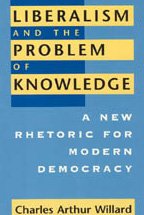
Liberalism and the Problem of Knowledge: A New Rhetoric for Modern Democracy (New Practices of Inquiry) - Hardcover
Synopsis
In this witty and provocative study of democracy and its critics, Charles Willard debunks liberalism, arguing that its exaggerated ideals of authenticity, unity, and community have deflected attention from the pervasive incompetence of "the rule of experts." He proposes a ground of communication that emphasizes common interests rather than narrow disputes.
The problem of "unity" and the public sphere has driven a wedge between libertarians and communitarians. To mediate this conflict, Willard advocates a shift from the discourse of liberalism to that of epistemics. As a means of organizing the ebb and flow of consensus, epistemics regards democracy as a family of knowledge problems—as ways of managing discourse across differences and protecting multiple views.
Building a bridge between warring peoples and warring paradigms, this book also reminds those who presume to instruct government that they are obliged to enlighten it, and that to do so requires an enlightened public discourse.
"synopsis" may belong to another edition of this title.
About the Author
Charles Willard is professor and chair of the Department of Communication at the University of Louisville.
From the Back Cover
In this witty and provocative study of democracy and its critics, Charles Willard debunks liberalism, arguing that its exaggerated ideals of authenticity, unity, and community have deflected attention from the pervasive incompetence of "the rule of experts". He proposes a ground of communication that emphasizes common interests rather than narrow disputes. The problem of "unity" and the public sphere has driven a wedge between libertarians and communitarians. To mediate this conflict, Willard advocates a shift from the discourse of liberalism to that of epistemics. As a means of organizing the ebb and flow of consensus, epistemics regards democracy as a family of knowledge problems - as ways of managing discourse across differences and protecting multiple views. Building a bridge between warring peoples and warring paradigms, this book also reminds those who presume to instruct government that they are obliged to enlighten it, and that to do so requires an enlightened public discourse.
"About this title" may belong to another edition of this title.
Search results for Liberalism and the Problem of Knowledge: A New Rhetoric...

Stock Image
Liberalism and the Problem of Knowledge : A New Rhetoric for Modern Democracy
Published by
University of Chicago Press, 1996
ISBN 10: 0226898458
ISBN 13: 9780226898452
New
Hardcover
Seller: GreatBookPrices, Columbia, MD, U.S.A.
Seller rating 5 out of 5 stars

Condition: New. Seller Inventory # 645180-n
Stock Image
Liberalism and the Problem of Knowledge Format: Hardcover
Published by
University of Chicago press, 1996
ISBN 10: 0226898458
ISBN 13: 9780226898452
New
Hardcover
Seller: INDOO, Avenel, NJ, U.S.A.
Seller rating 5 out of 5 stars
Condition: New. Brand New. Seller Inventory # 9780226898452
Stock Image
Liberalism and the Problem of Knowledge
Published by
The University of Chicago Press, 1996
ISBN 10: 0226898458
ISBN 13: 9780226898452
New
Hardcover
Seller: PBShop.store US, Wood Dale, IL, U.S.A.
Seller rating 5 out of 5 stars
HRD. Condition: New. New Book. Shipped from UK. Established seller since 2000. Seller Inventory # GB-9780226898452
Stock Image
Liberalism and the Problem of Knowledge
Published by
The University of Chicago Press, 1996
ISBN 10: 0226898458
ISBN 13: 9780226898452
New
Hardcover
Seller: PBShop.store UK, Fairford, GLOS, United Kingdom
Seller rating 5 out of 5 stars
HRD. Condition: New. New Book. Shipped from UK. Established seller since 2000. Seller Inventory # GB-9780226898452
Buy New
US$ 127.30
US$ 7.77 shipping
Ships from United Kingdom to U.S.A.
Ships from United Kingdom to U.S.A.
Quantity: 1 available
Stock Image
Liberalism and the Problem of Knowledge : A New Rhetoric for Modern Democracy
Published by
University of Chicago Press, 1996
ISBN 10: 0226898458
ISBN 13: 9780226898452
Used
Hardcover
Seller: GreatBookPrices, Columbia, MD, U.S.A.
Seller rating 5 out of 5 stars
Condition: As New. Unread book in perfect condition. Seller Inventory # 645180
Stock Image
Liberalism and the Problem of Knowledge : A New Rhetoric for Modern Democracy
Published by
University of Chicago Press, 1996
ISBN 10: 0226898458
ISBN 13: 9780226898452
New
Hardcover
Seller: GreatBookPricesUK, Woodford Green, United Kingdom
Seller rating 5 out of 5 stars
Condition: New. Seller Inventory # 645180-n
Buy New
US$ 127.29
US$ 19.85 shipping
Ships from United Kingdom to U.S.A.
Ships from United Kingdom to U.S.A.
Quantity: 1 available
Stock Image
Liberalism and the Problem of Knowledge : A New Rhetoric for Modern Democracy
Published by
University of Chicago Press, 1996
ISBN 10: 0226898458
ISBN 13: 9780226898452
Used
Hardcover
Seller: GreatBookPricesUK, Woodford Green, United Kingdom
Seller rating 5 out of 5 stars
Condition: As New. Unread book in perfect condition. Seller Inventory # 645180
Buy Used
US$ 144.39
US$ 19.85 shipping
Ships from United Kingdom to U.S.A.
Ships from United Kingdom to U.S.A.
Quantity: 1 available
Stock Image
Liberalism and the Problem of Knowledge: A New Rhetoric for Modern Democracy (New Practices of Inquiry)
Published by
University of Chicago Press, 1996
ISBN 10: 0226898458
ISBN 13: 9780226898452
New
Hardcover
Seller: Ria Christie Collections, Uxbridge, United Kingdom
Seller rating 5 out of 5 stars
Condition: New. In English. Seller Inventory # ria9780226898452_new
Buy New
US$ 151.63
US$ 14.94 shipping
Ships from United Kingdom to U.S.A.
Ships from United Kingdom to U.S.A.
Quantity: 2 available
Stock Image
Liberalism and the Problem of Knowledge A New Rhetoric for Modern Democracy
Seller: Revaluation Books, Exeter, United Kingdom
Seller rating 5 out of 5 stars
Hardcover. Condition: Brand New. 384 pages. 9.50x6.25x1.00 inches. In Stock. Seller Inventory # __0226898458
Buy New
US$ 150.88
US$ 16.54 shipping
Ships from United Kingdom to U.S.A.
Ships from United Kingdom to U.S.A.
Quantity: 1 available
Stock Image
Liberalism and the Problem of Knowledge
Published by
The University of Chicago Press, US, 1996
ISBN 10: 0226898458
ISBN 13: 9780226898452
New
Hardcover
Seller: Rarewaves.com USA, London, LONDO, United Kingdom
Seller rating 5 out of 5 stars
Hardback. Condition: New. In this study of democracy and its critics, the author debunks liberalism, arguing that its exaggerated ideals of authenticity, unity and community have deflected attention from the pervasive incompetence of "the rule of experts". He proposes a ground of communication that emphasizes common interests rather than narrow disputes. The problem of "unity" and the public sphere has driven a wedge between libertarians and communitarians. To mediate this conflict, Willard advocates a shift from the discourse of liberalism to that of epistemics. As a means of organizing the ebb and flow of consensus, epistemics regards democracy as a family of knowledge problems - as ways of managing discourse across differences and protecting multiple views. Building a bridge between warring peoples and warring paradigms, the book also reminds those who presume to instruct government that they are obliged to enlighten it, and that to do so requires an enlightened public discourse. Seller Inventory # LU-9780226898452
Buy New
US$ 171.68
Free Shipping
Ships from United Kingdom to U.S.A.
Ships from United Kingdom to U.S.A.
Quantity: 1 available