
Items related to Nature All Around Us: A Guide to Urban Ecology
Synopsis
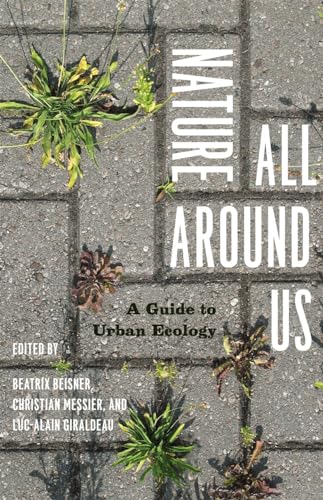
It’s easy to stand in awe of a city’s impressive skyline, marveling at its buildings reaching for the clouds and its vast network of roadways and train lines crisscrossing in every direction. It can often seem like everything in a city is man-made, all concrete, steel, and glass. But even the asphalt jungle is not all asphalt—a sidewalk’s cracks are filled with nature, if we know where and how to look. To aid us in this quest is Nature All Around Us, which will help us to recognize (and look after) the natural world we traipse through in our daily lives.
Nature All Around Us uses the familiar—such as summer Sundays humming with lawn mowers, gray squirrels foraging in planters, and flocks of pigeons—in order to introduce basic ecological concepts. In twenty-five short chapters organized by scale, from the home to the neighborhood to the city at large, it offers a subtle and entertaining education in ecology sure to inspire appreciation and ultimately stewardship of the environment. Various ecological concepts that any urban dweller might encounter are approachably examined, from understanding why a squirrel might act aggressively towards its neighbor to how nutrients and energy contained within a discarded apple core are recycled back into the food chain. Streaming through the work is an introduction to basic ecology, including the dangers of invasive species and the crucial role played by plants and trees in maintaining air quality.
Taken as a whole, Nature All Around Us is an unprecedented field guide to the ecology of the urban environment that invites us to look at our towns, cities, and even our backyards through the eyes of an ecologist. It is an entertaining, educational, and inspiring glimpse into nature in seemingly unnatural settings, a reminder that we don’t have to trek into the wild to see nature—we just have to open our eyes.
"synopsis" may belong to another edition of this title.
About the Authors
Beatrix Beisner is a professor in the Department of Biology at Montreal University in Quebec.
Christian Messier is a professor in the Department of Biology at Montreal University in Quebec.
Luc Alain Giraldeau is a professor in the Department of Biology at Montreal University in Quebec.
Excerpt. © Reprinted by permission. All rights reserved.
NATURE ALL AROUND US
A Guide to Urban EcologyTHE UNIVERSITY OF CHICAGO PRESS
Copyright © 2013 The University of ChicagoAll right reserved.
ISBN: 978-0-226-92275-1
Contents
Introduction: What Is Ecology?..........................11 Apple at My Core......................................52 Arboreal Aqueducts....................................103 Lawn Lions............................................164 Praise for Lazy Gardeners.............................215 The Evolution of Food.................................256 Hey, Taxi!............................................317 Social Life...........................................368 Bathroom Drama........................................419 Winter Warmth.........................................4610 The Secret Life of Ponds.............................5311 A Life of Extremes...................................5812 Prowling Predator....................................6513 Pigeontown...........................................7014 Animal Intelligentsia................................7615 Squirrelly Neighbors.................................8216 From the Chimney Tops................................8717 Long Lifelines.......................................9218 Canary in the City...................................9919 Wing Beats...........................................10420 Enough Already!......................................10921 Darwin's Sweet Tooth?................................11522 A Breath of Fresh Air................................12023 Successful Little Birds..............................12424 Opportunistic Gulls..................................12925 Urban Roots..........................................134Conclusion..............................................139Glossary................................................141
Chapter One
APPLE AT MY CORE
Our human notion of garbage as old, unusable, or unwanted material does not exist in nature. Instead, living organisms pass the essential materials for life to others in a relay race with no end. Death is not final; it's just a transitory state for what ecologists call organic matter. Let's observe the reincarnation of something you might consider garbage—an apple core discarded in your backyard. Although the word organic is often used these days to refer to healthier food choices, in biology and chemistry it means something quite different. In fact, organic simply means material that is living, or once was. Much of our kitchen waste slowly disintegrates into its organic components: molecules containing carbon and hydrogen (see the boxed definitions at the end of this chapter). The rest of our household waste is made up of inorganic molecules composed of other elements such as nitrogen, phosphorus, or iron. Many of these products of disintegration become nutrients essential for the growth of primary producers, which in most ecosystems are more simply called plants. Primary producers are at the base of all food chains because by using nutrients, sunlight, and water they produce new life that other organisms depend on.
In decomposition, complex waste material (like the core of an apple) is converted into simpler forms that are returned to the food chain. Many hardworking organisms—perhaps not surprisingly called decomposers—carry it out. Without decomposers, every plant or animal that has died since the beginning of life on Earth would accumulate around us, leaving no room for new life. In addition to filling the planet with waste, each death would sequester more of the nutrients surviving organisms need for growth, eventually leading to the extinction of all life as they are used up.
Organic matter starts decomposing as soon as the living organism stops protecting itself from decomposer attacks, usually on the death of the organism or one of its parts. When an apple is picked the tree can no longer protect it, and decomposition starts (we keep fruit in the refrigerator to slow down the decomposers). Let's see what happens to the apple core you throw on your backyard compost heap.
PHASE 1: DECOMPOSITION
The first organisms to attack the apple core are the macroscopic decomposers. These include invertebrates (animals without spinal cords), such as millipedes, fly larvae (maggots), and earthworms, that cut the core into smaller bits. Then smaller organisms, like protozoans and tiny worms called nematodes, take over breaking apart the garbage as these bigger decomposers leave.
Decomposing organisms feed on waste such as apple cores to fuel their metabolism—the same reason we eat. Metabolism produces carbon dioxide (CO2) through cellular respiration. In this way these initial decomposers produce both CO2 (a gas) and solid waste products. This solid excrement is rapidly colonized by microscopic decomposers such as bacteria and fungi that complete the work of deconstruction, creating humus, soil high in nutrients and therefore useful for plant growth.
The decomposers haven't yet finished with your apple core. Some proteins, sugars, cellulose, and lignin remain in the humus. These large, complex molecules bind up the nutrients the primary producers need. Once again the bacteria and fungi work to break these molecules into their simpler constituent molecules and elements. An important example of this conversion from complex to simple molecules is the decomposition of proteins found in dead plants and animals. Proteins are very large molecules made up of amino acids rich in nitrogen (N). Within the humus, nitrogen is still unusable for plants, since it is caught up in proteins. Decomposers convert these into smaller molecules: urea, ammonia (NH4+), and nitrites (NO2), and finally the form plants most prefer, the nitrates (NO3). Even though N is the most abundant molecule in the air we breathe (78 percent), plants can take up only the forms found in the soil, so microscopic decomposers are essential in degrading proteins into forms of nitrogen that plants can use to make more proteins.
At this point your apple core has completely disintegrated, transformed into its basic constituents of CO2 and inorganic nutrients like nitrogen. Now it's ready for the next step.
PHASE 2: RECONSTRUCTION
The element at the base of all life on Earth is carbon (C). In plants we find it principally as cellulose and lignin, the major components of wood, pulp, and bark. Carbon is found mostly in animals' tissues, including fat.
All living organisms need carbon for growth, maintenance, and reproduction. Plants take C directly from the air and convert it to other molecules (using light energy) through photosynthesis. Animals take in C by eating organic matter like plants or other animals, then convert it into energy by cellular respiration (the same process the decomposers use to keep growing).
This is the final step in the reincarnation of the apple core, now converted into minuscule molecules of CO2 and nutrients so that plants in the garden can take it up. If you feed your growing vegetables with compost, parts of the apple will become part of your body when you eat those magnificent home-grown tomatoes and cucumbers.
The number of atoms on Earth has remained more or less the same since the planet was formed. Because they are constantly recycled, some of the atoms in your body may have once belonged to Jurassic dinosaurs, while others might have spent time in the body of Plato or Mozart. Then again, maybe your atoms were part of their forgotten neighbors, so let's not get carried away.
Alice Parkes
Chapter Two
ARBOREAL AQUEDUCTS
It's noon on a sunny summer day. The thermometer reads 90°F (32°C), and not a drop of rain has fallen in weeks. Heat shimmers above the parked cars. The grass in your yard is turning brown, yet the magnificent maple in your front yard doesn't seem to be suffering. Now that you consider it, all the trees on your block seem immune to the drought and still sport very green foliage.
All organisms need water to survive, and trees are far from an exception. So why do they remain green while the grass turns brown? What adaptations did trees evolve to allow them to colonize all parts of the planet, from arid deserts to barren mountains to muddy swamps? Don't forget that for many living organisms, too much water is as much of a problem as too little. Scientists were long baffled about how trees survive in such a wide variety of humidity levels. The secret lies in the way trees transport water up those tall trunks, from the roots to the leaves.
Without water, there would be no life on Earth, or at least not the kind we know. Certainly there would be no trees. As they grow, trees go through a series of complex physiological processes including germination, photosynthesis, growth, and absorption of nutrients from the soil, and they all take lots of water. In a single summer, a large maple tree transports up to 53 gallons (200 L) of water every hour from its roots to its uppermost leaves.
How do trees pump all this water from the soil to the impressive heights where their leaves are found? For some trees the task seems downright impossible: consider Australian eucalyptus or the California sequoias, which must pump water up 500 feet (150 m).
MODULAR TUBES
Trees constitute a complex network of natural aqueducts. Just like municipal waterworks, arboreal aqueducts must constantly adapt flow to the amount demanded by the end users—in this case, the leaves.
Trees take water from the soil using their smallest roots, called root hairs, but some very small fungi (mycorrhizae) that colonize root hairs do most of this work. Mycorrhizae are indispensable to the survival of most trees: the minuscule filaments (hyphae) of the fungi vastly improve the tree's ability to absorb water and nutrients. The hyphae reach into and exploit resources from a much larger volume of soil than could the roots alone, while remaining attached to the tree's root hairs. In fact, the roots, root hairs, and mycorrhizae occupy as much volume as all of the tree's foliage. This extended root system gives trees a major advantage over lawn grasses, whose roots are often confined to the top 4 inches (10 cm) of soil.
After being picked up by the roots, water continues to travel through the plant by small vessels in the sapwood: mainly living tissue directly under the bark that makes up the outer 2 to 6 inches (5–15 cm) of the trunk. Acting like a sponge, sapwood moves water toward the leaves. In contrast, heartwood is the dead tissue in the middle of the trunk that holds the tree up. At the summit, the sapwood divides and makes its way into each branch and twig to irrigate every leaf, so even the most remote receives the water it needs—most of the time.
THE SECRET PUMP
Now that we better understand the route water takes through the tree, we can look at what makes it move. At one time researchers thought tree roots pushed water from the soil up to the leaves using "root pressure." But they quickly learned that if such a mechanism existed, it could not raise water higher than 10 feet (3 m)—certainly not high enough to reach the tops of most trees. To see how the process works, we need to understand what leaves do.
Leaves transpire. Lots. Plant transpiration is much like human perspiration. The foliage of a single tree produces enough water in a day to fill at least ten bathtubs, without expending metabolic energy, owing to a pressure differential between the atmosphere and the inside of microscopic pores (stomates) found on the underside of every leaf. During the day, each leaf dissipates heat by evaporating the water in its cells, creating water vapor within the leaf. Because it is under pressure, this vapor seeks to escape whenever the leaf opens its stomates, as it must do to capture carbon dioxide (CO2) in the air for photosynthesis. So a leaf picks up CO2 while releasing water vapor. This simple transfer of water from the leaf to the atmosphere, evapotranspiration, causes a chain reaction: to fill the vacuum created by the lost water, leaves suck more water from the trunk, the trunk in turn sucks water from the roots, and finally the roots absorb more water from the soil.
During droughts, urbanites may be asked to not water their lawns, to avoid washing their cars, and sometimes even to limit their time in the shower. Similarly, there are times when the tree needs more water than the environment can supply, making rationing necessary. A tree rations water by partially or completely closing the stomates. But this water saving comes at a cost, since it limits the amount of CO2 the leaves can take up, thereby reducing photosynthesis and ultimately growth. If the water shortage goes on too long, the tree will lose vitality. The year after a severe drought, it is common to see dead branches near the tops of trees.
Thus a tree faces a trade-off in acquiring resources. To capture enough CO2 to survive, it must open its stomates. But the more it opens them, the more water it loses. This dilemma applies to most plants except the cacti. Cacti and some other plants from arid regions have developed a different photosynthetic machinery to capture CO2 at night when it is cooler, minimizing loss of water during the hot days.
OAK EFFICIENCY?
There are two types of trees: those that waste water and those that save it. Wasters are found in wet or humid environments because they cannot survive without plenty of water. These arboreal wasters, including willows, cottonwoods, silver maples, and black ash trees, are generally found near water and in the floodplains of rivers. In these habitats, water wasters rapidly outcompete other species, but they remain vulnerable to prolonged droughts.
At the opposite end of the spectrum are water-saving species like pines, cedars, and oaks as well as species that grow in desertlike conditions such as those in the southwestern United States. These species control the opening of their stomates very precisely to minimize water loss. Their root systems are well developed, efficient, and very deep, so they can search more extensively for water. Their overall growth tends to be slow, but these trees can survive with very little water. They often occur on rocky outcroppings where they are competitively dominant.
In regions subject to occasional droughts, trees should evolve the strategy of dropping their leaves at those times to reduce their water requirements (of course, the trade-off is that they won't photosynthesize). Another strategy for dealing with drought is to produce more roots, maximizing water absorption when demand is high. Trees have evolved many ways to get the water they need. But one thing is certain: a water-wasting tree will never occur naturally in desert regions. Maybe humans could learn a thing or two.
Christian Messier, Sylvain Delagrange, and Frank Berninger
Chapter Three
LAWN LIONS
Finally, a peaceful moment! The neighbors have silenced their lawn mower and are kneeling quietly with trowels, trying to eradicate the source of the luxuriant yellow carpet that covers their lawn each spring. Just how did this small plant, originally from Eurasia, become such a successful invader of lawns throughout the world? As often happens with exotic species, humans have aided the dandelion's success. Perhaps our delight in blowing the seeds off dandelion heads is at least partly responsible.
An exotic species is one originating in another region of the world that has successfully moved past some natural boundary like a mountain range or an ocean to colonize new habitats. Some exotic species cannot survive in their new environments without human aid (purposeful or not). Others adapt so well that they become naturalized.
Among exotic species, some spread so rapidly that they become invasives, coming to dominate their new ecosystems and even eliminate native species. This is why ecologists often regard invasive species as a threat to natural biodiversity.
In general, a species becomes highly invasive only when a new environment offers it several advantages:
1. Adequate environmental (habitat) conditions.
2. A vacant ecological niche: a set of resources not already being used efficiently by native species.
3. An environment that lacks natural predators (including diseases, insects, or animals) that normally control its population in its native habitat.
The dandelion is an exotic species in North America, but it cannot really be considered as threatening biodiversity: it invades only habitats already strongly altered by humans, such as grassy lawns. Though many homeowners see it as undesirable (a weed), this view is more subjective than based on ecological reasoning.
In fact, early European settlers purposely introduced the dandelion (named from the French dent de lion, "lion's tooth," because of its serrated leaves) along with several other common plants used in cooking and in medicine, such as clover, mustard, daisies, and wild chicory. In North America, exotic species make up at least a quarter of the diversity of herbaceous plants. But some introductions were accidental, when seeds were stowed away in packing material or in the fodder brought to feed livestock on board ships.
A great many of the plant species introduced to North America originated in the steppes of western Eurasia and the mountains of Europe and prefer sunny, open areas. Such habitats were found naturally in the new countries' prairies, but also in areas the colonists had cleared of forest. Without human help, many of these species would have been less successful at establishing themselves across the continent.
(Continues...)
Excerpted from NATURE ALL AROUND US Copyright © 2013 by The University of Chicago. Excerpted by permission of THE UNIVERSITY OF CHICAGO PRESS. All rights reserved. No part of this excerpt may be reproduced or reprinted without permission in writing from the publisher.
Excerpts are provided by Dial-A-Book Inc. solely for the personal use of visitors to this web site.
"About this title" may belong to another edition of this title.
Search results for Nature All Around Us: A Guide to Urban Ecology

Stock Image
Nature All Around Us: A Guide to Urban Ecology
Published by
University of Chicago Press, 2012
ISBN 10: 0226922758
ISBN 13: 9780226922751
Used
Softcover
Seller: World of Books (was SecondSale), Montgomery, IL, U.S.A.
Seller rating 5 out of 5 stars

Condition: Very Good. Item in very good condition! Textbooks may not include supplemental items i.e. CDs, access codes etc. Seller Inventory # 00109592190
Stock Image
Nature All Around Us : A Guide to Urban Ecology
Published by
University of Chicago Press, 2012
ISBN 10: 0226922758
ISBN 13: 9780226922751
New
Softcover
Seller: GreatBookPrices, Columbia, MD, U.S.A.
Seller rating 5 out of 5 stars
Condition: New. Seller Inventory # 18471949-n
Stock Image
Nature All Around Us Format: Paperback
Published by
University of Chicago press, 2012
ISBN 10: 0226922758
ISBN 13: 9780226922751
New
Softcover
Seller: INDOO, Avenel, NJ, U.S.A.
Seller rating 5 out of 5 stars
Condition: New. Brand New. Seller Inventory # 9780226922751
Seller Image
Nature All Around Us : A Guide to Urban Ecology
Published by
University of Chicago Press, 2012
ISBN 10: 0226922758
ISBN 13: 9780226922751
Used
Softcover
Seller: GreatBookPrices, Columbia, MD, U.S.A.
Seller rating 5 out of 5 stars
Condition: As New. Unread book in perfect condition. Seller Inventory # 18471949
Stock Image
Nature All Around Us: A Guide to Urban Ecology (eng)
Published by
University of Chicago Press, 2012
ISBN 10: 0226922758
ISBN 13: 9780226922751
New
Softcover
Seller: Brook Bookstore On Demand, Napoli, NA, Italy
Seller rating 5 out of 5 stars
Condition: new. Seller Inventory # 2e6046f2643548019b837bea0acb7b73
Buy New
US$ 27.55
US$ 6.40 shipping
Ships from Italy to U.S.A.
Ships from Italy to U.S.A.
Quantity: Over 20 available
Stock Image
Nature All Around Us
Seller: PBShop.store UK, Fairford, GLOS, United Kingdom
Seller rating 5 out of 5 stars
PAP. Condition: New. New Book. Shipped from UK. Established seller since 2000. Seller Inventory # FW-9780226922751
Buy New
US$ 30.70
US$ 4.46 shipping
Ships from United Kingdom to U.S.A.
Ships from United Kingdom to U.S.A.
Quantity: 15 available
Stock Image
Nature All Around Us: A Guide to Urban Ecology
Published by
University Of Chicago Press, 2012
ISBN 10: 0226922758
ISBN 13: 9780226922751
New
Softcover
Seller: Kennys Bookshop and Art Galleries Ltd., Galway, GY, Ireland
Seller rating 5 out of 5 stars
Condition: New. Helps us to recognize (and look after) the natural world we traipse through in our daily lives. This book uses the familiar - such as summer Sundays humming with lawn mowers, gray squirrels foraging in planters, and flocks of pigeons - in order to introduce basic ecological concepts. Editor(s): Beisner, Beatrix; Messier, Christian; Giraldeau, Luc-Alain. Num Pages: 184 pages, 1 halftone, 78 line drawings. BIC Classification: PSAF; WNC. Category: (G) General (US: Trade). Dimension: 215 x 158 x 10. Weight in Grams: 198. A Guide to Urban Ecology. 184 pages, 1 halftone, 78 line drawings. Editor(s): Beisner, Beatrix; Messier, Christian; Giraldeau, Luc-Alain. Helps us to recognize (and look after) the natural world we traipse through in our daily lives. This book uses the familiar - such as summer Sundays humming with lawn mowers, gray squirrels foraging in planters, and flocks of pigeons - in order to introduce basic ecological concepts. Cateogry: (G) General (US: Trade). BIC Classification: PSAF; WNC. Dimension: 215 x 158 x 10. Weight: 198. . 2012. Paperback. . . . . Seller Inventory # V9780226922751
Buy New
US$ 28.03
US$ 11.05 shipping
Ships from Ireland to U.S.A.
Ships from Ireland to U.S.A.
Quantity: Over 20 available
Stock Image
Nature All Around Us
Published by
University of Chicago Press, 2012
ISBN 10: 0226922758
ISBN 13: 9780226922751
New
Softcover
Seller: Majestic Books, Hounslow, United Kingdom
Seller rating 4 out of 5 stars

Condition: New. pp. 160. Seller Inventory # 57966854
Buy New
US$ 30.70
US$ 8.81 shipping
Ships from United Kingdom to U.S.A.
Ships from United Kingdom to U.S.A.
Quantity: 3 available
Stock Image
Nature all Around us A Guide to Urban Ecology
Seller: Revaluation Books, Exeter, United Kingdom
Seller rating 5 out of 5 stars
Paperback. Condition: Brand New. 160 pages. 8.40x0.40x5.40 inches. In Stock. Seller Inventory # __0226922758
Buy New
US$ 26.57
US$ 13.55 shipping
Ships from United Kingdom to U.S.A.
Ships from United Kingdom to U.S.A.
Quantity: 2 available
Stock Image
Nature All Around Us
Seller: PBShop.store US, Wood Dale, IL, U.S.A.
Seller rating 5 out of 5 stars
PAP. Condition: New. New Book. Shipped from UK. Established seller since 2000. Seller Inventory # FW-9780226922751