
Items related to "Economist" Style Guide ("Economist"...
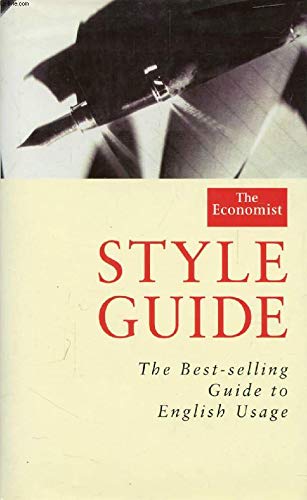
Synopsis
Most newspapers and magazines issue their contributors with a style guide. Writers, be they on staff or freelance, then know whether a publication's house style requires % or per cent or commas in dates. Sometimes it's just a tatty sheet of typed A4 but since 1986 The Economist has developed its stylish Style Guide, through six editions, into a full length reference book.
Because English is such a vast and continuously evolving language--its vocabulary is double that of French and more than three times larger than German--it is open to multifarious use and all the old arguments about correctness or lack of it. The Economist unequivocally sets out its version of what is acceptable and why, usually conforming to Fowler's Modern English Usage and other good guides to getting it right. It also refutes dozens of common errors, stating firmly, for example, that "Data are plural" and that "Any one refers to a number; anyone to anybody."
Since its style guide is set out in such detail, it makes sense to publish it for the rest of the world, most of whom are not writers for The Economist but who simply want a succinctly witty guide to writing accurately. The first section focuses on minutiae such as distinguishing between a "little-used car" and a "little used-car". It also insists that "to never split an infinitive is quite easy" and, in English so impeccable that you have to read it twice to be sure, that "Frankenstein was not a monster, but his creator." After a section setting out rules governing American and British English this handy reference book provides a miscellany of useful information including abbreviations, currencies, calendars and conversions for metric and imperial measurements. --Susan Elkin
"synopsis" may belong to another edition of this title.
Review
Rare is the style guide that a person--even a word person--would want to read cover to cover. But The Economist Style Guide, designed, as the book says, to promote good writing, is so witty and rigorous as to be irresistible. The book consists of three parts. The first is the Economist's style book, which acts as a position paper of sorts in favor of clear, concise, correct usage. The big no-noes listed in the book's introduction are: "Do not be stuffy.... Do not be hectoring or arrogant.... Do not be too pleased with yourself.... Do not be too chatty.... Do not be too didactic.... [And] do not be sloppy." Before even getting to the letter B, we are reminded that aggravate "means make worse, not irritate or annoy"; that an alibi "is the proven fact of being elsewhere, not a false explanation"; and that anarchy "means the complete absence of law or government. It may be harmonious or chaotic."
Part 2 of the book describes many of the spelling, grammar, and usage differences between British and American English. While many Briticisms are familiar to most Americans and vice versa, there are some words--such as homely, bomb, and table--that take on quite different meanings altogether when they cross the Atlantic. And part 3 offers a handy reference to such information as common business abbreviations, accountancy ratios, the Beaufort Scale, commodity-trade classifications, currencies, laws, measures, and stock-market indices. The U.S. reader should be aware (but not scared off by the fact) that some of the style issues addressed are specifically British. --Jane Steinberg
From the Publisher
A guide to emulating the acclaimed writing style of the esteemed magazine As virtually everyone doing business abroad can tell you, learn to communicate clearly, and you've taken a giant step toward professional success. It's no wonder, then, that this annual "how to" on improving your writing style attracts such a sizable number of readers year after year. After all, it's from the magazine whose superbly written articles are its hallmark. Offering explicit pathways to the clarity, precision, wit, and flair that set the quality of the authoritative weekly apart, The Economist Style Guide is an invaluable tool for anyone seeking to hone his or her communication skills.
"About this title" may belong to another edition of this title.
Search results for "Economist" Style Guide ("Economist"...

Stock Image
The Economist Style Guide ("Economist" Books)
Seller: AwesomeBooks, Wallingford, United Kingdom
Seller rating 5 out of 5 stars

Condition: Very Good. This book is in very good condition and will be shipped within 24 hours of ordering. The cover may have some limited signs of wear but the pages are clean, intact and the spine remains undamaged. This book has clearly been well maintained and looked after thus far. Money back guarantee if you are not satisfied. See all our books here, order more than 1 book and get discounted shipping. . Seller Inventory # 7719-9780241001790
Buy Used
US$ 3.20
US$ 5.45 shipping
Ships from United Kingdom to U.S.A.
Ships from United Kingdom to U.S.A.
Quantity: 2 available
Stock Image
Economist Style Guide
Seller: Better World Books, Mishawaka, IN, U.S.A.
Seller rating 5 out of 5 stars
Condition: Good. Pages intact with minimal writing/highlighting. The binding may be loose and creased. Dust jackets/supplements are not included. Stock photo provided. Product includes identifying sticker. Better World Books: Buy Books. Do Good. Seller Inventory # 8961813-75
Stock Image
Economist Style Guide
Seller: Better World Books Ltd, Dunfermline, United Kingdom
Seller rating 5 out of 5 stars
Condition: Good. Pages intact with minimal writing/highlighting. The binding may be loose and creased. Dust jackets/supplements are not included. Stock photo provided. Product includes identifying sticker. Better World Books: Buy Books. Do Good. Seller Inventory # 8961813-75
Buy Used
US$ 6.22
US$ 6.62 shipping
Ships from United Kingdom to U.S.A.
Ships from United Kingdom to U.S.A.
Quantity: 1 available
Stock Image
Economist Style Guide
Seller: Better World Books Ltd, Dunfermline, United Kingdom
Seller rating 5 out of 5 stars
Condition: Very Good. Pages intact with possible writing/highlighting. Binding strong with minor wear. Dust jackets/supplements may not be included. Stock photo provided. Product includes identifying sticker. Better World Books: Buy Books. Do Good. Seller Inventory # 13687820-75
Buy Used
US$ 6.22
US$ 6.62 shipping
Ships from United Kingdom to U.S.A.
Ships from United Kingdom to U.S.A.
Quantity: 2 available
Stock Image
The Economist Style Guide ("Economist" Books)
Seller: Bahamut Media, Reading, United Kingdom
Seller rating 4 out of 5 stars

Condition: Very Good. Shipped within 24 hours from our UK warehouse. Clean, undamaged book with no damage to pages and minimal wear to the cover. Spine still tight, in very good condition. Remember if you are not happy, you are covered by our 100% money back guarantee. Seller Inventory # 6545-9780241001790
Buy Used
US$ 3.61
US$ 9.24 shipping
Ships from United Kingdom to U.S.A.
Ships from United Kingdom to U.S.A.
Quantity: 2 available
Stock Image
"Economist" Style Guide ("Economist" Books)
Seller: Half Price Books Inc., Dallas, TX, U.S.A.
Seller rating 5 out of 5 stars
hardcover. Condition: Very Good. Connecting readers with great books since 1972! Used books may not include companion materials, and may have some shelf wear or limited writing. We ship orders daily and Customer Service is our top priority! Seller Inventory # S_363788348
Stock Image
The Economist Style Guide ("Economist" Books)
Seller: Orbiting Books, Hereford, United Kingdom
Seller rating 5 out of 5 stars
hardcover. Condition: Very Good. Creased Dust Jacket. Appears unread, may have minor damage from transit/storage. Next day dispatch from the UK (Mon-Fri). Please contact us with any queries. Seller Inventory # mon0000713673
Buy Used
US$ 1.36
US$ 15.88 shipping
Ships from United Kingdom to U.S.A.
Ships from United Kingdom to U.S.A.
Quantity: 1 available
Seller Image
The Economist Style Guide
Seller: Hamelyn, Madrid, M, Spain
Seller rating 5 out of 5 stars
Condition: Good. : Esta nueva edición de la guía de estilo de The Economist ofrece consejos generales sobre la escritura, señala errores comunes y clichés, ofrece orientación sobre el uso consistente de la puntuación, abreviaturas y letras mayúsculas, y contiene una amplia gama de material de referencia, que abarca desde ratios de contabilidad e índices bursátiles hasta leyes de la naturaleza, ciencia y economía. También incluye una sección especial sobre las diferencias entre el inglés británico y el inglés americano. Se publica como un volumen complementario de The Pocket World in Figures 1994. EAN: 9780241001790 Tipo: Libros Categoría: Literatura y Ficción Título: The Economist Style Guide Autor: The Economist Editorial: Penguin Idioma: en Páginas: 144 Formato: tapa dura. Seller Inventory # Happ-2026-07-06-3f22d165
Buy Used
US$ 11.07
US$ 13.43 shipping
Ships from Spain to U.S.A.
Ships from Spain to U.S.A.
Quantity: 1 available
Stock Image
"Economist" Style Guide ("Economist" Books)
Seller: Russell Books, Victoria, BC, Canada
Seller rating 5 out of 5 stars
Condition: Good. "Economist" Style Guide ("Economist" Books). Seller Inventory # FORT879525
Buy Used
US$ 9.99
US$ 19.99 shipping
Ships from Canada to U.S.A.
Ships from Canada to U.S.A.
Quantity: 1 available
Seller Image
The Economist Style Guide. The Best-selling Guide to English Usage
Published by
London, Hamish Hamilton, 1993
ISBN 10: 024100179X
ISBN 13: 9780241001790
Used
Hardcover
Seller: Barksdale Books, Almere, Netherlands
Seller rating 5 out of 5 stars
Condition: Good. Seller Inventory # 258697
Buy Used
US$ 11.54
US$ 22.40 shipping
Ships from Netherlands to U.S.A.
Ships from Netherlands to U.S.A.
Quantity: 1 available