
Items related to 'THE FIRST CENTURY: EMPERORS, GODS AND EVERYMAN'
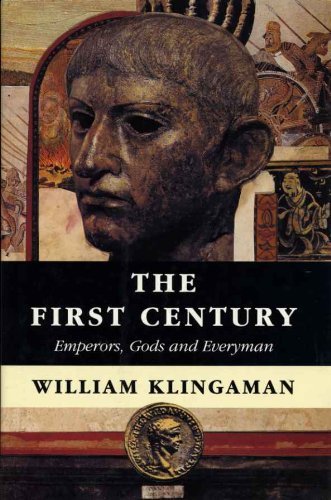
Synopsis
At the dawn of the first century, Rome was approaching the zenith of its power under Caesar Augustus. In Judea, Herod the Great had recently died and the Jewish people were in ferment, setting the stage for the prophetic ministry of John the Baptist. In China, the Confucian scholar Wang Mang had seized power from the decadent court of the Han Dynasty.
Augustus' successors ranged from the dour Tiberius and the unfortunate Claudius to the dissolute Nero and the violently unstable Caligula. These were the years in which Jesus of Nazareth lived and died; in the years following his crucifixion there was -- in the absence of any official orthodoxy -- an electrifying diversity of thought within the Christian movement that would never be duplicated. In Jerusalem, the collapse of the Jewish revolt and the destruction of the Temple led to the disappearance of the Jewish state for nearly nineteen hundred years. In the East, the rapidly spreading Indian religion of Buddhism made its first appearance at the Chinese imperial court. Within the Roman Empire, the traditions of classical Hellenism vied with mystical heritage of the East, creating an explosive mix of cults, zealots, and messiahs.
In The First Century , William Klingaman tells us what it was like to live during this time, quoting from first-person reports from around the world. He describes the diet of a Chinese peasant, the gruesome practices of Roman doctors, the military tactics of the semi-civilized Celtic warriors with their blue-painted faces, the sexual escapades of the Roman emperors' wives, the romantic advice of the exiled poet Ovid, the brutality of the games in the Colosseum, and the progress of a pilgrim's visit to the Temple.
From this examination of affairs around the world, some striking patterns emerge, including the parallels between the rebellions of Boudicca, the tribal queen in Britain, and the Trung sisters in Vietnam, and between the philosophies of the Christian missionary Paul and the Roman Stoic Seneca. Klingaman brings to life dozens of well-known characters as well as fascinating footnotes to history in the narrative of a crucial century.
"synopsis" may belong to another edition of this title.
From Library Journal
Since American culture often hedges between Christian and Oriental spiritual thought, sometimes opting to combine the two for a personalized belief system, there is clearly a need to put these two spiritual forces into historical perspective. Klingaman has done just that in his engrossing narrative of the first century A.D. He brings together Augustus Caesar, the ascension of Wang Mang, the poet Ovid, the notorious glutton Claudius, Jesus and his deviation from conventional Judaic tradition, and the spread of Mahayana Buddhism to make an intriguing comparison between Asian and Mediterranean political, military, and spiritual development. The author's attempt to recreate the atmosphere of the era will certainly appeal to lay people, but the lack of annotation will disappoint more serious scholars and students. As a sweeping historical overview of the birth of Christianity and Buddhism, this volume is both engaging and enlightening.
- Gerald Large, California State Univ., Los Angeles
Copyright 1990 Reed Business Information, Inc.
From Publishers Weekly
Parallels between East and West abound in this robust, readable history of the first century. For example, both Augustus Caesar and Chinese emperor Wang Mang, usurper of the Han throne, saw themselves as saviors of battered, debauched civilizations. While the Chinese reannexed the newly independent state of Vietnam led by the two courageous Trung sisters (40-43 C.E.), insecure Claudius sent Roman warlord Vespasian to crush a rebellion in Britain. Klingaman ( 1929: The Year of the Great Crash ) focuses on some 20 central characters in an engrossing, cinematic narrative which regrettably excludes Africa and the Americas and selectively glances at India, Asia Minor and Western Europe. At center stage is itinerant preacher Jesus, waging a cataclysmic holy war to liberate Israel from its state of sin.
Copyright 1990 Reed Business Information, Inc.
"About this title" may belong to another edition of this title.
Search results for 'THE FIRST CENTURY: EMPERORS, GODS AND EVERYMAN'

Stock Image
The First Century: Emperors, Gods And Everyman
Seller: AwesomeBooks, Wallingford, United Kingdom
Seller rating 5 out of 5 stars

Hardcover. Condition: Very Good. The First Century: Emperors, Gods And Everyman This book is in very good condition and will be shipped within 24 hours of ordering. The cover may have some limited signs of wear but the pages are clean, intact and the spine remains undamaged. This book has clearly been well maintained and looked after thus far. Money back guarantee if you are not satisfied. See all our books here, order more than 1 book and get discounted shipping. . Seller Inventory # 7719-9780241128879
Buy Used
US$ 4.80
US$ 5.45 shipping
Ships from United Kingdom to U.S.A.
Ships from United Kingdom to U.S.A.
Quantity: 2 available
Stock Image
First Century : Emperors, Gods and Everyman
Seller: Better World Books Ltd, Dunfermline, United Kingdom
Seller rating 5 out of 5 stars
Condition: Good. Pages intact with minimal writing/highlighting. The binding may be loose and creased. Dust jackets/supplements are not included. Stock photo provided. Product includes identifying sticker. Better World Books: Buy Books. Do Good. Seller Inventory # 46305201-75
Buy Used
US$ 6.22
US$ 6.62 shipping
Ships from United Kingdom to U.S.A.
Ships from United Kingdom to U.S.A.
Quantity: 1 available
Stock Image
The First Century: Emperors, Gods And Everyman
Published by
Hamish Hamilton 18/03/1991, 1991
ISBN 10: 0241128870
ISBN 13: 9780241128879
Used
Hardcover
Seller: Bahamut Media, Reading, United Kingdom
Seller rating 4 out of 5 stars

Condition: Very Good. Shipped within 24 hours from our UK warehouse. Clean, undamaged book with no damage to pages and minimal wear to the cover. Spine still tight, in very good condition. Remember if you are not happy, you are covered by our 100% money back guarantee. Seller Inventory # 6545-9780241128879
Buy Used
US$ 4.66
US$ 9.24 shipping
Ships from United Kingdom to U.S.A.
Ships from United Kingdom to U.S.A.
Quantity: 2 available
Stock Image
The First Century: Emperors, Gods And Everyman
Seller: WorldofBooks, Goring-By-Sea, WS, United Kingdom
Seller rating 5 out of 5 stars
Hardback. Condition: Very Good. The book has been read, but is in excellent condition. Pages are intact and not marred by notes or highlighting. The spine remains undamaged. Seller Inventory # GOR005509133
Buy Used
US$ 12.81
US$ 7.41 shipping
Ships from United Kingdom to U.S.A.
Ships from United Kingdom to U.S.A.
Quantity: 3 available
Stock Image
The First Century: Emperors, Gods and Everyman
Seller: Greener Books, London, United Kingdom
Seller rating 4 out of 5 stars
Hardcover. Condition: Used; Very Good. **SHIPPED FROM UK** We believe you will be completely satisfied with our quick and reliable service. All orders are dispatched as swiftly as possible! Buy with confidence! Greener Books. Seller Inventory # 4616675
Buy Used
US$ 5.00
US$ 26.47 shipping
Ships from United Kingdom to U.S.A.
Ships from United Kingdom to U.S.A.
Quantity: 2 available
Seller Image
The First Century: Emperors, Gods and Everman
Published by
Hamilton, London, 1991
ISBN 10: 0241128870
ISBN 13: 9780241128879
Used
Hardcover
First Edition
Seller: Roger Lucas Booksellers, Horncastle, United Kingdom
Seller rating 4 out of 5 stars
Hard Cover. Condition: Very Good. Dust Jacket Condition: Very Good. First Edition. 1st UK edition, 8vo, 402pp, line illustrations, VG Copy in VG DJ Size: 8vo - over 7¾" - 9¾" tall. Seller Inventory # 40600
Buy Used
US$ 8.18
US$ 23.82 shipping
Ships from United Kingdom to U.S.A.
Ships from United Kingdom to U.S.A.
Quantity: 1 available
Seller Image
The First Century Emperors, Gods, And Everyman
Seller: Book Haven, Wellington, WLG, New Zealand
Seller rating 5 out of 5 stars
Hardback. Condition: Very Good. In The First Century , William Klingaman tells us what it was like to live during this time, quoting from first-person reports from around the world. He describes the diet of a Chinese peasant, the gruesome practices of Roman doctors, the military tactics of the semi-civilized Celtic warriors with their blue-painted faces, the sexual escapades of the Roman emperors' wives, the romantic advice of the exiled poet Ovid, the brutality of the games in the Colosseum, and the progress of a pilgrim's visit to the Temple. DJ. 402 pages. Seller Inventory # 1587758
Buy Used
US$ 7.81
US$ 25.00 shipping
Ships from New Zealand to U.S.A.
Ships from New Zealand to U.S.A.
Quantity: 1 available
Stock Image
The First Century: Emperors, Gods And Everyman
Published by
Hamish Hamilton, London, 1991
ISBN 10: 0241128870
ISBN 13: 9780241128879
Used
Hardcover
First Edition
Seller: Sarah Zaluckyj, KINGTON, United Kingdom
Seller rating 5 out of 5 stars
Hardcover. Condition: Good +. Dust Jacket Condition: Dustjacket Good ++/Very Good. First British Edition-Later Print Run. 402 pages. Dustjacket has some wear to spine-ends, edges and corners. Hardback book binding has light wear to spine-ends only. A light tea-stain to opening page-edges with light foxing thus only graded as Good +. Pages clean and sound. Seller Inventory # 061507
Buy Used
US$ 10.84
US$ 27.79 shipping
Ships from United Kingdom to U.S.A.
Ships from United Kingdom to U.S.A.
Quantity: 1 available
Seller Image
The First Century: Emperors, Gods and Everyman
Published by
Hamish Hamilton, 1991
ISBN 10: 0241128870
ISBN 13: 9780241128879
Used
Hardcover
First Edition
Seller: Hadwebutknown, Birnam, PERTH, United Kingdom
Seller rating 5 out of 5 stars
First Edition. Covers the West, Middle east and China. Hardback pp.402 Near Fine in Near Fine jacket. Seller Inventory # 3515
Buy Used
US$ 9.54
US$ 33.09 shipping
Ships from United Kingdom to U.S.A.
Ships from United Kingdom to U.S.A.
Quantity: 1 available
Seller Image
The First Century: Emperors, Gods And Everyman
Published by
Hamish Hamilton, 1991
ISBN 10: 0241128870
ISBN 13: 9780241128879
Used
Hardcover
First Edition
Seller: Fireside Bookshop, Stroud, GLOS, United Kingdom
Seller rating 5 out of 5 stars
hardcover. Condition: Good. Dust Jacket Condition: Good. First Edition. Slight lean to spine. Slight tanning to pages. Edges of D/J a little creased. Embossed stamp to ffep. Seller Inventory # 719394
Buy Used
US$ 10.23
US$ 33.09 shipping
Ships from United Kingdom to U.S.A.
Ships from United Kingdom to U.S.A.
Quantity: 1 available