
Items related to African Women: Three Generations
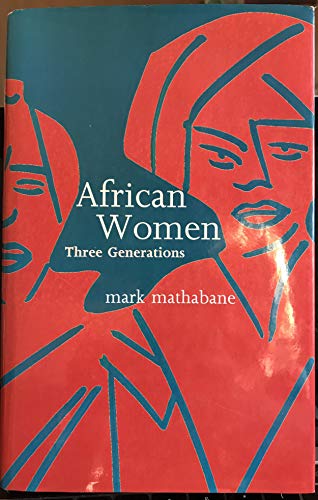
Synopsis
Mark Mathabane tells the stories of his sister Florah, mother Geli, and his grandmother. They have to cope with abuse, gambling, drunkenness, and infidelity from the men they love or have been forced to marry. All three women defy African tradition and the poverty and violence of life in a modern urban society, to make fulfilling lives for themselves and those they love within the context of South Africa's oppressive apartheid regime. The stories of Florah, Geli and Granny, are told in their own words, in alternating chapters that demonstrate how similiar are the problems faced by each generation - the need for an independent income to care for themselves and their children, the traditional assumption that women are property, commodities bought and sold by men, and the terrible hardship imposed not only on women but also on black men by the apartheid system. The story of these three courageous women is told with passion and sympathy, and conveys their honesty, faith, and even hopefulness in which they live.
"synopsis" may belong to another edition of this title.
From the Publisher
In this powerful and dramatic biography, Mark Mathabane weaves together the voices of his grandmother, mother, and sister to provide a rich, stirring look at three generations of black South African women.
From Kirkus Reviews
The South African-born Mathabane strains to tell the stories of his sister, mother, and grandmother, illuminating some lesser- known facets of black life under apartheid. Wanting to tell of the unsung struggles of black women in South Africa, Mathabane (co-author of Love in Black and White, 1991; Kaffir Boy in America, 1989; Kaffir Boy, 1986) probes his family in cycles of short chapters. Sister Florah found her marriage complicated by lobola, the traditional bride price. Mother Geli suffered through a marriage to an older man she didn't love. The author's Granny, abandoned in her village by her philandering, city-employed husband, bravely moved on her own to Johannesburg. All three women fought for safety, work, and housing, suffering the indignities of life in the squalid, dangerous black township of Alexandra. Whites are mostly absent from these stories, and the country's political upheavals intrude only occasionally. More important are township neighbors, the local church, and the persistence of traditional practices, including puberty rituals and a widespread belief in witchcraft, which the author warns readers not to deride. Though Mathabane claims to tell the women's stories ``in their own words,'' this is no oral history; his heavy authorial hand repeatedly intrudes, for instance, in putting phrases such as ``the perfect anodyne'' or ``Poverty, with its thousand terrors, returned'' in the mouth of his illiterate Granny. A worthy subject, but its treatment is marred by the author's suspect style. (25 b&w photographs--not seen) -- Copyright ©1994, Kirkus Associates, LP. All rights reserved.
"About this title" may belong to another edition of this title.
Search results for African Women: Three Generations

Stock Image
African Women: Three Generations
Seller: AwesomeBooks, Wallingford, United Kingdom
Seller rating 5 out of 5 stars

Hardcover. Condition: Very Good. African Women: Three Generations This book is in very good condition and will be shipped within 24 hours of ordering. The cover may have some limited signs of wear but the pages are clean, intact and the spine remains undamaged. This book has clearly been well maintained and looked after thus far. Money back guarantee if you are not satisfied. See all our books here, order more than 1 book and get discounted shipping. Seller Inventory # 7719-9780241135068
Buy Used
US$ 12.65
US$ 5.45 shipping
Ships from United Kingdom to U.S.A.
Ships from United Kingdom to U.S.A.
Quantity: 2 available
Stock Image
African Women: Three Generations
Seller: Bahamut Media, Reading, United Kingdom
Seller rating 4 out of 5 stars

Hardcover. Condition: Very Good. This book is in very good condition and will be shipped within 24 hours of ordering. The cover may have some limited signs of wear but the pages are clean, intact and the spine remains undamaged. This book has clearly been well maintained and looked after thus far. Money back guarantee if you are not satisfied. See all our books here, order more than 1 book and get discounted shipping. Seller Inventory # 6545-9780241135068
Buy Used
US$ 12.42
US$ 9.23 shipping
Ships from United Kingdom to U.S.A.
Ships from United Kingdom to U.S.A.
Quantity: 2 available
Seller Image
African Women: Three Generations
Seller: Diplomatist Books, Norwich, United Kingdom
Seller rating 4 out of 5 stars
Hardcover. Condition: Very Good. Dust Jacket Condition: Very Good. hb, d/w, 366pp, plates. Seller Inventory # 2110013
Buy Used
US$ 10.23
US$ 23.81 shipping
Ships from United Kingdom to U.S.A.
Ships from United Kingdom to U.S.A.
Quantity: 1 available
Stock Image
AFRICAN WOMEN Three Generations.
Published by
London: Hamish Hamilton, 1995
ISBN 10: 0241135060
ISBN 13: 9780241135068
Used
Hardcover
First Edition
Seller: Books On The Green, Lydd, KENT, United Kingdom
Seller rating 3 out of 5 stars

1st edition. Hardback in dustwrapper. Illustrated. Contents: pages very good and clean. Boards in very good, bright shape. Dustwrapper: very good and bright. A very good, tight copy. 366 pp. Seller Inventory # 22480
Buy Used
US$ 10.90
US$ 29.10 shipping
Ships from United Kingdom to U.S.A.
Ships from United Kingdom to U.S.A.
Quantity: 1 available
Stock Image
African Women : Three Generations
Published by
Hamish Hamilton, London, 1994
ISBN 10: 0241135060
ISBN 13: 9780241135068
Used
Hardcover
Seller: Scorpio Books, IOBA, Bungay, United Kingdom
Seller rating 5 out of 5 stars
Hardcover. Condition: Vg. Dust Jacket Condition: G. First Edition. 366pp. Plates. Wrapper has minimal shelfwear and is faded on spine. Size: 8vo. Seller Inventory # 011859
Buy Used
US$ 9.54
US$ 39.69 shipping
Ships from United Kingdom to U.S.A.
Ships from United Kingdom to U.S.A.
Quantity: 1 available
Seller Image
African Women; Three Generations.
Published by
Hamiish Hamilton Ltd, UK, 1995
ISBN 10: 0241135060
ISBN 13: 9780241135068
Used
Hardcover
First Edition
Seller: powellbooks Somerset UK., Ilminster, SOM, United Kingdom
Seller rating 3 out of 5 stars
Hardcover. Condition: Very Good. Dust Jacket Condition: Very Good. 1st Edition. In this book three generations of women speak about their lives, loves and struggle for economic independence in tribal South Africa. There is minor marking to the top of the text block but is otherwise tight and clean as are the boards and dust jacket. Book price includes 2nd class parcel post in UK only. Seller Inventory # 07818
Buy Used
US$ 29.98
US$ 43.65 shipping
Ships from United Kingdom to U.S.A.
Ships from United Kingdom to U.S.A.
Quantity: 1 available