
Items related to Little Labels--Big Sound: Small Record Companies and...
Synopsis
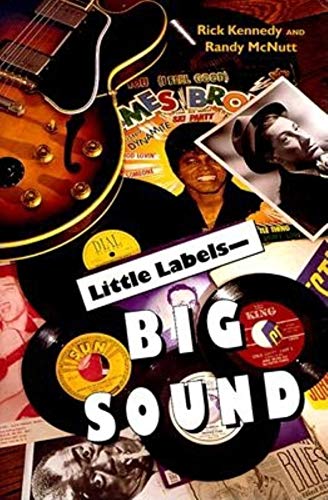
Little Labels -- Big Sound celebrates 10 legendary record labels, their founders and the artists they developed, people who created original and enduring music on the tide of social change. From the 1920s through the 1960s, scores of small, independent record companies nurtured distinctly American music: jazz, blues, gospel, country, rhythm and blues, and rock 'n' roll. These companies, run on shoestring budgets, were on the fringe of mainstream culture. Louis Armstrong, Hank Williams, James Brown, Roy Orbison, and other musicians brought regional American styles to a world audience and won enduring fame for themselves. But often forgotten are the colorful owners of small record labels who first recorded these musicians and helped to popularize their sound before the dominant, more bureaucratic competitors knew what had happened.
Rick Kennedy and Randy McNutt bring alive the glory days of the independent labels and their colorful founders, many of whom were interviewed for this book. Sometimes these men were visionaries. Ross Russell, a record-store owner in Los Angeles in the mid-1940s, risked his last dollar to create Dial Records because he was convinced that an obscure jazz saxophonist named Charlie Parker was creating a music revolution with his bebop jazz. Sam Phillips in Memphis had recorded white country and black R&B singers in the early 1950s, so he knew exactly what he was looking for when a shy, teenaged Elvis Presley walked into his storefront studio in 1954 and asked to make a record.
Other owners had little appreciation for the music but were street-smart entrepreneurs. The white-owned ""race"" labels of the 1920s, for example, recognized a black consumer market thatthe recording business had previously ignored. Operating out of such cities as Houston, Memphis, Cincinnati, and New Orleans, these savvy business people promoted regional sounds that were to reverberate around the world.
But influencing the development of music wasn't what these record-label owners had in mind; they were just trying to earn a living. Today, when most of the independent record labels have gone under or have been gobbled up by big conglomerates, the music they produced on primitive equipment remains fresh -- and bigger than life.
Little Labels -- Big Sound tells with verve and affection the story of the people and the small homegrown companies who gave America its beat.
"synopsis" may belong to another edition of this title.
About the Author
Rick Kennedy is a media relations manager with General Electric. He worked for a decade as a journalist, including several years as an entertainment critic when he interviewed numerous jazz giants from Count Basie to Dizzy Gillespie to Pat Metheny. Kennedy plays jazz piano and is the author of Jelly Roll, Bix, and Hoagy: Gennett Studios and the Birth of Recorded Jazz (Indiana University Press).
Randy McNutt is a longtime reporter with the Cincinnati Enquirer and the author of We Wanna Boogie: An Illustrated History of the American Rockabilly Movement and a book on Ohio ghost towns.
Reviews
Beginning with Henry Gennett, whose modest Midwestern record company, a piano dealership spinoff, helped launch the careers of jazz immortals King Oliver and Louis Armstrong, Kennedy (Jelly Roll, Bix, and Hoagy) and McNutt (We Wanna Boogie) tell how 10 independent record labels shaped the course of American popular music. Predictably, Sam Phillipss Sun Records, perhaps the most celebrated little label in music history, merits a chapter. More interesting, though, are profiles of less familiar independents such as Don Robeys gospel-oriented Peacock Records and John Vincents pioneering rhythm-and-blues label, Ace. The authors skillfully lay out the complex racial politics of their story, showing, for example, how a shared interest in profits and fresh sounds could bring together personalities as diverse as Soul Brother Number One, James Brown, and Syd Nathan, the feisty Jewish entrepreneur whose Cincinnati-based King Records made Brown a million-seller. The book includes scores of fascinating label-artist dramas, some well known (Dial and Charlie Parker; Riverside and Thelonious Monk), others long forgotten (Peacock and white soul singer Roy Head; Sun and rockabilly visionary Billy Lee Riley). An invaluable guide to the businesspeople, musicians and hangers-on who transformed regional musical styles into a national soundtrack, this book belongs on the same shelf as Peter Guralnicks Sweet Soul Music and Alan Lomaxs The Land Where the Blues Began. B&w photos.
Copyright 1999 Reed Business Information, Inc.
Built around the names, including Charlie Parker, James Brown and the ``King,'' that helped define 20th-century American music, a history of the independent record label in America. Kennedy (Jelly Roll, Bix and Hoagy, 1994) and McNutt (We Wanna Boogie: An Illustrated History of the American Rockabilly Movement, not reviewed) tell their tale of how the independent label and the music business as a whole have evolved by looking at ten storied labels, ranging from early jazz giant Paramount to the legendary Sun Records. The pair begin with 1920s start-up label Gennett Records, home to some of the earliest known jazz recordings and to a then unknown musician by the name of Louis Armstrong. The Gennett history, as is the case with each of the other nine stories, is brimming with fun, interesting tidbits, such as a detailed explanation of the genesis of Hoagy Carmichael's classic ``Stardust,'' originally named ``Star Dust.'' The two authors clearly know their music and the circumstances surrounding how that music was made, but the facts suffer at times from the dryness of the writing. In his preface, noted session man and current Berklee School of Music professor Al Kooper writes of the importance of passion and how that motivated the giants who started these labels. Kooper also speaks of how that passion has filtered into this volume; would that it were so. The fervor evident from their research doesn't filter into the writing, with the exception of the first-hand accounts that appear too infrequently. A retelling from Ace Records' John Vincent of how a conversation with Sam Phillips prompted him to go into the music industry has both the humor and excitement often lacking in the rest of the book. Still, those interested in the subject will find enough historical information to keep their attention until the end. -- Copyright ©1999, Kirkus Associates, LP. All rights reserved.
One of the enduring legends of the music business is the record company honcho, huge cigar clenched in his teeth, signing the naive country boy to a one-sided contract. The problem with this cliche is that usually a small, independent label has been the company out there beating the bushes for new talent and fresh trends. No label exemplifies this better than Chess Records. When Chess released a record in 1950 by an unknown (to white audiences anyway) blues singer named Muddy Waters, an empire was born, built on the foundation of blues and later rock'n'roll. Some of the greatest names in both genres recorded for Chess, from Howlin' Wolf to Chuck Berry to Bo Diddley to Buddy Guy. But along with the musical success came the almost inevitable charges of withholding royalties from artists. Freelancer Collis includes a liberal sprinkling of vintage photos to break up a sometimes overwhelming catalog of artists and hits. Chess was not the only trailblazing record label; in Little Labels?Big Sound we get a rundown of ten of the best, featuring such labels as Dial Records, instrumental in starting the bebop revolution with Charlie Parker, and Sun Records, which jump-started rock'n'roll by recording Elvis Presley, Jerry Lee Lewis, and Carl Perkins. Journalists Kennedy and McNutt have produced an extensively researched look at a time when primitive recording equipment was the standard and hunger for a quick buck was the rule. A guide to reissue anthologies for each of the labels covered is an added treat. Both books are recommended for music libraries.?Dan Bogey, Clearfield Cty. P.L. Federation, Curwensville, PA
Copyright 1999 Reed Business Information, Inc.
"About this title" may belong to another edition of this title.
Search results for Little Labels--Big Sound: Small Record Companies and...

Seller Image
Little Labels--Big Sound: Small Record Companies and the Rise of American Music
Published by
Indiana University Press, 1999
ISBN 10: 0253335485
ISBN 13: 9780253335487
Used
Hardcover
Seller: Gate City Books, GREENSBORO, NC, U.S.A.
Seller rating 5 out of 5 stars

Condition: good. USED book in GOOD condition. Great binding, pages and cover show normal signs of wear from use. Seller Inventory # GCM.3LMH
Stock Image
Little Labels, Big Sound: Small Record Companies and the Rise of American Music
Seller: Magers and Quinn Booksellers, Minneapolis, MN, U.S.A.
Seller rating 5 out of 5 stars
hardcover. Condition: Acceptable. May have underlining, highlighting, margin notes, remainder marks, inscriptions, book plates, tears, significant wear, and/or a missing dust jacket, box, or discs. Damaged item. Seller Inventory # 1535423
Stock Image
Little Labels--Big Sound: Small Record Companies and the Rise of American Music
Published by
Indiana University Press, 1999
ISBN 10: 0253335485
ISBN 13: 9780253335487
Used
Hardcover
Seller: Visible Voice Books, Cleveland, OH, U.S.A.
Seller rating 5 out of 5 stars
hardcover. Condition: Very Good. Indiana University Press May 1999 Jacketed, crisp, clean & tight. Seller Inventory # 196844
Stock Image
Little Labels--Big Sound: Small Record Companies and the Rise of American Music
Published by
Indiana University Press, 1999
ISBN 10: 0253335485
ISBN 13: 9780253335487
Used
Hardcover
Seller: HPB Inc., Dallas, TX, U.S.A.
Seller rating 5 out of 5 stars
hardcover. Condition: Very Good. Connecting readers with great books since 1972! Used books may not include companion materials, and may have some shelf wear or limited writing. We ship orders daily and Customer Service is our top priority! Seller Inventory # S_484028049
Stock Image
Little Labels -- Big Sound: Small Record Companies and the Rise of American Music
Published by
Indiana University Press, Bloomington, IN, 1999
ISBN 10: 0253335485
ISBN 13: 9780253335487
Used
Hardcover
First Edition
Seller: Lowry's Books, Three Rivers, MI, U.S.A.
Seller rating 4 out of 5 stars

Hardcover. Condition: Very Good. Dust Jacket Condition: Very Good. Photographs (illustrator). First Edition. Cover is in excellent condition. DJ is unclipped and in very good condition. Text is otherwise tight in binding. Text is clean and free of blemishes throughout. No other markings or indications of note. Size: 8vo - over 7¾" - 9¾" tall. Seller Inventory # 123259
Stock Image
Little Labels--Big Sound: Small Record Companies and the Rise of American Music
Published by
Indiana University Press, 1999
ISBN 10: 0253335485
ISBN 13: 9780253335487
New
Hardcover
First Edition
Seller: Neils Books, Moline, IL, U.S.A.
Seller rating 2 out of 5 stars

Hardcover. Condition: New. 1st Edition. Seller Inventory # 11011ab
Stock Image
Little Labels - Big Sound: Small Record Companies and the Rise of American Music
Published by
Indiana University Press, Bloomington, Indiana, 1999
ISBN 10: 0253335485
ISBN 13: 9780253335487
Used
Hardcover
Seller: Andover Books and Antiquities, Andover, MA, U.S.A.
Seller rating 2 out of 5 stars
Hardcover. Condition: Very good condition. Dust Jacket Condition: Very good. xxiii, 198 pp. LCC: 9849455. Seller Inventory # LN07170196