
Items related to Methods in Neuronal Modeling: From Synapses to Networks...
Synopsis
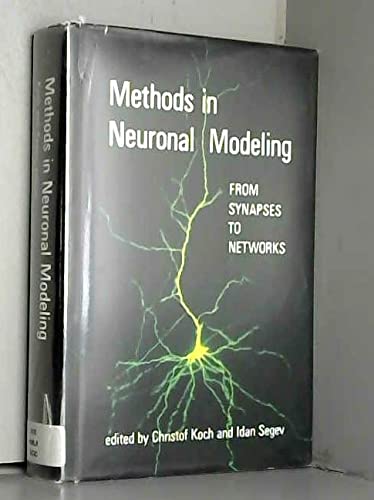
Methods in Neuronal Modeling is the first technical handbook on computational neuroscience. Written for researchers and theoreticians alike, it outlines methods and techniques used for simulating on digital computers the functional properties of single neurons from synapses, dendrites, single cells; and small invertebrate networks to large scale neural networks in the mammalian nervous system.
The use of new experimental tools such as selective staining methods, membrane patch electrodes, voltage and calcium-dependent dyes, and multielectrode recordings, together with the, advent of universally available powerful computing, makes it possible to construct detailed and realistic models of neuronal systems. Methods in Neuronal Modeling addresses such questions as what can and should be simulated and what techniques should be used; what experimental parameters are crucial for such simulations, and whether these models may be verified experimentally.
Chapters cover simulation of passive dendritic trees, compartmental models of single cells including neurons with a number of different ionic channels, calcium current dynamics, simulations of small invertebrate networks, simulations of the mammalian cortex, connectionists' models, and the use of parallel computers in modeling neural networks. Although the chapters were written by several authors, they are uniform in structure and notation. Detailed examples are given to clarify the different approaches. Each chapter concludes with a description of the model discussed and the details of its implementation on the computer.
Christof Koch is an Assistant Professor of Computation and Neural Systems at the California Institute of Technology. Idan Segev is a Lecturer in Neurobiology at the Institute of Life Science, Hebrew University of Jerusalem. Methods in Neuronal Modeling inaugurates the new series in Computational Neuroscience, edited by Terrence J. Sejnowski and Tomaso Poggio. A Bradford Book.
"synopsis" may belong to another edition of this title.
About the Author
Christof Koch is President and Chief Scientific Officer of the Allen Institute for Brain Science in Seattle. He is the author of The Quest for Consciousness and other books.
Review
An admirable concetration of expertise on statep-of-the-art neuronal modeling techniques―a must on the bookshelf of compuitational neuroscientists and theoretical neurobiologists.―Wollf Singer , M.D., Ph.D., Max-Planck-Institute for Brain Research (Endorsement)
Over the past three decades neuronal modeling has emerged as an essential tool in the experimental analysis of neurons adn neuronal circuits. The first edition of Methods in Neuronal Modeling helped to attract a new generation of neuroscientists to this enterprise. Rapid developments in experimental and modeling techniques have led to the need for this new edition. The extensive revisions bring the reader up to date and will make this an indispensible handbook for current and future workers. We may look forward to the day when the functions of the major types of neurons and their local circuits will be understood in terms of well-constrained computational models based on the techniques described in this book.―Gordon M. Shepard, Section of Neurobiology, Yale School of Medicine (Endorsement)
― (Endorsement)
"About this title" may belong to another edition of this title.
Search results for Methods in Neuronal Modeling: From Synapses to Networks...

Stock Image
Methods in Neuronal Modeling: From Synapses to Networks (Computational Neuroscience)
Seller: ThriftBooks-Dallas, Dallas, TX, U.S.A.
Seller rating 5 out of 5 stars

Hardcover. Condition: Good. No Jacket. Missing dust jacket; Pages can have notes/highlighting. Spine may show signs of wear. ~ ThriftBooks: Read More, Spend Less. Seller Inventory # G0262111330I3N01
Stock Image
Methods in Neuronal Modeling: From Synapses to Networks (Computational Neuroscience)
Seller: HPB-Emerald, Dallas, TX, U.S.A.
Seller rating 5 out of 5 stars
hardcover. Condition: Very Good. Connecting readers with great books since 1972! Used books may not include companion materials, and may have some shelf wear or limited writing. We ship orders daily and Customer Service is our top priority! Seller Inventory # S_470969445
Stock Image
Methods in Neuronal Modeling: From Synapses to Networks
Seller: Anybook.com, Lincoln, United Kingdom
Seller rating 5 out of 5 stars
Condition: Good. This is an ex-library book and may have the usual library/used-book markings inside.This book has hardback covers. Clean from markings. In good all round condition. No dust jacket. Please note the Image in this listing is a stock photo and may not match the covers of the actual item,1100grams, ISBN:0262111330. Seller Inventory # 9147092
Buy Used
US$ 25.83
US$ 17.60 shipping
Ships from United Kingdom to U.S.A.
Ships from United Kingdom to U.S.A.
Quantity: 1 available
Stock Image
Computational Neuroscience: Methods in Neuronal Modeling: From Synapses to Network
Seller: Anybook.com, Lincoln, United Kingdom
Seller rating 5 out of 5 stars
Condition: Fair. This is an ex-library book and may have the usual library/used-book markings inside.This book has hardback covers. Clean from markings. In fair condition, suitable as a study copy. No dust jacket. Please note the Image in this listing is a stock photo and may not match the covers of the actual item,1150grams, ISBN:0262111330. Seller Inventory # 9826342
Buy Used
US$ 27.62
US$ 17.60 shipping
Ships from United Kingdom to U.S.A.
Ships from United Kingdom to U.S.A.
Quantity: 1 available
Seller Image
Methods in Neuronal Modeling: From Synapses to Networks (Computational Neuroscience) | Christof Koch |
Seller: Versandantiquariat Claudia Graf, Lüdenscheid, Germany
Seller rating 5 out of 5 stars
*geb. Condition: Sehr gut. 538 Seiten, 743g - Einband und Innenteil sehr gut, Orig.-Schutzumschlag gering berieben u. stellenweise mit leichten Randknittern/-rissen (siehe meine Fotos) / sw. --- book itself very goog, duskjacket with few signs of use /// Klappentext: Methods in Neuronal Modeling is the first technical handbook on computational neuroscience. Written for researchers and theoreticians alike, it outlines methods and techniques used for simulating on digital computers the functional properties of single neurons from synapses, dendrites, single cells; and small invertebrate networks to large scale neural networks in the mammalian nervous system. The use of new experimental tools such as selective staining methods, membrane patch electrodes, voltage and calcium-dependent dyes, and multielectrode recordings, together with the, advent of universally available powerful computing, makes it possible to construct detailed and realistic models of neuronal systems. Methods in Neuronal Modeling addresses such questions as what can and should be simulated and what techniques should be used; what experimental parameters are crucial for such simulations, and whether these models may be verified experimentally. Chapters cover simulation of passive dendritic trees, compartmental models of single cells including neurons with a number of different ionic channels, calcium current dynamics, simulations of small invertebrate networks, simulations of the mammalian cortex, connectionists' models, and the use of parallel computers in modeling neural networks. Although the chapters were written by several authors, they are uniform in structure and notation. Detailed examples are given to clarify the different approaches. Each chapter concludes with a description of the model discussed and the details of its implementation on the computer. Christof Koch is an Assistant Professor of Computation and Neural Systems at the California Institute of Technology. Idan Segev is a Lecturer in Neurobiology at the Institute of Life Science, Hebrew University of Jerusalem. Methods in Neuronal Modeling inaugurates the new series in Computational Neuroscience, edited by Terrence J. Sejnowski and Tomaso Poggio. A Bradford Book. Sprache: Englisch Gewicht in Gramm: 743. Seller Inventory # 49469
Buy Used
US$ 28.88
US$ 44.87 shipping
Ships from Germany to U.S.A.
Ships from Germany to U.S.A.
Quantity: 1 available
Seller Image
Methods in Neuronal Modeling: From Synapses to Networks (Computational Neuroscience Series)
Published by
A Bradford Book, 1989
ISBN 10: 0262111330
ISBN 13: 9780262111331
Used
Hardcover
First Edition
Seller: Arroyo Seco Books, Pasadena, Member IOBA, Pasadena, CA, U.S.A.
Seller rating 4 out of 5 stars

Hardcover. Condition: Fine. Dust Jacket Condition: Fine. 1st Edition. Xii,524 Pp. Cloth. First Printing. Fine In Fine Dust Jacket. Seller Inventory # 050763