
Items related to Robo sapiens: Evolution of a New Species
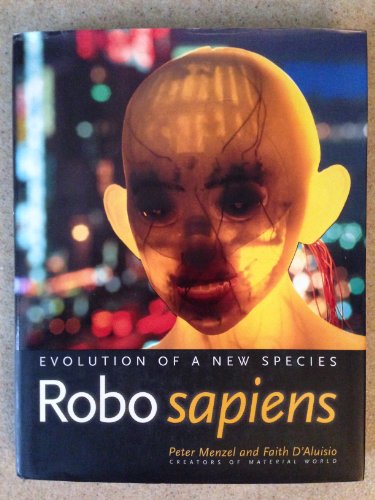
Synopsis
A field guide to our mechanical future, presenting the next generation of intelligent robots and their makers.
Around the world, scientists and engineers are participating in a high-stakes race to build the first intelligent robot. Many robots already exist--automobile factories are full of them. But the new generation of robots will be something else: smart machines that act like living creatures. When they are brought into existence, science fiction will have become fact.
What will happen then? With our prosthetic limbs, titanium hips, and artificial eyes, we are already beginning to resemble our machines. Equally important, our machines are beginning to resemble us. Robots already walk, talk, and dance; they can react to our facial expressions and obey verbal commands. When they take the next step and become fully autonomous, what will they do? Will we be partners or rivals? Could we meld into a single species--Robo sapiens?
In Robo sapiens, Peter Menzel and Faith D'Aluisio present the next generation of intelligent robots and their makers. Accompanying brilliant photographs of more than one hundred robots is an account of the little-known, yet vitally important scientific competition to build an autonomous robot. Containing extensive interviews with robotics pioneers, anecdotal field notes with behind-the-scenes information, and easy-to-understand technical data about the machines, Robo sapiens is a field guide to our mechanical future.
"synopsis" may belong to another edition of this title.
About the Author
Peter Menzel is a photographer known for his coverage of international feature stories on science and the environment. His award-winning photographs have been published in Life, National Geographic, Smithsonian, the New York Times Magazine, Time, Stern, GEO, and Le Figaro. Together with Faith D'Aluisio, he is the co-creator of the books Material World: A Global Family Portrait and Women in the Material World; and is the co-author of Man Eating Bugs: The Art and Science of Eating Insects.
From the Back Cover
Around the world, scientists and engineers are participating in a high-stakes race to build the first intelligent robot. Many robots already exist -- automobile factories are full of them. But the new generation of robots will be something else: smart machines that act like living creatures. When they are brought into existence, science fiction will have become fact.
What will happen then? With our prosthetic limbs, titanium hips, and artificial eyes, we are already beginning to resemble our machines. Equally important, our machines are beginning to resemble us. Robots already walk, talk, and dance; they can react to our facial expressions and obey verbal commands. When they take the next step and become fully autonomous, what will they do? Will we be partners or rivals? Could we meld into a single species -- Robo sapiens?
In Robo sapiens, Peter Menzel and Faith D'Aluisio present the next generation of intelligent robots and their makers. Accompanying brilliant photographs of more than one hundred robots is an account of the little-known, yet vitally important scientific competition to build an autonomous robot. Containing extensive interviews with robotics pioneers, anecdotal "field notes" with behind-the-scenes information, and easy-to-understand technical data about the machines, Robo sapiens is a field guide to our mechanical future.
Peter Menzel, recipient of the 2000 World Press Award for his robot reportage, is a photojournalist specializing in international coverage of science and the environment. Faith D'Aluisio is a former television news producer whose documentary and news series have won many regional and national prizes. Menzel and D'Aluisio photographed, wrote, andproduced the award-winning books Material World: A Global Family Portrait, Women in the Material World, and Man Eating Bugs.
From the Inside Flap
Around the world, scientists and engineers are participating in a high-stakes race to build the first intelligent robot. Many robots already exist -- automobile factories are full of them. But the new generation of robots will be something else: smart machines that act ever more like living creatures.
What will happen then? With our prosthetic limbs, titanium hips, and artificial eyes, we are already beginning to resemble our machines. And when we implant chips in our bodies to connect ourselves directly to computers, the likeness will become only more pronounced. Science fiction will have become science fact.
Meanwhile -- and equally important -- our machines are beginning to resemble us. Robotic spiders, crabs, geckos, and dogs are already spilling from the laboratories. The next steps are to re-create Homo sapiens itself and then go beyond. Robots can already walk, talk, and dance; they can react to human facial expressions and obey verbal commands. When scientists go on to create fully autonomous robots with greater intelligence than human beings, will they be our partners or our rivals? Will it be simply a robotic revolution or a true extension of evolution? Could machines and humankind meld into a single species -- Robo sapiens?
In Robo sapiens, award-winning journalists Peter Menzel and Faith D'Aluisio present the next generation of intelligent robots and their makers. Accompanying brilliant photographs of more than a hundred robots are extensive interviews with robotics pioneers, anecdotal field notes with behind-the-scenes information, and easy-to-understand technical data about the machines. Robo sapiens is a field guide to our mechanical future.
Reviews
"Today's robots... are explorers, space laborers, surgeons, maids, actors, pets." What do they look like? How do they work? And what's next? Tech photographer Menzel and journalist D'Aluisio worked together on Material World and Man Eating Bugs. Their latest collaboration joins terrific photos of robotsA176 color pictures of themAto short essays, sidebars and interviews explaining what each robot can do, how it works and what problems it was designed to solve. Several researchers tell D'Aluisio that true artificial intelligence (AI) is coming soonAa couple even believe that smart machines will someday wipe out humans. But this volume doesn't really add up to an argument about our mechanoid future: instead, it's an informativeAand handsomeAview of some current work in robotics, from out-there AI research to practical (and profitable) surgical technology. Menzel and D'Aluisio divide the machines they chronicle into six groups: the first two sets try to copy human abilities, while other sorts of 'bots function more like machines in industry or in science education. Many gizmos have special abilities of obvious, even lifesaving, practical use: "Ariel the crab-robot... walks pretty well underwater"; eventually, it will detect and clear mines. "Rosie," a remote boom crane robot, can help control damage from a reactor meltdown. Other constructions simulate human and animal actions, like running and walkingAa field called "biomimicry." More impressive yet are robots designed to investigate psychology and cognition; some of these are learningAand teaching their creatorsAwhat it means to be human. MIT researcher Cynthia Breazel introduces us to Kismet, a Kermit-the-Frog-esque 'droid whose big-eyed, goofy "facial expressions" (in her words) "tune the human's behavior so that it is appropriate for the robotAnot too much, not too little, just right."
Copyright 2000 Reed Business Information, Inc.
Computers are the most important thing to come along since ...." It would be interesting to ask people from over the past 30 years to complete the preceding sentence. In the 1970s most people might finish the sentence with "television" or "the automobile" or even "atomic energy." In the 1990s the ante was raised, and I imagine that the average person would complete the sentence with "the industrial revolution" or even "the invention of writing." Now, as the 21st century dawns, some would say: "Computers are the most important thing to come along since the rise of humankind on Earth." Even this last comparison may be conservative. Computer hardware power is doubling every two years or so. If that trend continues, then in another 20 years, our machines will be more powerful than many estimates of human brainpower. These supermachines might come about in several ways. In their book Robo sapiens, Peter Menzel and Faith D'Aluisio examine one of the most significant and plausible possibilities. The prospect of their title is explained on the very first page of the introduction: "Robo sapiens: ... A hybrid species of human and robot with intelligence vastly superior to that of purely biological mankind; began to emerge in the twenty-first century." After their excellent introductory comments, the authors indulge in little speculation. Instead they show us the current state of the art. Photographer Menzel and journalist D'Aluisio traveled to dozens of research sites around the world and conducted what must be hundreds of interviews. They have organized their work into 53 short chapters. Each consists of one or more interviews, photos of the robots, and sidebars giving project specifications and background information. Project by project, they build the overview for us. We see the opinions that researchers have of the field and of one another's work. We see the conflicts that exist among different research approaches. No consensus has been reached as to the path to success or what may be possible. We are in the midst of an intellectual turmoil, driven by human genius and the steadily increasing power of our computer hardware. The breadth of research projects is enormous. We are introduced to autonomous devices and teloperated ones, uncrewed rovers and robotic aircraft and pipeline crawlers. Pets and companions, prosthetics and hands-at-a-distance, housekeepers and welders, weapons and guardians-someone somewhere has found money (military, commercial, medical) to work on these possibilities. Many researchers are trying to build machines by imitating life-and some bioscientists are using robot models to improve their understanding of life. It is very difficult to write clearly and simply about such things and still remain faithful to the underlying technology. Menzel and D'Aluisio accomplish this feat. The interviews and sidebars are consistently intriguing but also show great effort in avoiding the misinterpretations that could come from comparing so many different research enterprises. (Considering the range of research studied, an appendix categorizing the different projects would have been helpful.) Many of the robots are mechanically complex. Often they are unlike anything we have seen before. Imagine that you had never seen a horse: you would need clear and objective pictures to get a good idea of the creature's appearance. Similarly, Menzel's color photos are essential to understanding the projects described. The photos are beautiful and, for the most part, extremely effective. In a few cases, however, the higher-level goals of the photography make the details of the machines unclear-for example, the motion-blurring effect used in picturing the M.I.T. Spring flamingo robot on page nine or the Honda P3 robot on page 34 [see opposite page]. The chapters related to robotic pets and artificial affect are especially fascinating. Setting aside issues of intelligence and mobility, when you pat your dog on the head and look into its eyes, you can see that someone is home. Very few of us would say any such thing about a machine. What's missing from the machine? Perhaps it's simply that our instincts say "warm, soft, responsive creature with large dark eyes" = "living being with a soul." Commercial products such as Sony's AIBO and (soon) Hasbro/iRobot's My Real Baby are early attempts to address this issue. Will people be attracted, repelled or simply bored by such creations? The arrival of Robo sapiens is not assured. Maybe we have not yet stumbled on some basic impossibility. Or maybe our researchers are ignoring some critical technique: to one degree or another, almost everyone interviewed is working from the bottom up, imitating the lower levels of animal capability with a view toward later building the higher functions. The alternative, top-down approach would seek to model the highest functions of thought first, perhaps in a supercomputer or computer network-and then, with luck, the hands and legs and wheels would be easy add-ons. For the past 10 or 15 years, the top-down approach has been in eclipse. A theme builds through the interviews: living creatures are superior in almost every way to existing machines. Even some of the superiorities that we typically grant machines over animals-durability, speed, strength-do not hold in a natural environment. Similarly, real-time computations that involve reasoning with the chaos of the material world are also beyond the computers we have now. But remember, computer power is doubling about every two years. What we see now in robotics and AI research is still the historic beginning. Menzel and D'Aluisio have given us a richly detailed picture of this tumult as it is at the end of the 20th century. Their book provides a baseline for comparison with projects in the years ahead. What develops in the next 10 years should yield strong evidence about where things are going. If we get effective household robots, if we get vehicles that can navigate real terrain autonomously, if we get lovable robotic pets ... then we are on track to create something very like Robo sapiens.
VERNOR VINGE taught mathematics and computer science at San Diego State University from 1972 to 2000. He is also a science fiction writer; his most recent novel is A Deepness in the Sky (Tor Books, 1999).
Robo sapiens will be a new generation of robotsDthe first intelligent robots: smart machines that act like living creatures. The authors of such award-winning works of photojournalism as Material World: A Global Family Portrait and Women in the Material World, photojournalist Menzel and D'Alusio, a former TV documentary producer, here collect interviews, essays, illustrations, and numerous photographs of all aspects of current research and actual production locations using robots, some of which approach the "intelligent" level. The coverage includes more than 100 different researchers and developers with their robots. Although the actual color photographs were not included, a sample indicates that Menzel's background as a photojournalist stood him in good stead. The interviews are interesting, and the range of applications areas is fascinating; from medicine to housecleaning, from game playing to dancing robots, there is something for everyone in this collection. While some of the resource and source material appendixes were unavailable at the time of review, the authors appear to try to provide enough information so that readers interested in following up a certain avenue will be able to do so. For most sci/tech collections.DHilary Burton, Lawrence Livermore National Lab., CA
Copyright 2000 Reed Business Information, Inc.
"About this title" may belong to another edition of this title.
Search results for Robo sapiens: Evolution of a New Species

Stock Image
Robo sapiens: Evolution of a New Species
Seller: World of Books (was SecondSale), Montgomery, IL, U.S.A.
Seller rating 5 out of 5 stars

Condition: Very Good. Item in very good condition! Textbooks may not include supplemental items i.e. CDs, access codes etc. Seller Inventory # 00097827334
Stock Image
Robo sapiens: Evolution of a New Species
Seller: More Than Words, Waltham, MA, U.S.A.
Seller rating 5 out of 5 stars
Condition: Good. A sound copy with only light wear. Overall a solid copy at a great price! Seller Inventory # BOS-U-09d-01524
Seller Image
Robo sapiens: Evolution of a New Species
Seller: Greenworld Books, Arlington, TX, U.S.A.
Seller rating 5 out of 5 stars
Condition: very_good. Fast Free Shipping â" Very Good condition book with a firm cover and clean pages. Shows normal use and some light wear or limited notes markings. A solid, nice copy to enjoy. Seller Inventory # GWV.0262133822.VG
Stock Image
Robo sapiens: Evolution of a New Species
Seller: HPB-Ruby, Dallas, TX, U.S.A.
Seller rating 5 out of 5 stars
hardcover. Condition: Very Good. Connecting readers with great books since 1972! Used books may not include companion materials, and may have some shelf wear or limited writing. We ship orders daily and Customer Service is our top priority! Seller Inventory # S_475491502
Stock Image
Robo sapiens: Evolution of a New Species
Seller: HPB-Emerald, Dallas, TX, U.S.A.
Seller rating 5 out of 5 stars
hardcover. Condition: Very Good. Connecting readers with great books since 1972! Used books may not include companion materials, and may have some shelf wear or limited writing. We ship orders daily and Customer Service is our top priority! Seller Inventory # S_463341548
Stock Image
Robo sapiens: Evolution of a New Species
Seller: HPB-Diamond, Dallas, TX, U.S.A.
Seller rating 5 out of 5 stars
hardcover. Condition: Very Good. Connecting readers with great books since 1972! Used books may not include companion materials, and may have some shelf wear or limited writing. We ship orders daily and Customer Service is our top priority! Seller Inventory # S_470628587
Stock Image
Robo Sapiens: Evolution of a New Species
Seller: ThriftBooks-Reno, Reno, NV, U.S.A.
Seller rating 5 out of 5 stars
Hardcover. Condition: Very Good. No Jacket. May have limited writing in cover pages. Pages are unmarked. ~ ThriftBooks: Read More, Spend Less. Seller Inventory # G0262133822I4N00
Stock Image
Robo Sapiens: Evolution of a New Species
Seller: ThriftBooks-Atlanta, AUSTELL, GA, U.S.A.
Seller rating 5 out of 5 stars
Hardcover. Condition: Very Good. No Jacket. Missing dust jacket; May have limited writing in cover pages. Pages are unmarked. ~ ThriftBooks: Read More, Spend Less. Seller Inventory # G0262133822I4N01
Stock Image
Robo Sapiens: Evolution of a New Species
Seller: ThriftBooks-Atlanta, AUSTELL, GA, U.S.A.
Seller rating 5 out of 5 stars
Hardcover. Condition: Very Good. No Jacket. May have limited writing in cover pages. Pages are unmarked. ~ ThriftBooks: Read More, Spend Less. Seller Inventory # G0262133822I4N00
Stock Image
Robo Sapiens: Evolution of a New Species
Seller: ThriftBooks-Dallas, Dallas, TX, U.S.A.
Seller rating 5 out of 5 stars
Hardcover. Condition: Very Good. No Jacket. May have limited writing in cover pages. Pages are unmarked. ~ ThriftBooks: Read More, Spend Less. Seller Inventory # G0262133822I4N00