
Items related to The Invisible Computer: Why Good Products Can Fail,...
The Invisible Computer: Why Good Products Can Fail, the Personal Computer Is So Complex, and Information Appliances Are the Solution - Hardcover
Synopsis
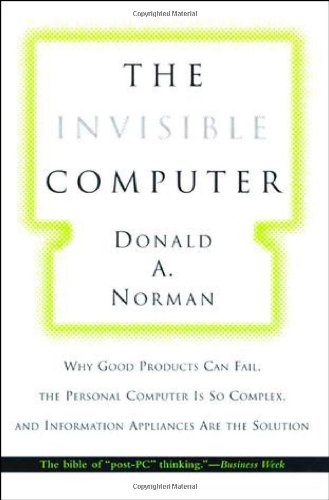
The author of The Design of Everyday Things calls for the redesign of personal computers and other "information appliances" to place users' needs before the complexity of the technology and for a human-centered development process. UP.
"synopsis" may belong to another edition of this title.
About the Author
Business Week has named Don Norman as one of the world's most influential designers. He has been both a professor and an executive: he was Vice President of Advanced Technology at Apple; his company, the Nielsen Norman Group, helps companies produce human-centered products and services; he has been on the faculty at Harvard, the University of California, San Diego, Northwestern University, and KAIST, in South Korea. He is the author of many books, including The Design of Everyday Things, The Invisible Computer (MIT Press, 1998), Emotional Design, and The Design of Future Things.
Reviews
Norman's thesis is that a number of modern products, most notably personal computers, come with a technological overload that makes them hard to use. He pictures a "vast chasm" that separates the early users of a device, who will put up with complex technology in order to reap the benefits offered, from later users, who want reliability and simplicity. "Alas, the aging teenagers who rule the computer companies of the world are still stuck on the youthful side of the chasm," he says. Norman maintains that personal computers and other technologically daunting devices should be as easy to use as such "information appliances" as watches, telephones, digital cameras, and compact-disc and tape players.
The personal computer industry is still in its "rebellious adolescent stage," says Norman, who asserts that it is time for it to "grow up" and "enter the... world of consumer appliances"Aconvenient, versatile, pleasurable tools with potential to communicate with each other in a global information matrix. Norman (The Design of Everyday Things; Things That Make Us Smart), an established voice in the field, explains why and offers prescriptions for how such changes are to come about, together with specific ideas about what kinds of information devices might emerge. He synthesizes wisdom from the history of technology, industrial social sciences, product design and marketing to support his vision of information appliances. The key reform he advocates is human-centered product design emphasizing user experience in addition to technology and marketing considerations. Norman's provocative analysis is laced with analogies and anecdotes, and is augmented by 128 illustrations. Though all the subtitle's claims are addressed in distinct chapters, some portions seem superfluous. Because "usability often lies in the details," the argument can occasionally get bogged down in minutiae or broad-stroke summaries of motion study and other historical innovations. Stylistic glitches aside, however, Norman offers an enlightening and pragmatic account of the interrelated currents and riptides affecting product development in the computer/information industry. Readers who digest this analysis will be well rewarded.
Copyright 1998 Reed Business Information, Inc.
The more things that computers do, the more complicated they invariably become to use. Norman contends that the personal computer is nearing the end of its life cycle, to be replaced by intuitive, task-focused "information appliances."
Copyright 1999 Reed Business Information, Inc.
So what good is your personal computer if it's too complex for you to operate, or if the software and hardware aren't completely compatible, or worse yet, if the model you bought is not the industry standard. Products through history have been developed with these problems, including Edison's phonograph. Apparently, the great inventor felt people would listen to the best quality music available, but the public wanted to hear the stars, and RCA Victor and other companies bested Edison, despite his superior product. Similarly, Norman says the makers of PCs think they can continue to tinker and experiment while the public demands convenience and simplicity of use. The author, a Hewlett-Packard executive, is convinced that the company that strips back and starts over with a more streamlined, horizontal organization dedicated to simplicity of use will succeed if it employs a "user-first, technology-last" approach. The likelihood of this actually happening is questionable, but Norman writes in a relatively easy-to-read style for a techno-author. Joe Collins
"About this title" may belong to another edition of this title.
Search results for The Invisible Computer: Why Good Products Can Fail,...

Stock Image
The Invisible Computer: Why Good Products Can Fail, the Personal Computer Is So Complex, and Information Appliances Are the Solution
Seller: World of Books (was SecondSale), Montgomery, IL, U.S.A.
Seller rating 5 out of 5 stars

Hardback. Condition: Good. From Science Finds, Industry Applies, Man Conforms (motto of the 1933 Chicago USA World's Fair)--to People Propose, Science Studies, Technology Conforms (Donald Norman's person-centered motto for the twenty-first centuray).Technologies have a life cycle, says Donald Norman, and companies and their products must change as they pass from youth to maturity. Alas, the computer industry thinks it is still in its rebellious teenage years, exulting in technical complexity. Customers want change. They are ready for products that offer convenience, ease of use, and pleasure. The technology should be invisible, hidden from sight.In this book, Norman shows why the computer is so difficult to use and why this complexity is fundamental to its nature. The only answer, says Norman, is to start over again, to develop information appliances that fit people's needs and lives. To do this companies must change the way they develop products. They need to start with an understanding of people: user needs first, technology last--the opposite of how things are done now. Seller Inventory # 00105187498
Stock Image
The Invisible Computer: Why Good Products Can Fail, the Personal Computer Is So Complex, and Information Appliances Are the Solution
Seller: World of Books (was SecondSale), Montgomery, IL, U.S.A.
Seller rating 5 out of 5 stars
Hardback. Condition: Very Good. From Science Finds, Industry Applies, Man Conforms (motto of the 1933 Chicago USA World's Fair)--to People Propose, Science Studies, Technology Conforms (Donald Norman's person-centered motto for the twenty-first centuray).Technologies have a life cycle, says Donald Norman, and companies and their products must change as they pass from youth to maturity. Alas, the computer industry thinks it is still in its rebellious teenage years, exulting in technical complexity. Customers want change. They are ready for products that offer convenience, ease of use, and pleasure. The technology should be invisible, hidden from sight.In this book, Norman shows why the computer is so difficult to use and why this complexity is fundamental to its nature. The only answer, says Norman, is to start over again, to develop information appliances that fit people's needs and lives. To do this companies must change the way they develop products. They need to start with an understanding of people: user needs first, technology last--the opposite of how things are done now. Seller Inventory # 00102299458
Stock Image
The Invisible Computer: Why Good Products Can Fail, the Personal Computer Is So Complex, and Information Appliances Are the Solution
Seller: Gulf Coast Books, Cypress, TX, U.S.A.
Seller rating 5 out of 5 stars
hardcover. Condition: Fair. Seller Inventory # 0262140659-4-26325960
Stock Image
The Invisible Computer: Why Good Products Can Fail, the Personal Computer Is So Complex, and Information Appliances Are the Solution
Published by
Mit Pr (edition First Edition), 1998
ISBN 10: 0262140659
ISBN 13: 9780262140652
Used
Hardcover
First Edition
Seller: BooksRun, Philadelphia, PA, U.S.A.
Seller rating 5 out of 5 stars
Hardcover. Condition: Very Good. First Edition. With dust jacket. It's a well-cared-for item that has seen limited use. The item may show minor signs of wear. All the text is legible, with all pages included. It may have slight markings and/or highlighting. Seller Inventory # 0262140659-11-1-29
Stock Image
The Invisible Computer: Why Good Products Can Fail, the Personal Computer Is So Complex, and Information Appliances Are the Solution
Seller: World of Books Inc, Montgomery, IL, U.S.A.
Seller rating 4 out of 5 stars

Hardback. Condition: Very Good. From Science Finds, Industry Applies, Man Conforms (motto of the 1933 Chicago USA World's Fair)--to People Propose, Science Studies, Technology Conforms (Donald Norman's person-centered motto for the twenty-first centuray).Technologies have a life cycle, says Donald Norman, and companies and their products must change as they pass from youth to maturity. Alas, the computer industry thinks it is still in its rebellious teenage years, exulting in technical complexity. Customers want change. They are ready for products that offer convenience, ease of use, and pleasure. The technology should be invisible, hidden from sight.In this book, Norman shows why the computer is so difficult to use and why this complexity is fundamental to its nature. The only answer, says Norman, is to start over again, to develop information appliances that fit people's needs and lives. To do this companies must change the way they develop products. They need to start with an understanding of people: user needs first, technology last--the opposite of how things are done now. Seller Inventory # CIN0262140659VG
Stock Image
The Invisible Computer: Why Good Products Can Fail, the Personal Computer Is So Complex, and Information Appliances Are the Solution
Seller: World of Books Inc, Montgomery, IL, U.S.A.
Seller rating 4 out of 5 stars
Hardback. Condition: Good. From Science Finds, Industry Applies, Man Conforms (motto of the 1933 Chicago USA World's Fair)--to People Propose, Science Studies, Technology Conforms (Donald Norman's person-centered motto for the twenty-first centuray).Technologies have a life cycle, says Donald Norman, and companies and their products must change as they pass from youth to maturity. Alas, the computer industry thinks it is still in its rebellious teenage years, exulting in technical complexity. Customers want change. They are ready for products that offer convenience, ease of use, and pleasure. The technology should be invisible, hidden from sight.In this book, Norman shows why the computer is so difficult to use and why this complexity is fundamental to its nature. The only answer, says Norman, is to start over again, to develop information appliances that fit people's needs and lives. To do this companies must change the way they develop products. They need to start with an understanding of people: user needs first, technology last--the opposite of how things are done now. Seller Inventory # CIN0262140659G
Stock Image
The Invisible Computer: Why Good Products Can Fail, the Personal Computer Is So Complex, and Information Appliances Are the Solution
Seller: HPB-Movies, Dallas, TX, U.S.A.
Seller rating 4 out of 5 stars
hardcover. Condition: Very Good. Connecting readers with great books since 1972! Used books may not include companion materials, and may have some shelf wear or limited writing. We ship orders daily and Customer Service is our top priority! Seller Inventory # S_474186824
Stock Image
The Invisible Computer : Why Good Products Can Fail, the Personal Computer Is So Complex, and Information Appliances Are the Solution
Seller: Better World Books, Mishawaka, IN, U.S.A.
Seller rating 5 out of 5 stars
Condition: Very Good. Pages intact with possible writing/highlighting. Binding strong with minor wear. Dust jackets/supplements may not be included. Stock photo provided. Product includes identifying sticker. Better World Books: Buy Books. Do Good. Seller Inventory # 13736651-6
Stock Image
The Invisible Computer
Seller: Sleepy Hollow Books, Huntington, VT, U.S.A.
Seller rating 5 out of 5 stars
Hardcover. vg/vg, lightly rubbed dj. Business; 16327. Seller Inventory # 16327
Seller Image
The Invisible Computer: Why Good Products Can Fail, the Personal Computer Is So Complex, and Information Appliances Are the Solution
Seller: -OnTimeBooks-, Phoenix, AZ, U.S.A.
Seller rating 5 out of 5 stars
Condition: good. A copy that has been read, remains in good condition. All pages are intact, and the cover is intact. The spine and cover show signs of wear. Pages can include notes and highlighting and show signs of wear, and the copy can include "From the library of" labels or previous owner inscriptions. 100% GUARANTEE! Shipped with delivery confirmation, if you're not satisfied with purchase please return item! Ships via media mail. Seller Inventory # OTV.0262140659.G