
Items related to Faithful Persuasion: In Aid of a Rhetoric of Christian...
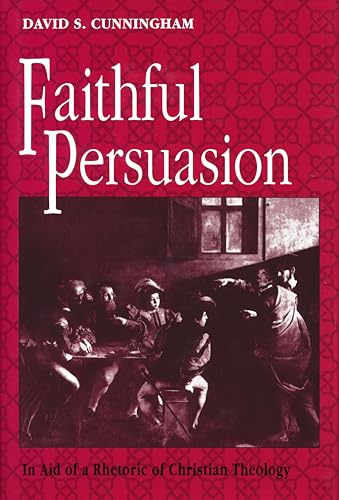
Synopsis
In Faithful Persuasion David S. Cunningham offers the contemporary era's first sustained account of the relationship between rhetoric and Christian theology. Cunningham argues that Christian thinkers should abandon their attempts to codify argumentation within the canons of formal logic and suggests that they should instead come to a more organic understanding of the process of persuasion. This rhetorical approach to theology can cast new light on longstanding theological controversies and establish a new agenda for the study of the methods, sources, and norms of Christian theology.
Drawing chiefly upon the rhetorical insights of Aristotle, and on the reappropriation of Aristotle’s views by numerous modern rhetoricians―ranging from John Henry Newman to Kenneth Burke and Chaim Perelman―Cunningham establishes a firm foundation from which to support his central assertion that ‘Christian theology can best be understood as a form of persuasive argument.’ In addition, he explores the implications of a rhetorical method for studies in doctrinal formulation, biblical exegesis, and church history.
Written for theologians, clergy members, and laypeople with a strong interest in theology, this book will introduce readers to the richness of the rhetorical tradition and its important implications for the discipline of Christian theology.
"synopsis" may belong to another edition of this title.
About the Author
David S. Cunningham is Assistant Professor of Theology at the University of St. Thomas, St. Paul MN. He has published numerous articles and reviews for a variety of theological journals.
From the Back Cover
Over the past twenty years, scholars in a wide variety of academic disciplines have been giving increasing attention to rhetoric - the study of persuasive argument. In Faithful Persuasion David S. Cunningham offers the contemporary era's first sustained account of the relationship between rhetoric and Christian theology. Cunningham argues that Christian thinkers should abandon their attempts to codify argumentation within the canons of formal logic and suggests that they should instead come to a more organic understanding of the process of persuasion. This rhetorical approach to theology can cast new light on longstanding theological controversies and establish a new agenda for the study of the methods, sources, and norms of Christian theology. Drawing chiefly upon the rhetorical insights of Aristotle, and on the reappropriation of Aristotle's views by numerous modern rhetoricians - ranging from John Henry Newman to Kenneth Burke and Chaim Perelman - Cunningham establishes a firm foundation from which to support his central assertion that "Christian theology can best be understood as a form of persuasive argument". In addition, he explores the implications of a rhetorical method for studies in doctrinal formulation, biblical exegesis, and church history. Written for theologians, clergy members, and laypeople with a strong interest in theology, this book will introduce readers to the richness of the rhetorical tradition and its important implications for the discipline of Christian theology.
"About this title" may belong to another edition of this title.
Search results for Faithful Persuasion: In Aid of a Rhetoric of Christian...

Stock Image
Faithful Persuasion: In Aid of a Rhetoric of Christian Theology
Published by
University of Notre Dame Press, 1991
ISBN 10: 0268009848
ISBN 13: 9780268009847
Used
Hardcover
Seller: World of Books (was SecondSale), Montgomery, IL, U.S.A.
Seller rating 5 out of 5 stars

Hardback. Condition: Very Good. In Faithful Persuasion David S. Cunningham offers the contemporary era's first sustained account of the relationship between rhetoric and Christian theology. Cunningham argues that Christian thinkers should abandon their attempts to codify argumentation within the canons of formal logic and suggests that they should instead come to a more organic understanding of the process of persuasion. This rhetorical approach to theology can cast new light on longstanding theological controversies and establish a new agenda for the study of the methods, sources, and norms of Christian theology. Drawing chiefly upon the rhetorical insights of Aristotle, and on the reappropriation of Aristotle's views by numerous modern rhetoricians--ranging from John Henry Newman to Kenneth Burke and Chaim Perelman--Cunningham establishes a firm foundation from which to support his central assertion that 'Christian theology can best be understood as a form of persuasive argument.' In addition, he explores the implications of a rhetorical method for studies in doctrinal formulation, biblical exegesis, and church history. Written for theologians, clergy members, and laypeople with a strong interest in theology, this book will introduce readers to the richness of the rhetorical tradition and its important implications for the discipline of Christian theology. Seller Inventory # 00073921988
Stock Image
Faithful Persuasion : In Aid of a Rhetoric of Christian Theology
Published by
University of Notre Dame Press, 1991
ISBN 10: 0268009848
ISBN 13: 9780268009847
Used
Hardcover
Seller: Better World Books: West, Reno, NV, U.S.A.
Seller rating 5 out of 5 stars
Condition: Very Good. Former library copy. Pages intact with possible writing/highlighting. Binding strong with minor wear. Dust jackets/supplements may not be included. Includes library markings. Stock photo provided. Product includes identifying sticker. Better World Books: Buy Books. Do Good. Seller Inventory # 50535324-75
Stock Image
Faithful Persuasion : In Aid of a Rhetoric of Christian Theology
Published by
University of Notre Dame Press, 1991
ISBN 10: 0268009848
ISBN 13: 9780268009847
Used
Hardcover
Seller: Better World Books, Mishawaka, IN, U.S.A.
Seller rating 5 out of 5 stars
Condition: Good. Former library copy. Pages intact with minimal writing/highlighting. The binding may be loose and creased. Dust jackets/supplements are not included. Includes library markings. Stock photo provided. Product includes identifying sticker. Better World Books: Buy Books. Do Good. Seller Inventory # 2249880-6
Stock Image
Faithful Persuasion : In Aid of a Rhetoric of Christian Theology
Published by
University of Notre Dame Press, 1991
ISBN 10: 0268009848
ISBN 13: 9780268009847
Used
Hardcover
Seller: Better World Books: West, Reno, NV, U.S.A.
Seller rating 5 out of 5 stars
Condition: Good. Former library copy. Pages intact with minimal writing/highlighting. The binding may be loose and creased. Dust jackets/supplements are not included. Includes library markings. Stock photo provided. Product includes identifying sticker. Better World Books: Buy Books. Do Good. Seller Inventory # 2249880-6
Stock Image
Faithful Persuasion: In Aid of a Rhetoric of Christian Theology
Published by
University of Notre Dame Press, 1991
ISBN 10: 0268009848
ISBN 13: 9780268009847
Used
Hardcover
Seller: ThriftBooks-Atlanta, AUSTELL, GA, U.S.A.
Seller rating 5 out of 5 stars
Hardcover. Condition: Very Good. No Jacket. May have limited writing in cover pages. Pages are unmarked. ~ ThriftBooks: Read More, Spend Less. Seller Inventory # G0268009848I4N00
Stock Image
Faithful Persuasion: In Aid of a Rhetoric of Christian Theology
Published by
University of Notre Dame Press, 1991
ISBN 10: 0268009848
ISBN 13: 9780268009847
Used
Hardcover
Seller: Half Price Books Inc., Dallas, TX, U.S.A.
Seller rating 5 out of 5 stars
Hardcover. Condition: Very Good. Connecting readers with great books since 1972! Used books may not include companion materials, and may have some shelf wear or limited writing. We ship orders daily and Customer Service is our top priority! Seller Inventory # S_484697874
Stock Image
Faithful Persuasion: In Aid of a Rhetoric of Christian Theology
Published by
University of Notre Dame Press, 1991
ISBN 10: 0268009848
ISBN 13: 9780268009847
Used
Hardcover
Seller: World of Books Inc, Montgomery, IL, U.S.A.
Seller rating 4 out of 5 stars

Hardback. Condition: Very Good. In Faithful Persuasion David S. Cunningham offers the contemporary era's first sustained account of the relationship between rhetoric and Christian theology. Cunningham argues that Christian thinkers should abandon their attempts to codify argumentation within the canons of formal logic and suggests that they should instead come to a more organic understanding of the process of persuasion. This rhetorical approach to theology can cast new light on longstanding theological controversies and establish a new agenda for the study of the methods, sources, and norms of Christian theology. Drawing chiefly upon the rhetorical insights of Aristotle, and on the reappropriation of Aristotle's views by numerous modern rhetoricians--ranging from John Henry Newman to Kenneth Burke and Chaim Perelman--Cunningham establishes a firm foundation from which to support his central assertion that 'Christian theology can best be understood as a form of persuasive argument.' In addition, he explores the implications of a rhetorical method for studies in doctrinal formulation, biblical exegesis, and church history. Written for theologians, clergy members, and laypeople with a strong interest in theology, this book will introduce readers to the richness of the rhetorical tradition and its important implications for the discipline of Christian theology. Seller Inventory # CIN0268009848VG
Seller Image
Faithful Persuasion: In Aid of a Rhetoric of Christian Theology
Published by
University of Notre Dame Press, 1991
ISBN 10: 0268009848
ISBN 13: 9780268009847
Used
Hardcover
First Edition
Seller: Regent College Bookstore, Vancouver, BC, Canada
Seller rating 5 out of 5 stars
Hardcover. Condition: Good. 1st Edition. 312 pp. DJ is good though shows slight wear. Hardcover is good though slightly dirtied along the upper edge. Binding is tight, text block is unmarked. Seller Inventory # ABE-1669248821419
Stock Image
Faithful Persuasion: In Aid of a Rhetoric of Christian Theology
Published by
University of Notre Dame Press, Notre Dame, Indiana, 1991
ISBN 10: 0268009848
ISBN 13: 9780268009847
Used
Paperback
Seller: Lowry's Books, Three Rivers, MI, U.S.A.
Seller rating 4 out of 5 stars
Paperback. Condition: Good. No Jacket. This paperback has some rubbing of the covers and light edge wear. Light sticker residue on both covers, no creasing. Interior text is clean and tight in it's binding. No ownership or other markings. A good, clean copy. Size: 8vo - over 7¾" - 9¾" tall. Seller Inventory # 041363
Stock Image
Faithful Persuasion: In Aid of a Rhetoric of Christian Theology
Published by
University of Notre Dame Press July 1992, 1992
ISBN 10: 0268009848
ISBN 13: 9780268009847
New
Hardcover
Seller: Eighth Day Books, LLC, Wichita, KS, U.S.A.
Seller rating 4 out of 5 stars
Hardcover. Condition: New. David Cunningham believes Christianity places itself at a disadvantage. Though much of Christian theological discourse speaks from an obviously confrontational posture, few of its theologians are willing to admit that theology is comprised of arguments. Far from absolute, Christian theology is, in the words of Cunningham (brace yourself here), ''a fragile and uncertain endeavor. Its claims can only be tentative, and the truth of its assertions are known only to God.'' Theology speaks about what seems to be true, and Cunningham believes it does this best by following the negative way. Just as we can act on what cannot be fully known, so can we speak. Cunningham seeks to reintroduce rhetoric to Christian theology, reminding us that the New Testament, patristic and Reformation eras all employed skill in rhetoric to great effect. He divides his book into five sections -- theoria, pathos, ethos, logos and praxis -- skillfully developing his own argument that we must recover a sense of our audience, the character with which we should speak and the word itself to be spoken. Cunningham concludes with a return to via negativa, reminding us that ''the theological task is a yearning for truth,'' but not truth itself. All statements must be submitted to the mystery of the triune God as we simultaneously seek to faithfully persuade others to worship Father, Son and Holy Spirit. Seller Inventory # 20070707116417