
Synopsis
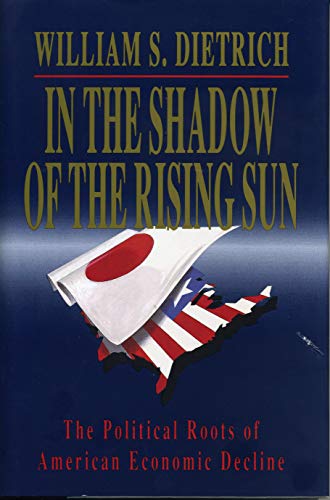
Why is the United States unable to compete effectively with Japan? What explains the inability of American political leaders to devise an industrial policy capable of focusing the energies of American business on the task of meeting the Japanese challenge? How can America emerge from the shadow of the Rising Sun? This book addresses these questions and proposes a controversial decision.
To get at the political roots of American economic decline, businessman-scholar William Dietrich puts the disciplined thinking of political philosophy, comparative politics, and international political economy to effective use in analyzing the source and nature of American institutional weakness.
Unlike many who have written on U.S.-Japanese relations, Dietrich does not seek a solution a particular new policy or institutional innovation, such as an American counterpart to Japan's MITI. Rather, he emphasizes the systemic nature of America's problems. The failures of management, finance, and politics are interlocking and reinforcing, he shows, and thus a change in the others that spell doom for any partial approach.
Most fundamental, however, are the political weaknesses of the system. It is in the basic political inheritance of America, reflected in the very design of the Constitution and the long dominance of Jeffersonian individualism over Hamiltonian statism, that we must locate the roots of American impotence in the face of Japan's challenge.
As the problem is systemic, so must the solution be equally wide-ranging. Nothing short of "fundamental institutional reform," Dietrich argues, will succeed in reversing America's downward course.
Boasts about the victory of free-market capitalism in the wake of the collapse of the Communist state-directed system are premature and distract attention form the necessary recognition that it is the Japanese combination of the free market with a strong central state and a highly skilled professional bureaucracy that has really proved triumphant in our modern age of advanced technology. Only if we fully understand the reasons for Japanese success and American decline can we begin the arduous but crucial task of reconstructing the American polity to give it the power required to formulate and implement a national industrial policy that can regain for the United States its preeminent place among the world's industrial powers.
The alternative, Dietrich describes in a chilling scenario, is a "Pax Nipponica" that will find America playing second fiddle to Japan with economic, cultural, and political consequences that will make Britain's eclipse by the United States earlier in this century seem mild by comparison.
"synopsis" may belong to another edition of this title.
About the Author
William S. Dietrich is President of Dietrich Industries, a steel processor and building products manufacturer based in Pittsburgh. A graduate of Princeton, he received a PhD in Political Science from the University of Pittsburgh in 1984. His combination of business experience and academic expertise makes him unusually well qualified to address the complex practical and theoretical issues he tackles in this book.
Reviews
As good and thoughtful a case as has been made for a US industrial policy--defined by businessman Dietrich as the state's purposeful allocation of resources to high-tech enterprises with the capacity to add substantive value. In his evenhanded, well-reasoned appraisal of America's inability to compete on equal terms with Japan in a host of basic and emergent fields, Dietrich (helmsman of a steel-processing and building-products firm in Pittsburgh) parts company with most latter-day Jeremiahs. Instead of amassing anecdotal evidence attesting to Japan's widening edge, he accepts the situation as a given and focuses on explaining its origins in cultural terms, comparing America's antistatist traditions as a constitutional democracy to the feudal heritage of an island nation that has an essentially homogeneous population and virtually no ethnic or regional strife. And Japan, Dietrich points out, also has cadres of able civil servants who are above politics and dedicated to advancing the country's interest. The author shows how these professionals (who command the greatest respect) employ a variety of public and private means to the end of making Japan the world's ranking economic power. By contrast, he observes, career bureaucrats in the US have precious little prestige, let alone authority; nor are political appointees able to accomplish much during their typically brief tenures. Unfortunately, Dietrich concludes, America can no longer afford its instinctive commitment to free markets and free trade, much less unfettered individualism. Indeed, he argues, the US should take its economic conflicts with Japan at least as seriously as the erstwhile cold war with the Soviet bloc. If it fails to meet this challenge, the nation risks losing significant measures of autonomy not only to Japan but also to other East Asian and European countries that have embraced the statist approach. Although less than hopeful about any immediate or meaningful change, Dietrich proposes systemic reforms that would commit the US to a coherent as well as comprehensive economic strategy. A no-nonsense audit that puts a consequential dilemma in disturbing perspective. -- Copyright ©1991, Kirkus Associates, LP. All rights reserved.
Dietrich suggests that the U.S. economy urgently needs a new industrial policy to survive Japan's challenge. Faced with systemic managerial, financial, and political shortcomings, America must think the unthinkable and develop a program based upon a strong central state and a top professional bureaucracy. Such a policy would be insulated from transitory political shifts and would involve a "state-induced willful shifting of the industrial structure toward high-technology, high-value-added industries." This very interesting book deserves a thoughtful read by government and industry leaders alike. For larger public and academic economic collections.
- Kenneth J. Cook, Melbourne, Fla.
Copyright 1991 Reed Business Information, Inc.
"About this title" may belong to another edition of this title.
Other Popular Editions of the Same Title

Search results for In the Shadow of the Rising Sun: The Political Roots...

Stock Image
In the Shadow of the Rising Sun : The Political Roots of American Economic Decline
Published by
Pennsylvania State University Press, 1991
ISBN 10: 0271007656
ISBN 13: 9780271007656
Used
Hardcover
Seller: Better World Books, Mishawaka, IN, U.S.A.
Seller rating 5 out of 5 stars

Condition: Very Good. Pages intact with possible writing/highlighting. Binding strong with minor wear. Dust jackets/supplements may not be included. Stock photo provided. Product includes identifying sticker. Better World Books: Buy Books. Do Good. Seller Inventory # 8111218-6
Stock Image
In the Shadow of the Rising Sun : The Political Roots of American Economic Decline
Published by
Pennsylvania State University Press, 1991
ISBN 10: 0271007656
ISBN 13: 9780271007656
Used
Hardcover
Seller: Better World Books, Mishawaka, IN, U.S.A.
Seller rating 5 out of 5 stars
Condition: Very Good. Former library copy. Pages intact with possible writing/highlighting. Binding strong with minor wear. Dust jackets/supplements may not be included. Includes library markings. Stock photo provided. Product includes identifying sticker. Better World Books: Buy Books. Do Good. Seller Inventory # 41224231-6
Stock Image
In the Shadow of the Rising Sun: The Political Roots of American Economic Decline
Published by
Penn State University Press, 1991
ISBN 10: 0271007656
ISBN 13: 9780271007656
Used
Hardcover
Seller: Wonder Book, Frederick, MD, U.S.A.
Seller rating 5 out of 5 stars
Condition: Very Good. Very Good condition. Very Good dust jacket. A copy that may have a few cosmetic defects. May also contain light spine creasing or a few markings such as an owner's name, short gifter's inscription or light stamp. Seller Inventory # G05B-02905
Stock Image
In the Shadow of the Rising Sun: The Political Roots of American Economic Decline
Published by
Penn State University Press, 1991
ISBN 10: 0271007656
ISBN 13: 9780271007656
Used
Hardcover
Seller: ThriftBooks-Atlanta, AUSTELL, GA, U.S.A.
Seller rating 5 out of 5 stars
Hardcover. Condition: As New. No Jacket. Pages are clean and are not marred by notes or folds of any kind. ~ ThriftBooks: Read More, Spend Less. Seller Inventory # G0271007656I2N00
Stock Image
In the Shadow of the Rising Sun: The Political Roots of American Economic Decline
Published by
Penn State University Press, 1991
ISBN 10: 0271007656
ISBN 13: 9780271007656
Used
Hardcover
Seller: ThriftBooks-Atlanta, AUSTELL, GA, U.S.A.
Seller rating 5 out of 5 stars
Hardcover. Condition: Very Good. No Jacket. May have limited writing in cover pages. Pages are unmarked. ~ ThriftBooks: Read More, Spend Less. Seller Inventory # G0271007656I4N00
Stock Image
In the Shadow of the Rising Sun: The Political Roots of American Economic Decline
Published by
Penn State University Press, 1991
ISBN 10: 0271007656
ISBN 13: 9780271007656
Used
Hardcover
Seller: Open Books, Chicago, IL, U.S.A.
Seller rating 5 out of 5 stars
hardcover. Condition: Very Good. Open Books is a nonprofit social venture that provides literacy experiences for thousands of readers each year through inspiring programs and creative capitalization of books. Seller Inventory # mon0000778434
Stock Image
IN THE SHADOW OF THE RISING SUN
Published by
The Pennsylvania State University Press, University Park, PA, 1991
ISBN 10: 0271007656
ISBN 13: 9780271007656
Used
Hardcover
First Edition
Seller: Russ States, Oil City, PA, U.S.A.
Seller rating 5 out of 5 stars
Cloth. Condition: Fine. Dust Jacket Condition: Fine. First Edition. (1991), 343pp, light rubbing to dj. Seller Inventory # 09-1676
Stock Image
In the Shadow of the Rising Sun: The Political Roots of American Economic Decline
Published by
Penn State University Press, 1991
ISBN 10: 0271007656
ISBN 13: 9780271007656
Used
Hardcover
Seller: Midtown Scholar Bookstore, Harrisburg, PA, U.S.A.
Seller rating 5 out of 5 stars
Hardcover. Condition: Very Good. crisp clean w/light shelfwear/edgewear - may have remainder mark Standard-sized. Seller Inventory # 0271007656-01
Stock Image
In the Shadow of the Rising Sun: The Political Roots of American Economic Decline
Published by
Penn State University Press, 1991
ISBN 10: 0271007656
ISBN 13: 9780271007656
Used
Hardcover
Seller: Midtown Scholar Bookstore, Harrisburg, PA, U.S.A.
Seller rating 5 out of 5 stars
Hardcover. Condition: Good. some shelfwear but still NICE! - may have remainder mark or previous owner's name Standard-sized. Seller Inventory # 0271007656-02
Stock Image
In the Shadow of the Rising Sun: The Political Roots of American Economic Decline
Published by
Pennsylvania State University Press, University Park, PA, 1991
ISBN 10: 0271007656
ISBN 13: 9780271007656
Used
Hardcover
Seller: Persephone's Books, Gastonia, NC, U.S.A.
Seller rating 5 out of 5 stars
Cloth. Condition: Fine. Dust Jacket Condition: Fine. xvi, 343 pp. Seller Inventory # 077676