
Items related to What Drives Financial Markets
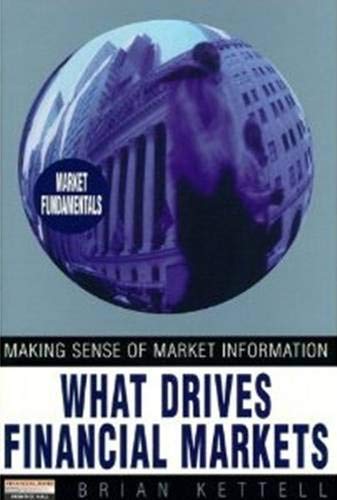
Synopsis
Concentrates on an understanding of the economics that underlie this quest for value.
"synopsis" may belong to another edition of this title.
About the Author
Brian Kettell, MSc, BSc.Econ has many years experience working in financial markets and banking. A graduate of the London School of Economics, he has worked for Citibank, American Express, Arab Banking Corporation (Vice President) and Shearson Lehman (Vice President). This experience has since been applied in providing training courses on international financial markets. He has delivered training courses on the markets for a variety of organizations including: Chase Manhattan Bank, Nomura, Morgan Stanley, Kleinwort Benson, Banque Indosuez and The Euromoney Institute of Finance. He is now Senior Lecturer at London University and a visiting Professor of Finance at several French Business Schools. He has published widely, over 80 articles, in numerous journals including Central Banking, The Banker and The Securities Journal. His previous books include The International Debt Game (with George Magnus, Chief Economist, Warburg Dillion Read), Businessman's Guide to the Foreign Exchange Market, Monetary Economics, The Finance of International Business, Gold and The Foreign Exchange Handbook (with Steve Bell, Chief Economist, Deutsche Bank). In addition he has published a large number of case studies on financial markets.
From the Back Cover
When analysts, dealers and investors are subject to information overload, how can they realistically isolate and interpret the relevant market signals needed to build a coherent financial strategy?
Given the reality of increased market volatility it is increasingly important to understand which are the most influential economic and psychological indicators and how, in turn, they impact on the prices of financial assets.
What Drives Financial Markets contains an accessible set of rules by which financial analysts, dealers and investors can observe and respond to new economic indicators. This book illustrates the interaction between fiscal, psychological, political and economic factors that drives financial markets, highlighting the key role of market sentiment. Emphasis is placed on interpreting relevant signals in order to be ale to act swiftly and profitably.
The book defines the four criteria on which to judge the value of an indicator: relevance, timely release, availability and stability. It also gives clear analysis of how the business cycle affects financial markets, as well as discussing the influence exerted by such institutions as the US Federal Reserve. Readers will understand and analyze the driving forces and impact of economic changes, identify long-term trends as opposed to short term volatility, and make appropriate investment decisions.
Excerpt. © Reprinted by permission. All rights reserved.
Introduction
To say that the global financial markets were subject to information overload would be a major understatement. Indeed the news and data streaming endlessly from computer terminals providing the information that lubricates the workings of the financial world appear limitless. The four main information vendors had total sales of $4.4 billion in 1997.
The sheer volume of words and numbers is amazing. Reuters alone prints out the equivalent of 27,000 pages of data each second. A bond trader with a Bloomberg machine and a Bridge screen on one side, a Dow Jones screen on the other side, and a pair of Reuters terminals in front, plus a television set, an 80 button phone and a computer with company electronic mail on has a problem. How can traders distill this quantity of information into a coherent strategy from which they can endeavor to make money? The aim of writing this book is to provide answers to this problem.
In interpreting these data traders have to know which information they need to follow and which they can reliably ignore. Which indicators are worth paying attention to and which are not? How do the indicators relate to each other in order to build up a meaningful picture of the economy? How can you interpret this stream of information in order to make sensible investment decisions in the financial markets? These are the basic questions that this book addresses.
Many of the factors affecting financial markets are driven by the actions of the US Federal Reserve, the subject of a companion book Fed-Watching. Due to the fact that the behavior of financial markets and the actions of the Fed are inextricably connected readers should be aware that Chapters 3 and 4 of this book are also reproduced in Fed-Watching.
"About this title" may belong to another edition of this title.
Search results for What Drives Financial Markets

Stock Image
What Drives Financial Markets : Making Sense of Financial Market Forces
Published by
Pearson Education, Limited, 1999
ISBN 10: 0273630709
ISBN 13: 9780273630708
Used
Softcover
Seller: Better World Books, Mishawaka, IN, U.S.A.
Seller rating 5 out of 5 stars

Condition: Good. Pages intact with minimal writing/highlighting. The binding may be loose and creased. Dust jackets/supplements are not included. Stock photo provided. Product includes identifying sticker. Better World Books: Buy Books. Do Good. Seller Inventory # 10042691-75
Seller Image
What Drives Financial Markets: Making Sense of Financial Forces (Financial Times Series)
Seller: Book Broker, Berlin, Germany
Seller rating 5 out of 5 stars
Condition: Sehr gut. 01. 254 S. Alle Bücher & Medienartikel von Book Broker sind stets in gutem & sehr gutem gebrauchsfähigen Zustand. Dieser Artikel weist folgende Merkmale auf: Helle/saubere Seiten in fester Bindung. Leichte Gebrauchsspuren. Sprache: Englisch Gewicht in Gramm: 470 Taschenbuch, Maße: 15.24 cm x 2.54 cm x 22.86 cm. Seller Inventory # 661025730
Buy Used
US$ 29.44
US$ 38.99 shipping
Ships from Germany to U.S.A.
Ships from Germany to U.S.A.
Quantity: 1 available