
Items related to Constructive Thinking: The Key to Emotional Intelligence
Synopsis
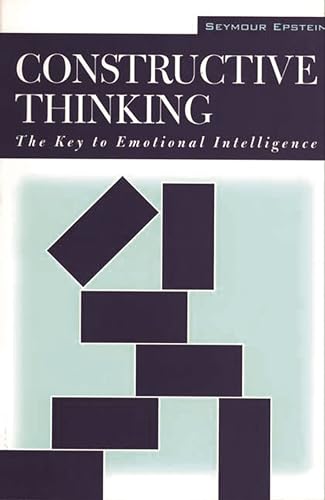
This is a book on how to gain control of one's emotions. It is a serious book that contains a theory of automatic processing it presents and its implications for controlling emotions. Epstein is a professor of personality psychology and a highly regarded research psychologist who has supported his theory with extensive research published in the most demanding professional journals. He was motivated to write the book by the success of a course he taught based on his theory. Students reported obtaining an understanding and control of their emotions that they never thought possible and that they said changed the course of their lives.
According to the theory, people operate by two minds, a rational-analytical mind and an intuitive-experiential mind, the latter being intimately associated with emotions. Each mind operates by its own principles and each has its own form of intelligence. The intelligence of the rational-analytical mind is measured by IQ tests and the intelligence of the intuitive-experiential mind (which is related to emotional intelligence) by the Constructive Thinking Inventory (CTI), a test developed by Epstein that is included in the book. By understanding the principles of operation of the intuitive-experiential mind, it is possible to train it as well as to learn from it, and thereby to improve one's emotional intelligence. The book provides exercises for applying the principles in everyday life and a review of a variety of other procedures for improving emotional intelligence. It is suited for use as a primary or supplementary text in courses on improving emotional intelligence or coping with stress as well as for individual reading.
"synopsis" may belong to another edition of this title.
About the Author
SEYMOUR EPSTEIN is Professor Emeritus of Psychology at the University of Massachusetts, Amherst. A noted authority on personality, he has received continuous research support from the National Institute of Mental Health for over 40 years and has received their coveted Merit Award. He has published extensively, including an earlier trade-oriented version of this book entitled You're Smarter Than You Think (1993).
Excerpt. © Reprinted by permission. All rights reserved.
Excerpts from Chapter I, "A Tale of Two Tales":
As a first step toward understanding the difference between emotional and intellectual intelligence, consider the following two perspectives on the meaning of life. As you read each passage, try to answer the following questions: How intellectually intelligent is the protagonist? How emotionally intelligent is he? On what basis did you distinguish between emotional and intellectual intelligence?
The first passage is from "My Confession" by Leo Tolstoi, the great Russian novelist, who describes his thoughts during a period of depression.
"When I thought of the fame which my works had gained me, I used to say to myself, 'Well, what if I should be more famous than Gogol, Pushkin, Shakespeare, Moliere...well, what then?...Such questions demand an answer, and an immediate one; without one it is impossible to live, but answer there was none... If I wished for something, I knew beforehand, that were I to satisfy the wish, nothing would come of it, I should still be dissatisfied...I knew not what I wanted...
"Such was the condition I had come to, at the time when all the circumstances of my life were pre-eminently happy ones, and when I had not yet reached my fiftieth year. I had a good, a loving, and a well-beloved wife, good children, a fine estate, which, without much trouble on my part, continually increased my income; I was more than ever respected by my friends and acquaintances; I was praised by strangers, and could lay cliam to having made my name famous...
"I could not attribute reasonable motive to any single act, much less to my whole life. I was only astonished that this had not occurred to me before from premises which had so long been known. Illness and death would come..., if not today, then tomorow, to those whom I loved, to myself, and nothing would remain but stench and worms. All my acts, whatever I did, would sooner or later be forgotten, and I myself be nowhere. Why, then, busy one's self with anything? How could men see this and live? It is possible to live only as long as life intoxicates us; as soon as we are sober again we see that it is all a delusion and a stupid one."
Now consider the following tale:
A Buddhist monk, being hotly purused by a vicious tiger, fell off a cliff. By good fortune, he landed on a ledge. He could see the tiger waiting hungrily above him, but even if the tiger departed, he knew that the slope was too steep for him to climb. Since there was no escape from above and a sheer drop below, he realized his fate was sealed. No sooner did he have this thought, then the ledge that was supporting him began to develop cracks in it, and it was apparent that it would shortly fall away and hurtle him to his death. As he looked about, he spied a strawberry plant growing out of a crevice in the rock. He plucked a berry from it, ate it very slowly to savor its taste, and thought, "How delicious!"...
Given the awareness of the limited time we all have to live on earth, it is equally logical to conclude that life is futile, and there is no point therefore in living, as to conclude that one might as well make the best of what time one has. Although the two conclusions are equally logical, one is more constructive in the sense that it leads to a more satisfactory way of leading one's life. Does this mean that one should always think positively? Not necessarily, for thinking positively in some circumstances, such as in the face of danger, can lead to disaster. Thinking constructively is not the same as thinking positively. I have much more to say about constructive thinking later in this book. For now, I only wish to emphasize that specific kinds of thoughts precede and determine emotions, that these thoughts occur automatically, that they vary in constructiveness, and that constructive thinking underlies emotional intelligence. If you automatically think constructively, you will exhibit emotional intelligence, and if you don't, you won't...
In this chapter I tried to give you an intuitive feeling for the difference between intellectual and emotional intelligence and for the preconscious thoughts that underlie the latter. In the next, I discuss intellectual and emotional intelligence in greater detail and consider what each is and is not and what would have to be accomplished in the measurement of emoional intelligence to establish it as a scientifically viable concept comparable to intellectual intelligence.
"About this title" may belong to another edition of this title.
Search results for Constructive Thinking: The Key to Emotional Intelligence

Stock Image
Constructive Thinking: The Key to Emotional Intelligence
Seller: ThriftBooks-Dallas, Dallas, TX, U.S.A.
Seller rating 5 out of 5 stars

Paperback. Condition: Fair. No Jacket. Readable copy. Pages may have considerable notes/highlighting. ~ ThriftBooks: Read More, Spend Less. Seller Inventory # G027595885XI5N00
Seller Image
Constructive Thinking: The Key to Emotional Intelligence
Seller: Goodwill of Greater Milwaukee and Chicago, Racine, WI, U.S.A.
Seller rating 5 out of 5 stars
Condition: acceptable. Book is considered to be in acceptable condition. The actual cover image may not match the stock photo. Book may have one or more of the following defects: noticeable wear on the cover dust jacket or spine; curved, dog eared or creased page s ; writing or highlighting inside or on the edges; sticker s or other adhesive on cover; CD DVD may not be included; and book may be a former library copy. Seller Inventory # SEWV.027595885X.A
Seller Image
Constructive Thinking: The Key to Emotional Intelligence
Seller: MERS Goodwill, Saint Louis, MO, U.S.A.
Seller rating 5 out of 5 stars
Condition: acceptable. Used - Acceptable: All pages and the cover are intact, but shrink wrap, dust covers, or boxed set case may be missing. Pages may include limited notes, highlighting, or minor water damage but the text is readable. Pages may include limited notes and highlighting, but the text cannot be obscured or unreadable. Any access codes or passwords originally included with the book may be expired, used or no longer valid. Image is stock photo and cover art edition may be different than pictured. Seller Inventory # MERV.027595885X.A
Seller Image
Constructive Thinking: The Key to Emotional Intelligence
Seller: Bookbot, Prague, Czech Republic
Seller rating 5 out of 5 stars
Softcover. Condition: Fine. Leichte Gebrauchsspuren; Leichte Verformung / umgeknickte Seiten. This book explores how to gain control over emotions through a theory of automatic processing and its implications. The author, a respected professor of personality psychology, has backed his theory with extensive research published in leading professional journals. Inspired by the success of a course he taught, where students reported transformative insights into their emotional control, he aims to share this knowledge widely. The theory posits that individuals operate with two minds: a rational-analytical mind and an intuitive-experiential mind, the latter closely linked to emotions. Each mind functions under distinct principles and possesses its own intelligence. The rational-analytical mind's intelligence is assessed through IQ tests, while the intuitive-experiential mind's intelligence, related to emotional intelligence, is measured by the Constructive Thinking Inventory (CTI), developed by the author and included in the book. By understanding how the intuitive-experiential mind operates, individuals can train and learn from it, thereby enhancing their emotional intelligence. The book offers practical exercises for applying these principles in daily life and reviews various methods for improving emotional intelligence. It serves as a valuable resource for courses on emotional intelligence and stress management, as well as for individual readers seeking personal growth. Seller Inventory # 65c9438e-898f-4c48-8260-e88f106873f6
Buy Used
US$ 7.16
US$ 23.62 shipping
Ships from Czech Republic to U.S.A.
Ships from Czech Republic to U.S.A.
Quantity: 1 available
Seller Image
Constructive Thinking: The Key to Emotional Intelligence
Published by
Praeger, Westport CT, USA, 1993
ISBN 10: 027595885X
ISBN 13: 9780275958855
Used
Softcover
Seller: Versandantiquariat R. Bandick, Hameln, Germany
Seller rating 5 out of 5 stars
Softcover. Condition: Sehr gut. "Epstein pvovides techniques for gaining control of emotions and putting them to positive use while also developing the theoretical insights behind such control.". Seller Inventory # 000485
Buy Used
US$ 13.91
US$ 22.50 shipping
Ships from Germany to U.S.A.
Ships from Germany to U.S.A.
Quantity: 1 available
Seller Image
Constructive Thinking : The Key to Emotional Intelligence
Seller: GreatBookPrices, Columbia, MD, U.S.A.
Seller rating 5 out of 5 stars
Condition: As New. Unread book in perfect condition. Seller Inventory # 483423
Seller Image
Constructive Thinking : The Key to Emotional Intelligence
Seller: GreatBookPrices, Columbia, MD, U.S.A.
Seller rating 5 out of 5 stars
Condition: New. Seller Inventory # 483423-n
Stock Image
Constructive Thinking: The Key To Emotional Intelligence
Seller: Chiron Media, Wallingford, United Kingdom
Seller rating 5 out of 5 stars
Paperback. Condition: New. Brand new book, sourced directly from publisher. Dispatch time is 6-7 days from our warehouse. Book will be sent in robust, secure packaging to ensure it reaches you securely. Seller Inventory # 6666-IUK-9780275958855
Buy New
US$ 52.30
US$ 6.61 shipping
Ships from United Kingdom to U.S.A.
Ships from United Kingdom to U.S.A.
Quantity: Over 20 available
Stock Image
Constructive Thinking
Print on DemandSeller: PBShop.store US, Wood Dale, IL, U.S.A.
Seller rating 5 out of 5 stars
PAP. Condition: New. New Book. Shipped from UK. THIS BOOK IS PRINTED ON DEMAND. Established seller since 2000. Seller Inventory # L0-9780275958855
Seller Image
Constructive Thinking: The Key to Emotional Intelligence (Paperback or Softback)
Published by
Praeger 8/27/1998, 1998
ISBN 10: 027595885X
ISBN 13: 9780275958855
New
Paperback or Softback
Seller: BargainBookStores, Grand Rapids, MI, U.S.A.
Seller rating 5 out of 5 stars
Paperback or Softback. Condition: New. Constructive Thinking: The Key to Emotional Intelligence. Book. Seller Inventory # BBS-9780275958855