
Items related to War Machine: The Rationalisation of Slaughter in the...
Synopsis
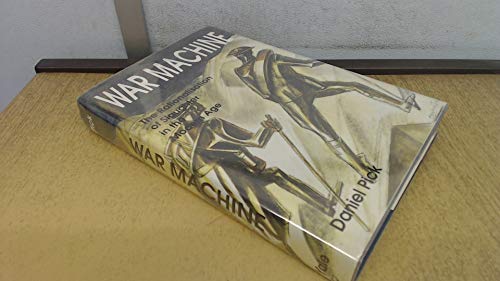
This intriguing study examines Western perceptions of war in and beyond the nineteenth century, surveying the writings of novelists, anthropologists, psychiatrists, psychoanalysts, philosophers, poets, natural scientists, and journalists to trace the terms of modern thought on the nature of military conflict.
Daniel Pick brings together philosophical and historical models of war with fictions of invasion, propaganda from the Great War, interpretations of shellshock and speculations about the biological value of conquest. He discusses the work of such familiar commentators as Clausewitz, Engels, and Treitschke, and examines little-known writings by Proudhon, De Quincey, Ruskin, Valery, and many others, culminating in the extraordinary dialogue between Freud and Einstein, Why War? He analyses Victorian fears of French contamination through the Channel Tunnel as well as the widespread continuing dread of German domination. And he charts the history of the pervasive European belief that war is beneficial or at least functionally necessary.
A central theme of the book is the disturbing relationship between machinery and destruction. Visions of relentless technological 'progress' and the inexorable advance of the military-industrial complex often seem to distort our understanding of war, even to reduce it to a sophisticated game played out by high-precision automata. Pick explores both the reassuring and troubling aspects of such representations. Shorn of human agency or responsibility, war apparently threatens to become technologically unstoppable, the remorseless 'perfect abattoir' of the industrial age. War Machine explores the enduring historical fascination with - and recoil from - brutal mechanical slaughter, and the modern aquiescence in, and enthusiasm for (in Rilke's phrase), 'these days of monstrously accelerated dying'.
"synopsis" may belong to another edition of this title.
Reviews
Pick (history, Univ. of London) offers a comprehensive and stimulating overview of the changing perception of war in 19th-century European culture and politics. He shows that war was theorized on one hand as vibrant and natural, reviving the life force of societies made effete by industrial civilization. That same civilization, however, enhanced war's potential to slip out of control, becoming a "driverless train" capable of negating the heroic virtues it purported to foster. A particular strength of Pick's work is its demonstration of Germany's emergence as an archetype of the "warfare state" combining modern technology with atavistic impulses. Useful too, albeit obscured by deconstructionist jargon, is Pick's critique of the thesis that World War I was a watershed in establishing the modern idea of war. The 19th century, he argues, established the terms and the language of a debate that is still with us. Recommended for scholarly collections.
- D.E. Showalter, Colorado Coll., Colordado Springs
Copyright 1993 Reed Business Information, Inc.
"About this title" may belong to another edition of this title.
Search results for War Machine: The Rationalisation of Slaughter in the...

Seller Image
War Machine: The Rationalisation of Slaughter in the Modern Age
Seller: -OnTimeBooks-, Phoenix, AZ, U.S.A.
Seller rating 5 out of 5 stars

Condition: good. A copy that has been read, remains in good condition. All pages are intact, and the cover is intact. The spine and cover show signs of wear. Pages can include notes and highlighting and show signs of wear, and the copy can include "From the library of" labels or previous owner inscriptions. 100% GUARANTEE! Shipped with delivery confirmation, if you're not satisfied with purchase please return item! Ships via media mail. Seller Inventory # OTV.0300054173.G
Stock Image
War Machine: The Rationalisation of Slaughter in the Modern Age
Seller: ThriftBooks-Dallas, Dallas, TX, U.S.A.
Seller rating 5 out of 5 stars
Hardcover. Condition: Good. No Jacket. Former library book; Missing dust jacket; Pages can have notes/highlighting. Spine may show signs of wear. ~ ThriftBooks: Read More, Spend Less. Seller Inventory # G0300054173I3N11
Stock Image
War Machine : The Rationalisation of Slaughter in the Modern Age
Seller: Better World Books Ltd, Dunfermline, United Kingdom
Seller rating 5 out of 5 stars
Condition: Good. Former library copy. Pages intact with minimal writing/highlighting. The binding may be loose and creased. Dust jackets/supplements are not included. Includes library markings. Stock photo provided. Product includes identifying sticker. Better World Books: Buy Books. Do Good. Seller Inventory # GRP18722290
Buy Used
US$ 9.66
US$ 6.65 shipping
Ships from United Kingdom to U.S.A.
Ships from United Kingdom to U.S.A.
Quantity: 1 available
Stock Image
War Machine : The Rationalisation of Slaughter in the Modern Age
Seller: Better World Books, Mishawaka, IN, U.S.A.
Seller rating 5 out of 5 stars
Condition: Good. Former library copy. Pages intact with minimal writing/highlighting. The binding may be loose and creased. Dust jackets/supplements are not included. Includes library markings. Stock photo provided. Product includes identifying sticker. Better World Books: Buy Books. Do Good. Seller Inventory # GRP18722290
Stock Image
War Machine: The Rationalisation of Slaughter in the Modern Age
Seller: Anybook.com, Lincoln, United Kingdom
Seller rating 5 out of 5 stars
Condition: Good. This is an ex-library book and may have the usual library/used-book markings inside.This book has hardback covers. In good all round condition. Dust jacket in good condition. Please note the Image in this listing is a stock photo and may not match the covers of the actual item,800grams, ISBN:9780300054170. Seller Inventory # 5816398
Buy Used
US$ 3.43
US$ 17.36 shipping
Ships from United Kingdom to U.S.A.
Ships from United Kingdom to U.S.A.
Quantity: 1 available
Stock Image
War Machine: The Rationalisation of Slaughter in the Modern Age
Seller: Sell Books, Elland, YORKS, United Kingdom
Seller rating 5 out of 5 stars
hardcover. Condition: Good. Our good condition books are generally good for reading but not for gifting or collecting. They could have imperfections such as creasing, fanning, inscriptions, margin notes, yellowing, staining on edge or cover or pages, bumps, scuffs, etc etc (sometimes multiple of these). It's a wide category that encompasses anything that isn't almost-new down to anything that is slightly better than poor. We would NOT recommend gifting Good books - these should be considered reading copies. Our books are dispatched from a Yorkshire former cotton mill. We list via barcode/ISBN so please note that the images are stock images and may not be the exact copy you receive, furthermore the details about edition and year might not be accurate as many publishers reuse the same ISBN for multiple editions and as we simply scan a barcode or enter an ISBN we do not check the validity of the edition data when listing. If you're looking for an exact edition please don't order (at least not without checking with us first, although we don't always have time to check). We aim to dispatch prompty, the service used will depend on order value and book size. We can ship to most countries, see our shipping policies. Payment is via Abe only. Seller Inventory # SBAB-P-BDL00149-RAG-20231101-G
Buy Used
US$ 5.80
US$ 15.19 shipping
Ships from United Kingdom to U.S.A.
Ships from United Kingdom to U.S.A.
Quantity: 1 available
Stock Image
War Machine: The Rationalisation of Slaughter in the Modern Age
Published by
Yale University Press, 1993
ISBN 10: 0300054173
ISBN 13: 9780300054170
Used
Hardcover
First Edition
Seller: Kisharon Langdon New Chapters, HARROW, United Kingdom
Seller rating 4 out of 5 stars

Condition: As New. This copy is a FIRST EDITION in Like New condition ? crisp, clean, and showing no meaningful signs of use. Pages are bright and free from marks, writing, or highlighting. The spine is tight and the covers are sharp with no creasing or damage. Every book we list is individually hand-checked by our team at Kisharon Langdon New Chapters. We take pride in honest, accurate grading ? what you read is what you receive. New Chapters is a social enterprise supporting people with Learning Disabilities and Autism into meaningful work. Your purchase makes a real difference. Seller Inventory # HISTORY/Box98/MH43/090726
Buy Used
US$ 10.31
US$ 13.30 shipping
Ships from United Kingdom to U.S.A.
Ships from United Kingdom to U.S.A.
Quantity: 1 available
Stock Image
War Machine: The Rationalisation of Slaughter in the Modern Age
Published by
Yale University Press, 1993
ISBN 10: 0300054173
ISBN 13: 9780300054170
Used
Hardcover
First Edition
Seller: Paisleyhaze Books, New Hartford, CT, U.S.A.
Seller rating 5 out of 5 stars
Hardcover. Condition: As New. Dust Jacket Condition: As New. 1st Edition. Yale University Press hardcover in dust jacket, 1993, 1st edition, unused and carefully stored, No remainder marks or "shelf wear" (as New/as New)with review slip laid in. We will add a custom fitted mylar cover, bubble-wrap the book and ship it in a BOX with delivery confirmation/tracking. Seller Inventory # 11099P
Stock Image
War Machine: The Rationalisation of Slaughter in the Modern Age
Seller: Anybook.com, Lincoln, United Kingdom
Seller rating 5 out of 5 stars
Condition: Good. This is an ex-library book and may have the usual library/used-book markings inside.This book has hardback covers. Clean from markings. In good all round condition. Dust jacket in fair condition. Please note the Image in this listing is a stock photo and may not match the covers of the actual item,850grams, ISBN:9780300054170. Seller Inventory # 8969561
Buy Used
US$ 12.75
US$ 17.36 shipping
Ships from United Kingdom to U.S.A.
Ships from United Kingdom to U.S.A.
Quantity: 1 available
Stock Image
War Machine: The Rationalisation of Slaughter in the Modern Age
Published by
Yale University Press, New Haven, 1993
ISBN 10: 0300054173
ISBN 13: 9780300054170
Used
Hardcover
First Edition
Seller: Stone Soup Books, Camden, ME, U.S.A.
Seller rating 4 out of 5 stars
hardcover. Condition: Fine. Dust Jacket Condition: Near Fine. 8vo, a study of Western thought on war, bibliography, index, 292 pages. Seller Inventory # 16432