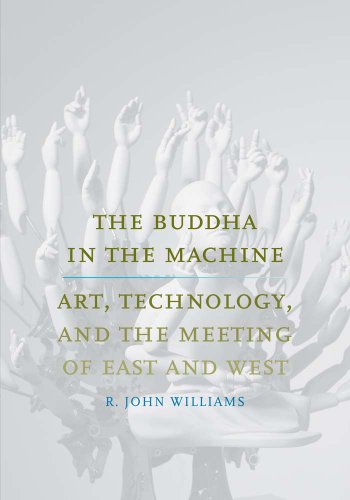
The famous 1893 Chicago World’s Fair celebrated the dawn of corporate capitalism and a new Machine Age with an exhibit of the world’s largest engine. Yet the noise was so great, visitors ran out of the Machinery Hall to retreat to the peace and quiet of the Japanese pavilion’s Buddhist temples and lotus ponds. Thus began over a century of the West’s turn toward an Asian aesthetic as an antidote to modern technology.
From the turn-of-the-century Columbian Exhibition to the latest Zen-inspired designs of Apple, Inc., R. John Williams charts the history of our embrace of Eastern ideals of beauty to counter our fear of the rise of modern technological systems. In a dazzling work of synthesis, Williams examines Asian influences on book design and department store marketing, the commercial fiction of Jack London, the poetic technique of Ezra Pound, the popularity of Charlie Chan movies, the architecture of Frank Lloyd Wright, and the design of the latest high-tech gadgets. Williams demonstrates how, rather than retreating from modernity, writers, artists, and inventors turned to traditional Eastern technê as a therapeutic means of living with―but never abandoning―Western technology.
"synopsis" may belong to another edition of this title.
R. John Williams is assistant professor of English at Yale University, teaching courses in literature, film, and media studies.
Acknowledgments, ix,
1. Asia-as-Technê, 1,
2. The Teahouse of the American Book Boston Bindings and Asia-as-Technê, 1890–1920, 13,
3. Mastering the Machine Technology and the Racial Logic of Jack London's Asia, 45,
4. Machine/Art Ernest Fenollosa, Ezra Pound, and the Chinese Written Character, 86,
5. The Technê Whim Lin Yutang and the Invention of the Chinese Typewriter, 129,
6. The Chinese Parrot Technê-Pop Culture and the Oriental Detective Genre, 149,
7. Technê-Zen and the Spiritual Quality of Global Capitalism, 174,
8. The Meeting of East and West, 199,
Appendixes,
A: Japanese Edition Books Published in the 1890s, 219,
B: Chronology of Futurism/Vorticism in London, 1913–1915, 222,
C: Ezra Pound 1910–1912 vs. Ezra Pound 1914–1915, 224,
D: Total Quality Management and Pirsig's Zen and the Art of Motorcycle Maintenance, 225,
E: Zen and Management/Corporation Studies, 227,
F: "Zen and the Art of" in Contemporary Discourse, 229,
Notes, 239,
Index, 311,
Asia-as-Technê
Somewhere on the way, in passing from the scientific facts and distinctions to the traditional philosophical foundations of modern Western culture, a mistake was made. We must find this mistake.
—F. S. C. Northrop, The Meeting of East and West (1946)
A root word of technology, technê, originally meant "art." The ancient Greeks never separated art from manufacture in their minds, and so never developed separate words for them ... The real ugliness is not the result of any objects of technology ... The real ugliness lies in the relationship between the people who produce the technology and the things they produce.
—Robert Pirsig, Zen and the Art of Motorcycle Maintenance (1974)
The writers and artists described in this book are joined by a desire to embrace "Eastern" aesthetics as a means of redeeming "Western" technoculture. The assumption they all share is that at the core of Western culture since at least the Enlightenment there lies an originary and all-encompassing philosophical error, manifested most immediately in the perils of modern technology—and that Asian art off ers a way out of that awful matrix. That desire, I hope to demonstrate, has informed Anglo-and even Asian-American debates about technology and art since the late nineteenth century, and continues to skew our responses to our own technocultural environment. Although the "machine" has for over a hundred years functioned as an almost religious object of enthusiasm and veneration, American art and literature have been shaped as much by resistance to technology as by submission to it—and, with startling frequency, that resistance has taken the form of an investment in what I call Asia-as-technê: a compelling fantasy that would posit Eastern aesthetics as both the antidote to and the perfection of machine culture.
None of the figures I examine in this book question the pervasive influence of technological developments on Western life and culture (and, as such, are largely guilty of what historians of science call "technological determinism"); each of them, however, looks to the East for more organic, less oppressive ways of living with machines. As a way of illustrating how these two impulses—lamenting technology's corrupting power in the West and seeking remedial technologies from the East—frequently coincide, allow me to begin with a preliminary, somewhat extended example. Between 1998 and 2001 British artist David Hockney submitted the entire history of Western art to a kind of aesthetic Turing test, and, according to his analysis, a surprising number of the old masters tested positive for cyborgism. "Turing test" is not his phrase, of course, but the basic idea—determining whether or not in the art of the old masters we have been all along communing with "machines" rather than sentient, creative beings—is nonetheless at the heart of his investigation. The essence of Hockney's argument, articulated most elaborately in his volume Secret Knowledge (2001), is that hiding within the ghostly realism of Western art (and, as we shall see, in stark contrast to the art of the East) there is a machine—or rather a whole panoply of optical technologies and mechanical methods that were lost or perhaps purposefully hidden from the historical record. As Hockney tells it, the reason so many of the old masters achieved such startlingly realistic effects was that their techniques for representation extended far beyond the powers of observational "eyeballing" (SK, pp. 184–185). Whereas art historians had already, if intermittently, acknowledged the occasional use of perspective machines and optical devices (pantographs, drafting grids, mirrors, camera obscuras, camera lucidas, and so on; Figs. 1.1–1.2), no one had ever claimed that these technologies were so central to Western artistic tradition, or that they were in use as far back as the early fifteenth century.
Hockney's goal, in other words, is to demonstrate that the real culprit of artistic realism—the undercover use of optical technologies—has been hiding in plain sight all along. For Hockney, the moment of the originary crime (and, for reasons we will elaborate shortly, he really does think of it as something like a "crime") occurs very specifically in the late 1420s, when Van Eyck's starkly lit oil paintings show a dramatically "realistic" break from the flattened frescos and tempura techniques of previous artists. If we compare, for instance, the two paintings in Plates 1–2, something dramatic does seem to have happened between them, the Van Eyck suddenly "alive" with deeper color and shadows. But of course, as in any classic detective story, guilt has to be isolated, hypostatized, and disciplined by way of a presiding, restoration narrative (it never turns out, that is, that the murder was "society's fault"), and Secret Knowledge is no different. It simply will not do for Hockney to characterize this artistic transformation as the complex, cumulative result of new developments in oil painting, the burgeoning study of human cadavers, the invention of linear perspective, changes in patronage and apprenticeship, Van Eyck's own artistic brilliance, and the growing availability of eyeglasses (another type of "optics" that Hockney seems to ignore, even though it would have certainly allowed artists to see more clearly their work and models). No, for Hockney, "something else is in play"—a singular "else."
What follows in Secret Knowledge is a stunning re-creation of the scene of the "crime." Enlisting the help of University of Arizona physicist Charles Falco (who plays a mustachioed Watson to the artist's Sherlock), Hockney makes the "scientific" case that since there is a convex mirror in the background of Van Eyck's 1434 masterpiece The Arnolfini Portrait (Plates 3–4), it stands to reason that he must have had a concave mirror, and concave mirrors, it turns out, are not only good for burning Roman ships (as Archimedes is supposed to have done) but also for projecting images inside a camera. Indeed, if one bothers trying it out (a normal shaving mirror will do), it works surprisingly well. We are suddenly reminded, then, that the "camera" existed centuries before photography, the latter being a chemical invention, not a fundamentally structural one. The word "camera" is the Latin equivalent of the English "chamber," and the curious visual eff ect of a pinhole projection into a dark chamber or room, due to the fact that light rays passing through the pinhole are crossed and so appear upside down on the opposite wall or screen, was known already to Aristotle and Euclid. To stand in one of these dark rooms, in other words, is to be inside a camera. Specifically, then, Hockney argues that Van Eyck must have used a concave mirror to project the most visually stunning elements of the Arnolfini Portrait onto a screen inside a camera (that is, his darkened art studio), which would have not only allowed him to see the scene in two-dimensional form (something any regular mirror would have done), but also to set up a kind of beautiful, ghostly image that could then be painted over—fixed, as it were, by a paintbrush rather than, as would come centuries later, chemicals or digital code.
Suddenly, for Hockney, the entire history of Western art becomes a story of covert technologies. The montage-like discontinuities and depth-of-field distortions seen in so many classic works (heretofore explained as the mere piecemeal staging of an artist's subjects over time) become evidences of a secret lens-and-mirror apparatus, influencing everything from Filippo Brunelleschi's invention of linear perspective to the stark chiaroscurism of Caravaggio and the rapid and painterly precision of Diego Velasquez. Whether or not one accepts Hockney's thesis, there can be no denying that it offers a provocative means of reexamining the history of Western art. Seeing through the paintings into the skeletal secrets of their mechanical origins, we "begin to look at paintings in a new way" (SK, p. 131). Indeed, when one considers the possibility that artists were cleverly (masterfully? secretively?) arresting a projected, analog image, doing the work, that is, that chemicals and digital sensors would later do, the figures in the paintings somehow become even more ghostly and present.
The most provocative aspect of Hockney's thesis, however, is not that it overturns sacred assumptions about the almost supernaturally mimetic powers of the Western old masters. On the contrary, Hockney goes out of his way to argue that "optics don't make marks" (even sporting a garish T-shirt with that phrase boldly printed on it in the BBC documentary on his work), which is to say, even with the assistance of optical technologies, the artist's hand was still inside the machine, still in control, setting up the scene, applying paint, positioning lenses, making all sorts of artistic decisions about composition, color, lighting, and so on. Hockney's overarching argument, in other words, is not that the old masters "cheated," but rather that this development introduced a "crime" of a different magnitude. The real scandal for Hockney has something more to do with the very ideological assumptions regarding the portrayal of "reality" by means of linear, geometrically fixed perspective and the modeled, shadowy forms of chiaroscurism. According to Hockney, it is this increasingly calculative, enframing, and mechanistic approach to portraying the world that is the real crime:
In a perspective picture, your viewpoint is fixed because the space is drawn from a single spot.... Histories of perspective generally suggest that anything that came before was "primitive" or that there had been a struggle to achieve perspective—and that once mastered it conquered the world. It was the "correct" way of depicting the world, whereas other graphic conventions were not. (SK, p. 204)
The supposedly linear "progress" of the invention of linear perspective, in other words, is a deception. The ideology of the perspectival window is less a reflection than it is an alienation of our natural experience, a "prison" wherein the "tyranny of the lens" has "pushed the world away," and "separated us" from "our environment" (SK, pp. 230–231).
What leads Hockney to these conclusions—the real motivation, that is, behind his exposé of the machine at the heart of Western art—is a particular vision of Asian aesthetics, which enters his argument as a means of providing a series of alternative, nonalienating techniques for depicting the world and our experience of it. A full decade before taking up these arguments in Secret Knowledge, Hockney produced an hour-long documentary film titled A Day on the Grand Canal with the Emperor of China; or, Surface Is Illusion but So Is Depth (1988) detailing the striking diff erences in artistic strategies between a highly perspectival scene by Canaletto during the Renais sance (Plates 5–6) and a seventy-two-foot-long Chinese landscape scroll from the seventeenth century (Plates 7–8). In Secret Knowledge, Hockney returns to the results of this comparative analysis: "Eastern cultures," he explains, developed methods of artistic representation that were "anything but primitive." Indeed, such methods allowed for "very sophisticated representations of space, closer in fact to our physical experience of moving through the world" (SK, p. 204). Observing, for instance, the "principle of moving focus" found in the Chinese landscape scroll, Hockney argues (in a subtle jab at the window-like linearity of the Western codex) that the only "limitation" of such an art form is that "it cannot be shown properly in a book" (SK, p. 230). Unfettered by the fixed positioning of "Alberti's window," however, the Chinese scroll allows one to "take a stroll through a landscape with which you are quite connected," to "meander" and "move down to the water's edge," to "look down on the lake ... descend onto a plain, then up into mountains again" (SK, p. 230). Throughout the art of Japan, China, and India (at least until very recently), Hockney contends, the deceptive and constraining optics of shadows and fixed perspectivism were never allowed to visually dictate one's experience with art and nature. By contrast, the West, in its obsession with "windows," "geometry," and "machines," has become trapped by its own mechanistic ideologies of disenchantment; hence, the need for someone like Hockney to articulate the original sin at the heart of the dilemma, to refocus our attention on the great art of the East so as to redeem us from our corrupt, mechanical inheritance. As Hockney explains in A Day in the Grand Canal (illustrating the following principle with a piece of chalk on a blackboard), in Western mechanical perspective, the principle of the vanishing point "places the viewer in an immobile point outside the picture" (see point A in Fig. 1.3). "Theoretically," he explains, the vanishing point (point B) "represents infinity," which is to say, if the viewer moves forward, so does the vanishing point; and (only half-joking now) "if the infinite is god," then we are left with a proposition in which "god" and the "immobile viewer" will never meet. It's "bad theology." But in the Chinese scroll, the viewer is "in movement," and "infinity is now everywhere, including the viewer" (Fig. 1.4). Thus, "god is everywhere, including within you."
One is reminded, however, that Hockney's own art—indeed, the art for which he has become most famous—is hardly antitechnological. Beginning with his work in the United States in the early 1980s, Hockney began exploring precisely this principle of "moving" perspective (echoing the modernist innovations of the cubists and vorticists) through various experiments in photo-collage. In works like Ian with Self-Portrait (1982) and Henry Moore (1982) and Still Life, Blue Guitar (1982, Plate 9), the Polaroid camera's white-frame images are placed together in a flat, ordered grid, while the scenes depicted offer not a single "window," but multiple shots of the same scene, with shifting focus and slightly skewed continuities. Hockney's most famous collage, Pearblossom Hwy., 11–18th April 1986 (Plate 10), creates an even more multifocalizing effect, with almost all traces of receding perspective flattened onto a choppy plane of multiple points of view. Here the so-called vanishing point in traditional perspective refuses to vanish, seemingly jutting out from the bottom of the collage into the viewer's space. In Walking in the Zen Garden at the Ryonji Temple, Feb. 21st 1983 (Plate 11) the traditional contracting lines of perspective are even reversed, coming closer together as they come toward the viewer. However, the point in all of these works for Hockney is not to celebrate or return to some "primitive" aesthetic culture. On the contrary, his is a Polaroid solution to the machine/art dilemma of Western art, relying directly on what were then new and cutting-edge technologies (as would his later efforts in fax and computer art) to bring us to that supposedly more authentic, Eastern ideal. The implicit idea, in other words, is that there is something already highly civilizational and modern and yet somehow more organic and healthy about Eastern aesthetics, something that must be embraced so as to counter the very dilemma created by that most modern of Western creations, the machine.
Excerpted from The Buddha in the Machine by R. John Williams. Copyright © 2014 R. John Williams. Excerpted by permission of Yale UNIVERSITY PRESS.
All rights reserved. No part of this excerpt may be reproduced or reprinted without permission in writing from the publisher.
Excerpts are provided by Dial-A-Book Inc. solely for the personal use of visitors to this web site.
"About this title" may belong to another edition of this title.
Seller: Better World Books, Mishawaka, IN, U.S.A.
Condition: Very Good. Pages intact with possible writing/highlighting. Binding strong with minor wear. Dust jackets/supplements may not be included. Stock photo provided. Product includes identifying sticker. Better World Books: Buy Books. Do Good. Seller Inventory # 41138373-6
Seller: Mercantile Books, Columbus, OH, U.S.A.
hardcover. Condition: Very Good. Hardcover in mylar Dust Jacket. Pages clean, crisp, unmarked. Cover has light wear. Jacket lightly scuffed, with a few small tears. Shipped promptly with Tracking. Asst12. Seller Inventory # DC-D9WL-6EA5
Seller: Dorley House Books, Inc., Hagerstown, MD, U.S.A.
Hardcover. Condition: Near Fine. Dust Jacket Condition: Near Fine. Color & b&w (illustrator). 1st. 1st printing; dj in mylar; pictorial c; 322 clean, unmarked pages; "The Buddha in the Machine introduces a sophisticated framework for analyzing ethnicity and technology." Rachel McBride Lindsey, American Studies. Seller Inventory # 092781
Seller: Black Gull Books (P.B.F.A.), St Leonard's on Sea, United Kingdom
hardcover. Condition: Very Good. Dust Jacket Condition: good. Seller Inventory # 17883
Quantity: 1 available
Seller: CARDINAL BOOKS ~~ ABAC/ILAB, London -- Birr, ON, Canada
Hardcover. Condition: As New. Dust Jacket Condition: Near Fine. Hard-cover edition, in dust jacket. Clean, tight and unmarked. Nearly as new! Size: 8vo - over 7¾ - 9¾" tall. Book. Seller Inventory # 51241n51
Quantity: 1 available
Seller: Majestic Books, Hounslow, United Kingdom
Condition: New. pp. 368 168 Illus. (121 Col.). Seller Inventory # 95974052
Quantity: 1 available
Seller: Romtrade Corp., STERLING HEIGHTS, MI, U.S.A.
Condition: New. This is a Brand-new US Edition. This Item may be shipped from US or any other country as we have multiple locations worldwide. Seller Inventory # ABNR-173729
Seller: Basi6 International, Irving, TX, U.S.A.
Condition: Brand New. New. US edition. Expediting shipping for all USA and Europe orders excluding PO Box. Excellent Customer Service. Seller Inventory # ABEOCT25-69463
Seller: Books Puddle, New York, NY, U.S.A.
Condition: New. pp. 368. Seller Inventory # 2697504635
Seller: Kloof Booksellers & Scientia Verlag, Amsterdam, Netherlands
Condition: as new. New Haven : Yale University Press, 2014. Paperback. 322 pp.Includes bibliographical references (pages 239-310) and index. From the turn-of-the-century Columbian Exhibition to the Zen-inspired designs of Apple, Inc, the author charts the history of our embrace of Eastern ideals of beauty to counter our fear of the rise of modern technological systems. He also examines Asian influences on book design and department store marketing. Condition : as new copy. ISBN 9780300194470. Keywords : ART, Seller Inventory # 28192
Quantity: 1 available