
Items related to Signor Marconi's Magic Box: The Most Remarkable Invention...
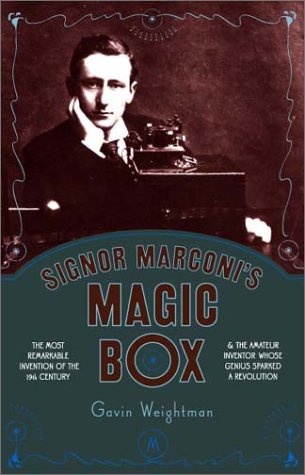
Signor Marconi's Magic Box: The Most Remarkable Invention Of The 19th Century & The Amateur Inventor Whose Genius Sparked A Revolution - Hardcover
Synopsis
The world at the turn of the twentieth century was in the throes of "Marconi-mania"-brought on by an incredible invention that no one could quite explain, and by a dapper and eccentric figure (who would one day win the newly minted Nobel Prize) at the center of it all. At a time when the telephone, telegraph, and electricity made the whole world wonder just what science would think of next, the startling answer had come in 1896 in the form of two mysterious wooden boxes containing a device one Guglielmo Marconi had rigged up to transmit messages "through the ether." It was the birth of the radio, and no scientist in Europe or America, not even Marconi himself, could at first explain how it worked…it just did. And no one knew how far these radio waves could travel, until 1903, when a message from President Theodore Roosevelt to the king of England flashed from Cape Cod to Cornwall clear across the Atlantic.Here is a rich portrait of the man and his era-and a captivating tale of science and scientists, business and businessmen. There are stories of British blowhards, American con artists-and Marconi himself: a character par excellence, who eventually winds up a virtual prisoner of his worldwide fame and fortune.
"synopsis" may belong to another edition of this title.
About the Author
Gavin Weightman is a documentary filmmaker, a journalist, and the author of The Frozen-Water Trade , a Book Sense 76 selection. He lives in London.
Reviews
Dapper, aristocratic Guglielmo Marconi doesn't fit the typical inventor stereotype: he lacked wild hair, wasn't absentminded, wore debonair-looking hats and frequently wooed women when traveling by ship. Yet Marconi's aptitude for technology led him to become the father of wireless telegraphy and radio. Born in 1874 to an Italian father and an Irish mother, Marconi was always fascinated by the nascent technology of electricity and, as a young man, was struck by the idea that he could transmit telegraph messages-then carried by cables-through the air. At a crowded London meeting hall in 1896, he made a dramatic public demonstration of his idea by sending a current from one innocuous-looking box to a receiver he carried around the hall with him, causing it to ring: "No messages were being sent at all-just an invisible electronic signal. But in 1896 that was sensational enough," writes documentary filmmaker and journalist Weightman. Like many other great inventions, wireless was being pursued at the same time by a number of different inventors, including some shameless charlatans-some of whom, like the delightfully crooked Abraham White, give Weightman's dry book some desperately needed spark-and a great deal of Weightman's text is about the juggling for position among the inventors and their respective companies around the turn of the century. Although Weightman has his hands on an extremely exciting subject, there is precious little life to his writing, and even exciting episodes, like the sending of an early type of wireless distress signal from the sinking Titanic, fail to engage. Photos.
Copyright 2003 Reed Business Information, Inc.
Guglielmo Marconi invented the best radio equipment in the technology's infancy a century ago. He made a fortune, cruised among queens of England and kings of Italy, and died an acolyte of Mussolini. Weightman ably chronicles Marconi's life in the context of his urgency to perfect radio transmission and reception before rivals did. Marconi was born into comfortable circumstances, and his youthful passion for crafting devices to generate "Hertzian" waves was supported by his Irish mother and Italian father. Weightman delivers the technical information about Marconi's sending radio waves further than anyone else could at the time--he was the first to send signals across the Atlantic--then settles into the narrative of Marconi's patent battles and business operations, as well as his two marriages. Taciturn and careful, Marconi does not make for an effervescent biography; rather, the author's study is as stolid as its subject and does justice to Marconi's central place in the origination of wireless communication. Gilbert Taylor
Copyright © American Library Association. All rights reserved
"About this title" may belong to another edition of this title.
Search results for Signor Marconi's Magic Box: The Most Remarkable Invention...

Seller Image
Signor Marconi's Magic Box: The Most Remarkable Invention Of The 19th Century & The Amateur Inventor Whose Genius Sparked A Revolution
Seller: Greenworld Books, Arlington, TX, U.S.A.
Seller rating 5 out of 5 stars

Condition: good. Fast Free Shipping â" Good condition. It may show normal signs of use, such as light writing, highlighting, or library markings, but all pages are intact and the book is fully readable. A solid, complete copy that's ready to enjoy. Seller Inventory # GWV.0306812754.G
Stock Image
Signor Marconi's Magic Box: The Most Remarkable Invention Of The 19th Century & The Amateur Inventor Whose Genius Sparked A Revolution
Published by
Da Capo Press (edition First Edition (1st printing)), 2003
ISBN 10: 0306812754
ISBN 13: 9780306812750
Used
Hardcover
Seller: BooksRun, Philadelphia, PA, U.S.A.
Seller rating 5 out of 5 stars
Hardcover. Condition: Very Good. First Edition (1st printing). It's a well-cared-for item that has seen limited use. The item may show minor signs of wear. All the text is legible, with all pages included. It may have slight markings and/or highlighting. Seller Inventory # 0306812754-11-1
Seller Image
Signor Marconi's Magic Box: The Most Remarkable Invention Of The 19th Century & The Amateur Inventor Whose Genius Sparked A Revolution
Seller: Greenworld Books, Arlington, TX, U.S.A.
Seller rating 5 out of 5 stars
Condition: very_good. Fast Free Shipping â" Very Good condition book with a firm cover and clean pages. Shows normal use and some light wear or limited notes markings. A solid, nice copy to enjoy. Seller Inventory # GWV.0306812754.VG
Stock Image
Signor Marconi's Magic Box: The Most Remarkable Invention Of The 19th Century & The Amateur Inventor Whose Genius Sparked A Revolution
Seller: Wonder Book, Frederick, MD, U.S.A.
Seller rating 5 out of 5 stars
Condition: Good. Good condition. Very Good dust jacket. A copy that has been read but remains intact. May contain markings such as bookplates, stamps, limited notes and highlighting, or a few light stains. Seller Inventory # L12I-00595
Stock Image
Signor Marconi's Magic Box: The Most Remarkable Invention Of The 19th Century & The Amateur Inventor Whose Genius Sparked A Revolution
Seller: Wonder Book, Frederick, MD, U.S.A.
Seller rating 5 out of 5 stars
Condition: Very Good. Very Good condition. Very Good dust jacket. A copy that may have a few cosmetic defects. May also contain light spine creasing or a few markings such as an owner's name, short gifter's inscription or light stamp. Seller Inventory # O10R-00040
Stock Image
Signor Marconis Magic Box: The Most Remarkable Invention Of The
Seller: Hawking Books, Edgewood, TX, U.S.A.
Seller rating 4 out of 5 stars

Condition: Very Good. Very Good Condition. Clean, tight and Neat. Five star seller - Buy with confidence! Seller Inventory # X0306812754X2
Stock Image
Signor Marconi's Magic Box: The Most Remarkable Invention Of The 19th Century & The Amateur Inventor Whose Genius Sparked A Revolution
Seller: HPB-Emerald, Dallas, TX, U.S.A.
Seller rating 5 out of 5 stars
hardcover. Condition: Very Good. Connecting readers with great books since 1972! Used books may not include companion materials, and may have some shelf wear or limited writing. We ship orders daily and Customer Service is our top priority! Seller Inventory # S_419834263
Stock Image
Signor Marconi's Magic Box: The Most Remarkable Invention Of The 19th Century & The Amateur Inventor Whose Genius Sparked A Revolution
Seller: HPB Inc., Dallas, TX, U.S.A.
Seller rating 5 out of 5 stars
hardcover. Condition: Very Good. Connecting readers with great books since 1972! Used books may not include companion materials, and may have some shelf wear or limited writing. We ship orders daily and Customer Service is our top priority! Seller Inventory # S_430501438
Stock Image
Signor Marconi's Magic Box: The Most Remarkable Invention Of The 19th Century & The Amateur Inventor Whose Genius Sparked A Revolution
Seller: ThriftBooks-Dallas, Dallas, TX, U.S.A.
Seller rating 5 out of 5 stars
Hardcover. Condition: Very Good. No Jacket. May have limited writing in cover pages. Pages are unmarked. ~ ThriftBooks: Read More, Spend Less. Seller Inventory # G0306812754I4N00
Stock Image
Signor Marconi's Magic Box: The Most Remarkable Invention Of The 19th Century & The Amateur Inventor Whose Genius Sparked A Revolution
Seller: ThriftBooks-Phoenix, Phoenix, AZ, U.S.A.
Seller rating 5 out of 5 stars
Hardcover. Condition: Good. No Jacket. Pages can have notes/highlighting. Spine may show signs of wear. ~ ThriftBooks: Read More, Spend Less. Seller Inventory # G0306812754I3N00