
Items related to Becoming Eichmann: Rethinking the Life, Crimes, and...
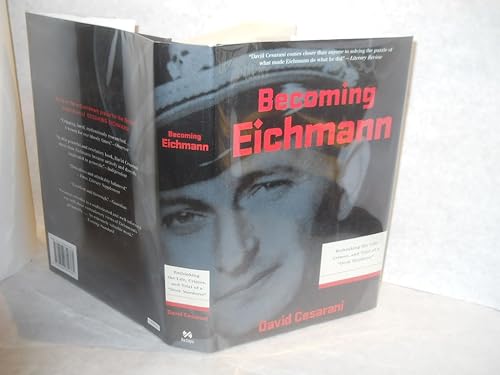
Becoming Eichmann: Rethinking the Life, Crimes, and Trial of a "Desk Murderer" (Eichmann: His Life and Crimes) - Hardcover
Synopsis
In charge of the logistical apparatus of mass deportation and extinction, Adolf Eichmann was at the center of the Nazi genocide against the Jews. He was personally responsible for transporting over two million Jews to their deaths in Auschwitz-Birkenau and other death camps. This is the first account of Eichmann's life to appear since the aftermath of his famous trial in 1961 and his subsequent execution in Jerusalem a year later. It reveals that the depiction of Eichmann as a loser who drifted into the ranks of the SS is a fabrication that conceals Eichmann's considerable abilities and his early political development. Drawing on recently unearthed documents, David Cesarani shows how Eichmann became the Reich's "expert" on Jewish matters and reveals his initially cordial working relationship with Zionist Jews in Germany, despite his intense anti-Semitism. Cesarani explains how the massive ethnic cleansing Eichmann conducted in Poland in 1939-40 was the crucial bridge to his later role in the mass deportation of the Jews. And Cesarani argues controversially that Eichmann was not necessarily predisposed to mass murder, exploring the remarkable, largely unknown period in Eichmann's early career when he first learned how to become an administrator of genocide. This challenging work deepens our understanding of Adolf Eichmann and offers fresh insights both into the operation of the Final Solution and the making of its most notorious perpetrator.
"synopsis" may belong to another edition of this title.
About the Author
David Cesarini, one of Britain's leading historians, is Research Professor in History at Royal Holloway, London University. He has published widely on Anglo-Jewish history and the history of Zionism.
Reviews
To the Israeli prosecutor who interrogated him in 1961, Adolf Eichmann was a fanatical anti-Semite and a central figure in the annihilation of the Jews. To Hannah Arendt, he was a dim-witted bureaucrat, a cog in the machinery of destruction that was the Holocaust. British historian Cesarani, author of numerous books on the Holocaust and Jewish history, offers a more complex and nuanced portrait. Based on research into sources that were unavailable in the 1960s and on the most recent scholarly work on the Holocaust, Cesarani corrects the historical record on numerous issues. Contrary to popular myth, he says, Eichmann had a normal childhood and a socially and professionally successful young adulthood. Eichmann joined the SS not because he was a misfit but because, like so many German and Austrian middle-class men, he found the Third Reich a great engine of social mobility. Cesarani's biography is convincing on many counts. But in the end, the broad outlines of Arendt's portrait in her brilliant Eichmann in Jerusalem remain standing. Eichmann may have been more intelligent and skilled than she concluded, but he was the perfect expression of the highly bureaucratized and systematic killing process that the Nazis perfected. 8 pages of b&w photos, 2 maps. (May 15)
Copyright © Reed Business Information, a division of Reed Elsevier Inc. All rights reserved.
*Starred Review* Since Adolf Eichmann's trial and execution, scholars have looked to the events of the Holocaust logistician's life to assess the depth of his guilt and to speculate on the social mechanisms that turn individuals genocidal. Cesarani aims to strip away some of the mythology that such efforts have invariably generated. His thesis--that Eichmann's evil arose not from banal bean counting but from the bureaucrat's ambitious careerism--both builds upon and pointedly rejects Hannah Arendt's visceral Eichmann in Jerusalem and will certainly attract attention for doing so. Yet Cesarani does more than simply reopen the cog-or-monster debates that surrounded Arendt's assessment. Pointing out key moments in which Eichmann overcame his own humanity--swallowing his initial shock at the sight of mass shootings and finding recovery from a "total moral collapse" in Hungary in 1944--Cesarani emphasizes Eichmann's deliberate choices, habituation to power, and gradual desensitization to mass atrocity. In doing so, he presents a compelling vision of Eichmann that comports with our current awareness of the psychological dynamics of genocide. Similarly compelling is Cesarani's fascinatingly Darwinian description of the ever-changing bureaucratic structures of Nazism to which Eichmann was continually adapting as he rose in the ranks. Few biographies, and fewer Holocaust histories, are as innovative or as nuanced. Brendan Driscoll
Copyright © American Library Association. All rights reserved
"About this title" may belong to another edition of this title.
Search results for Becoming Eichmann: Rethinking the Life, Crimes, and...

Stock Image
Becoming Eichmann: Rethinking the Life, Crimes and Trial of a Desk Murderer
Seller: World of Books (was SecondSale), Montgomery, IL, U.S.A.
Seller rating 5 out of 5 stars

Hardback. Condition: Good. This book constitutes the proceedings of the 16th Latin American Symposium on Theoretical Informatics, LATIN 2024, which took place in Puerto Varas, Chile, in March 2024. The 44 papers presented in this volume were carefully reviewed and selected from 93 submissions. They were organized in topical sections as follows: Part I: Algorithms and Data Structures; Approximation and Online Algorithms; Complexity Theory; Part II: Combinatorics and Graph Theory; Parameterized Algorithms; Automata Theory and Formal Languages; and Game Theory and Fairness. Seller Inventory # 00101318283
Seller Image
Becoming Eichmann: Rethinking the Life, Crimes, and Trial of a "Desk Murderer" (Eichmann: His Life and Crimes)
Seller: -OnTimeBooks-, Phoenix, AZ, U.S.A.
Seller rating 5 out of 5 stars
Condition: good. A copy that has been read, remains in good condition. All pages are intact, and the cover is intact. The spine and cover show signs of wear. Pages can include notes and highlighting and show signs of wear, and the copy can include "From the library of" labels or previous owner inscriptions. 100% GUARANTEE! Shipped with delivery confirmation, if you're not satisfied with purchase please return item! Ships via media mail. Seller Inventory # OTV.0306814765.G
Stock Image
Becoming Eichmann: Rethinking the Life, Crimes, and Trial of a "Desk Murderer" (Eichmann: His Life and Crimes)
Seller: HPB-Ruby, Dallas, TX, U.S.A.
Seller rating 5 out of 5 stars
hardcover. Condition: Very Good. Connecting readers with great books since 1972! Used books may not include companion materials, and may have some shelf wear or limited writing. We ship orders daily and Customer Service is our top priority! Seller Inventory # S_472544907
Stock Image
Becoming Eichmann: Rethinking the Life, Crimes, and Trial of a Desk Murderer (Eichmann: His Life and Crimes)
Seller: ThriftBooks-Atlanta, AUSTELL, GA, U.S.A.
Seller rating 5 out of 5 stars
Hardcover. Condition: Good. No Jacket. Pages can have notes/highlighting. Spine may show signs of wear. ~ ThriftBooks: Read More, Spend Less. Seller Inventory # G0306814765I3N00
Stock Image
Becoming Eichmann: Rethinking the Life, Crimes, and Trial of a Desk Murderer (Eichmann: His Life and Crimes)
Seller: ThriftBooks-Dallas, Dallas, TX, U.S.A.
Seller rating 5 out of 5 stars
Hardcover. Condition: Fair. No Jacket. Missing dust jacket; Readable copy. Pages may have considerable notes/highlighting. ~ ThriftBooks: Read More, Spend Less. Seller Inventory # G0306814765I5N01
Stock Image
Becoming Eichmann : Rethinking the Life, Crimes, and Trial of a Desk Murderer
Seller: Better World Books, Mishawaka, IN, U.S.A.
Seller rating 5 out of 5 stars
Condition: Good. New Ed. Pages intact with minimal writing/highlighting. The binding may be loose and creased. Dust jackets/supplements are not included. Stock photo provided. Product includes identifying sticker. Better World Books: Buy Books. Do Good. Seller Inventory # 5643878-6
Stock Image
Becoming Eichmann : Rethinking the Life, Crimes, and Trial of a Desk Murderer
Seller: Better World Books, Mishawaka, IN, U.S.A.
Seller rating 5 out of 5 stars
Condition: Very Good. New Ed. Pages intact with possible writing/highlighting. Binding strong with minor wear. Dust jackets/supplements may not be included. Stock photo provided. Product includes identifying sticker. Better World Books: Buy Books. Do Good. Seller Inventory # 4463177-6
Stock Image
Becoming Eichmann: Rethinking the Life, Crimes, and Trial of a Desk Murderer (Eichmann: His Life and Crimes)
Seller: ThriftBooks-Atlanta, AUSTELL, GA, U.S.A.
Seller rating 5 out of 5 stars
Hardcover. Condition: Fair. No Jacket. Readable copy. Pages may have considerable notes/highlighting. ~ ThriftBooks: Read More, Spend Less. Seller Inventory # G0306814765I5N00
Stock Image
Becoming Eichmann: Rethinking the Life, Crimes, and Trial of a "Desk Murderer" (Eichmann: His Life and Crimes)
Seller: HPB-Diamond, Dallas, TX, U.S.A.
Seller rating 5 out of 5 stars
hardcover. Condition: Very Good. Connecting readers with great books since 1972! Used books may not include companion materials, and may have some shelf wear or limited writing. We ship orders daily and Customer Service is our top priority! Seller Inventory # S_472789150
Seller Image
Becoming Eichmann: Rethinking the Life, Crimes, and Trial of a "Desk Murderer" (Eichmann: His Life and Crimes)
Seller: Greenworld Books, Arlington, TX, U.S.A.
Seller rating 5 out of 5 stars
Condition: very_good. Fast Free Shipping â" Very Good condition book with a firm cover and clean pages. Shows normal use and some light wear or limited notes markings. A solid, nice copy to enjoy. Seller Inventory # GWV.0306814765.VG