Items related to Tycoon's War: How Cornelius Vanderbilt Invaded...
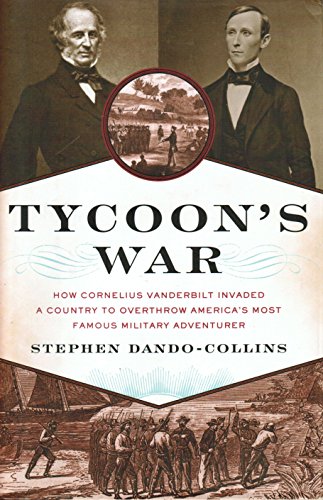
Tycoon's War: How Cornelius Vanderbilt Invaded a Country to Overthrow America's Most Famous Military Adventurer - Hardcover
Synopsis
When he died in 1877, Cornelius Vanderbilt, founder of the Vanderbilt dynasty, was wealthier than the U.S. Treasury. But he had nearly lost his fortune in 1856, when William Walker, a young Nashville genius, set out to conquer Central America and, in the process, take away Vanderbilt's most profitable shipping business. To win back his empire, Vanderbilt had to win a bloody war involving seven countries.
Tycoon's War tells the story of an epic imperialist duel—a violent battle of capitalist versus idealist, money versus ambition—and a monumental clash of egos that resulted in the deaths of thousands of Americans.
Written by a master storyteller, this incredible true story, impeccably researched and never before told in full, is packed with greed, intrigue, and some of the most hair-raising battle scenes ever written.
"synopsis" may belong to another edition of this title.
About the Author
Stephen Dando-Collins is an Australian-born historian who has written a number of fiction and non-fiction books, including Caesar's Legion and Standing Bear Is a Person. He lives in Tasmania.
Review
Dallas Morning News
“Stephen Dando-Collins did his homework in this tale of guns-trump-butter capitalism.”Augusta Metro Spirit
“An in-depth look at one of the more fascinating periods of Vanderbilt’s life with a crisp narrative built upon impeccable archival research. Tycoon’s War is a story of the celebration of greed during the expansion of these United States, which highlights the blood, cruelty and power struggle at the heart of American capitalism throughout the ages...Tycoon’s War is a classic story of conflict, desire, and the strive for success at all costs...Packed from cover to cover with greed and suspense, this book resonates with a contemporary America buried in a struggling economy where the rich buy yachts while the rest struggle to fill gas tanks...Built upon a fascinating display of historical events, this story strikes at the heart of the capitalist machine while raising questions about the nature of today’s wars and tomorrow’s tycoons. A smooth read that blends conflict and concern into a healthy mixture of greedy suspense, Dando-Collins has once again spun of a gem of a tale by crafting a narrative that allows us to view the past while seeking our own futures in a world often far beyond the control of the average person.”
Wall Street Journal, 8/30/08
“A fascinating window into an era when the rules of industrial capitalism were in their infancy and gunboat diplomacy was standard operating procedure...Dando-Collins tells this tale well, bringing the events and the personalities to vivid life. The book reads almost as a densely detailed screenplay treatment for a hell of a movie...A terrific read.”
Curled Up with a Good Book, 9/1/08
“Dando-Collins does an excellent job of turning his dedicated research into an easy-to-read narrative of the corruption, greed and murder that Vanderbilt epitomized...A frightening glimpse behind the façade of Cornelius Vanderbilt.”
Dallas Morning News, 9/7/08
“Stephen Dando-Collins did his homework in this tale of guns-trump-butter capitalism.”
Providence Journal, 11/2/08
“The sheer drama of the story, ably conveyed by Dando-Collins’ efficient prose, sweeps the reader along through the misadventure...[His] version of the tale reminds a 21st-century audience that nation-building by Americans on foreign soil is no new phenomenon.”
Charleston Post and Courier, 10/19/08
“This is one incredible story of adventurism gone wild...A story of blind ambition, the clash of wills, money and conquest—all the elements of a good story.”
Milwaukee Shepard Express, 11/6/08
“A page-turning history lesson in greed and folly...A sordid, fascinating and true tale.”
Southwest Journal of Cultures, November 2008
“A well-written and compelling story about an oft-overlooked chapter in U.S. history...A creative work, well worth the attention of those interested in the nineteenth century...The combination of industrial capitalism, mercenaries, greed, excess, and genius—combined with Dando-Collins’ storytelling capabilities—make this a very absorbing story, and one worth retelling.”
Military Heritage, 4/09
“An insightful look at American history...[An] absorbing story of greed and power in 19th-century America.”
“[An] absorbing tale of a conflict in 19th-century Central America sparked by two men with rather different ideas about Manifest Destiny...A dual biography of William Walker and Cornelius Vanderbilt...Dando-Collins juggles disparate elements to maintain cohesion in a convoluted history of military campaigns, changes in governments, complicated business transactions and bizarre backdoor diplomatic dealings.”John Steele Gordon, Wall Street Journal
“A fascinating window into an era when the rules of industrial capitalism were in their infancy and gunboat diplomacy was standard operating procedure...Dando-Collins tells this tale well, bringing the events and the personalities to vivid life. The book reads almost as a densely detailed screenplay treatment for a hell of a movie...A terrific read.”Shelf Awareness, 10/08
“A richly detailed recounting of the careers of William Walker and Cornelius Vanderbilt before 1855 and the epic battle of wills that raged between them during 1856 and 1857...A rip-roaring adventure that is also an object lesson in political and commercial exploitation of Central America at the hands of William Walker and Cornelius Vanderbilt, two larger-than-life 19th century American originals.”
Library Journal
“Dando-Collins presents the story readably.”Curled Up with a Good Book
“Dando-Collins does an excellent job of turning his dedicated research into an easy-to-read narrative of the corruption, greed and murder that Vanderbilt epitomized...A frightening glimpse behind the façade of Cornelius Vanderbilt.”Augusta Metro Spirit, 8/27/08
“A classic story of conflict, desire, and the strive for success at all costs...Packed from cover to cover with greed and suspense, this book resonates with a contemporary America buried in a struggling economy where the rich buy yachts while the rest struggle to fill gas tanks...A gem of a tale.”
"About this title" may belong to another edition of this title.
- PublisherDa Capo Press
- Publication date2008
- ISBN 10 0306816075
- ISBN 13 9780306816079
- BindingHardcover
- Edition number1
- Number of pages384
- Rating
Buy New
Learn more about this copy
US$ 24.97
Shipping:
US$ 3.25
Within U.S.A.
Other Popular Editions of the Same Title

Top Search Results from the AbeBooks Marketplace
Stock Image
Tycoon's War: How Cornelius Vanderbilt Invaded a Country to Overthrow America's Most Famous Military Adventurer
Seller: HPB-Emerald, Dallas, TX, U.S.A.
Seller rating 5 out of 5 stars

Hardcover. Condition: Very Good. Connecting readers with great books since 1972! Used books may not include companion materials, and may have some shelf wear or limited writing. We ship orders daily and Customer Service is our top priority!. Seller Inventory # S_402890541
Quantity: 1 available
Stock Image
Tycoon's War: How Cornelius Vanderbilt Invaded a Country to Overthrow America's Most Famous Military Adventurer
Seller: HPB-Diamond, Dallas, TX, U.S.A.
Seller rating 5 out of 5 stars
Hardcover. Condition: Very Good. Connecting readers with great books since 1972! Used books may not include companion materials, and may have some shelf wear or limited writing. We ship orders daily and Customer Service is our top priority!. Seller Inventory # S_401812872
Quantity: 1 available
Stock Image
Tycoon's War: How Cornelius Vanderbilt Invaded a Country to Overthrow America's Most Famous Military Adventurer
Seller: ThriftBooks-Atlanta, AUSTELL, GA, U.S.A.
Seller rating 5 out of 5 stars
Hardcover. Condition: Good. No Jacket. Former library book; Pages can have notes/highlighting. Spine may show signs of wear. ~ ThriftBooks: Read More, Spend Less 1.55. Seller Inventory # G0306816075I3N10
Quantity: 1 available
Stock Image
Tycoon's War: How Cornelius Vanderbilt Invaded a Country to Overthrow America's Most Famous Military Adventurer
Seller: ThriftBooks-Dallas, Dallas, TX, U.S.A.
Seller rating 5 out of 5 stars
Hardcover. Condition: Very Good. No Jacket. Former library book; May have limited writing in cover pages. Pages are unmarked. ~ ThriftBooks: Read More, Spend Less 1.55. Seller Inventory # G0306816075I4N10
Quantity: 1 available
Stock Image
Tycoon's War: How Cornelius Vanderbilt Invaded a Country to Overthrow America's Most Famous Military Adventurer
Seller: Orphans Treasure Box, Champaign, IL, U.S.A.
Seller rating 4 out of 5 stars

hardcover. Condition: Very Good. Ships quickly. Mild shelf/reading wear. Orphans Treasure Box sells books to raise money for orphans and vulnerable kids. Seller Inventory # BBJ9781853671586-07172024-EMH017
Quantity: 1 available
Stock Image
Tycoon's War: How Cornelius Vanderbilt Invaded a Country to Overthrow America's Most Famous Military Adventurer
Seller: HPB Inc., Dallas, TX, U.S.A.
Seller rating 5 out of 5 stars
Hardcover. Condition: Very Good. Connecting readers with great books since 1972! Used books may not include companion materials, and may have some shelf wear or limited writing. We ship orders daily and Customer Service is our top priority!. Seller Inventory # S_406883715
Quantity: 1 available
Stock Image
Tycoon's War: How Cornelius Vanderbilt Invaded a Country to Overthrow America's Most Famous Military Adventurer
Seller: Books Unplugged, Amherst, NY, U.S.A.
Seller rating 5 out of 5 stars
Condition: Good. Buy with confidence! Book is in good condition with minor wear to the pages, binding, and minor marks within 1.3. Seller Inventory # bk0306816075xvz189zvxgdd
Quantity: 1 available
Stock Image
Tycoon's War : How Cornelius Vanderbilt Invaded a Country to Overthrow America's Most Famous Military Adventurer
Seller: Better World Books: West, Reno, NV, U.S.A.
Seller rating 5 out of 5 stars
Condition: Very Good. Former library book; may include library markings. Used book that is in excellent condition. May show signs of wear or have minor defects. Seller Inventory # 4106346-6
Quantity: 1 available
Seller Image
Tycoon's War: How Cornelius Vanderbilt Invaded a Country to Overthrow America's Most Famous Military Adventurer
Published by
Da Capo Press, 2008
ISBN 10: 0306816075
ISBN 13: 9780306816079
Used
Hardcover
First Edition
Seller: Henniker Book Farm and Gifts, Henniker, NH, U.S.A.
Seller rating 5 out of 5 stars
Hardcover. Condition: Very Good. Dust Jacket Condition: Very Good. First Edition; First Printing. Very Good/Very Good Condition. No marks on the text block. No marks of previous ownership or inscription. First edition, first printing. ; Height: 9.75 Inches, Length: 6.25 Inches, Width: 1.25 Inches; 384 pages. Seller Inventory # 68380
Quantity: 1 available
Stock Image
Tycoon's War: How Cornelius Vanderbilt Invaded a Country to Overthrow America's Most Famous Military Adventurer
Published by
Da Capo Press, New York, 2008
ISBN 10: 0306816075
ISBN 13: 9780306816079
Used
Hardcover
First Edition
Seller: James & Mary Laurie, Booksellers A.B.A.A, Minneapolis, MN, U.S.A.
Seller rating 4 out of 5 stars
Hardcover. Condition: Book fine, Dust jacket fine. 1st. Seller Inventory # 9009587
Quantity: 1 available