
Items related to Jericho's Fall
Synopsis
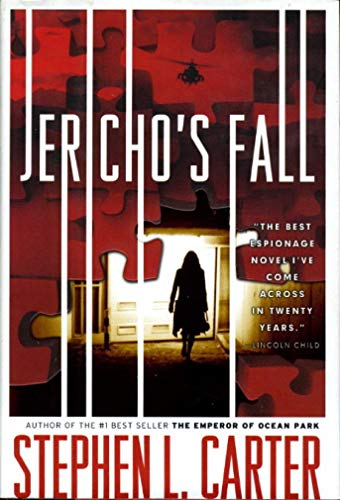
A riveting spy thriller, Jericho's Fall is the spellbinding story of a young woman running for her life from shadowy government forces.
In a secluded mountain retreat, Jericho Ainsley, former CIA director and former secretary of defense, is dying of cancer. To his bedside he has called Rebecca DeForde, a young, single mother, who was once his lover. Instead of simply bidding farewell, however, Ainsley imparts an explosive secret and DeForde finds herself thrown into a world of international intrigue, involving ex-CIA executives, local police, private investigators, and even a US senator. With no one to trust, DeForde is suddenly on the run, relying on her own wits and the lessons she learned from Ainsley to stay alive.
"synopsis" may belong to another edition of this title.
About the Author
Stephen L. Carter’s brilliant debut, The Emperor of Ocean Park, spent eleven weeks on the New York Times best-seller list. Now, in Jericho’s Fall, Carter turns his formidable talents to the shadowy world of spies, official secrecy, and financial fraud in a thriller that rivets the reader’s attention until the very last page.
In an imposing house in the Colorado Rockies, Jericho Ainsley, former head of the Central Intelligence Agency and a Wall Street titan, lies dying. He summons to his bedside Beck DeForde, the younger woman for whom he threw away his career years ago, miring them both in scandal. Beck believes she is visiting to say farewell. Instead, she is drawn into a battle over an explosive secret that foreign governments and powerful corporations alike want to wrest from Jericho before he dies.
An intricate and timely thriller that plumbs the emotional depths of a failed love affair and a family torn apart by mistrust, Jericho’s Fall takes us on a fast-moving journey through the secretive world of intelligence operations and the meltdown of the financial markets. And it creates, in Beck DeForde, an unforgettable heroine for our turbulent age.
Stephen L. Carter is the William Nelson Cromwell Professor of Law at Yale University, and the author of seven nonfiction books. Jericho’s Fall is his fourth novel. He and his family live in Connecticut.
Reviews
From The Washington Post's Book World/washingtonpost.com Reviewed by Patrick Anderson Jericho Ainsley, once the director of the Central Intelligence Agency, is dying of cancer in his well-fortified mountaintop home in Colorado. Rebecca (Beck) DeForde, who was his mistress 15 years earlier, when she was 19 and he was in his 50s, is summoned to his bedside. She is greeted by his two daughters: a Hollywood producer who hates her and a nun who purports to be her friend. They warn that the cancer has spread to their father's brain and that, despite moments of lucidity, he is mad. Jericho himself urges her to flee because an unidentified "they" will try to kill her and his daughters, too. But he also predicts that his close friend and CIA associate Dak Agadakos "is coming to the house to make me tell him certain things. After that, he plans to kill me." Thus begins Stephen L. Carter's "Jericho's Fall," an odd but readable mixture of spy thriller, literary novel and haunted-house mystery. In an author's note, Carter declares that the book's "only purpose is entertainment," and he provides plenty of that. When the book fails, it is because the author, who is a professor of law at Yale, tries too hard to entertain us. Even for a novel about a Machiavellian, possibly mad, ex-CIA director, this novel contains an alarming number of unsolved, probably unsolvable mysteries. Beck, our heroine, remains calm in the face of her ex-lover's warnings of violence: "Maybe Jericho was mad, maybe he was sane. Either way, he remained the same schemer he had always been, seeing the world as a series of conspiracies, to be defeated by counterconspiracies." Still, she is shaken when, after she goes for a morning run, she finds a newly killed, headless dog in the driveway. And that is only the first of many mysterious happenings. Cellphones and computers malfunction. The lights go out. Helicopters circle overhead, and mysterious strangers keep turning up. Two minor characters die suspiciously. The Ainsley daughter who is a nun turns out to have once been an interrogator for the CIA. The local sheriff is strangely hostile to Beck, although one of his deputies offers her not only protection but romance. It becomes clear that someone wants to kill Jericho, but it's not clear who or why. One possibility is that he has arranged for the release, after his death, of state secrets that would threaten old colleagues or even national security. Another is that he will reveal the truth about a Wall Street scandal in which an old CIA associate may have stolen billions of dollars. There are hints that it's the CIA itself, or some other government agency, that wants Jericho silenced. Beck, although determined to help Jericho, is increasingly aware that he may be using her for his own selfish ends and that she has no idea who is her friend and who her foe. Jericho remains unknowable, although Carter uses him to drop bits of CIA lore. At one point he says, on the subject of hired assassins: "We used to have a saying around the Agency. About who makes the best assassin. We said you need somebody crazy enough to pull the trigger, but sane enough not to miss." To an extent, Carter is basing his fiction on fact. He writes in his author's note, "The problem of mental illness among intelligence professionals is often said to be endemic." He adds, after citing several examples, "The longest shadow, however, is cast by James Jesus Angleton, whose counterintelligence work at the Agency from the sixties through the mid-seventies was clouded by a growing paranoia that tore the intelligence community apart." Angleton and the fictional Jericho Ainsley may share paranoia, but they are otherwise dissimilar: Jericho is presented as rich, aristocratic ("One of his ancestors had a traffic circle named for him in Washington"), charming and handsome -- not terms that suggest Angleton. "Jericho's Fall" builds toward an exciting ending when helicopters land, shots are fired, bombs go off, betrayals multiply, secrets are revealed, unexpected figures turn up, and the body count mounts steadily. It's an all-out, wham-bang climax that struck me as too exciting. Chapter after chapter ends, like the Saturday-afternoon serials of yore, with some new, often artificial climax. Beck keeps reminding herself that she must survive for the sake of her daughter (whose father may or may not be Jericho). It's all a bit much. Carter writes graceful prose, and he understands the mechanics of suspenseful storytelling, but he overdoes it here. I'm not sure that the story of an insane CIA director lends itself to the pure entertainment that Carter set out to write. A more serious novel might examine the mental health of hard-pressed intelligence officials -- preferably in Langley, not on a Colorado mountaintop -- but this action thriller isn't it.
Copyright 2009, The Washington Post. All Rights Reserved.
Despite a few doubts about the plausibility of the book's story line, most critics thoroughly enjoyed Jericho's Fall, a fast-paced thriller filled with intrigue, deception, and suspense. Carter guides Beck, his appealing, likeable heroine, through labyrinthine plot twists at breakneck speed, stopping along the way to shed light on the shady underbelly of the CIA, national security, and even Wall Street. Though the Boston Globe lamented the book's sacrifice of character in favor of complicated plot machinations, and the Washington Post considered the story line too melodramatic, most reviewers praised Carter's elegant writing and intricate maneuverings. The end result is a superbly enjoyable, gripping page-turner that will leave readers trying to catch their breath.
Bestseller Carter, who expertly blended social commentary and devious plots in his previous novels (The Emperor of Ocean Park; New England White; Palace Council), delivers a modest spy thriller, his first work of fiction not to focus on characters from what he has termed the darker nation. The sententious opening sentence (On the Sunday before the terror began, Rebecca DeForde pointed the rental car into the sullen darkness of her distant past) sets the tone for this minor effort. Rebecca has traveled to the Colorado Rockies to visit former CIA director Jericho Ainsley, who's dying of cancer. Jericho's decades of power and influence came to an end when he began an affair with her 15 years earlier. On arrival, Rebecca learns that shadowy forces fear that Jericho will reveal damaging Company secrets, and that his life is threatened by more than illness. Fans will miss the fully realized characters and mysterious puzzles of Carter's more complex, less predictable earlier work. Author tour. (July)
Copyright © Reed Business Information, a division of Reed Elsevier Inc. All rights reserved.
Excerpt. © Reprinted by permission. All rights reserved.
The Mountain
(i)
Darkness bore down on her as the car shuddered up the mountain. Distant lights danced at the edge of her vision, then vanished. Beck wondered how bad it would be. In her mind, she saw only the Jericho she had loved fifteen yeas ago and, in some ways, still did: the dashing scion of an old New England family that had provided government officials since the Revolution. One of his ancestors had a traffic circle named for him in Washington. A cousin served in the Senate. The family’s history was overwhelming; the Jericho for whom Beck had fallen had certainly overwhelmed her. He had been brilliant, and powerful, and confident, and fun, ever ready with eternal wisdom, or clever barbs. She did not like to think of that mighty man ravaged by disease. She had no illusions. She remembered what cancer had done to her own father.
Whatever was waiting, she had to go.
On Saturday afternoon, having cleared her decks with Pfister, Beck took the shuttle from Boston to Washington. She lived in Virginia, a stone’s throw from Reagan National Airport. Her daughter was at a church retreat, church being a thing that Beck did because she had been raised that way, and her mother would be offended if Rebecca dared differ. Beck decided to let Nina stay the night with the other kids. The two of them could ride together to the airport on Sunday, then enplane for their different destinations. Rebecca’s mother, Jacqueline, had been after her for weeks to send Nina for a visit, and maybe this was the time. The child was only in second grade; missing a few days of instruction would do her no harm. Beck hesitated, then made the inevitable call to Florida, to ask if her mother could look after Nina. The conversation soon turned into a battle.
I don’t know how you could even think about taking a six-year-old to visit a man like that.
I’m not taking her, Mom. That’s why I’m calling you.
You said you decided not to take her. That means you thought about it. I don’t understand how your mind works sometimes.
She tried, and failed, to remember a time when she and her mother had not been at odds. Because, in the eyes of her eternally disappointed mother, Beck would never be more than ten years old. Certainly their animosity predated Jericho; and perhaps it had played some sort of role (as every one of the therapists Rebecca had consulted over the years seemed to think) in her falling in love, as a college sophomore, with a married man thirty-two years her senior who tossed away his remarkable career in order to possess her.
I appreciate your help, Mom.
Oh, so you appreciate me now. Does that mean you’ll call more often?
But Beck rarely called anybody. She was not the calling sort. She lived in a cookie-cutter townhouse in Alexandria, along with her daughter and the cat, and when she was not homemaking or child-rearing she was working. Her mother had married young, and was supported by her husband until the day he died. Beck’s marriage had lasted less than two years. The thing with Jericho had ruined Rebecca for men, her mother insisted; and maybe it was true. Her mother was full of certitudes about the errors of others, and for the next few days would fill Nina’s mind with her fevered dogmas. Hating herself, Beck had put her daughter on the plane to Florida anyway; and Nina, cradling the cat carrier, had marched regally into the jetway, never turning her head for a final wave, because she was a lot more like her grandmother than like her mother.
Or maybe not. Rebecca herself had been a feisty child, curious and willful and prepared at any moment to be disobedient. She had always pretended that she was fine without her mother, perhaps because her mother spent so much time insisting on the opposite. Her rebelliousness had led her into trouble all her life, including at her pricey private high school, where a protest against the dress code had led to a suspension; and at Princeton, where a star wide receiver tried to have his way with the reluctant freshman and wound up with a broken nose for his troubles, missing half the season. A year later, she had wound up in Jericho’s bed. Maybe Nina was not like her grandmother at all, but simply a younger version of Beck—a possibility too scary to contemplate.
(ii)
Lights on her tail. Was she being followed?
A wiser woman, Beck told herself, would have dismissed such a notion as the sort of nonsense that always sneaked into her head when she thought about Jericho. In the chilly night hours on a lonely and lightless mountain road, however, when the same pair of headlights kept slipping in and out of the fog, it was easier to be fearful than wise.
She accelerated—no easy matter for the little rental car—and the headlights vanished. She slowed to round a curve, and they were behind her again.
“How do you know they’re the same headlights?” she sneered.
She just knew. She knew because the years had slipped away and she was back in Jericho’s world, a world where a canoodling couple at the next table in a restaurant at a resort in Barbados meant you were under surveillance, where the maid at the Ritz planted bugs in the bedroom, where unexpected cars in the middle of the Yucatán were packed with terrorists ready to exact revenge for your earnest defense of your country.
She reminded herself that Jericho’s paranoia no longer guided her life, but her foot pressed harder anyway, and the little car shuddered ahead. She shot down into the valley and passed through half a town. It began to snow. She climbed again, breasted the rise, went around a curve, and suddenly was suspended in nothing.
No headlights behind her, no road in front of her.
Then she almost drove over the cliff.
Things like that happened in the Rockies, not metaphorically but in reality, especially in the middle of the night, when you daydreamed your way into an unexpected nighttime snowstorm—unexpected because in Beck’s corner of the country, the worst that ever happened in April was rain. At ten thousand feet, as she was beginning to remember, the weather was different. One moment, hypnotized by the cone of her headlights as it illuminated the shadowy road ahead and the dark trees rushing by on either side, Beck was gliding along, totting up the errors of her life; then, before she realized what was happening, heavy flakes were swirling thickly around her, and the road had vanished.
Rebecca slowed, then slewed, the front end mounting an unseen verge, the rear end fishtailing, but by then her winter smarts had returned, and she eased the wheel over in the direction of the skid. The car swiveled and bumped and came to rest ten yards off the road. She sat still, breath hitching. No headlights behind her, or up on the road, or anywhere else.
“False alarm,” Beck muttered, furious at herself for having let Jericho back into her head, gleefully whispering his mad cautions.
She set the brake and opened the door and found, to her relief, that she was not in a ditch or a snowbank. She could back the car uphill onto the tarmac. But turning around would be easier, if there was room. Shivering as the cold leached into her fashionable boots, she squinted ahead, checking to make sure that she had room enough. The whirl of snow was slowing. She had trouble judging the distance. The beams of her headlights were swallowed up by a stand of conifers dead ahead, but there was plenty of room. Except, when she looked again, the trees were a forest, and miles away, on the other side of a steep gorge. Her toes skirted the edge. She shuffled backward. Had she tried to turn around instead of backing up, she would likely have gone over.
There in a nutshell was life since Jericho: backing up and backing up, never taking chances. One plunge over the cliff was enough for any life.
Beck stood at the edge and peered into the yawning darkness. High up on the opposite slope, she could pick out what had to be the lights of Jericho’s vast house. His family wealth had purchased the property, and the scandal of their relationship had sentenced him to life imprisonment within. She had dropped out of college. He had dropped out of much more. She did the arithmetic, all the presidential ears into which he had whispered his devious advice. She remembered the year they met, the start of his indefinite sabbatical from public life, spent among the lawns of Princeton, the hushed and reverent tones in which the faculty murmured Jericho’s name. She remembered how his seminars were interrupted almost weekly by protesters branding him a war criminal; and the relish with which he had baited his young accusers, demanding that they explain which of the regimes he was alleged to have overthrown they would have preferred to preserve, and why.
Since leaving government service, Jericho had published half a dozen books on international politics, but nobody cared any more. Hardly anyone remembered who he was, or had been. Not two months ago, she had found his recent nine-hundred-page tome on the achievement of peace in the Middle East remaindered at Barnes & Noble, going for three dollars and ninety-nine cents.
Her cell phone vibrated on her hip. Beck was surprised. Usually there was no service up here, but every now and then one found a patch of mountain digitally linked to the rest of the world. She fished the phone from her jacket. The screen said the number was unknown. When she answered, she got a blast of static in her ear, followed by a whine like a fax signal. Annoyed, she cut off the call. The phone immediately rang again, another unknown number, the same screech in her ear. No third ring. She decided to test her momentary connectedness by checking her messages, but when she tried she had no bars.
So how had whoever it was called her? She walked back and forth in the clearing, but found no service anywhere.
Never...
"About this title" may belong to another edition of this title.
Search results for Jericho's Fall

Stock Image
Jericho's Fall
Seller: World of Books (was SecondSale), Montgomery, IL, U.S.A.
Seller rating 5 out of 5 stars

Hardback. Condition: Fair. A riveting spy thriller, Jericho's Fall is the spellbinding story of a young woman running for her life from shadowy government forces. In a secluded mountain retreat, Jericho Ainsley, former CIA director and former secretary of defense, is dying of cancer. To his bedside he has called Rebecca DeForde, a young, single mother, who was once his lover. Instead of simply bidding farewell, however, Ainsley imparts an explosive secret and DeForde finds herself thrown into a world of international intrigue, involving ex-CIA executives, local police, private investigators, and even a US senator. With no one to trust, DeForde is suddenly on the run, relying on her own wits and the lessons she learned from Ainsley to stay alive. Seller Inventory # 00108740372
Stock Image
Jericho's Fall
Seller: World of Books (was SecondSale), Montgomery, IL, U.S.A.
Seller rating 5 out of 5 stars
Hardback. Condition: Good. A riveting spy thriller, Jericho's Fall is the spellbinding story of a young woman running for her life from shadowy government forces. In a secluded mountain retreat, Jericho Ainsley, former CIA director and former secretary of defense, is dying of cancer. To his bedside he has called Rebecca DeForde, a young, single mother, who was once his lover. Instead of simply bidding farewell, however, Ainsley imparts an explosive secret and DeForde finds herself thrown into a world of international intrigue, involving ex-CIA executives, local police, private investigators, and even a US senator. With no one to trust, DeForde is suddenly on the run, relying on her own wits and the lessons she learned from Ainsley to stay alive. Seller Inventory # 00090056255
Stock Image
Jericho's Fall
Seller: HPB-Diamond, Dallas, TX, U.S.A.
Seller rating 5 out of 5 stars
hardcover. Condition: Very Good. Connecting readers with great books since 1972! Used books may not include companion materials, and may have some shelf wear or limited writing. We ship orders daily and Customer Service is our top priority! Seller Inventory # S_474876454
Stock Image
Jericho's Fall
Seller: BooksRun, Philadelphia, PA, U.S.A.
Seller rating 5 out of 5 stars
Hardcover. Condition: Very Good. With dust jacket. It's a well-cared-for item that has seen limited use. The item may show minor signs of wear. All the text is legible, with all pages included. It may have slight markings and/or highlighting. Seller Inventory # 0307272621-11-1-29
Stock Image
Jericho's Fall
Seller: Wonder Book, Frederick, MD, U.S.A.
Seller rating 5 out of 5 stars
Condition: Good. Good condition. Like New dust jacket. A copy that has been read but remains intact. May contain markings such as bookplates, stamps, limited notes and highlighting, or a few light stains. Seller Inventory # Z03N-00373
Stock Image
Jericho's Fall
Seller: Wonder Book, Frederick, MD, U.S.A.
Seller rating 5 out of 5 stars
Condition: As New. Like New condition. Like New dust jacket. A near perfect copy that may have very minor cosmetic defects. Seller Inventory # K11A-04397
Stock Image
Jericho's Fall
Seller: ThriftBooks-Atlanta, AUSTELL, GA, U.S.A.
Seller rating 5 out of 5 stars
Hardcover. Condition: Very Good. No Jacket. May have limited writing in cover pages. Pages are unmarked. ~ ThriftBooks: Read More, Spend Less. Seller Inventory # G0307272621I4N00
Stock Image
Jericho's Fall
Seller: ThriftBooks-Dallas, Dallas, TX, U.S.A.
Seller rating 5 out of 5 stars
Hardcover. Condition: Good. No Jacket. Former library book; Pages can have notes/highlighting. Spine may show signs of wear. ~ ThriftBooks: Read More, Spend Less. Seller Inventory # G0307272621I3N10
Stock Image
Jericho's Fall
Seller: ThriftBooks-Dallas, Dallas, TX, U.S.A.
Seller rating 5 out of 5 stars
Hardcover. Condition: Very Good. No Jacket. May have limited writing in cover pages. Pages are unmarked. ~ ThriftBooks: Read More, Spend Less. Seller Inventory # G0307272621I4N00
Stock Image
Jericho's Fall
Seller: GoldBooks, Denver, CO, U.S.A.
Seller rating 5 out of 5 stars
Hardcover. Condition: very good. Very Good Copy. Customer Service Guaranteed. Seller Inventory # 23E23_8_0307272621