Items related to The Engagements
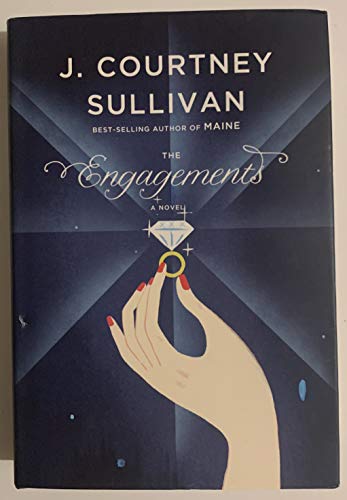

From the New York Times best-selling author of Commencement and Maine comes a gorgeous, sprawling novel about marriage—about those who marry in a white heat of passion, those who marry for partnership and comfort, and those who live together, love each other, and have absolutely no intention of ruining it all with a wedding.
Evelyn has been married to her husband for forty years—forty years since he slipped off her first wedding ring and put his own in its place. Delphine has seen both sides of love—the ecstatic, glorious highs of seduction, and the bitter, spiteful fury that descends when it’s over. James, a paramedic who works the night shift, knows his wife’s family thinks she could have done better; while Kate, partnered with Dan for a decade, has seen every kind of wedding—beach weddings, backyard weddings, castle weddings—and has vowed never, ever, to have one of her own.
As these lives and marriages unfold in surprising ways, we meet Frances Gerety, a young advertising copywriter in 1947. Frances is working on the De Beers campaign and she needs a signature line, so, one night before bed, she scribbles a phrase on a scrap of paper: “A Diamond Is Forever.” And that line changes everything.
A rich, layered, exhilarating novel spanning nearly a hundred years, The Engagements captures four wholly unique marriages, while tracing the story of diamonds in America, and the way—for better or for worse—these glittering stones have come to symbolize our deepest hopes for everlasting love.
"synopsis" may belong to another edition of this title.
About the Author:
Excerpt. © Reprinted by permission. All rights reserved.:
J. Courtney Sullivan is the author of the New York Times best-selling novels Commencement and Maine. Maine was named a Best Book of the Year by Time magazine and a Washington Post Notable Book for 2011. Her writing has also appeared in The New York Times, the Chicago Tribune, The Wall Street Journal, Glamour, Allure, Real Simple, and New York magazine, among others. She lives in Brooklyn, New York.
1947
Frances poured the last bitter remains of the coffeepot into her cup. The small kitchen table was covered in paper: layouts, copies of confidential reports, lousy ideas she had scrapped hours ago, and good ones, already published in Look, Vogue, The Saturday Evening Post, Life, and Harper’s Bazaar, to remind her that she had done it before and could do it again.
For once, the apartment building was silent. Usually, from off in some distant corner she could hear a baby crying, a couple arguing, a toilet flushing. But it was past three a.m. The revelers had long been asleep, and the milkmen weren’t yet awake.
Her roommate had gone to bed around ten— at the sight of her standing there in her nightgown and curlers, Frances was overcome with professional jealousy, even though Ann was only a secretary in a law office, who would spend tomorrow the same way she spent every day, fetching coffee and taking dictation.
Frances had just finished writing the newest De Beers copy, a honeymoon series with pictures of pretty places newlyweds might go— the rocky coast of Maine! Arizona! Paris! And something generic for people without much money, which she labeled By the river.
In a way, that one was the most important of them all, since they were trying to appeal to the average Joe. A decade earlier, when De Beers first came on as a client, the agency had done a lot of surveying to find out the strength— or really the weakness— of the diamond engagement ring tradition. In those days, not many women had wanted one. It was considered just absolutely money down the drain. They’d take a washing machine or a new car, anything but an expensive diamond ring. She had helped to
change all that.
The honeymoon ads read, May your happiness last as long as your diamond. A pretty good line, she thought.
“Time for bed, Frank,” she whispered to herself, the same words her mother had whispered to her every night when she was a child.
She was just about to switch off the light when she saw the blank signature line that the art director had drawn on the layouts, which she was meant to fill in by morning.
“Rats.”
Frances sat back down, lit a cigarette, and picked up a pencil.
A day earlier, Gerry Lauck, head of the New York office, had called her.
“I think we should have something that identifies this as diamond advertising,” he said. “A signature line. What do you think?”
When Gerry Lauck asked what you thought, it was wise to understand that he was not actually asking. In her opinion, the man was a genius. Unpredictable and a bit gloomy at times, but perhaps all geniuses were like that.
“Yes, perfect,” she said.
Gerry looked like Winston Churchill, he acted like Winston Churchill, and sometimes Frances believed he thought he was Winston Churchill. He even had fits of depression. The first time she had to go to New York to show him her ideas, she was scared to death. Gerry looked them over, his face giving no indication of what he thought. After several torturous minutes, he smiled and said, “Frances, you write beautifully. More important, you know how to sell.”
They had liked each other ever since. Half the employees of N. W. Ayer were afraid of Gerry Lauck, or couldn’t stand him. The other half thought he hung the moon, and Frances was one of them.
“The line shouldn’t say anything about De Beers, of course,” Gerry continued over the phone.
“Of course.”
For nine years, De Beers had spent millions on ads that barely mentioned the company itself. To even name it as a distributor would be breaking the law. So the advertisements were simply for diamonds, and they were beautiful. Ayer pulled out all the stops. They couldn’t show pictures of diamond jewelry in the ads, which left the art department in a pickle. In theory, Gerry had nothing to do with creative. He was a straight-up businessman and just handed out the assignments. But as an art lover, he thought to commission a series of original paintings from Lucioni, Berman, Lamotte, and Dame Laura Knight. He purchased preexisting works from some of the finest galleries in Europe for the De Beers collection, by Dalí, Picasso, and Edzard.
The resulting four- color ads showed gorgeous landscapes, cities, cathedrals. Printed on the page, just below the artist’s creation, would be a box displaying illustrations of stones, ranging from half a carat to three carats, along with approximate prices for each. Gerry was the first person to create an ad campaign featuring fine art. A year or two later, everyone in the business was doing it.
“I’ll need the tagline by tomorrow,” Gerry said. “I’ll be in to Philadelphia in the morning and then on to South Africa by late afternoon.”
“Sure thing,” Frances said, and then promptly forgot all about it until now, the middle of the night.
She sighed. If she hadn’t been bucking all her life for the title of World’s Biggest Procrastinator, maybe she ’d get some sleep one of these days. She knew she had to work tonight, but still she had stayed out with her pal Dorothy Dignam until Dorothy had to catch the nine o’clock train back to Penn Station.
Dorothy started as an Ayer copywriter in the Philadelphia office in 1930, but soon after Frances came to the agency four years back, Dorothy moved to the New York office at 30 Rockefeller Center to head up the public relations department. Like Frances, De Beers was her main priority. They had publicists in Miami, Hollywood, and Paris, too, just for this one client. Dorothy had even arranged for the creation of a short film with Columbia Pictures, The Magic Stone: Diamonds Through the Centuries. It started playing in theaters in September 1945 and by the time the run was over, it had been seen by more than fifteen million people.
Her friend would never tell her age, but Frances guessed that Dorothy was at least a decade and a half older than she was, probably about fifty. She had been in advertising in Chicago in the last year of the First World War. She was the Chicago Herald’s society reporter at seventeen years old and stayed until the day Mr. Hearst moved in and moved her out. She went from there to the offices of the Contented Cow milk company as a copywriter, and later to Ayer.
Dorothy was a real hot ticket. She was something of a model for Frances. She had traveled the world for Ayer in the thirties, working in London, Paris, and Geneva for Ford, sailing to Norway and Sweden to study household electrical progress. She even made frequent visits to Hollywood, where she went to the Trocadero for dinner and saw all the stars. She once ran into Joan Crawford in Bullocks Wilshire. Dorothy bought size 16 of the dress that Joan had purchased in size 14. Just an inexpensive black daytime frock and very useful to both of us, I’m sure was how she had described it in a postcard she sent.
Their dinner tonight had started off as a business meeting, but after two martinis each they were laughing uproariously at a table at Bookbinder’s, eating oysters and telling jokes about the fellas at work. They were endlessly amused by the things they were expected to know as women in the office. A few years ago, Dorothy started keeping a sheet of paper in the vacant drawer under her typewriter, and every question that was asked of her, she typed down.
Tonight, she had read Frances a few of the latest: “How should a woman look when her son is seventeen? Could a winter hat have a bird’s nest on it? Is Macy’s singular or plural? Do women ever warble in the bathtub? What’s the difference between suede and buck? Does Queen Mary have a nice complexion? How many times a day do you feed a baby? Is this thing an inverted pleat?”
They had had a ball, but now Frances would have to pay the price.
She glanced at a sheet of paper, a recent strategy plan, and read, We are dealing primarily with a problem in mass psychology. We seek to maintain and strengthen the tradition of the diamond engagement ring— to make it a psychological necessity. Target audience: some seventy million people fifteen years and over whose opinion we hope to influence in support of our objectives.
Well, that narrowed it down nicely.
In 1938, a representative of Sir Ernest Oppenheimer, president of De Beers Consolidated Mines, wrote to Ayer to inquire whether, as he put it, “the use of propaganda in various forms” might boost the sales of diamonds in America.
The Depression had caused diamond prices to plummet around the world. Consumer interest had all but vanished. There were only half as many diamonds sold in America as there had been before the war, and the few diamond engagement rings still being purchased were inexpensive and small. De Beers had reserve stocks they couldn’t possibly sell. Oppenheimer was eager to bring the diamond engagement ring to prominence in the United States, and he had it on good authority that Ayer was the best in the business, the only agency for the job. He proposed a campaign at $500,000 annually for the first three years.
What Ayer had done for De Beers was a true testament to the power of advertising. By 1941, diamond sales had increased by 55 percent. After the Second World War, the number of weddings in America soared, and diamonds went right along with them. The price of diamonds went up, too: Today, a two- carat diamond could range in price from $1,500 to $3,300. In 1939, it would have been $900 to $1,750.
They had created a whole new sort of advertising for this campaign, and other agencies had been copying it ever since. In the absence of a direct sale to be made, or a brand name to be introduced, there was only an idea: the emotional currency attached to a diamond.
De Beers produced less than they could, to keep supply low and price high. Not only did their advertising approach boost sales, it also ensured that, once sold, a diamond would never return to the marketplace. After Frances got finished pulling their heartstrings, widows or even divorcées would not want to part with their rings.
On occasion over the years, she had imagined what the Oppenheimers must look like. The peculiar particulars of their relationship stoked her imagination, making her wonder what their faces did when they saw her newest ideas. Were there raised eyebrows? Slight smiles? Exclamations?
It was unusual for her not to have met a client, but De Beers was prohibited from coming to the United States because of the cartel. The company controlled the world supply of rough diamonds, a monopoly so strong that the mere presence of its representatives in America violated the law. They operated out of Johannesburg and London. Once a year, Gerry Lauck took the ads she wrote to South Africa in a thick leatherbound book for their approval. He kept a set of golf clubs there, since it was easier than lugging them back and forth from New York.
The fi rst time Gerry went to Johannesburg to present market research to the Oppenheimers, the small seaplane he was traveling on made a crash landing off the Island of Mozambique. He used the large mounted maps and charts he had brought along as flotation devices to get to shore. Two others on board died, and The New York Times ran the headline airliner is wrecked in southeast africa: american escapes injury. Gerry felt that the presentation quite literally saved his life, and perhaps for that reason, he was willing to do whatever it took for De Beers.
Her roommate let out a great snore in the next room, interrupting Frances’s thoughts.
Ann was waiting on a marriage proposal from a dull accountant she had been dating for a while now. After that, Frances would be back on the hunt for a new roommate, as had tended to happen every few months or so since the war ended. Rose, Myrtle, Hildy: one by one, she had lost them all to matrimony. But she was up for a promotion at the office, so perhaps when Ann left she could finally afford to live alone.
When Frances started working at Ayer four years ago, at the age of twenty- eight, she had convinced her parents that it was time for her to move away from home and into the city. But her paycheck demanded that she get a roommate to help with the rent. She wanted a house of her own on the Main Line. Then she ’d never have to worry about getting enough hot water in the shower on winter mornings, or tolerating Ann’s nasally soprano as she accompanied Dinah Shore on the radio at night. She relished and reamed about the prospect of living alone, the same way most single girls probably dreamed about married life.
Frances ran a finger over one of her new honeymoon ads. Other women never seemed to think about what came next. They were so eager to be paired up, as if marriage was known to be full of splendor. Frances was the opposite: she could never stop thinking about it. She might go to dinner or out dancing with someone new, and have a fi ne time. But when she got home and climbed into bed afterward, her heart would race with fear. If she went out with him again, then they might go out again after that. Eventually, she would have to take him home to be evaluated by her parents, and vice versa. Then he would propose. And she, like all the other working girls who had married before her, would simply disappear into a life of motherhood and isolation.
Frances poured the last bitter remains of the coffeepot into her cup. The small kitchen table was covered in paper: layouts, copies of confidential reports, lousy ideas she had scrapped hours ago, and good ones, already published in Look, Vogue, The Saturday Evening Post, Life, and Harper’s Bazaar, to remind her that she had done it before and could do it again.
For once, the apartment building was silent. Usually, from off in some distant corner she could hear a baby crying, a couple arguing, a toilet flushing. But it was past three a.m. The revelers had long been asleep, and the milkmen weren’t yet awake.
Her roommate had gone to bed around ten— at the sight of her standing there in her nightgown and curlers, Frances was overcome with professional jealousy, even though Ann was only a secretary in a law office, who would spend tomorrow the same way she spent every day, fetching coffee and taking dictation.
Frances had just finished writing the newest De Beers copy, a honeymoon series with pictures of pretty places newlyweds might go— the rocky coast of Maine! Arizona! Paris! And something generic for people without much money, which she labeled By the river.
In a way, that one was the most important of them all, since they were trying to appeal to the average Joe. A decade earlier, when De Beers first came on as a client, the agency had done a lot of surveying to find out the strength— or really the weakness— of the diamond engagement ring tradition. In those days, not many women had wanted one. It was considered just absolutely money down the drain. They’d take a washing machine or a new car, anything but an expensive diamond ring. She had helped to
change all that.
The honeymoon ads read, May your happiness last as long as your diamond. A pretty good line, she thought.
“Time for bed, Frank,” she whispered to herself, the same words her mother had whispered to her every night when she was a child.
She was just about to switch off the light when she saw the blank signature line that the art director had drawn on the layouts, which she was meant to fill in by morning.
“Rats.”
Frances sat back down, lit a cigarette, and picked up a pencil.
A day earlier, Gerry Lauck, head of the New York office, had called her.
“I think we should have something that identifies this as diamond advertising,” he said. “A signature line. What do you think?”
When Gerry Lauck asked what you thought, it was wise to understand that he was not actually asking. In her opinion, the man was a genius. Unpredictable and a bit gloomy at times, but perhaps all geniuses were like that.
“Yes, perfect,” she said.
Gerry looked like Winston Churchill, he acted like Winston Churchill, and sometimes Frances believed he thought he was Winston Churchill. He even had fits of depression. The first time she had to go to New York to show him her ideas, she was scared to death. Gerry looked them over, his face giving no indication of what he thought. After several torturous minutes, he smiled and said, “Frances, you write beautifully. More important, you know how to sell.”
They had liked each other ever since. Half the employees of N. W. Ayer were afraid of Gerry Lauck, or couldn’t stand him. The other half thought he hung the moon, and Frances was one of them.
“The line shouldn’t say anything about De Beers, of course,” Gerry continued over the phone.
“Of course.”
For nine years, De Beers had spent millions on ads that barely mentioned the company itself. To even name it as a distributor would be breaking the law. So the advertisements were simply for diamonds, and they were beautiful. Ayer pulled out all the stops. They couldn’t show pictures of diamond jewelry in the ads, which left the art department in a pickle. In theory, Gerry had nothing to do with creative. He was a straight-up businessman and just handed out the assignments. But as an art lover, he thought to commission a series of original paintings from Lucioni, Berman, Lamotte, and Dame Laura Knight. He purchased preexisting works from some of the finest galleries in Europe for the De Beers collection, by Dalí, Picasso, and Edzard.
The resulting four- color ads showed gorgeous landscapes, cities, cathedrals. Printed on the page, just below the artist’s creation, would be a box displaying illustrations of stones, ranging from half a carat to three carats, along with approximate prices for each. Gerry was the first person to create an ad campaign featuring fine art. A year or two later, everyone in the business was doing it.
“I’ll need the tagline by tomorrow,” Gerry said. “I’ll be in to Philadelphia in the morning and then on to South Africa by late afternoon.”
“Sure thing,” Frances said, and then promptly forgot all about it until now, the middle of the night.
She sighed. If she hadn’t been bucking all her life for the title of World’s Biggest Procrastinator, maybe she ’d get some sleep one of these days. She knew she had to work tonight, but still she had stayed out with her pal Dorothy Dignam until Dorothy had to catch the nine o’clock train back to Penn Station.
Dorothy started as an Ayer copywriter in the Philadelphia office in 1930, but soon after Frances came to the agency four years back, Dorothy moved to the New York office at 30 Rockefeller Center to head up the public relations department. Like Frances, De Beers was her main priority. They had publicists in Miami, Hollywood, and Paris, too, just for this one client. Dorothy had even arranged for the creation of a short film with Columbia Pictures, The Magic Stone: Diamonds Through the Centuries. It started playing in theaters in September 1945 and by the time the run was over, it had been seen by more than fifteen million people.
Her friend would never tell her age, but Frances guessed that Dorothy was at least a decade and a half older than she was, probably about fifty. She had been in advertising in Chicago in the last year of the First World War. She was the Chicago Herald’s society reporter at seventeen years old and stayed until the day Mr. Hearst moved in and moved her out. She went from there to the offices of the Contented Cow milk company as a copywriter, and later to Ayer.
Dorothy was a real hot ticket. She was something of a model for Frances. She had traveled the world for Ayer in the thirties, working in London, Paris, and Geneva for Ford, sailing to Norway and Sweden to study household electrical progress. She even made frequent visits to Hollywood, where she went to the Trocadero for dinner and saw all the stars. She once ran into Joan Crawford in Bullocks Wilshire. Dorothy bought size 16 of the dress that Joan had purchased in size 14. Just an inexpensive black daytime frock and very useful to both of us, I’m sure was how she had described it in a postcard she sent.
Their dinner tonight had started off as a business meeting, but after two martinis each they were laughing uproariously at a table at Bookbinder’s, eating oysters and telling jokes about the fellas at work. They were endlessly amused by the things they were expected to know as women in the office. A few years ago, Dorothy started keeping a sheet of paper in the vacant drawer under her typewriter, and every question that was asked of her, she typed down.
Tonight, she had read Frances a few of the latest: “How should a woman look when her son is seventeen? Could a winter hat have a bird’s nest on it? Is Macy’s singular or plural? Do women ever warble in the bathtub? What’s the difference between suede and buck? Does Queen Mary have a nice complexion? How many times a day do you feed a baby? Is this thing an inverted pleat?”
They had had a ball, but now Frances would have to pay the price.
She glanced at a sheet of paper, a recent strategy plan, and read, We are dealing primarily with a problem in mass psychology. We seek to maintain and strengthen the tradition of the diamond engagement ring— to make it a psychological necessity. Target audience: some seventy million people fifteen years and over whose opinion we hope to influence in support of our objectives.
Well, that narrowed it down nicely.
In 1938, a representative of Sir Ernest Oppenheimer, president of De Beers Consolidated Mines, wrote to Ayer to inquire whether, as he put it, “the use of propaganda in various forms” might boost the sales of diamonds in America.
The Depression had caused diamond prices to plummet around the world. Consumer interest had all but vanished. There were only half as many diamonds sold in America as there had been before the war, and the few diamond engagement rings still being purchased were inexpensive and small. De Beers had reserve stocks they couldn’t possibly sell. Oppenheimer was eager to bring the diamond engagement ring to prominence in the United States, and he had it on good authority that Ayer was the best in the business, the only agency for the job. He proposed a campaign at $500,000 annually for the first three years.
What Ayer had done for De Beers was a true testament to the power of advertising. By 1941, diamond sales had increased by 55 percent. After the Second World War, the number of weddings in America soared, and diamonds went right along with them. The price of diamonds went up, too: Today, a two- carat diamond could range in price from $1,500 to $3,300. In 1939, it would have been $900 to $1,750.
They had created a whole new sort of advertising for this campaign, and other agencies had been copying it ever since. In the absence of a direct sale to be made, or a brand name to be introduced, there was only an idea: the emotional currency attached to a diamond.
De Beers produced less than they could, to keep supply low and price high. Not only did their advertising approach boost sales, it also ensured that, once sold, a diamond would never return to the marketplace. After Frances got finished pulling their heartstrings, widows or even divorcées would not want to part with their rings.
On occasion over the years, she had imagined what the Oppenheimers must look like. The peculiar particulars of their relationship stoked her imagination, making her wonder what their faces did when they saw her newest ideas. Were there raised eyebrows? Slight smiles? Exclamations?
It was unusual for her not to have met a client, but De Beers was prohibited from coming to the United States because of the cartel. The company controlled the world supply of rough diamonds, a monopoly so strong that the mere presence of its representatives in America violated the law. They operated out of Johannesburg and London. Once a year, Gerry Lauck took the ads she wrote to South Africa in a thick leatherbound book for their approval. He kept a set of golf clubs there, since it was easier than lugging them back and forth from New York.
The fi rst time Gerry went to Johannesburg to present market research to the Oppenheimers, the small seaplane he was traveling on made a crash landing off the Island of Mozambique. He used the large mounted maps and charts he had brought along as flotation devices to get to shore. Two others on board died, and The New York Times ran the headline airliner is wrecked in southeast africa: american escapes injury. Gerry felt that the presentation quite literally saved his life, and perhaps for that reason, he was willing to do whatever it took for De Beers.
Her roommate let out a great snore in the next room, interrupting Frances’s thoughts.
Ann was waiting on a marriage proposal from a dull accountant she had been dating for a while now. After that, Frances would be back on the hunt for a new roommate, as had tended to happen every few months or so since the war ended. Rose, Myrtle, Hildy: one by one, she had lost them all to matrimony. But she was up for a promotion at the office, so perhaps when Ann left she could finally afford to live alone.
When Frances started working at Ayer four years ago, at the age of twenty- eight, she had convinced her parents that it was time for her to move away from home and into the city. But her paycheck demanded that she get a roommate to help with the rent. She wanted a house of her own on the Main Line. Then she ’d never have to worry about getting enough hot water in the shower on winter mornings, or tolerating Ann’s nasally soprano as she accompanied Dinah Shore on the radio at night. She relished and reamed about the prospect of living alone, the same way most single girls probably dreamed about married life.
Frances ran a finger over one of her new honeymoon ads. Other women never seemed to think about what came next. They were so eager to be paired up, as if marriage was known to be full of splendor. Frances was the opposite: she could never stop thinking about it. She might go to dinner or out dancing with someone new, and have a fi ne time. But when she got home and climbed into bed afterward, her heart would race with fear. If she went out with him again, then they might go out again after that. Eventually, she would have to take him home to be evaluated by her parents, and vice versa. Then he would propose. And she, like all the other working girls who had married before her, would simply disappear into a life of motherhood and isolation.
"About this title" may belong to another edition of this title.
- PublisherKnopf
- Publication date2013
- ISBN 10 030795871X
- ISBN 13 9780307958716
- BindingHardcover
- Edition number1
- Number of pages400
- Rating
Buy New
Learn more about this copy
US$ 9.49
Shipping:
US$ 3.99
Within U.S.A.
Other Popular Editions of the Same Title
Top Search Results from the AbeBooks Marketplace
Stock Image
The Engagements
Seller:
Rating

Book Description hardcover. Condition: New. HC. Seller Inventory # 53MS900004TB
Buy New
US$ 9.49
Convert currency
Stock Image
The Engagements
Seller:
Rating
Book Description Hardcover. Condition: new. Buy for Great customer experience. Seller Inventory # GoldenDragon030795871X
Buy New
US$ 22.94
Convert currency
Stock Image
The Engagements
Seller:
Rating
Book Description Condition: New. Book is in NEW condition. 1.7. Seller Inventory # 030795871X-2-1
Buy New
US$ 27.14
Convert currency
Stock Image
The Engagements
Seller:
Rating
Book Description Condition: New. New! This book is in the same immaculate condition as when it was published 1.7. Seller Inventory # 353-030795871X-new
Buy New
US$ 27.15
Convert currency
Stock Image
The Engagements
Seller:
Rating
Book Description Hardcover. Condition: new. New. Seller Inventory # Wizard030795871X
Buy New
US$ 26.14
Convert currency
Stock Image
The Engagements
Seller:
Rating
Book Description Hardcover. Condition: new. New Copy. Customer Service Guaranteed. Seller Inventory # think030795871X
Buy New
US$ 26.97
Convert currency
Stock Image
The Engagements
Seller:
Rating
Book Description Condition: new. Seller Inventory # FrontCover030795871X
Buy New
US$ 28.76
Convert currency
Stock Image
The Engagements
Seller:
Rating
Book Description Hardcover. Condition: new. New. Fast Shipping and good customer service. Seller Inventory # Holz_New_030795871X
Buy New
US$ 40.00
Convert currency
Stock Image
The Engagements
Published by
Alfred a Knopf Inc
(2013)
ISBN 10: 030795871X
ISBN 13: 9780307958716
New
Hardcover
Quantity: 1
Seller:
Rating
Book Description Hardcover. Condition: Brand New. 400 pages. 9.75x6.50x1.50 inches. In Stock. Seller Inventory # 030795871X
Buy New
US$ 34.18
Convert currency
Stock Image
The Engagements
Seller:
Rating
Book Description Hardcover. Condition: new. Brand New Copy. Seller Inventory # BBB_new030795871X
Buy New
US$ 53.31
Convert currency