Items related to From Certainty to Uncertainty: The Story of Science...
Synopsis
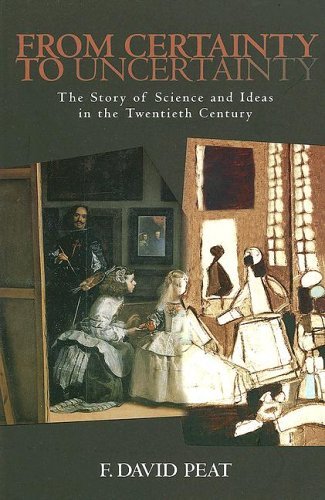
Early theorists believed that in science lay the promise of certainty. Built on a foundation of fact and constructed with objective and trustworthy tools, science produced knowledge. But science has also shown us that this knowledge will always be fundamentally incomplete and that a true understanding of the world is ultimately beyond our grasp.
In this thoughtful and compelling book, physicist F. David Peat examines the basic philosophic difference between the certainty that characterized the thinking of humankind through the nineteenth century and contrasts it with the startling fall of certainty in the twentieth. The nineteenth century was marked by a boundless optimism and confidence in the power of progress and technology. Science and philosophy were on firm ground. Newtonian physics showed that the universe was a gigantic clockwork mechanism that functioned according to rigid lawsâ€"that its course could be predicted with total confidence far into the future. Indeed, in 1900, the President of the Royal Society in Britain went so far as to proclaim that everything of importance had already been discovered by science.
But it was not long before the seeds of a scientific revolution began to take root. Quantum Theory and the General Theory of Relativity exploded the clockwork universe, proving beyond a shadow of a doubt that our knowledge was, at best, incompleteâ€"and would probably remain that way forever. There were places in the universe, such as black holes, from which no information at all could ever be obtained. Chaos Theory also demonstrated our inherent limits to knowing, predicting, and controlling the world around us and showed the way that chaos can often be found at the heart of natural and social systems.
Although we may not always recognize it, this new world view has had a profound effect not only on science, but on art, literature, philosophy, and societal relations. The twenty-first century now begins with a humble acceptance of uncertainty.
From Certainty to Uncertainty traces the rise and fall of the deterministic universe and shows the evolving influences that such disparate disciplines now have on one another. Drawing on the lessons we can learn from history, Peat also speculates on how we will manage our lives into the future.
Table of Contents- Front Matter
- 1 Quantum Uncertainty
- 2 On Incompleteness
- 3 From Object to Process
- 4 Language
- 5 The End of Representation
- 6 From Clockwork to Chaos
- 7 Re-envisioning the Planet
- 8 Pausing the Cosmos
- Postscript
- Appendix: Gödel's Theorem
- Index
"synopsis" may belong to another edition of this title.
From the Inside Flap
"F. David Peat takes us on a wide-ranging, intellectual journey through the major scientific ideas of the 20th century, from physics and complexity to psychology and ecology. It's a grand, exhilarating tour of the post-modern world." -- Marcia Bartusiak, author of Einstein's Unfinished Symphony
"Lucid, engaging, provocative... simply brilliant. Peat delivers a fascinating take on why uncertainty in quantum physics intimately affects every aspect of our lives and thoughts. This timely book should be required reading for anybody who cares about where we all go from here." -- James Burke, author of Circles: Fifty Round-Trips Through History, Technology, Science, Culture
"The journey from certainty to uncertainty is not confined to a scientific tale. It is the story of how human thought has changed in every aspect so that we now live in an age where the only certainty is uncertainty. By making his story an intimate one and absorbing the reader with the very human nature of intellectual revolution, David Peat has done a wonderful job of illustrating how our vision of the universe has changed so radically, so quickly." -- Michael White, author of The Pope and the Heretic and Leonardo: The First Scientist
About the Author
F. David Peat is one of the foremost researchers specializing in theoretical physics. He also founded the Pari Center for New Learning in Italy, where people can explore the new paradigms created by science and contemplate their meanings.
"About this title" may belong to another edition of this title.
- PublisherJoseph Henry Press
- Publication date2002
- ISBN 10 0309096200
- ISBN 13 9780309096201
- BindingPaperback
- Edition number1
- Number of pages246
- Rating
Buy New
Learn more about this copy
US$ 54.10
Shipping:
US$ 4.25
Within U.S.A.

Top Search Results from the AbeBooks Marketplace
Stock Image
From Certainty to Uncertainty: The Story of Science and Ideas in the Twentieth Century
Seller: HPB-Diamond, Dallas, TX, U.S.A.
Seller rating 5 out of 5 stars

paperback. Condition: Very Good. Connecting readers with great books since 1972! Used books may not include companion materials, and may have some shelf wear or limited writing. We ship orders daily and Customer Service is our top priority!. Seller Inventory # S_386200085
Quantity: 1 available
Stock Image
From Certainty to Uncertainty: The Story of Science and Ideas in the Twentieth Century
Seller: HPB-Red, Dallas, TX, U.S.A.
Seller rating 5 out of 5 stars
paperback. Condition: Good. Connecting readers with great books since 1972! Used textbooks may not include companion materials such as access codes, etc. May have some wear or writing/highlighting. We ship orders daily and Customer Service is our top priority!. Seller Inventory # S_352848546
Quantity: 1 available
Stock Image
From Certainty to Uncertainty: The Story of Science and Ideas in the Twentieth Century
Seller: HPB Inc., Dallas, TX, U.S.A.
Seller rating 5 out of 5 stars
paperback. Condition: Very Good. Connecting readers with great books since 1972! Used books may not include companion materials, and may have some shelf wear or limited writing. We ship orders daily and Customer Service is our top priority!. Seller Inventory # S_394397645
Quantity: 1 available
Stock Image
From Certainty to Uncertainty : The Story of Science and Ideas in the Twentieth Century
Published by
National Academies Press, 2002
ISBN 10: 0309096200
ISBN 13: 9780309096201
Used
Softcover
Seller: Better World Books, Mishawaka, IN, U.S.A.
Seller rating 5 out of 5 stars
Condition: Good. Used book that is in clean, average condition without any missing pages. Seller Inventory # 40682152-6
Quantity: 2 available
Stock Image
From Certainty to Uncertainty: The Story of Science and Ideas in the Twentieth Century
Seller: SecondSale, Montgomery, IL, U.S.A.
Seller rating 5 out of 5 stars
Condition: Good. Item in very good condition! Textbooks may not include supplemental items i.e. CDs, access codes etc. Seller Inventory # 00072671135
Quantity: 1 available
Stock Image
From Certainty to Uncertainty: The Story of Science and Ideas in the Twentieth Century
Seller: Book Deals, Tucson, AZ, U.S.A.
Seller rating 5 out of 5 stars
Condition: Very Good. Very Good condition. Shows only minor signs of wear, and very minimal markings inside (if any). 0.8. Seller Inventory # 353-0309096200-vrg
Quantity: 1 available
Stock Image
From Certainty to Uncertainty: The Story of Science and Ideas in the Twentieth Century
Seller: GF Books, Inc., Hawthorne, CA, U.S.A.
Seller rating 5 out of 5 stars
Condition: Very Good. Book is in Used-VeryGood condition. Pages and cover are clean and intact. Used items may not include supplementary materials such as CDs or access codes. May show signs of minor shelf wear and contain very limited notes and highlighting. 0.8. Seller Inventory # 0309096200-2-3
Quantity: 1 available
Stock Image
From Certainty to Uncertainty: The Story of Science and Ideas in the Twentieth Century
Seller: Book Deals, Tucson, AZ, U.S.A.
Seller rating 5 out of 5 stars
Condition: Good. Good condition. This is the average used book, that has all pages or leaves present, but may include writing. Book may be ex-library with stamps and stickers. 0.8. Seller Inventory # 353-0309096200-gdd
Quantity: 1 available
Stock Image
From Certainty to Uncertainty: The Story of Science and Ideas in the Twentieth Century
Seller: GoldenDragon, Houston, TX, U.S.A.
Seller rating 5 out of 5 stars
Paperback. Condition: very good. Very Good Copy. Fast Shipment. Seller Inventory # SilverDragon0309096200
Quantity: 1 available
Stock Image
From Certainty to Uncertainty: The Story of Science and Ideas in the Twentieth Century
Seller: GoldBooks, Denver, CO, U.S.A.
Seller rating 5 out of 5 stars
Paperback. Condition: very good. Very Good Copy. Customer Service Guaranteed. Seller Inventory # think_very_0309096200
Quantity: 1 available