
Items related to Relationships: An Open and Honest Guide to Making Bad...
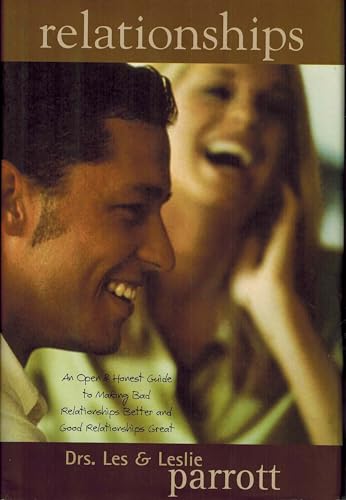
Relationships: An Open and Honest Guide to Making Bad Relationships Better and Good Relationships Great - Hardcover
Synopsis
Today more than ever, people long for connection. In an age marked by isolation and loneliness, they measure riches in terms of belonging, acceptance, vulnerability, honesty, closeness, and commitment. And what they most want to know is how to make bad relationships better and good relationships great. Drs. Les and Leslie Parrott understand firsthand our deep need for relationships; and as relationship experts, they know what it takes to build strong, lasting bonds. In Relationships, the Parrotts take us below the surface to the depths of human interactions -- to the nitty-gritty realities, the ups-and-downs of building vital, satisfying connections. They provide the tools needed to handle tough times and to really succeed at forging strong, rewarding relationships with friends, with the opposite sex, with family, and with God. This cutting-edge book is full of the latest findings and contemporary relationship-building strategies. In a high-tech world, it offers a high-touch solution to a better life. The Parrotts share not just from their knowledge, but from their hearts and lives to help us all understand - who we are and what we bring to our relationships - how our families of origin shape the way we relate to others - tips for building friendships that last - secrets to finding the love we long for and handling sexual issues - how to handle failed friendships and breakups without falling apart - how to relate to God without feeling phony Filled with insightful, true-life stories and thought-provoking questions, Relationships is an honest and timely guide to forming the rich relationships that are life's greatest treasure. This book is accompanied by a workbook that contains more than 35 self-tests to help you put what you learn into action. The Relationships Workbook will help you internalize cutting-edge strategies, skills, and insights for nurturing healthy relationships.
"synopsis" may belong to another edition of this title.
About the Author
Drs. Les and Leslie Parrott are codirectors of the Center for Relationship Development at Seattle Pacific University (SPU), a groundbreaking program dedicated to teaching the basics of good relationships. Les Parrott is a professor of clinical psychology at SPU, and Leslie is a marriage and family therapist at SPU. The Parrotts are authors of the Gold Medallion Award-winning Saving Your Marriage Before It Starts, Becoming Soul Mates, Love Is, Relationships, and When Bad Things Happen to Good Marriages. They have been featured on Oprah, CBS This Morning, CNN, and The View, and in USA Today and the New York Times. They are also frequent guest speakers and have written for a variety of magazines. They live in Seattle, Washington, with their two sons.Leslie Parrott is co-director, with her husband Dr. Les Parrott, of the Center for Relationships Development on the campus of Seattle Pacific University (SPU), a groundbreaking program dedicated to teaching the basics of good relationships. Leslie is also a marriage and family therapist as well as the coauthor of the Gold Medallion Award-wining Saving Your Marriage Before It Starts, The Love List, Becoming Soul Mates, Love Talk, and Your Time Starved Marriage. Leslie is also the author of If You Ever Needed Friends It s Now and the children s book, God Loves You Nose to Toes. She has been featured on Oprah and CBS This Morning, and in USA Today and the New York Times. Leslie is a frequent guest speaker and has written for a variety of magazines. The Parrotts' radio program, Love Talk, can be heard on stations throughout North America. She lives in Seattle, Washington, with Les and their two sons.
From the Back Cover
Today more than ever, people long for connection. In an age marked by isolation and loneliness, they measure riches in terms of belonging, acceptance, vulnerability, honesty, closeness, and commitment. And what they most want to know is how to make bad relationships better and good relationships great. Drs. Les and Leslie Parrott understand firsthand our deep need for relationships; and as relationship experts, they know what it takes to build strong, lasting bonds. In Relationships, the Parrotts take us below the surface to the depths of human interactions -- to the nitty-gritty realities, the ups-and-downs of building vital, satisfying connections. They provide the tools needed to handle tough times and to really succeed at forging strong, rewarding relationships with friends, with the opposite sex, with family, and with God. This cutting-edge book is full of the latest findings and contemporary relationship-building strategies. In a high-tech world, it offers a high-touch solution to a better life. The Parrotts share not just from their knowledge, but from their hearts and lives to help us all understand - who we are and what we bring to our relationships - how our families of origin shape the way we relate to others - tips for building friendships that last - secrets to finding the love we long for and handling sexual issues - how to handle failed friendships and breakups without falling apart - how to relate to God without feeling phony Filled with insightful, true-life stories and thought-provoking questions, Relationships is an honest and timely guide to forming the rich relationships that are life's greatest treasure. This book is accompanied by a workbook that contains more than 35 self-tests to help you put what you learn into action. The Relationships Workbook will help you internalize cutting-edge strategies, skills, and insights for nurturing healthy relationships.
Excerpt. © Reprinted by permission. All rights reserved.
Introduction Our Longing for Belonging There is no substitute for the comfort supplied by the utterly taken-for-granted relationship. -- Iris Murdoch Recently a pioneering band of researchers studied the age-old mystery of what makes people happy. Their answer is not what you might expect. What appears consistently at the top of the charts is not success, wealth, achievement, good looks, or any of those enviable assets. The clear winner is relationships. Close ones. Nothing reaches so deeply into the human personality, tugs so tightly, as relationship. Why? For one reason, it is only in the context of connection with others that our deepest needs can be met. Whether we like it or not, each of us has an unshakable dependence on others. It s what philosopher John Donne was getting at when he said so succinctly, "No man is an island." We need camaraderie, affection, love. These are not options in life, or sentimental trimmings; they are part of our species survival kit. We need to belong. Not long ago, we spent a Saturday evening on a radio talk show in Chicago. The show was an open line to much of the nation. The two of us sat with a host in a small glass booth full of electrical equipment, and outside a sole telephone operator managed six working lines. From 8:00 p.m. until 10:00 p.m. we talked to strange voices coming from Anywhere, USA. The lines were never free, always one speaking, five waiting. The subject was relationships, and the calls ranged from questions and opinions about family and friends to sex and romance. This wasn t so much an interview. We were simply facilitators of a large-scale discussion adding our two cents worth when the host wanted a professional sound bite. Once the program got rolling, most of the callers phoned in to commend or clobber a previous caller. "That last guy who called about his mother being so domineering needs to get a life," said one typical caller. "If he doesn t want a meddling mom, he needs to move out of her house." Blah, blah, blah. Having never done a radio show quite like this, we were getting the feeling that most people were more interested in hearing themselves talk than anything else. At least we felt that way before Tom, a desperate college student, phoned in. "You re on the air, Tom, go ahead," the host said. "Ya. I ve never called a radio station or anything, but I m kinda . . ." Tom cleared his throat and continued speaking slowly. "I m kinda . . ." "Do you have a question or comment, Tom?" said the time-conscious host. "Go ahead." "I don t have a question or anything" deep sigh "I m just listening and I feel . . . I don t know." The host rolled his eyes at us and gave the phone operator on the other side of the glass partition nonverbal signals to get Tom off the line and go to the next caller. "You called for a reason, Tom," I (Les) said. "What is it you are feeling?" "Well, it s just that I haven t talked to anyone for so long." "You haven t talked to anyone!" the host blurted out. "I ve talked to people, but not really talked in a way that means anything." The host looked quizzical and nodded in our direction. "So what is it you are feeling, Tom?" I asked. There was an exceptionally long silence before Tom answered with a single word: "Lonely." Something about this word and the way he said it his frankness and vulnerability as well as the follow-up discussion, drastically changed the tone of the remaining minutes of the program. The crusty callers and opinionated commentaries seemed to vanish. One caller after the next echoed Tom s emotion. On this Saturday night, all over the country, if only for a few minutes, faceless people phoned in to share the experience of being alone. Even the cynical host warmed up a bit and wondered out loud: "Aren t all of us, even with people all around, susceptible to loneliness?" The answer is yes. In a culture where we can pull money from a machine and never interact with a human bank teller, walk on a crowded sidewalk without meeting another s eyes, and call telephone assistance only to get information from a computerized voice, it s truly possible to be alone in a crowd. National surveys, in fact, find that a quarter of all Americans say they ve felt lonely in the last month. And if they don t confess to feeling lonely, two-thirds of Americans say that having close relationships with other people is always on their minds. Surprisingly, college students living with attractive, intelligent, pleasant people are among the most relationally-starved members of society. The number-one reason college students seek counseling, in fact, is for their relationships. Some experts explain this by saying students tend to be overly idealistic, expecting too much from potential mates and friends. Others say students may reject possible friends and partners because they re overcome with their own social anxiety and fear of rejection. Whatever the reason, everyone agrees that no matter what our age, we all have a deep longing for belonging. We want to be wanted, accepted, enjoyed, and loved. Psychologists call it our "affiliative drive." And make no mistake, no one is too big, strong, talented, or tough to go without belonging. The need to belong is not just about feeling warm and accepted, however. It s literally a matter of life or death.
"About this title" may belong to another edition of this title.
Search results for Relationships: An Open and Honest Guide to Making Bad...

Stock Image
Relationships: An Open and Honest Guide to Making Bad Relationships Better and Good Relationships Great
Seller: World of Books (was SecondSale), Montgomery, IL, U.S.A.
Seller rating 5 out of 5 stars

Condition: Very Good. Item in very good condition! Textbooks may not include supplemental items i.e. CDs, access codes etc. Seller Inventory # 00094344839
Stock Image
Relationships: An Open and Honest Guide to Making Bad Relationships Better and Good Relationships Great
Seller: World of Books (was SecondSale), Montgomery, IL, U.S.A.
Seller rating 5 out of 5 stars
Condition: Good. Item in good condition. Textbooks may not include supplemental items i.e. CDs, access codes etc. Seller Inventory # 00095171004
Seller Image
Relationships: An Open and Honest Guide to Making Bad Relationships Better and Good Relationships Great
Seller: Zoom Books East, Glendale Heights, IL, U.S.A.
Seller rating 5 out of 5 stars
Condition: very_good. Book is in very good condition and may include minimal underlining highlighting. The book can also include "From the library of" labels. May not contain miscellaneous items toys, dvds, etc. . We offer 100% money back guarantee and 24 7 customer service. Seller Inventory # ZEV.031020755X.VG
Seller Image
Relationships: An Open and Honest Guide to Making Bad Relationships Better and Good Relationships Great
Seller: Greenworld Books, Arlington, TX, U.S.A.
Seller rating 5 out of 5 stars
Condition: very_good. Fast Free Shipping â" Very Good condition book with a firm cover and clean pages. Shows normal use and some light wear or limited notes markings. A solid, nice copy to enjoy. Seller Inventory # GWV.031020755X.VG
Seller Image
Relationships: An Open and Honest Guide to Making Bad Relationships Better and Good Relationships Great
Seller: ZBK Books, Carlstadt, NJ, U.S.A.
Seller rating 5 out of 5 stars
Condition: good. Fast & Free Shipping â" Good condition. It may show normal signs of use, such as light writing, highlighting, or library markings, but all pages are intact and the book is fully readable. A solid, complete copy that's ready to enjoy. Seller Inventory # ZWV.031020755X.G
Seller Image
Relationships: An Open and Honest Guide to Making Bad Relationships Better and Good Relationships Great
Seller: Greenworld Books, Arlington, TX, U.S.A.
Seller rating 5 out of 5 stars
Condition: good. Fast Free Shipping â" Good condition. It may show normal signs of use, such as light writing, highlighting, or library markings, but all pages are intact and the book is fully readable. A solid, complete copy that's ready to enjoy. Seller Inventory # GWV.031020755X.G
Stock Image
Relationships: An Open and Honest Guide to Making Bad Relationships Better and Good Relationships Great
Seller: Once Upon A Time Books, Siloam Springs, AR, U.S.A.
Seller rating 4 out of 5 stars

Hardcover. Condition: Good. This is a used book in good condition and may show some signs of use or wear . This is a used book in good condition and may show some signs of use or wear . Seller Inventory # mon0003410453
Stock Image
Relationships: An Open and Honest Guide to Making Bad Relationships Better and Good Relationships Great
Seller: BooksRun, Philadelphia, PA, U.S.A.
Seller rating 5 out of 5 stars
Hardcover. Condition: Very Good. It's a well-cared-for item that has seen limited use. The item may show minor signs of wear. All the text is legible, with all pages included. It may have slight markings and/or highlighting. Seller Inventory # 031020755X-11-1
Stock Image
Relationships : An Open and Honest Guide to Making Bad Relationships Better and Good Relationships Great
Seller: Better World Books, Mishawaka, IN, U.S.A.
Seller rating 5 out of 5 stars
Condition: Good. 1 Edition. Pages intact with minimal writing/highlighting. The binding may be loose and creased. Dust jackets/supplements are not included. Stock photo provided. Product includes identifying sticker. Better World Books: Buy Books. Do Good. Seller Inventory # GRP97515466
Stock Image
Relationships : An Open and Honest Guide to Making Bad Relationships Better and Good Relationships Great
Seller: Better World Books: West, Reno, NV, U.S.A.
Seller rating 5 out of 5 stars
Condition: Good. 1 Edition. Former library copy. Pages intact with minimal writing/highlighting. The binding may be loose and creased. Dust jackets/supplements are not included. Includes library markings. Stock photo provided. Product includes identifying sticker. Better World Books: Buy Books. Do Good. Seller Inventory # 14364184-6