
Items related to Take the Risk: Learning to Identify, Choose, and Live...
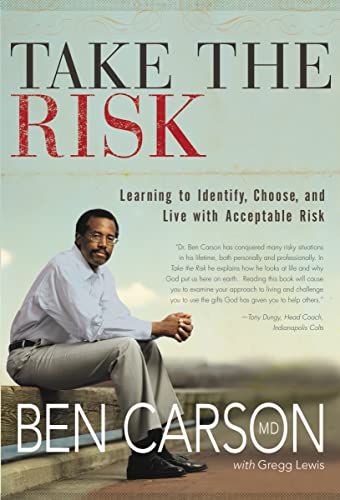
Synopsis
By avoiding risk, are you also avoiding your life's full potential? Join acclaimed neurosurgeon Dr. Ben Carson as he explores the life-changing power of taking the risk, even if you're afraid.
In our risk-avoidant culture, we place a high premium on safety. We insure our vacations. We check crash tests on cars. We extend the warranties on our appliances. But by insulating ourselves from the unknown--the natural risks of life--we miss the great adventure of living our lives to their fullest potential.
Dr. Ben Carson spent his childhood as an at-risk child on the streets of Detroit, and he took big risks in performing complex surgeries on the brain and the spinal cord. Now, offering inspiring personal examples, Dr. Carson invites us to embrace risk in our own lives.
In Take the Risk, Dr. Carson examines our safety-at-all-costs culture and the meaning of risk and security in our lives. Take the Risk guides you through an extensive examination of risk, including:
- Risk-taking in history
- An assessment of the real costs and rewards of risk
- Learning how to assess and accept risks
- Understanding how risk reveals the purpose of your life
From a man whose life dramatically portrays the connection between great risks and greater successes, the insights Dr. Carson shares in Take the Risk will help you dispel your fear of risk in order to dream big, aim high, move with confidence, and reap the rewards of wise risk-taking.
Praise for Take the Risk:
"Whether you are a world-renowned neurosurgeon, a CEO, or a teacher, this book applies to anyone who ever wondered about the difference between the pacesetters and those who struggle to keep up. It is the pacesetters who Take the Risk, and this book explains when and why to take risks to empower everyone to become a trailblazer rather than a mere spectator. For anyone who wants to rise above mediocrity, this book is a must-read."
--Armstrong Williams, author and radio host, The Armstrong Williams Show
"synopsis" may belong to another edition of this title.
About the Authors
Dr. Benjamin S. Carson has served as the director of pediatric neurosurgery at Johns Hopkins Medical Institutions, a candidate for President of the United States, and the seventeenth Secretary of the Department of Housing and Urban Development. He currently serves as the founder and chairman of the American Cornerstone Institute. He is also the author of six bestselling books: Gifted Hands, Think Big, The Big Picture, One Nation, A More Perfect Union, and Created Equal, the last four of which he coauthored with his wife, Candy. They are the parents of three grown sons and grandparents to eight grandchildren. They live in Palm Beach Gardens, Florida.
Gregg Lewis is an award-winning author and coauthor of more than fifty books, including Gifted Hands, The Ben Carson Story, Take the Risk and The Big Picture.
From the Back Cover
No risk, pay the cost.
Know risk, reap the rewards.
In our risk-avoidance culture, we place a high premium on safety. We insure our vacations. We check crash tests on cars. We extend the warranties on our appliances. But by insulating ourselves from the unknown--the risks of life--we miss the great adventure of living our lives to their full potential.
Ben Carson spent his childhood as an at-risk child on the streets of Detroit, and today he takes daily risks in performing complex surgeries on the brain and the spinal cord. Now, offering inspiring personal examples, Dr. Carson invites us to embrace risk in our own lives. From a man whose life dramatically portrays the connection between great risks and greater successes, here are insights that will help you dispel your fear of risk so you can dream big, aim high, move with confidence, and reap rewards you've never imagined.
By avoiding risk, are you also avoiding the full potential of your life?
The surgery was as risky as anything Dr. Ben Carson had seen. The Bijani sisters--conjoined twins--shared part of a skull, brain tissue, and crucial blood flow. One or both of them could die during the operation. But the women wanted separate lives. And they were willing to accept the risk to reach the goal, even against the advice of their doctors …
As a child on the dangerous streets of Detroit, and as a surgeon in operating theaters around the world, Dr. Ben Carson has learned all about risk--he faces it on a daily basis. Out of his perilous childhood, a world-class surgeon emerged precisely because of the risks Dr. Carson was willing to take. In his compelling new book, he examines our safety-at-all-costs culture and the meaning of risk and security in our lives.
In our 21st-century world, we insulate ourselves with safety. We insure everything from vacations to cell phones. We go on low-cholesterol diets and buy low-risk mutual funds. But in the end, everyone faces risk, like the Bijani twins did with their brave decision. Even if our choices are not so dramatic or the outcome so heartbreaking, what does it mean if we back away instead of move forward? Have we so muffled our hearts and minds that we fail to reach for all that life can offer us--and all that we can offer life?
Take the Risk guides the reader through an examination of risk, including:
• A short review of risk-taking in history.
• An assessment of the real costs and rewards of risk.
• Learning how to assess and accept risks.
• Understanding how risk reveals the purpose of your lives.
Reviews
Carson (Think Big) retells stories from previous books, focusing on the idea of risk. As one of the world's top pediatric neurosurgeons, Carson has a lot of experience weighing the odds—and in most cases, lives are on the line. His Best/Worst Analysis for any situation includes four questions: What's the best thing that can happen if I do this? What's the worst thing that can happen if I do this? What's the best thing that can happen if I don't do it? What's the worst thing that can happen if I don't do it? Carson's decisions are also rooted in his faith, with his greatest priority being to use the talents God has given rather than simply to preserve his reputation. By the end, his four-question formula wears thin, however, and he uses the idea of risk to launch into apparently unrelated subjects—the creation/evolution debate, his own belief in God, sharing his faith, problems with public education and even fiscal policy (where he suggests getting rid of money altogether in lieu of handprints and retina scans). Carson can be inspiring, but this book would have been better with a tighter focus and greater depth. (Jan.)
Copyright © Reed Business Information, a division of Reed Elsevier Inc. All rights reserved.
Excerpt. © Reprinted by permission. All rights reserved.
Take the Risk
Learning to Identify, Choose, and Live with Acceptable RiskBy Benjamin Carson Gregg LewisZondervan
Copyright © 2008 Benjamin CarsonAll right reserved.
ISBN: 978-0-310-25973-2
Contents
Introduction..............................................................71. Risking Their Lives....................................................112. To Risk or Not to Risk?................................................193. When Is Risk Worth It?.................................................324. Life Itself Is a Risky Business........................................415. The Truth about Risk...................................................526. Growing Up "At Risk"...................................................677. My Risky Behavior Nearly Got the Best of Me............................788. Risks I Took That Changed My Life Forever..............................889. Four Simple Questions to Help Assess Any Risk..........................10610. Faith Is a Risk-Whatever You Believe..................................12511. Living Your Faith in an Uncertain World...............................13712. Navigating Professional Risks.........................................14913. My Personal Risks in the Face of Death................................16314. Taking Yourself Out of the Middle of Decisions........................17515. Parenting Perils?.....................................................18716. Public Risk (and the Beginning of Some Solutions).....................20417. Even Bigger Risks.....................................................218Conclusion: My Prescription in a Dangerous World..........................234
Chapter One
Risking Their Lives
Baltimore to London to Singapore ...
I had no time to rest and recover after my twenty-hour journey. As soon as I arrived at the airport, I was whisked through customs, ushered into the backseat of a waiting Mercedes, and driven directly to Singapore's new and prestigious Raffles Hospital for a lengthy introductory meeting and then a light lunch with my surgical colleague hosts.
After these preliminaries, I was ready for my first appointment-the long-anticipated encounter with our special patients. It promised to be one of the most fascinating and unusual interviews of my life. I don't recall what my fellow neurosurgeon Dr. Keith Goh said to me as the entourage of physicians, nurses, and medical administrators rounded the corner in that hospital corridor-but I will never forget my first sight of Ladan and Laleh Bijani.
The young women waited to greet me in the hallway outside the suite of rooms that had been converted into a small apartment. They had lived there for a number of months while an army of medical doctors, specialists, and technicians examined them and conducted test after test after test. The Bijani twins wore the traditional Iranian attire of their homeland-long skirts, long-sleeved tops, muted colors, nothing over their faces, but a large scarflike cloth covering the thick, dark brown hair on their heads. Their warm and welcoming smiles struck me immediately.
Dr. Goh, a short, dark-haired Asian in his forties, quickly introduced me to the women. The Bijanis' English, which I'd been informed they had learned since arriving in Singapore seven months before, was broken and stilted but more than adequate for simple conversation.
After shaking hands with and greeting the first twin, I stepped around to greet the other one-a semi-awkward little side step necessary because Ladan and Laleh could not face me at the same time. Indeed, the twenty-nine-year-old sisters were a true medical rarity: identical twins conjoined at the head, their two skulls fused above and behind their ears so that their faces turned permanently away from each other at about a 130-degree angle.
The connection of their skulls held their heads nearly straight up and down. But with their ears touching and their shoulders and arms constantly rubbing, they were forced to lean their upper bodies toward one another and drop their inside shoulders to simultaneously create room to maneuver and maintain the balance necessary to move and stand together.
The result of a single fertilized egg that divides but never completely separates in the womb, conjoined twins (meaning they are attached at some point of their bodies) occur only once in every 200,000 births. All but a few are stillborn or die shortly after birth. Live craniopagus (from the Greek cranio, meaning "helmet," and pagus, meaning "fixed") twins are attached at the head and are the rarest of all-perhaps one in two million births. The odds of such twins living to two years of age are much, much slimmer-which made Ladan and Laleh's survival into adulthood a remarkable thing indeed.
Even more astounding is the fact that these young women had done far more than survive. Adopted by a compassionate Iranian medical doctor when their birth family couldn't care for them, Ladan and Laleh were given every possible opportunity to adapt and live as normal a life as possible. And adapt they did.
They attended elementary school with their peers. In time they grew, graduated from secondary school, and went on to university, where they studied journalism and pre-law. The two graduated from law school and were now fully qualified attorneys-which had recently precipitated a crisis resulting in added tensions between the sisters. Only Ladan wished to pursue a legal career, while Laleh had decided she wanted to go into journalism. Their physical bodies bound them together in a mutually shared existence, even as their two distinct personalities and now two very different life dreams-pulled them in different directions.
For years Ladan and Laleh had searched the world over for a neurosurgeon who would agree to operate and give them at least a chance of achieving their lifelong dream of pursuing two normal, individual, and distinctively different lives. Expert after expert refused to consider their request. Every doctor willing to examine their records told them that surgery would be too risky, that at least one of them-and probably both-would die. Their case was just too complex, they were too old, and the odds of a positive outcome were too low.
But the Bijanis refused to give up. When they read that Dr. Goh and his team had successfully separated eleven-month-old Nepalese craniopagus twins a couple of years before, they contacted him. After studying their medical records and concluding that a successful surgery just might be possible, he contacted me to ask if I'd be willing to help.
I had consulted and worked long-distance with Keith Goh on the Nepalese babies through the use of our virtual workstation at Johns Hopkins. I had also served as one of the primary surgeons for the first successful separation of occipital craniopagus twins (the Bender boys at Johns Hopkins in 1987). Ten years later, at the Medical University of South Africa, I was primary surgeon for the Zambian brothers Joseph and Luka Banda during the first separation of Type 2 vertical craniopagus twins in which both not only survived, but remained neurologically intact. Because of all those experiences, Dr. Goh wanted me to work with him on the surgery, and the Bijani twins themselves had also requested that I join their case.
I had actually declined their invitation when I'd first been contacted months before. The very fact that these young women had adapted so well and had already survived to the age of twenty-nine seemed to me reason enough to recommend against surgery. In an attempt to dissuade them, I had suggested to Dr. Goh that he remind the Bijanis of the case of Chang and Eng Bunker, the original "Siamese twins." Born in Siam (now Thailand) back in 1811, these brothers achieved celebrity, traveling the world as the headline attraction of P. T. Barnum's circus before retiring from show business, purchasing adjacent properties in North Carolina, and becoming successful farmers. They married sisters, fathered a total of twenty-one children between them, and lived healthy lives to the age of sixty-three.
If ever I'd heard of another set of conjoined twins who I thought rivaled the Bunkers' adaptability and who just might match or exceed their amazing longevity, it was these remarkable young women who had already survived and accomplished so much. The idea of separating them at the age of twenty-nine just didn't make sense, and after examining their records and studying the initial CAT scans Dr. Goh had sent me, I was convinced the risks were just too high.
Yet now, months later in Singapore, standing face-to-face with these two determined, obviously bright, and outgoing young women-who just happened to be attached at the head-I found myself incredibly impressed and thoroughly charmed.
Ladan and Laleh smiled shyly and even giggled at the commotion of the people who'd come with me to meet them. I was amazed by how at ease they seemed to be with all the attention. Dr. Goh had told me the twins had become quite the celebrities since their arrival in Singapore. Every time they'd ventured outside the hospital-to eat, shop, or just sightsee-the Bijanis had attracted media and crowds of curious well-wishers who clamored for pictures and autographs or simply wanted to shake their hands. So far, according to Dr. Goh, the young women seemed to find the attention more amusing than troubling.
The crowd gathered in that hospital hallway that afternoon, however, was logistically awkward, so the Bijanis invited me (along with Dr. Goh and a couple of others) into their living quarters to continue our conversation. As they led the way, I could see they had mobility down to a science. I followed, watching with interest and marveling at the smooth, almost subconscious choreography required just to turn and walk, slip through a doorway, and then gracefully seat themselves on the short couch that dominated a sitting room just inside the living area.
I sat in a chair directly across the room, a coffee table between us. From there I would be able to lean a little left to talk with one sister and then just tilt my head and lean a little right to speak to the other. Not only did I want to be able to respect their individuality by speaking to each of them separately and making eye contact as I did so, but I wanted to be able to read the expressions on their faces and the looks in their eyes as they answered my questions.
We made pleasant small talk for a short time-about their stay in Singapore, the ease with which they had picked up conversational English, and all the media attention they'd experienced. At that point I lightheartedly "warned" them that all the attention they had received so far would seem like a drop in the bucket compared to the media frenzy that would result from a successful surgery. "The queen, the king, and everyone else will want to meet you," I said. They laughed at the prospect but didn't seemed at all troubled.
As we talked, I noted that Ladan was decidedly the more outgoing and talkative of the two. Laleh seemed, if not exactly shy, at least more reserved and pensive.
When the discussion moved on to the impending surgery, the twins became a bit more somber. As they talked honestly about some of the difficulties they had faced in life, I realized even the simplest and most routine movements-from getting in and out of a car to bending over and picking a pencil up off the floor or fixing a snack-required complex choreography and complete cooperation between the two of them. Every life choice-from what classes to take in school, to which friends to spend time with, to when to go to the bathroom-was a committee decision demanding unanimous consent.
But the longer I spent in their presence, the less I found myself trying to imagine all of the challenges they had overcome. Instead, I tried to picture how different things would be for them if a successful operation were to free them to live separate lives. After twenty-nine years of perpetual and involuntary attachment to another human being, the abstract idea of privacy would be very appealing-but what would it really feel like to be wholly alone for the first time in your life?
One of the primary reasons I had declined the Bijanis' case when I'd first been approached was that I feared the psychological ramifications of separating conjoined twins after twenty-nine years. What if separation proved more emotionally damaging than remaining attached? My thinking began to shift, however, as I learned more about their situation, their conflicting aspirations, and their determination to pursue the operation. I knew they had undergone extensive psychological counseling in recent months, but still, I needed to hear their own responses to my concerns about the formidable psychological adjustments they would face if they were separated. So I asked them to tell me what they thought about the issue.
They assured me that they knew a successful separation would not bring an end to the many challenges they faced. They acknowledged that some of their lifelong emotional bonds might be hard to sever. But again they expressed their determination to press ahead with the operation. They were determined.
When I asked if I could feel their heads, they readily agreed. As I ran my fingers over the top, side, and back of their skulls, I explained that after many hours spent studying their CAT scans, I had a good idea of what their brains looked like. Still, before surgery the next day, I told them, "I want to get a sense of the junction of your skulls."
The examination only took a few seconds, but it was long enough to remind me just how complex this surgery promised to be. It was one thing to look at film on a lighted board or to hold a life-size plastic model of their conjoined heads and try to visualize the challenge this surgery would present. It was another thing entirely, however, to run my fingertips through their hair, tracing the extent of the solid, bony juncture of their two skulls. The attachment covered an area that was almost half the size of a head-from above and in front of the ears on the side of the head, then over the ears and down to almost the base of their skulls in the back.
I knew that Dr. Goh had explained to them the various steps and procedures involved in the surgery, but I wanted to know for myself that they understood the risks. "I have to tell you," I said to them, "what I believe you already know-that this will be an extremely complex and risky surgery." To make certain they understood, I waited for their translator to repeat what I said in Farsi. "Based on my experience and my study of your case, and despite the excellent resources available to your fine surgical team here at Raffle Hospital, I still think there is at least a 50 percent chance this surgery could result in death or serious brain damage for one or both of you. I need to make certain you both understand that."
At Johns Hopkins my colleagues and I routinely perform some of the most complex neurosurgical procedures in the world. Any operation with as much as a 10 percent chance of mortality would be considered an extraordinarily dangerous procedure-a sky-high risk. So a 50 percent risk is truly stratospheric. I wanted to be sure that Ladan and Laleh understood the stakes.
Both women assured me again that Dr. Goh had been very honest with them. They understood the challenges. But most convincing for me was hearing the emotion and conviction in their voices as they insisted, "We would rather die than not pursue this if there is any chance we could be free to live our own separate lives. Death would be better than continuing to live like this!"
Because we put such a premium on life, it was startling to hear two healthy, vivacious young women state such feelings in a straightforward manner just hours before an operation. Most of us, even those of us who deal with life-and-death issues every day, don't often stop and think seriously about what quality of life means to us. But as we spoke, I had a growing awareness that these women had thought long and hard about the subject and that it would be extremely difficult for anyone not in their situation to even begin to understand how they felt.
I had already heard from the Singaporean medical team, who had learned it from one of the twins' caretakers, that the tension between the women had escalated in recent months. Some arguments had even led to physical altercations. I could only imagine how awful it would be to experience serious conflict with someone you could never walk away from.
Most people can easily understand why someone who is enslaved or imprisoned would risk death to escape and experience freedom. For Ladan and Laleh, their state was very much the same thing. They desperately wanted to escape what was for them an untenable situation. The hope of freedom was worth any risk. As I began to understand that, I also began to feel better about embarking on such a potentially dangerous course of action.
Meeting these young women-and hearing the determination in their voices, recognizing the desperation in their lives, and seeing the hope and resolve in their eyes-sealed the deal for me. By the time our conversation began to wind down, I was thinking, Let's get these women separated so they can get on with their lives!
Even though I had assured Ladan and Laleh during our interview that I cared about their well-being, before leaving their apartment, I looked them both in the eyes once again and acknowledged that we were about to embark on a long, arduous, and extremely dangerous operation. That while the odds were not good and I could not promise them a successful outcome, I did feel optimistic enough to think there was reason to hope. I said, "There are a lot of things in life beyond our human ability, knowledge, and control. But there is nothing beyond God."
As I stood and shook hands with them and bid them good-bye-until I saw them in the operating room the next morning-I told Ladan and Laleh what I tell all of my patients during my final pre-op exams: "I've never known a case yet where worry helped. So I'm going to say my prayers tonight before I go to sleep. I hope you'll do the same. I believe if we do that, we'll all have less to worry about tomorrow."
As I turned and walked out of that room, I believed beyond a shadow of any doubt that both Ladan and Laleh Bijani truly understood what they faced. They were approaching this dangerous and unprecedented surgery with much the same spirit of determination they had shown in tackling so many challenges in their lives.
Most of all, they had convinced me that they understood the risks.
(Continues...)
Excerpted from Take the Riskby Benjamin Carson Gregg Lewis Copyright © 2008 by Benjamin Carson. Excerpted by permission.
All rights reserved. No part of this excerpt may be reproduced or reprinted without permission in writing from the publisher.
Excerpts are provided by Dial-A-Book Inc. solely for the personal use of visitors to this web site.
"About this title" may belong to another edition of this title.
Search results for Take the Risk: Learning to Identify, Choose, and Live...

Stock Image
Take the Risk: Learning to Identify, Choose, and Live with Acceptable Risk
Seller: World of Books (was SecondSale), Montgomery, IL, U.S.A.
Seller rating 5 out of 5 stars

Hardback. Condition: Good. You can find our cultures obsession with avoiding risk everywhere, from multiple insurance policies to crash-tested vehicles. But is ducking risk the most productive way for us to live? Surgeon and author Dr. Ben Carson, who faces risk on a daily basis, offers an inspiring message on how accepting risk can lead us to a higher purpose. Seller Inventory # 00088835073
Stock Image
Take the Risk: Learning to Identify, Choose, and Live with Acceptable Risk
Seller: World of Books (was SecondSale), Montgomery, IL, U.S.A.
Seller rating 5 out of 5 stars
Condition: Acceptable. Item in acceptable condition! Textbooks may not include supplemental items i.e. CDs, access codes etc. Seller Inventory # 00087294643
Stock Image
Take the Risk: Learning to Identify, Choose, and Live with Acceptable Risk
Seller: Orion Tech, Kingwood, TX, U.S.A.
Seller rating 5 out of 5 stars
Hardcover. Condition: Good. Seller Inventory # 0310259738-3-19630442
Stock Image
Take the Risk: Learning to Identify, Choose, and Live with Acceptable Risk
Seller: Your Online Bookstore, Houston, TX, U.S.A.
Seller rating 5 out of 5 stars
Hardcover. Condition: Fair. Seller Inventory # 0310259738-4-19505649
Seller Image
Take the Risk: Learning to Identify, Choose, and Live with Acceptable Risk
Seller: Zoom Books Company, Lynden, WA, U.S.A.
Seller rating 5 out of 5 stars
Condition: very_good. Book is in very good condition and may include minimal underlining highlighting. The book can also include "From the library of" labels. May not contain miscellaneous items toys, dvds, etc. . We offer 100% money back guarantee and 24 7 customer service. Seller Inventory # ZBV.0310259738.VG
Seller Image
Take the Risk: Learning to Identify, Choose, and Live with Acceptable Risk
Seller: Greenworld Books, Arlington, TX, U.S.A.
Seller rating 5 out of 5 stars
Condition: good. Fast Free Shipping â" Good condition. It may show normal signs of use, such as light writing, highlighting, or library markings, but all pages are intact and the book is fully readable. A solid, complete copy that's ready to enjoy. Seller Inventory # GWV.0310259738.G
Stock Image
Take the Risk: Learning to Identify, Choose, and Live with Acceptable Risk
Seller: BooksRun, Philadelphia, PA, U.S.A.
Seller rating 5 out of 5 stars
Hardcover. Condition: Very Good. With dust jacket. It's a well-cared-for item that has seen limited use. The item may show minor signs of wear. All the text is legible, with all pages included. It may have slight markings and/or highlighting. Seller Inventory # 0310259738-11-1-29
Stock Image
Take the Risk: Learning to Identify, Choose, and Live with Acceptable Risk
Seller: Evergreen Goodwill, Seattle, WA, U.S.A.
Seller rating 5 out of 5 stars
hardcover. Condition: Good. Seller Inventory # mon0000756426
Stock Image
Take the Risk: Learning to Identify, Choose, and Live with Acceptable Risk
Seller: More Than Words, Waltham, MA, U.S.A.
Seller rating 5 out of 5 stars
Condition: Good. A sound copy with only light wear. Overall a solid copy at a great price! Seller Inventory # BOS-S-12b-01538
Stock Image
Take the Risk: Learning to Identify, Choose, and Live with Acceptable Risk
Seller: BookHolders, Towson, MD, U.S.A.
Seller rating 5 out of 5 stars
Condition: Good. [ No Hassle 30 Day Returns ][ Ships Daily ] [ Underlining/Highlighting: NONE ] [ Writing: SOME ] [ Edition: First ] Publisher: Zondervan Pub Date: 1/1/2008 Binding: Hardcover Pages: 240 First edition. Seller Inventory # 6947637