
Items related to Funk: The Music, The People, and The Rhythm of The...
Synopsis
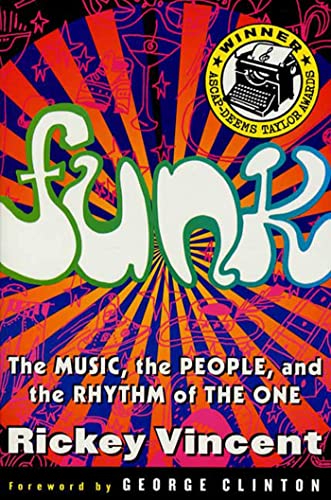
Funk: It's the only musical genre ever to have transformed the nation into a throbbing army of bell-bottomed, hoop-earringed, rainbow-Afro'd warriors on the dance floor. Its rhythms and lyrics turned bleak urban realties inside out with distinctive, danceable, downright irresistable music.
Funk hasn't received the critical attention that rock, jazz, and the blues have-until now. Colorful, intelligent, and in-you-face, Rickey Vincent's Funk celebrates the songs, the musicians, the philosophy, and the meaning of funk. The book spans from the early work of James Brown (the Godfather of Funk) through today, covering funky soul (Stevie Wonder, the Temptations), so-called "black rock" (Jimi Hendrix, Sly and the Family Stone, the Isely Brothers), jazz-funk (Miles Davis, Herbie Hancock), monster funk (Parliament, Funkadelic, Bootsy's Rubber Band), naked funk (Rick James, Gap Band), disco-funk (Chic, K.C. and the Sunshine Band), funky pop (Kook & the Gang, Chaka Khan), P-Funk Hip Hop (Digital Underground, De La Soul), funk-sampling rap (Ice Cube, Dr. Dre), funk rock (Red Hot Chili Peppers, Primus), and more.
Funk tells a vital, vibrant history-the history of a uniquely American music born out of tradition and community, filled with energy, attitude, anger, hope, and an irrepressible spirit.
"synopsis" may belong to another edition of this title.
About the Author
Rickey Vincent has written about music for Vibe, Mondo 2000, and elsewhere. An instructor at San Francisco State University, he is known among Bay Area funkateers as the Uhuru Maggot, thanks to his all-funk radio show on KPFA. He lives in Berkeley, California, with his wife and son.
From the Back Cover
Funk hasn't received the critical attention that rock, jazz, and the blues have - until now. Colorful, intelligent, and in-your-face, Rickey Vincent's Funk celebrates the songs, the musicians, the philosophy, and the meaning of funk. The book spans from the early work of James Brown (the Godfather of Funk) through today, covering funky soul (Stevie Wonder, the Temptations), so-called "black rock" (Jimi Hendrix, Sly and the Family Stone, the Isley Brothers), jazz-funk (Miles Davis, Herbie Hancock), monster funk (Parliament, Funkadelic, Bootsy's Rubber Band), naked funk (Rick James, Gap Band), disco-funk (Chic, K.C. and the Sunshine Band), funky pop (Kool & the Gang, Chaka Khan), P-Funk Hip Hop (Digital Underground, De La Soul), funk-sampling rap (Ice Cube, Dr. Dre), funk rock (Red Hot Chili Peppers, Primus), and more. Funk tells a vital, vibrant history - the history of a uniquely American music born out of tradition and community, filled with energy, attitude, anger, hope and an irrepressible spirit.
Reviews
In his introduction, Clinton, the force behind Parliament/Funkadelic, defines the importance of "The Funk," as well as Vincent's written history, as political assertions: "[The] story told herein chronicles the predicament the [music] industry faces in trying to monopolize their profiteering of Black Music." By examining the Black jazz and blues roots of funk, Vincent depicts a people more often than not robbed of their music. Funk has remained considerably free from industry greed and gentrification due, argues Vincent, to its illicit power. In the next breath, he contends that James Brown, Sly Stone and Clinton owe as much to the Beatles for their successes?particularly the 1967 Sgt. Pepper's Lonely Hearts Club Band album, which would influence Jimi Hendrix's Electric Ladyland and Clinton's own Free Your Mind and Your Ass Will Follow. Vincent's funk is broad, encompassing Hendrix; Miles Davis; Earth, Wind, and Fire; and Dr. Dre. It's true rap's sampling of funk classics brought new interest in sloppy, sexy jams. When rappers refused at first to pay their dues, by way of recording royalties, they only helped to draw attention to such forgotten bands as The Ohio Players and The Meters. Funk is an untidy quarrel of history, musicology and hearsay that certifies the cultural heritage of a Hip Hop nation.
Copyright 1996 Reed Business Information, Inc.
While it's usually easy to distinguish music that is funky from music that is not, it's much more difficult to say what funk actually is. In this book, Vincent, who has an all-funk show on KALX in California, attempts to arrive at such a definition and to provide a historical overview of "The Funk" (as he calls it) from its emergence as a recognizable element of black music in the 1960s to its varied manifestations in today's popular culture. He does a good job of demonstrating how funkiness celebrates various aspects of African American culture, many of which have historically not been valued by white society, and makes clear the broad impact of various funk styles on American music. Unfortunately, Vincent's encyclopedic knowledge of funk is not matched by a broad understanding of the larger musical context in which he wishes to place it; his stabs at music theory are weak and ill informed, and by the time he refers to the Rolling Stones as James Brown imitators and to Ronald Shannon Jackson as a guitarist, the reader has come to the uncomfortable conclusion that the author has bitten off far more than he can chew. Worst of all, Vincent's writing style borders on unreadable: the sentence "It would be a measure of any hip black act in the seventies to come with a funk bomb to get respect" is, unfortunately, typical. The book ends with a fine annotated discography, but it's not enough to justify purchase. Not recommended.?Rick Anderson, Contoocook, N.H.
Copyright 1996 Reed Business Information, Inc.
Funk, which with its sharp syncopation and improvisational freedom has had a lasting impact on all popular music, is finally the subject of a book-length study. Vincent provides substantial analysis of funk's musical elements, especially its unique harmonies and rhythms, and the social forces that shaped its development. He focuses on well-and lesser-known innovators since the 1960s and on how such diverse elements as jazz and African pop music fed into funk, and he concludes that rap and hip-hop have successfully continued to incorporate funk's beat and lyrical edge. His book is strongest when he argues for recognizing the cultural importance of George Clinton and the brigade of his Parliament-Funkadelic cohorts. Vincent shows that not only did Clinton establish a framework for the explosive talents of bassist Bootsy Collins, keyboardist Bernie Woffell, and others but "without polemics, militarism, or racially charged code words, Clinton's P-Funk placed the African-American sensibility at the center of the universe, and ultimately at the center of history." Aaron Cohen
"About this title" may belong to another edition of this title.
Search results for Funk: The Music, The People, and The Rhythm of The...

Stock Image
Funk
Seller: World of Books (was SecondSale), Montgomery, IL, U.S.A.
Seller rating 5 out of 5 stars

Paperback. Condition: Good. The Music, the People, and the Rhythm of The One Introduction by George Clinton. Seller Inventory # 00104592264
Seller Image
Funk: The Music, The People, and The Rhythm of The One
Seller: 2nd Life Books, Burlington, NJ, U.S.A.
Seller rating 5 out of 5 stars
Condition: very_good. Used book in very good condition. May have some minor wear. May NOT include discs, or access code or other supplemental material. Ships directly from Amazon and is eligible for Prime or super saver FREE shipping. We ship Monday-Saturday and respond to inquiries within 24 hours. Seller Inventory # BXM.ESFE
Stock Image
Funk: The Music, the People, and the Rhythm of the One
Seller: ThriftBooks-Dallas, Dallas, TX, U.S.A.
Seller rating 5 out of 5 stars
Paperback. Condition: Fair. No Jacket. Former library book; Missing dust jacket; Readable copy. Pages may have considerable notes/highlighting. ~ ThriftBooks: Read More, Spend Less. Seller Inventory # G0312134991I5N11
Stock Image
Funk: The Music, the People, and the Rhythm of the One
Seller: ThriftBooks-Dallas, Dallas, TX, U.S.A.
Seller rating 5 out of 5 stars
Paperback. Condition: Good. No Jacket. Pages can have notes/highlighting. Spine may show signs of wear. ~ ThriftBooks: Read More, Spend Less. Seller Inventory # G0312134991I3N00
Stock Image
Funk: The Music, The People, and The Rhythm of The One
Published by
St. Martin's Griffin (edition St Martin's Griffin ed), 1996
ISBN 10: 0312134991
ISBN 13: 9780312134990
Used
Paperback
Seller: BooksRun, Philadelphia, PA, U.S.A.
Seller rating 5 out of 5 stars
Paperback. Condition: Very Good. St Martin's Griffin ed. It's a well-cared-for item that has seen limited use. The item may show minor signs of wear. All the text is legible, with all pages included. It may have slight markings and/or highlighting. Seller Inventory # 0312134991-11-1
Seller Image
Funk: The Music, The People, and The Rhythm of The One
Seller: -OnTimeBooks-, Phoenix, AZ, U.S.A.
Seller rating 5 out of 5 stars
Condition: good. A copy that has been read, remains in good condition. All pages are intact, and the cover is intact. The spine and cover show signs of wear. Pages can include notes and highlighting and show signs of wear, and the copy can include "From the library of" labels or previous owner inscriptions. 100% GUARANTEE! Shipped with delivery confirmation, if you're not satisfied with purchase please return item! Ships via media mail. Seller Inventory # OTV.0312134991.G
Seller Image
Funk: The Music, The People, and The Rhythm of The One
Seller: Austin Goodwill 1101, Austin, TX, U.S.A.
Seller rating 5 out of 5 stars
Condition: acceptable. Book shows noticeable wear from use. May include writing, highlighting, or other markings, but not excessive. Cover or edges may have visible wear. The book remains complete and fully readable. Seller Inventory # CTXV.0312134991.A
Stock Image
Funk
Seller: World of Books Inc, Montgomery, IL, U.S.A.
Seller rating 4 out of 5 stars

Paperback. Condition: Good. The Music, the People, and the Rhythm of The One Introduction by George Clinton. Seller Inventory # CIN0312134991G
Stock Image
Funk : The Music, the People, and the Rhythm of the One
Seller: Better World Books, Mishawaka, IN, U.S.A.
Seller rating 5 out of 5 stars
Condition: Fine. Used book that is in almost brand-new condition. May contain a remainder mark. Better World Books: Buy Books. Do Good. Seller Inventory # 15983419-6
Stock Image
Funk : The Music, the People, and the Rhythm of the One
Seller: Better World Books, Mishawaka, IN, U.S.A.
Seller rating 5 out of 5 stars
Condition: Good. Pages intact with minimal writing/highlighting. The binding may be loose and creased. Dust jackets/supplements are not included. Stock photo provided. Product includes identifying sticker. Better World Books: Buy Books. Do Good. Seller Inventory # 4618927-6