
Items related to Truth: A History and a Guide for the Perplexed
Synopsis
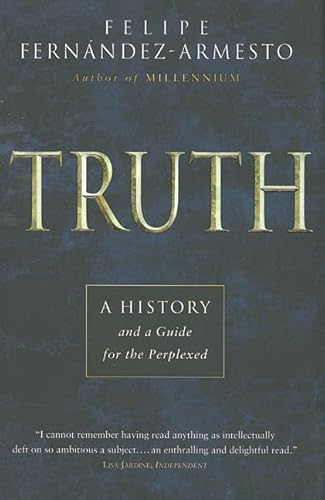
A fascinating look at truth in human society examines how, throughout history, people have tried to distinguish truth from falsehood and explains aspects of humanity's basic assumptions about truth.
"synopsis" may belong to another edition of this title.
Reviews
An idiosyncratic exploration of "the quest for language that can match reality," Oxford historian Fern ndez-Armesto's essay is a highly personal stroll through human history and various cultures' notions of truth. Fern ndez-Armesto (Millennium, etc.) examines four distinct approaches to truthA"the truth you feel," "the truth you are told," "the truth of reason" and sense perceptionAin separate chapters. His goal, he reveals in a preface, is to rescue discussions about truth from the polarizing dead-ends of absolutism and relativism, "to reassure readers that the search for truth is still on and leave relativists and fundamentalists where they belongAon the margins of history." His book is far too anecdotal and unsystematic to achieve that stated goal, but it nevertheless makes for provocative, often illuminating reading, particularly since he includes Chinese, Indian, Polynesian and other traditions in his excavation of how different cultures in different times apprehended the idea of truth. Writing with an interdisciplinarian's lack of, well, discipline, he stumbles badly on such topics as pragmatism, quantum mechanics, chaos theory and G?del's Incompleteness Theorem, repeating or even adding to common misperceptions, rather than dispelling them. Yet he also writes with the confidence and clarityAneither of which is to be confused with accuracy or depthAof a top-notch lecturer. In the end, what he has to say about how language cannot be conceived as separate from the world it tries to describe is not just an interesting philosophical comment but also a moving perspective on what happens whenever one person speaks to another. (Nov.)
Copyright 1999 Reed Business Information, Inc.
From Fern ndez-Armesto (Modern History/Oxford Univ.; Reformations, 1997, etc.), a thoughtful and incisive meditation on the historical development of the concept of truth, and on its uncertain future. Fern ndez-Armesto asserts that to an unprecedented and dangerous degree, our society has abandoned the pursuit of truth, ``a long-standing, widely shared project of mankind.'' His hope here is to explore this modern predicament and suggest that the quest for truth is not dead, despite the conflict between religious fundamentalists who claim to know all truth and secular nihilists who think it can never be known. The author illuminates this theme by sketching the development of four basic epistemological categories: (1) the ``truth you feel,'' characteristic of primitive society, in which emotions and nonsensory or nonrational kinds of perception convey truth; (2) the ``truth you are told,'' important in archaic society, in which truth flows from oracular, divinatory, or scriptural sources of authority; (3) the ``truth you think for yourself, or deductive or rationalist methods of pursuing truth, which evolved from ancient origins to reach an apex of prestige in the 17th and 18th centuries; and (4) the ``truth you perceive through your senses,'' or that derived from direct perceptual experience, which is dominant today. All four, Fern ndez-Armesto argues, have always been around, though the ascendancy of the fourth is a relatively recent phenomenon. Examining the modern abandonment of truth in the humanities and the growth of relativism in our culture, which he views as ominous developments, he urges a return to traditional approaches to truth and advocates ``hounding subjectivism and relativism until truth is run to earth.'' Fern ndez-Armestos profound analysis of a crisis that pervades both the academy and the larger world points a way beyond the timid equivocations of our time. -- Copyright ©1999, Kirkus Associates, LP. All rights reserved.
No title ever announced greater auctorial confidence! And Fernandez-Armesto delivers. With remarkable aplomb, he surveys the centuries to limn four distinct conceptions of truth: the primal emotional truth of tribal peoples; the magisterial truth of oracular authority; the rational truth of logic; and the empirical truth of sense perception. All four of these conceptions come to life in vivid historical anecdotes: we join, for instance, a fourth-century Chinese monk in his perilous trek across mountain glaciers in search of a genuinely authentic sutra; later, we shudder with a nineteenth-century German philosopher contemplating the possibility that mathematics might disintegrate in self-contradiction. But no interpretation of past versions of truth will generate as much debate as the judgment that contemporary searchers of the truth have been cruelly ambushed by fundamentalists on one side and sophists on the other. Fernandez-Armesto inspires hope that we may yet extricate ourselves from our cultural crisis of doubt by renewing our collective quest for truth. Bryce Christensen
"About this title" may belong to another edition of this title.
Search results for Truth: A History and a Guide for the Perplexed

Stock Image
Truth: A History and a Guide for the Perplexed
Seller: Evergreen Goodwill, Seattle, WA, U.S.A.
Seller rating 5 out of 5 stars

hardcover. Condition: Good. Seller Inventory # mon0000527965
Stock Image
Truth
Seller: World of Books (was SecondSale), Montgomery, IL, U.S.A.
Seller rating 5 out of 5 stars
Hardback. Condition: Good. Written by a renowned Oxford historian, this fascinating volume presents a global history of truth. Sharp and authoritative, Truth manages to touch every period of human experience; it leaps from truth-telling technologies of primitive societies to the private mental worlds of great philosophers; from spiritualism to science and from New York to New Guinea. In clear, lucid prose, this little book takes on an enormous subject and makes it understandable to anyone. Seller Inventory # 00106777861
Stock Image
Truth
Seller: World of Books (was SecondSale), Montgomery, IL, U.S.A.
Seller rating 5 out of 5 stars
Hardback. Condition: Very Good. Written by a renowned Oxford historian, this fascinating volume presents a global history of truth. Sharp and authoritative, Truth manages to touch every period of human experience; it leaps from truth-telling technologies of primitive societies to the private mental worlds of great philosophers; from spiritualism to science and from New York to New Guinea. In clear, lucid prose, this little book takes on an enormous subject and makes it understandable to anyone. Seller Inventory # 00108160933
Stock Image
Truth : A History and a Guide for the Perplexed
Seller: Better World Books, Mishawaka, IN, U.S.A.
Seller rating 5 out of 5 stars
Condition: Good. 1st U.S. ed. Former library copy. Pages intact with minimal writing/highlighting. The binding may be loose and creased. Dust jackets/supplements are not included. Includes library markings. Stock photo provided. Product includes identifying sticker. Better World Books: Buy Books. Do Good. Seller Inventory # GRP94683440
Stock Image
Truth : A History and a Guide for the Perplexed
Seller: Better World Books, Mishawaka, IN, U.S.A.
Seller rating 5 out of 5 stars
Condition: Good. 1st U.S. ed. Pages intact with minimal writing/highlighting. The binding may be loose and creased. Dust jackets/supplements are not included. Stock photo provided. Product includes identifying sticker. Better World Books: Buy Books. Do Good. Seller Inventory # 2262324-75
Stock Image
Truth: A History and a Guide for the Perplexed
Published by
Thomas Dunne Books, 1999
ISBN 10: 0312242530
ISBN 13: 9780312242534
Used
Hardcover
First Edition
Seller: The Maryland Book Bank, Baltimore, MD, U.S.A.
Seller rating 5 out of 5 stars
hardcover. Condition: Very Good. First Edition. Used - Very Good. Seller Inventory # 13-C-2-0245
Stock Image
Truth: A History and a Guide for the Perplexed
Seller: Wonder Book, Frederick, MD, U.S.A.
Seller rating 5 out of 5 stars
Condition: Very Good. Very Good condition. Very Good dust jacket. With remainder mark. A copy that may have a few cosmetic defects. May also contain light spine creasing or a few markings such as an owner's name, short gifter's inscription or light stamp. Seller Inventory # Q05Q-00758
Stock Image
Truth: A History and a Guide for the Perplexed
Seller: Wonder Book, Frederick, MD, U.S.A.
Seller rating 5 out of 5 stars
Condition: Very Good. Very Good condition. Very Good dust jacket. A copy that may have a few cosmetic defects. May also contain light spine creasing or a few markings such as an owner's name, short gifter's inscription or light stamp. Seller Inventory # K04M-00300
Stock Image
Truth: A History and a Guide for the Perplexed
Seller: ThriftBooks-Atlanta, AUSTELL, GA, U.S.A.
Seller rating 5 out of 5 stars
Hardcover. Condition: Good. No Jacket. Pages can have notes/highlighting. Spine may show signs of wear. ~ ThriftBooks: Read More, Spend Less. Seller Inventory # G0312242530I3N00
Stock Image
Truth: A History and a Guide for the Perplexed
Seller: ThriftBooks-Atlanta, AUSTELL, GA, U.S.A.
Seller rating 5 out of 5 stars
Hardcover. Condition: Very Good. No Jacket. Former library book; May have limited writing in cover pages. Pages are unmarked. ~ ThriftBooks: Read More, Spend Less. Seller Inventory # G0312242530I4N10