
Items related to A Wall in Palestine
Synopsis
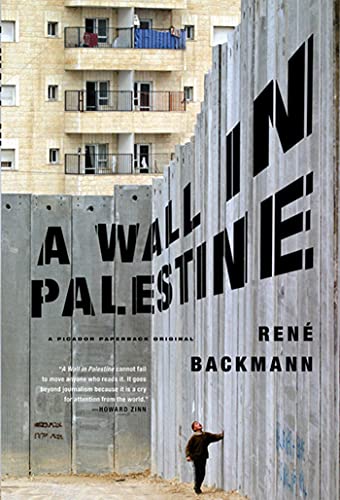
The West Bank Barrier is expected to be completed in 2010. Declared illegal by the United Nations International Court of Justice, this network of concrete walls, trenches, and barbed-wire fences could permanently redraw one of the most disputed property lines in the Middle East--the Green Line that separates Israel and the West Bank. To Israel the "security fence" is intended to keep Palestinian terrorists from entering its territory. But to Palestinians the "apartheid wall" that sliced through orchards and houses, and cuts off family members from one another, is a land grab.
In this comprehensive book, Backmann not only addresses the barrier's impact on ordinary citizens, but how it will shape the future of the Middle East. Though it promises security to an Israeli population weary of terrorism, it also is responsible for the widespread destruction of Palestinian homes and farmland; with its Byzantine checkpoint regulations, it has also severely crippled the Palestinian economy; and, most urgent, the barrier often deviates from the Green Line, appropriating thousands of acres of land, effectively redrawing the boundary between the West Bank and Israel.
Backmann interviews Israeli policy makers, politicians, and military personnel, as well as Palestinians living throughout the West Bank, telling the stories not only of the barrier's architects, but also of those who must reckon with it on a day-to-day basis on the ground.
With bold, brilliant, and often impassioned reportage, A Wall in Palestine renders the West Bank Barrier--its purpose, its efficacy, its consequences--as no book before.
"synopsis" may belong to another edition of this title.
About the Author
René Backmann is the Editor-in-Chief of Le Nouvel Observateur's foreign desk. He has been an investigative reporter and foreign correspondent for more than forty years. In 1999, he was awarded the Prix Mumm, France's highest honor for journalism.
Reviews
Starred Review. French journalist Backmann takes on the Orwellian semantic debate played out daily in the lives of Palestinians living in the Israeli-occupied West Bank: is the massive construction project snaking through more than 400 miles of the West Bank a security barrier, as Israel calls it, or an apartheid wall, as many Palestinians describe it? Is it being built in order to protect Israeli citizens from Palestinian terrorism, as Israel insists, or was it conceived to protect the [Israeli] settlements, to give them room to grow? Are Palestinians' humanitarian needs being met, as project supporters say—or in the words of an Israeli human rights lawyer, does the wall's construction inevitably bring about human rights violations? With extensive boots-on-the-ground journalism and close examination of the historical record, Backmann demonstrates that while Israeli security concerns are real, the wall is undeniably also a political tool with life-shattering implications for the Palestinians whose lives it surrounds and constricts. In gathering these various voices in one powerful and accessible book, Backmann makes a vital contribution to the discourse surrounding the potential for peace in the region—and the costs the conflict continues to extract. (Feb.)
Copyright © Reed Business Information, a division of Reed Elsevier Inc. All rights reserved.
The wall separating Israel and the Palestinian West Bank, which runs for more than 400 miles, has been declared illegal by the United Nations International Court of Justice. Israel began constructing the wall in October 2000 after the Second Intifada, but reporter Backmann speculates that it has been under consideration since at least 1977, when then minister of agriculture Ariel Sharon began encouraging Jewish settlement of the area. Backmann analyzes the long history of tensions between Israel and the Palestinians that led to construction of the wall. More poignantly, she offers profiles of the individuals whose lives have been severely disrupted by the wall: a woman who now must travel through barriers and checkpoints for hours to reach a school she founded, a journey that used to take 15 minutes; a coffee and spice business on the brink of failure because the busy street on which it was located now dead-ends at the grim, gray wall; husbands and wives who cannot live together unless they give up homes and businesses. A compelling look at the human side of the Arab-Israeli conflict. --Vanessa Bush
"About this title" may belong to another edition of this title.
Search results for A Wall in Palestine

Stock Image
A Wall in Palestine
Seller: World of Books (was SecondSale), Montgomery, IL, U.S.A.
Seller rating 5 out of 5 stars

Paperback. Condition: Fair. The West Bank Barrier is expected to be completed in 2010. This title presents an examination of the barrier - its purpose, its efficacy, its consequences - and an affecting story about two cultures who have arrived at a devastating endgame, one which may occlude the possibility of peace for generations to come. Seller Inventory # 00101930962
Stock Image
A Wall in Palestine
Seller: World of Books (was SecondSale), Montgomery, IL, U.S.A.
Seller rating 5 out of 5 stars
Paperback. Condition: Good. The West Bank Barrier is expected to be completed in 2010. This title presents an examination of the barrier - its purpose, its efficacy, its consequences - and an affecting story about two cultures who have arrived at a devastating endgame, one which may occlude the possibility of peace for generations to come. Seller Inventory # 00101930876
Stock Image
A Wall in Palestine
Seller: World of Books (was SecondSale), Montgomery, IL, U.S.A.
Seller rating 5 out of 5 stars
Paperback. Condition: Very Good. The West Bank Barrier is expected to be completed in 2010. This title presents an examination of the barrier - its purpose, its efficacy, its consequences - and an affecting story about two cultures who have arrived at a devastating endgame, one which may occlude the possibility of peace for generations to come. Seller Inventory # 00101930195
Stock Image
A Wall in Palestine
Seller: Wonder Book, Frederick, MD, U.S.A.
Seller rating 5 out of 5 stars
Condition: Very Good. Very Good condition. A copy that may have a few cosmetic defects. May also contain light spine creasing or a few markings such as an owner's name, short gifter's inscription or light stamp. Seller Inventory # V12P-00522
Stock Image
A Wall in Palestine
Seller: ThriftBooks-Atlanta, AUSTELL, GA, U.S.A.
Seller rating 5 out of 5 stars
Paperback. Condition: Good. No Jacket. Pages can have notes/highlighting. Spine may show signs of wear. ~ ThriftBooks: Read More, Spend Less. Seller Inventory # G0312427816I3N00
Stock Image
A Wall in Palestine
Seller: ThriftBooks-Dallas, Dallas, TX, U.S.A.
Seller rating 5 out of 5 stars
Paperback. Condition: Good. No Jacket. Pages can have notes/highlighting. Spine may show signs of wear. ~ ThriftBooks: Read More, Spend Less. Seller Inventory # G0312427816I3N00
Stock Image
A Wall in Palestine
Seller: ThriftBooks-Dallas, Dallas, TX, U.S.A.
Seller rating 5 out of 5 stars
Paperback. Condition: As New. No Jacket. Pages are clean and are not marred by notes or folds of any kind. ~ ThriftBooks: Read More, Spend Less. Seller Inventory # G0312427816I2N00
Stock Image
A Wall in Palestine
Seller: ThriftBooks-Atlanta, AUSTELL, GA, U.S.A.
Seller rating 5 out of 5 stars
Paperback. Condition: Fair. No Jacket. Former library book; Readable copy. Pages may have considerable notes/highlighting. ~ ThriftBooks: Read More, Spend Less. Seller Inventory # G0312427816I5N10
Stock Image
A Wall in Palestine
Seller: ThriftBooks-Reno, Reno, NV, U.S.A.
Seller rating 5 out of 5 stars
Paperback. Condition: Good. No Jacket. Pages can have notes/highlighting. Spine may show signs of wear. ~ ThriftBooks: Read More, Spend Less. Seller Inventory # G0312427816I3N00
Stock Image
A Wall in Palestine
Seller: World of Books Inc, Montgomery, IL, U.S.A.
Seller rating 4 out of 5 stars

Paperback. Condition: Good. The West Bank Barrier is expected to be completed in 2010. This title presents an examination of the barrier - its purpose, its efficacy, its consequences - and an affecting story about two cultures who have arrived at a devastating endgame, one which may occlude the possibility of peace for generations to come. Seller Inventory # CIN0312427816G