
Items related to Travels in the Scriptorium
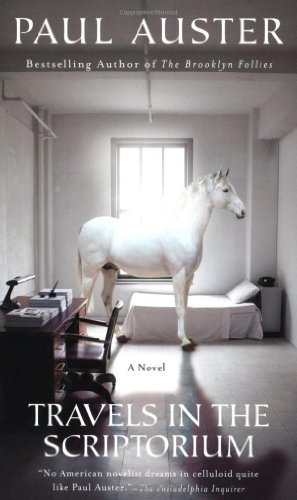
Synopsis
An old man awakens, disoriented, in an unfamiliar chamber. With no memory of who he is or how he has arrived there, he pores over the relics on the desk, examining the circumstances of his confinement and searching his own hazy mind for clues. Determining that he is locked in, the man-identified only as Mr. Blank-begins reading a manuscript he finds on the desk, the story of another prisoner, set in an alternate world the man doesn't recognize. Nevertheless, the pages seem to have been left for him, along with a haunting set of photographs. As the day passes, various characters call on the man in his cell-vaguely familiar people, some who seem to resent him for crimes he can't remember-and each brings frustrating hints of his identity and his past. All the while an overhead camera clicks and clicks, recording his movements, and a microphone records every sound in the room. Someone is watching. Both chilling and poignant, Travels in the Scriptorium is vintage Paul Auster: mysterious texts, fluid identities, a hidden past, and, somewhere, an obscure tormentor. And yet, as we discover during one day in the life of Mr. Blank, his world is not so different from our own.
"synopsis" may belong to another edition of this title.
About the Author
Paul Auster is the author of numerous novels, screenplays, and works of nonfiction, as well as a poet, translator, and film director. His many critically acclaimed novels include The Book of Illusions and Oracle Night.
Reviews
Paul Auster dazzled the literary world two decades ago with the self-reflexive, playful New York Trilogy. A dozen novels later, he continues to draw on the familiar situations and themes that marked him as one of the most accomplished experimentalists. Critics often compare Auster's multilayered tales of colliding realities and lost identities to those of Samuel Beckett, Franz Kafka, Jorge Luis Borges, and John Barth, though Travels in the Scriptorium finds a mixed critical reception. Current Auster fans will enjoy the intricate allusions and wordplay. Those coming to the author for the first time may find the book obscure—or worse, unengaging. For them, Moon Palace, In the Country of Last Things, or the New York Trilogy would be better novels for discovering the classic Auster.
Copyright © 2004 Phillips & Nelson Media, Inc.
This enigmatic interrogation into the life of the sequestered and nameless protagonist referred to as Mr. Blank will leave some listeners perplexed and others awestruck by Auster's manipulative narrative devices. Trapped within a room, Mr. Blank tries to recall who he is as a host of people from his past visits him. As usual, Hill performs fantastically with much energy and emotion. His edgy gravelly voice is tempered with a range of intensity that will grip listeners. Yet this doesn't deter him from a softer tone when vocalizing women or revealing a more sentimental element of the story. The only problem with Hill's voice is that his pitch ranges drastically, even in the same sentence. The sound engineers need to pay close attention and level it out. Otherwise, listeners are left constantly turning up and down the sound.
Copyright © Reed Business Information, a division of Reed Elsevier Inc. All rights reserved.
Paul Auster writes of isolation by recounting a day in the life of Mr. Blank, a man locked in a room for reasons he doesn't know and visited by people he can't remember. Throughout the course of the day, characters from Mr. Blank's past begin to fill in vague details about why he is there and the crimes he has committed, all while a camera clicks away, recording every detail. Dick Hill does a near-perfect job as Mr. Blank, capturing his frustration with his circumstances, his fear of the unknown, and the feebleness he feels. Altering his voice, Hill gives each character an equally believable persona, creating a fitting aura for Auster's sinister tale of confinement and lost identity. H.L.S. © AudioFile 2007, Portland, Maine-- Copyright © AudioFile, Portland, Maine
Auster, a literary descendent of Kafka and Borges, is fascinated by the very act of storytelling. Consequently, his novels always involve some form of doubling as one story coils within another. In the wake of The Brooklyn Follies (2006), an expansive novel, Auster presents a spare, metaphysical fable. Mr. Blank, Auster's protagonist, is confined to an austere room, uncertain of his status or the room's location. Names carry great weight in Auster's uncanny fiction, and so it figures that Mr. Blank has lost his memory. His keepers have provided him with a stack of photographs of people who seem dimly familiar and with a typescript written by another prisoner in another time and place. As Mr. Blank reads this compelling account of violence and loss in the Confederation, a land that vaguely resembles nineteenth-century America during the genocidal assault against indigenous peoples, various visitors arrive, claiming to be Blank's victims. But what are his crimes? Auster fans will recognize a parade of characters from earlier works, reaching back to his famed New York Trilogy (1985-86), In the Country of Last Things (1987), and Leviathan (1992), as Auster coyly celebrates the power of the imagination and marvels over the labyrinthine nature of the mind in an archly playful and shrewdly philosophical tribute to the transcendence of stories. Donna Seaman
Copyright © American Library Association. All rights reserved
Reviewed by Howard Norman
Determined reading keeps the mind's attention. And you will want to be very determined in reading Paul Auster's fictional treatise on crime and amnesia, Travels in the Scriptorium. It's not the characters or plot that is difficult to keep tabs on but your own emotions, as this is a chilling story of isolation.
The setup is this: An old man, known only as Mr. Blank, wakes up in a sparsely furnished room. "He can't remember how long he has been here," Auster writes, "or the nature of the circumstances that precipitated his removal to this place. Perhaps he has always been here; perhaps this is where he has lived since the day he was born. What he knows is that his heart is filled with an implacable sense of guilt. At the same time, he can't escape the feeling that he is the victim of a terrible injustice."
Because this is an Auster novel, writing itself has, almost inevitably, a spectral presence: Soon Mr. Blank begins to read a manuscript he finds on the desk. It's a harrowing account of another prisoner, Mr. Blank's doppelgänger. This account immediately becomes part of a narrative duet. As time passes, characters from the manuscript show up, each slightly familiar to Mr. Blank, each delivering shards of his past life. Altogether they constitute an uncanny guest list of interlocutors. As a result of their visits -- visitations -- Mr. Blank becomes convinced that he may well have done dreadful things to these characters (some are from Auster's previous novels!). What's more, everything is recorded by an overhead camera and hidden microphone.
Anna is Mr. Blank's most merciful visitor; yet in the way she sponge-bathes and even sexually services him, in her almost perversely accommodating conversation, scenes with her are mesmerizing and uncomfortable in equal measure. Auster keeps upping the voyeuristic ante: "It should be noted that a second camera and a second tape recorder have been planted in the bathroom ceiling, making it possible for all activities in that space to be recorded as well, and because the word all is an absolute term, the transcription of dialogue between Anna and Mr. Blank can be verified in every one of its details." With this passage, a reader understands that Mr. Blank will keep no secrets, except possibly from himself.
Anna, another caretaker named Sophie, an ex-policeman named James P. Flood, a doctor named Samuel Farr -- all mention treacherous "missions" Mr. Blank sent them on in the past. Then there's that manuscript. It delineates a newly formed country called the Confederation and specifically chronicles the political quagmires of a certain Sigmund Graf, who, when he returns from a dangerous assignment in the forbidden Alien Territories, is sentenced to death.
In this and other aspects, Travels in the Scriptorium is part dystopian myth and part literary seance; allusions intersect with allusions, identities are fluid, the past is folded almost chokingly tight into the present, shadows of the truth have shadows. All of this refracting inventiveness is why Auster is often referred to as a master of the metaphysical detective story. While in these pages there's no actual detective working a beat, still, as revelation after revelation is delivered, the reader is kept on edge, guessing until the very end.
Auster is one of our most intellectually elegant writers. He has persistently subverted the ordinary mechanisms of suspense, chronology, even genre. In certain fundamental attributes, this new novel resembles his Oracle Night, published in 2003. Yet determined readers come to savor the inimitable way Auster keeps restructuring and vivifying his novelistic obsessions. Themes are hungry ghosts, Borges said. Fortunately, Auster's ghosts are insatiable.
Copyright 2007, The Washington Post. All Rights Reserved.
Excerpt. © Reprinted by permission. All rights reserved.
Excerpt
The old man sits on the edge of the narrow bed, palms spread out on his knees, head down, staring at the floor. He has no idea that a camera is planted in the ceiling directly above him. The shutter clicks silently once every second, producing eighty-six thousand four hundred still photos with each revolution of the earth. Even if he knew he was being watched, it wouldn’t make any difference. His mind is elsewhere, stranded among the figments in his head as he searches for an answer to the question that haunts him.
Who is he? What is he doing here? When did he arrive and how long will he remain? With any luck, time will tell us all. For the moment, our only task is to study the pictures as attentively as we can and refrain from drawing any premature conclusions.
There are a number of objects in the room, and on each one a strip of white tape has been affixed to the surface, bearing a single word written out in block letters. On the bedside table, for example, the word is table. On the lamp, the word is lamp. Even on the wall, which is not strictly speaking an object, there is a strip of tape that reads wall. The old man looks up for a moment, sees the wall, sees the strip of tape attached to the wall, and pronounces the word wall in a soft voice. What cannot be known at this point is whether he is reading the word on the strip of tape or simply referring to the wall itself. It could be that he has forgotten how to read but still recognizes things for what they are and can call them by their names, or, conversely, that he has lost the ability to recognize things for what they are but still knows how to read.
He is dressed in blue-and-yellow striped cotton pajamas, and his feet are encased in a pair of black leather slippers. It is unclear to him exactly where he is. In the room, yes, but in what building is the room located? In a house? In a hospital? In a prison? He can’t remember how long he has been here or the nature of the circumstances that precipitated his removal to this place. Perhaps he has always been here; perhaps this is where he has lived since the day he was born. What he knows is that his heart is filled with an implacable sense of guilt. At the same time, he can’t escape the feeling that he is the victim of a terrible injustice.
There is one window in the room, but the shade is drawn, and as far as he can remember he has not yet looked out of it. Likewise with the door and its white porcelain knob. Is he locked in, or is he free to come and go as he wishes? He has yet to investigate this matter—for, as stated in the first paragraph above, his mind is elsewhere, adrift in the past as he wanders among the phantom beings that clutter his head, struggling to answer the question that haunts him.
The pictures do not lie, but neither do they tell the whole story. They are merely a record of time passing, the outward evidence. The old man’s age, for example, is difficult to determine from the slightly out-of-focus black-and-white images. The only fact that can be set down with any certainty is that he is not young, but the word old is a flexible term and can be used to describe a person anywhere between sixty and a hundred. We will therefore drop the epithet old man and henceforth refer to the person in the room as Mr. Blank. For the time being, no first name will be necessary.
Mr. Blank stands up from the bed at last, pauses briefly to steady his balance, and then shuffles over to the desk at the other end of the room. He feels tired, as if he has just woken from a fitful, too short night of sleep, and as the soles of his slippers scrape along the bare wood floor, he is reminded of the sound of sandpaper. Far off in the distance, beyond the room, beyond the building in which the room is located, he hears the faint cry of a bird—perhaps a crow, perhaps a seagull, he can’t tell which.
Mr. Blank lowers his body into the chair at the desk. It is an exceedingly comfortable chair, he decides, made of soft brown leather and equipped with broad armrests to accommodate his elbows and forearms, not to speak of an invisible spring mechanism that allows him to rock back and forth at will, which is precisely what he begins to do the moment he sits down. Rocking back and forth has a soothing effect on him, and as Mr. Blank continues to indulge in these pleasurable oscillations, he remembers the rocking horse that sat in his bedroom when he was a small boy, and then he begins to relive some of the imaginary journeys he used to take on that horse, whose name was Whitey and who, in the young Mr. Blank’s mind, was not a wooden object adorned with white paint but a living being, a true horse.
After this brief excursion into his early boyhood, anguish rises up into Mr. Blank’s throat again. He says out loud in a weary voice: I mustn’t allow this to happen. Then he leans forward to examine the piles of papers and photographs stacked neatly on the surface of the mahogany desk. He takes hold of the pictures first, three dozen eight-by-ten black-and-white portraits of men and women of various ages and races. The photo on top shows a young woman in her early twenties. Her dark hair is cropped short, and there is an intense, troubled look in her eyes as she gazes into the lens. She is standing outdoors in some city, perhaps an Italian or French city, because she happens to be positioned in front of a medieval church, and because the woman is wearing a scarf and a woolen coat, it is safe to assume the picture was taken in winter. Mr. Blank stares into the eyes of the young woman and strains to remember who she is. After twenty seconds or so, he hears himself whisper a single word: Anna. A feeling of overpowering love washes through him. He wonders if Anna isn’t someone he was once married to, or if, perhaps, he isn’t looking at a picture of his daughter. An instant after thinking these thoughts, he is attacked by a fresh wave of guilt, and he knows that Anna is dead. Even worse, he suspects that he is responsible for her death. It might even be, he tells himself, that he was the person who killed her.
Mr. Blank groans in pain. Looking at the pictures is too much for him, so he pushes them aside and turns his attention to the papers. There are four piles in all, each about six inches high. For no particular reason that he is aware of, he reaches for the top page on the pile farthest to the left. The handwritten words, printed out in block letters similar to the ones on the strips of white tape, read as follows:
Viewed from the outermost reaches of space, the earth is no larger than a speck of dust. Remember that the next time you write the word “humanity.”
From the look of disgust that comes over his face as he scans these sentences, we can be fairly confident that Mr. Blank has not lost the ability to read. But who the author of these sentences might be is still open to question.
Mr. Blank reaches out for the next page on the pile and discovers that it is a typed manuscript of some sort. The first paragraph reads:
The moment I started to tell my story, they knocked me down and kicked me in the head. When I climbed to my feet and started to talk again, one of them hit me across the mouth, and then another one punched me in the stomach. I fell down. I managed to get up again, but just as I was about to begin the story for the third time, the Colonel threw me against the wall and I passed out.
There are two more paragraphs on the page, but before Mr. Blank can begin reading the second one, the telephone rings. It is a black rotary model from the late forties or early fifties of the past century, and since it is located on the bedside table, Mr. Blank is forced to stand up from the soft leather chair and shuffle over to the other side of the room. He picks up the receiver on the fourth ring.
Hello, says Mr. Blank.
Mr. Blank? asks the voice on the other end.
If you say so.
Are you sure? I can’t take any chances.
I’m not sure of anything. If you want to call me Mr. Blank, I’m happy to answer to that name. Who am I talking to?
James.
I don’t know any James.
James P. Flood.
Refresh my memory.
I came to visit you yesterday. We spent two hours together.
Ah. The policeman.
Ex-policeman.
Right. The ex-policeman. What can I do for you?
I want to see you again.
Wasn’t one conversation enough?
Not really. I know I’m just a minor character in this business, but they said I was allowed to see you twice.
You’re telling me I have no choice.
I’m afraid so. But we don’t have to talk in the room if you don’t want to. We can go out and sit in the park if you’d prefer that.
I don’t have anything to wear. I’m standing here dressed in pajamas and slippers.
Look in the closet. You have all the clothes you need.
Ah. The closet. Thank you.
Have you had your breakfast, Mr. Blank?
I don’t think so. Am I allowed to eat?
Three meals a day. It’s still a bit early, but Anna should be coming around pretty soon.
Anna? Did you say Anna?
She’s the person who takes care of you.
I thought she was dead.
Hardly.
Maybe it’s a different Anna.
I doubt it. Of all the people involved in this story, she’s the only one who’s completely on your side.
And the others?
Let’s just say there’s a lot of resentment, and we’ll leave it at that.
Copyright © 2007 by Paul Auster. All rights reserved.
The old man sits on the edge of the narrow bed, palms spread out on his knees, head down, staring at the floor. He has no idea that a camera is planted in the ceiling directly above him. The shutter clicks silently once every second, producing eighty-six thousand four hundred still photos with each revolution of the earth. Even if he knew he was being watched, it wouldn’t make any difference. His mind is elsewhere, stranded among the figments in his head as he searches for an answer to the question that haunts him.
Who is he? What is he doing here? When did he arrive and how long will he remain? With any luck, time will tell us all. For the moment, our only task is to study the pictures as attentively as we can and refrain from drawing any premature conclusions.
There are a number of objects in the room, and on each one a strip of white tape has been affixed to the surface, bearing a single word written out in block letters. On the bedside table, for example, the word is table. On the lamp, the word is lamp. Even on the wall, which is not strictly speaking an object, there is a strip of tape that reads wall. The old man looks up for a moment, sees the wall, sees the strip of tape attached to the wall, and pronounces the word wall in a soft voice. What cannot be known at this point is whether he is reading the word on the strip of tape or simply referring to the wall itself. It could be that he has forgotten how to read but still recognizes things for what they are and can call them by their names, or, conversely, that he has lost the ability to recognize things for what they are but still knows how to read.
He is dressed in blue-and-yellow striped cotton pajamas, and his feet are encased in a pair of black leather slippers. It is unclear to him exactly where he is. In the room, yes, but in what building is the room located? In a house? In a hospital? In a prison? He can’t remember how long he has been here or the nature of the circumstances that precipitated his removal to this place. Perhaps he has always been here; perhaps this is where he has lived since the day he was born. What he knows is that his heart is filled with an implacable sense of guilt. At the same time, he can’t escape the feeling that he is the victim of a terrible injustice.
There is one window in the room, but the shade is drawn, and as far as he can remember he has not yet looked out of it. Likewise with the door and its white porcelain knob. Is he locked in, or is he free to come and go as he wishes? He has yet to investigate this matter—for, as stated in the first paragraph above, his mind is elsewhere, adrift in the past as he wanders among the phantom beings that clutter his head, struggling to answer the question that haunts him.
The pictures do not lie, but neither do they tell the whole story. They are merely a record of time passing, the outward evidence. The old man’s age, for example, is difficult to determine from the slightly out-of-focus black-and-white images. The only fact that can be set down with any certainty is that he is not young, but the word old is a flexible term and can be used to describe a person anywhere between sixty and a hundred. We will therefore drop the epithet old man and henceforth refer to the person in the room as Mr. Blank. For the time being, no first name will be necessary.
Mr. Blank stands up from the bed at last, pauses briefly to steady his balance, and then shuffles over to the desk at the other end of the room. He feels tired, as if he has just woken from a fitful, too short night of sleep, and as the soles of his slippers scrape along the bare wood floor, he is reminded of the sound of sandpaper. Far off in the distance, beyond the room, beyond the building in which the room is located, he hears the faint cry of a bird—perhaps a crow, perhaps a seagull, he can’t tell which.
Mr. Blank lowers his body into the chair at the desk. It is an exceedingly comfortable chair, he decides, made of soft brown leather and equipped with broad armrests to accommodate his elbows and forearms, not to speak of an invisible spring mechanism that allows him to rock back and forth at will, which is precisely what he begins to do the moment he sits down. Rocking back and forth has a soothing effect on him, and as Mr. Blank continues to indulge in these pleasurable oscillations, he remembers the rocking horse that sat in his bedroom when he was a small boy, and then he begins to relive some of the imaginary journeys he used to take on that horse, whose name was Whitey and who, in the young Mr. Blank’s mind, was not a wooden object adorned with white paint but a living being, a true horse.
After this brief excursion into his early boyhood, anguish rises up into Mr. Blank’s throat again. He says out loud in a weary voice: I mustn’t allow this to happen. Then he leans forward to examine the piles of papers and photographs stacked neatly on the surface of the mahogany desk. He takes hold of the pictures first, three dozen eight-by-ten black-and-white portraits of men and women of various ages and races. The photo on top shows a young woman in her early twenties. Her dark hair is cropped short, and there is an intense, troubled look in her eyes as she gazes into the lens. She is standing outdoors in some city, perhaps an Italian or French city, because she happens to be positioned in front of a medieval church, and because the woman is wearing a scarf and a woolen coat, it is safe to assume the picture was taken in winter. Mr. Blank stares into the eyes of the young woman and strains to remember who she is. After twenty seconds or so, he hears himself whisper a single word: Anna. A feeling of overpowering love washes through him. He wonders if Anna isn’t someone he was once married to, or if, perhaps, he isn’t looking at a picture of his daughter. An instant after thinking these thoughts, he is attacked by a fresh wave of guilt, and he knows that Anna is dead. Even worse, he suspects that he is responsible for her death. It might even be, he tells himself, that he was the person who killed her.
Mr. Blank groans in pain. Looking at the pictures is too much for him, so he pushes them aside and turns his attention to the papers. There are four piles in all, each about six inches high. For no particular reason that he is aware of, he reaches for the top page on the pile farthest to the left. The handwritten words, printed out in block letters similar to the ones on the strips of white tape, read as follows:
Viewed from the outermost reaches of space, the earth is no larger than a speck of dust. Remember that the next time you write the word “humanity.”
From the look of disgust that comes over his face as he scans these sentences, we can be fairly confident that Mr. Blank has not lost the ability to read. But who the author of these sentences might be is still open to question.
Mr. Blank reaches out for the next page on the pile and discovers that it is a typed manuscript of some sort. The first paragraph reads:
The moment I started to tell my story, they knocked me down and kicked me in the head. When I climbed to my feet and started to talk again, one of them hit me across the mouth, and then another one punched me in the stomach. I fell down. I managed to get up again, but just as I was about to begin the story for the third time, the Colonel threw me against the wall and I passed out.
There are two more paragraphs on the page, but before Mr. Blank can begin reading the second one, the telephone rings. It is a black rotary model from the late forties or early fifties of the past century, and since it is located on the bedside table, Mr. Blank is forced to stand up from the soft leather chair and shuffle over to the other side of the room. He picks up the receiver on the fourth ring.
Hello, says Mr. Blank.
Mr. Blank? asks the voice on the other end.
If you say so.
Are you sure? I can’t take any chances.
I’m not sure of anything. If you want to call me Mr. Blank, I’m happy to answer to that name. Who am I talking to?
James.
I don’t know any James.
James P. Flood.
Refresh my memory.
I came to visit you yesterday. We spent two hours together.
Ah. The policeman.
Ex-policeman.
Right. The ex-policeman. What can I do for you?
I want to see you again.
Wasn’t one conversation enough?
Not really. I know I’m just a minor character in this business, but they said I was allowed to see you twice.
You’re telling me I have no choice.
I’m afraid so. But we don’t have to talk in the room if you don’t want to. We can go out and sit in the park if you’d prefer that.
I don’t have anything to wear. I’m standing here dressed in pajamas and slippers.
Look in the closet. You have all the clothes you need.
Ah. The closet. Thank you.
Have you had your breakfast, Mr. Blank?
I don’t think so. Am I allowed to eat?
Three meals a day. It’s still a bit early, but Anna should be coming around pretty soon.
Anna? Did you say Anna?
She’s the person who takes care of you.
I thought she was dead.
Hardly.
Maybe it’s a different Anna.
I doubt it. Of all the people involved in this story, she’s the only one who’s completely on your side.
And the others?
Let’s just say there’s a lot of resentment, and we’ll leave it at that.
Copyright © 2007 by Paul Auster. All rights reserved.
"About this title" may belong to another edition of this title.
Search results for Travels in the Scriptorium

Stock Image
Travels in the Scriptorium: A Novel
Seller: Better World Books, Mishawaka, IN, U.S.A.
Seller rating 5 out of 5 stars

Condition: Very Good. Pages intact with possible writing/highlighting. Binding strong with minor wear. Dust jackets/supplements may not be included. Stock photo provided. Product includes identifying sticker. Better World Books: Buy Books. Do Good. Seller Inventory # 54607955-6
Stock Image
Travels in the Scriptorium: A Novel
Seller: Better World Books, Mishawaka, IN, U.S.A.
Seller rating 5 out of 5 stars
Condition: Good. Pages intact with minimal writing/highlighting. The binding may be loose and creased. Dust jackets/supplements are not included. Stock photo provided. Product includes identifying sticker. Better World Books: Buy Books. Do Good. Seller Inventory # 3188390-6
Stock Image
Travels in the Scriptorium
Seller: ThriftBooks-Atlanta, AUSTELL, GA, U.S.A.
Seller rating 5 out of 5 stars
Unknown. Condition: Good. No Jacket. Pages can have notes/highlighting. Spine may show signs of wear. ~ ThriftBooks: Read More, Spend Less. Seller Inventory # G0312948409I3N00
Stock Image
Travels in the Scriptorium
Seller: ThriftBooks-Dallas, Dallas, TX, U.S.A.
Seller rating 5 out of 5 stars
Unknown. Condition: Very Good. No Jacket. May have limited writing in cover pages. Pages are unmarked. ~ ThriftBooks: Read More, Spend Less. Seller Inventory # G0312948409I4N00
Stock Image
Travels in the Scriptorium
Seller: medimops, Berlin, Germany
Seller rating 5 out of 5 stars
Condition: good. Befriedigend/Good: Durchschnittlich erhaltenes Buch bzw. Schutzumschlag mit Gebrauchsspuren, aber vollständigen Seiten. / Describes the average WORN book or dust jacket that has all the pages present. Seller Inventory # M00312948409-G
Buy Used
US$ 7.68
US$ 11.37 shipping
Ships from Germany to U.S.A.
Ships from Germany to U.S.A.
Quantity: 1 available
Seller Image
Travels in the Scriptorium
Seller: Hamelyn, Madrid, M, Spain
Seller rating 5 out of 5 stars
Condition: Fair. : En 'Viajes en el Scriptorium', un anciano se encuentra en una habitación desconocida, luchando contra la amnesia y la incertidumbre. Rodeado de objetos etiquetados y fotografías enigmáticas, recibe la visita de una mujer que le habla de tratamientos y promesas. La novela explora la identidad, la memoria y la realidad a través de la experiencia confusa del protagonista, invitando al lector a cuestionar la naturaleza de la percepción y la existencia. EAN: 9780312948405 Tipo: Libros Categoría: Literatura y Ficción Título: Travels in the Scriptorium Autor: Paul Auster Editorial: Macmillan USA Idioma: en Páginas: 132 Formato: tapa blanda. Seller Inventory # Happ-2026-04-30-86ef4c3f
Stock Image
Travels in the Scriptorium
Seller: Ammareal, Morangis, France
Seller rating 5 out of 5 stars
Softcover. Condition: Très bon. Ancien livre de bibliothèque. Ammareal reverse jusqu'à 15% du prix net de cet article à des organisations caritatives. ENGLISH DESCRIPTION Book Condition: Used, Very good. Former library book. Ammareal gives back up to 15% of this item's net price to charity organizations. Seller Inventory # F-368-429
Buy Used
US$ 4.10
US$ 18.76 shipping
Ships from France to U.S.A.
Ships from France to U.S.A.
Quantity: 1 available
Seller Image
Travels in the scriptorium
Seller: Le-Livre, SABLONS, France
Seller rating 5 out of 5 stars
Couverture souple. Condition: bon. RO80247491: 2007. In-12. Broché. Etat d'usage, Couv. légèrement passée, Dos satisfaisant, Papier jauni. 118 pages. Texte en anglais. . . . Classification Dewey : 420-Langue anglaise. Anglo-saxon. Seller Inventory # RO80247491
Buy Used
US$ 19.85
US$ 47.76 shipping
Ships from France to U.S.A.
Ships from France to U.S.A.
Quantity: 1 available
Seller Image
Travels in the Scriptorium
Seller: Vulkaneifel Bücher, Birgel, Germany
Seller rating 5 out of 5 stars
Broschiert. Condition: Sehr gut. 118 Seiten kleine Lagerspuren am Buch, Inhalt einwandfrei und ungelesen Sprache: Englisch Gewicht in Gramm: 70. Seller Inventory # 102950
Buy Used
US$ 5.80
US$ 141.45 shipping
Ships from Germany to U.S.A.
Ships from Germany to U.S.A.
Quantity: 1 available