
Synopsis
An exhilarating blend of past and present, of mystery and romance, and of love lost and found.
"I should not write this lest Charlotte come snooping, for he made me promise not to tell anyone of his whereabouts. And yet it is all so strange I am loath not to record it. I will mark it now, and maybe tomorrow awaken to find it only a mad dream anyhow, like all the rest..." --From the diary of Emily Bronte
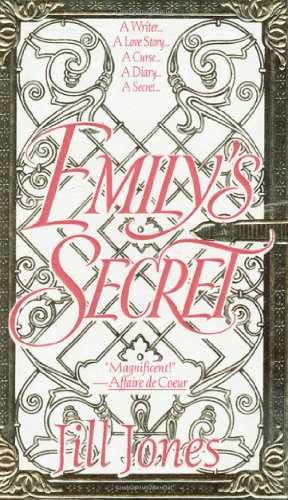
Alex Hightower, an American professor, has always been fascinated by Emily Bronte and her brief, tragic life. But what were the secrets she took with her to her grave? The answers begin in the village of Haworth, where Emily lived and died, as Alex delves into the past to unlock a hundred-and-fifty-year-old mystery.
Was Emily a lonely spinster of legend? Or a troubled, passionate woman who loved in secret? And who is Selena, the mysterious gypsy beauty Alex meets on Haworth's storm-tossed moors, who speaks of a family curse, and who knows more than she realizes about Emily's secrets?
"synopsis" may belong to another edition of this title.
About the Author
Jill Jones lives in western North Carolina with her husband, Jerry, who is a watercolor artist. Emily's Secret is her first novel.
Reviews
YA?Well-written historical fiction that explores the life of Emily Bronte through the eyes of one of her descendants. It combines a modern-day love story with flashbacks to the writer's life. Jones provides an excellent description of the times of the Brontes and leaves readers wondering about the circumstances of Emily's death.
Copyright 1996 Reed Business Information, Inc.
Academics may not normally make the most compelling protagonists of romance fiction. But when a professor has devoted his career to the study of Emily Bronte (one of the ur-romance novelists, after all), his love life is bound to be a little more interesting than usual, particularly when his story becomes entangled with Emily's own. American prof Alex Hightower journeys to Yorkshire in the hope of proving his theory that Emily did not die a natural death but rather committed suicide after a passionate secret love affair. Alex is branded a fool by most of his colleagues, most bitingly by his ex-lover and current nemesis Maggie Flynn, an Oxford don and femme fatale of epic proportions. But in the paintings of gypsy artist Selina Wood, Alex begins to uncover proof that his suspicions may be correct. Prickly, elusive and beautiful, Selina soon beguiles Alex almost as much as Emily herself, and the history of Emily's secret romance becomes entwined with that of Alex and Selina. The passion portrayed in Jones's first novel pales in comparison to Bronte's Wuthering Heights, but watching Alex's life take on the Gothic overtones of Bronte's novel is fun, and the scholarly squabbles between Alex and Maggie make for an entertaining subplot.
Copyright 1995 Reed Business Information, Inc.
In Jones' complex plot, an American history professor, searching for the truth behind Emily Bronte's sudden death, meets an English artist whose Gypsy heritage holds the secret he is pursuing. Professor Alex Hightower and Selena are drawn to each other, but Selena wonders whether his attraction to her is based solely on the mysterious letter--in a handwriting resembling Bronte's--that shows up in each of her paintings. Woven into the contemporary plot are invented snatches from Emily's diary telling the story of her passion for a Gypsy horse trader whom she rescued on the moors and nursed back to health and whose secret she carries to her death. The mysterious letter verifies their relationship. Bronte fans will be intrigued, perhaps indignant, by Jones' mysterious, romantic reinterpretation. Denise Perry Donavin
Excerpt. © Reprinted by permission. All rights reserved.
Emily's Secret
Chapter 1
Thunder shook the sodden skies over London as Alexander Hightower topped the stairs of the Underground, exhausted to his bones. Across the traffic-choked avenue the chimes from Big Ben somehow managed to overpower the street noise below, where red buses roared and taxicabs honked, competing with private cars and commercial trucks in the muddy, endless race of commerce.
One o’clock.
Alex drew the black mackintosh closer around him and moved under the protection of a nearby archway. Above him pigeons clucked and cooed in the shelter of windowsills and alcoves, the rain sending their residue like so much whitewash to the pavement below.
He spotted a display of umbrellas in the window of a nearby souvenir shop and decided immediately on his first purchase on British soil.
“I’ll take that one.” Alex indicated the largest black one in the lot. He paid the vendor with soggy pound notes, opened the umbrella with a snap, then ventured into the heavy traffic, making his way across the circle and past the park.
One o’clock.
He had exactly two hours. Two brief hours until he had to face Maggie Flynn. And into those two hours he had to cram what under more leisurely circumstances could easily take him several days.
Damn!
He walked briskly, dodging puddles, wishing he hadn’t agreed to this afternoon’s meeting. He was in no shape to spar with Maggie Flynn. His clothes were rumpled, travel-worn from the long night spent cramped in the coach class seat on the flight from New York. He was in need of a shower, a shave, and a nap. But as it was, he’d barely had time to check into his hotel and sling his bags into the room before starting off again.
Maggie Flynn, it would seem, had bested him again.
Alex reached the ancient shrine of Westminster Abbey, where a service was in progress inside the magnificent Gothic structure. Organ music swelled to the tops of the intricate arches and reverberated off the smooth stone walls, loud enough to shake the crumbling bones that lay beneath the floors and in the tombs and vaults. Lightning flashed fiercely through the majestic stained-glass windows, and moments later thunder echoed throughout the cavernous cathedral.
Alex felt the hair on his arms stand on end, and he shivered. He was not a religious man, but if there was a God, he thought it likely He might call this place Home.
But it wasn’t God he had come here to see. He waited until the music died, the aisles emptied, and a tall man in a red coat indicated that the Royal Chapels would be reopened. Then Alex made his way through the gate among the throngs of other sightseers, paid his three pounds, and entered a time warp.
Tread softly past the long, long sleep of kings …
They were all there, virtually every monarch who had held power over Britain since there was a Britain. Edward the Confessor, who established the Abbey, followed by a parade of Henries, Richards, and Jameses along with their wives and consorts and various and sundry relatives. He paid his respects to Queen Elizabeth I, whose carefully carved marble effigy slept peacefully atop her tomb. In the room opposite, given almost equal space, the bones of that throne-usurper, Mary Queen of Scots, reposed restlessly for eternity. Lightning flashed, eerily illuminating the sepulcher.
Alex moved on, filing past the ancient coronation chair and the legendary Stone of Scone. Most of Britain’s monarchs had been crowned on this chair, and he was duly awed by the sheer weight of the history that surrounded him.
But it was another kind of hero he’d come to honor today. Royalty of a different sort from whom he sought a silent blessing for his improbable quest.
He stepped into the South Trancept, better known as the Poet’s Corner, and allowed the moment to envelop him. Here his true heroes were either buried or memorialized. The giants of English literature. Those whose works he had studied and taught and loved most of his life. Dryden. Dickens. Johnson. Kipling. Hardy. They were all buried right here, beneath his feet. The walls, columns, and floors were filled with memorials, tributes to the likes of Milton, Shakespeare, Wordsworth, Byron, Shelley, Tennyson, Coleridge, and many more.
And then, there to the right, Alex spied an inconspicuous, inornate square framing three names, engraved in plain letters:
Charlotte Brontë
1816-1855
Emily Jane Brontë
1818-1848
Anne Brontë
1820-1849
With courage to endure
Another streak of lightning pierced the afternoon gloom.
Alex stood for a long moment, gazing at the memorial, wondering what these three strange and provincial women would think about having been enshrined here. Charlotte, who sought fame and fortune, would be ecstatic, he felt certain. Anne, in her own quiet way, would be pleased. And Emily, at the very least, would approve of the plainness of the memorial.
Alex allowed himself a small smile. As a scholar of early Victorian literature, he had studied the lives and works of these three writers so long and so intensely he felt as if he knew them intimately. He knew what clothes they wore and what food they ate. He knew much of their suffering, as well as their victories. At times he felt almost a part of the family.
His eye was drawn to the middle name on the memorial—Emily Jane Brontë. Of them all, she was his favorite. Perhaps because she was the most elusive. Little work remained from which to try to piece together the personal and literary puzzle she presented. Less than two hundred of her poems existed, many only fragments, along with one strange and darkly fascinating novel, Wuthering Heights. She had lived only thirty years and died after a short illness. It was her death Alex found most inexplicable about Emily Brontë. A young woman. A strong will. A premature death. She died, he theorized, if not by her own hand, then certainly by her own design.
O for the day when I shall rest,
And never suffer more!
His theory, that Emily’s death was, in essence, a suicide, was not popular among Brontë devotees.
Although many concurred that in those final months she seemed to have lost the will to live, most attributed it to her grief over her brother Branwell’s death, while others offered more complex psychological explanations, including anorexia nervosa.
Alex alone among his contemporaries in the world of academe had dared mention suicide. Emily Brontë was, after all, something of a sainted literary figure. A scholar’s monarch. One was not welcome to loosely question tradition.
But Alex sensed there was something that had driven this intensely private woman to take her own life, not with a gunshot or a dram of poison, but rather in a way that would not raise the suspicion of others, based on her past behavior.
Through willful neglect.
What else but a deep and unyielding desire for death would cause her to refuse, totally and absolutely, all medical help when she became so gravely ill? Something devastating must have happened to her in those last few months, something so frightful and traumatic that death had seemed the only escape.
Something she had successfully hidden from snooping biographers like himself.
Alex had been vocal about his opinion, both to his students and among his colleagues, and the latter had called his hand. The academic world, like science, scorns conjecture. His peers, Maggie Flynn foremost among them, demanded proof.
Put up or shut up.
The showdown was to be a formal debate that loomed like a menacing storm at the end of the summer.
Having a gut-level feeling was one thing. Finding solid evidence to back it up was quite another. Alex had studied every available Brontë resource in the United States, but still had nothing stronger than a hunch to present, based on his interpretation of some of Emily’s work. The only element of her life he had so far been unable to examine was her environment—the wild and haunting moors of northern England which she had loved deeply and which had influenced virtually everything she wrote.
So tomorrow he would travel to Haworth, the small West Yorkshire village that had been her home. He planned to review the material available at the Brontë Parsonage Museum Library there. But more than that, he wanted to walk the rugged countryside she trod, breathe the air she breathed. It wasn’t in a library, he felt, that he would find an answer. If he found one at all, it would come from insight gained by personally experiencing the forces that had touched her and molded her life.
It wasn’t much to build his seditious suicide theory on, but it was the only strategy remaining. He must uncover Emily’s secret, for unless he found arguable proof, in late August, in front of many of the world’s preeminent scholars of English literature, he would be torn to shreds over the issue by another expert in the field, Dr. Maggie Flynn.
Maggie.
His colleague.
His former lover.
Alex stared at the letters carved in the cold marble memorial. “Why?” he murmured. “Why did you choose to die?” He ran his fingers across the engraved name.
“Emily,” he entreated softly. “Answer me.”
Rain, driven by a sharp easterly wind, pelted against Selena’s cheeks as she dashed from the old farmhouse. The gale whipped a long strand of dark hair from beneath the knitted cap she wore, lashing it with a sting into one eye. Unsure of her footing on the slippery, sandy mud, she made a careful run for the old Land Rover par...
"About this title" may belong to another edition of this title.
Other Popular Editions of the Same Title

Search results for Emily's Secret: A Writer...A Love Story...A Curse...A...

Stock Image
Emily's Secret: A Writer.A Love Story.A Curse.A Diary.A Secret.
Published by
St. Martin's Paperbacks, 1995
ISBN 10: 0312955766
ISBN 13: 9780312955762
Used
Mass Market Paperback
Seller: Gulf Coast Books, Cypress, TX, U.S.A.
Seller rating 5 out of 5 stars

Mass Market Paperback. Condition: Fair. Seller Inventory # 0312955766-4-30501347
Stock Image
Emily's Secret: A Writer.A Love Story.A Curse.A Diary.A Secret.
Published by
St. Martin's Paperbacks, 1995
ISBN 10: 0312955766
ISBN 13: 9780312955762
Used
mass_market
Seller: Half Price Books Inc., Dallas, TX, U.S.A.
Seller rating 5 out of 5 stars
mass_market. Condition: Very Good. Connecting readers with great books since 1972! Used books may not include companion materials, and may have some shelf wear or limited writing. We ship orders daily and Customer Service is our top priority! Seller Inventory # S_461666300
Stock Image
Emily's Secret: A Writer.A Love Story.A Curse.A Diary.A Secret.
Published by
St. Martin's Paperbacks, 1995
ISBN 10: 0312955766
ISBN 13: 9780312955762
Used
Mass Market Paperback
Seller: Your Online Bookstore, Houston, TX, U.S.A.
Seller rating 5 out of 5 stars
Mass Market Paperback. Condition: Fair. Seller Inventory # 0312955766-4-23022910
Stock Image
Emily's Secret: A Writer.A Love Story.A Curse.A Diary.A Secret.
Published by
St. Martin's Paperbacks, 1995
ISBN 10: 0312955766
ISBN 13: 9780312955762
Used
Mass Market Paperback
Seller: HPB-Diamond, Dallas, TX, U.S.A.
Seller rating 5 out of 5 stars
Mass Market Paperback. Condition: Good. Connecting readers with great books since 1972! Used books may not include companion materials, and may have some shelf wear or limited writing. We ship orders daily and Customer Service is our top priority! Seller Inventory # S_337848445
Stock Image
Emilys Secret: A Writer.A Love Story.A Curse.A Diary.A S
Published by
St. Martin's Paperbacks, 1995
ISBN 10: 0312955766
ISBN 13: 9780312955762
Used
Softcover
Seller: Hawking Books, Edgewood, TX, U.S.A.
Seller rating 4 out of 5 stars

Condition: Very Good. Very Good Condition. Five star seller - Buy with confidence! Seller Inventory # X0312955766X2
Stock Image
Emily's Secret: A Writer.A Love Story.A Curse.A Diary.A Secret.
Seller: ThriftBooks-Atlanta, AUSTELL, GA, U.S.A.
Seller rating 5 out of 5 stars
Unknown. Condition: Good. No Jacket. Pages can have notes/highlighting. Spine may show signs of wear. ~ ThriftBooks: Read More, Spend Less. Seller Inventory # G0312955766I3N00
Stock Image
Emily's Secret: A Writer.A Love Story.A Curse.A Diary.A Secret.
Published by
St. Martin's Paperbacks, 1995
ISBN 10: 0312955766
ISBN 13: 9780312955762
Used
Paperback
Seller: GoldBooks, Denver, CO, U.S.A.
Seller rating 5 out of 5 stars
Paperback. Condition: fair. Acceptable Copy. Customer Service Guaranteed. Seller Inventory # 36I18_10_0312955766
Stock Image
Emily's Secret: A Writer.A Love Story.A Curse.A Diary.A Secret.
Published by
St. Martin's Paperbacks September 1995, 1995
ISBN 10: 0312955766
ISBN 13: 9780312955762
Used
Mass Market Paperback
Seller: Colorado's Used Book Store, Englewood, CO, U.S.A.
Seller rating 3 out of 5 stars

Mass Market Paperback. Condition: Very Good. Jones,Jill Emily's Secret Light edge and cover wear. Lightly tanning pages. All Orders Shipped With Tracking And Delivery Confirmation Numbers. Seller Inventory # 440448
Stock Image
Emily's Secret : A Writer. A Love Story. A Curse. A Diary. A Secret.
Seller: Better World Books, Mishawaka, IN, U.S.A.
Seller rating 5 out of 5 stars
Condition: Good. Pages intact with minimal writing/highlighting. The binding may be loose and creased. Dust jackets/supplements are not included. Stock photo provided. Product includes identifying sticker. Better World Books: Buy Books. Do Good. Seller Inventory # 12937316-6
Stock Image
Emily's Secret: A Writer.A Love Story.A Curse.A Diary.A Secret.
Published by
St. Martin's Paperbacks, 1995
ISBN 10: 0312955766
ISBN 13: 9780312955762
New
Mass Market Paperback
Seller: BennettBooksLtd, Los Angeles, CA, U.S.A.
Seller rating 5 out of 5 stars
Mass Market Paperback. Condition: New. In shrink wrap. Looks like an interesting title! Seller Inventory # Q-0312955766