Items related to Consider the Lobster: And Other Essays
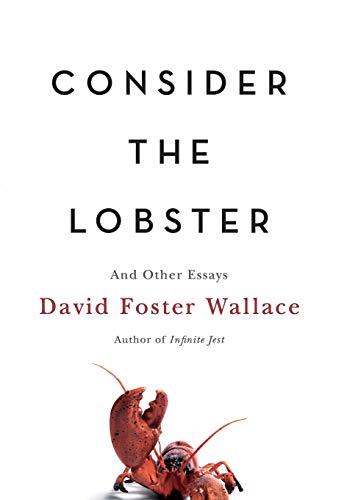

Do lobsters feel pain? Did Franz Kafka have a funny bone? What is John Updike's deal, anyway? And what happens when adult video starlets meet their fans in person?
David Foster Wallace answers these questions and more in essays that are also enthralling narrative adventures. Whether covering the three-ring circus of John McCain's 2000 presidential race, plunging into the wars between dictionary writers, or confronting the World's Largest Lobster Cooker at the annual Maine Lobster Festival, Wallace projects a quality of thought that is uniquely his and a voice as powerful and distinct as any in American letters.
David Foster Wallace answers these questions and more in essays that are also enthralling narrative adventures. Whether covering the three-ring circus of John McCain's 2000 presidential race, plunging into the wars between dictionary writers, or confronting the World's Largest Lobster Cooker at the annual Maine Lobster Festival, Wallace projects a quality of thought that is uniquely his and a voice as powerful and distinct as any in American letters.
"synopsis" may belong to another edition of this title.
About the Author:
David Foster Wallace was born in Ithaca, New York, in 1962 and raised in Illinois, where he was a regionally ranked junior tennis player. He received bachelor of arts degrees in philosophy and English from Amherst College and wrote what would become his first novel, The Broom of the System, as his senior English thesis. He received a masters of fine arts from University of Arizona in 1987 and briefly pursued graduate work in philosophy at Harvard University. His second novel, Infinite Jest, was published in 1996. Wallace taught creative writing at Emerson College, Illinois State University, and Pomona College, and published the story collections Girl with Curious Hair, Brief Interviews with Hideous Men, Oblivion, the essay collections A Supposedly Fun Thing I'll Never Do Again, and Consider the Lobster. He was awarded the MacArthur Fellowship, a Lannan Literary Award, and a Whiting Writers' Award, and was appointed to the Usage Panel for The American Heritage Dictionary of the English Language. He died in 2008. His last novel, The Pale King, was published in 2011.
From AudioFile:
Only 4 of the original 10 essays are here, but each is formidable. In "Consider the Lobster," the author rambles around the Rockland [Maine] Lobster Festival, a veritable orgy of lobster murder, speculating on the morality of cooking and eating a sentient creature. In the next piece, "The View From Mrs. Thompson's," listeners feel the effects of 9/11 on ordinary folks in middle America. Later, in "The Big Red Son," Wallace attends the Adult Video News awards and faithfully records the comments of some of the sleaze-mongers and stars of the porn film industry, and he positively unstrings the tennis star's autobiography in "How Tracy Austin Broke My Heart." Wallace reads his fresh, provocative essays with delicious irreverence, earning his place alongside the great social satirists of this, or any, time. S.J.H. © AudioFile 2006, Portland, Maine-- Copyright © AudioFile, Portland, Maine
"About this title" may belong to another edition of this title.
- PublisherLittle, Brown and Company
- Publication date2005
- ISBN 10 0316156116
- ISBN 13 9780316156110
- BindingHardcover
- Edition number1
- Number of pages352
- Rating
Buy New
Learn more about this copy
US$ 18.91
Shipping:
US$ 4.25
Within U.S.A.
Top Search Results from the AbeBooks Marketplace
Stock Image
Consider the Lobster: And Other Essays
Published by
Little, Brown and Company
(2005)
ISBN 10: 0316156116
ISBN 13: 9780316156110
New
Hardcover
Quantity: 1
Seller:
Rating

Book Description Hardcover. Condition: new. New Copy. Customer Service Guaranteed. Seller Inventory # think0316156116
Buy New
US$ 18.91
Convert currency
Stock Image
Consider the Lobster: And Other Essays
Published by
Little, Brown and Company
(2005)
ISBN 10: 0316156116
ISBN 13: 9780316156110
New
Hardcover
Quantity: 1
Seller:
Rating
Book Description Hardcover. Condition: new. New. Fast Shipping and good customer service. Seller Inventory # Holz_New_0316156116
Buy New
US$ 21.06
Convert currency
Stock Image
Consider the Lobster: And Other Essays
Published by
Little, Brown and Company
(2005)
ISBN 10: 0316156116
ISBN 13: 9780316156110
New
Hardcover
Quantity: 1
Seller:
Rating
Book Description Condition: new. Seller Inventory # newMercantile_0316156116
Buy New
US$ 22.78
Convert currency
Stock Image
Consider the Lobster: And Other Essays
Published by
Little, Brown and Company
(2005)
ISBN 10: 0316156116
ISBN 13: 9780316156110
New
Hardcover
Quantity: 1
Seller:
Rating
Book Description Hardcover. Condition: new. New. Seller Inventory # Wizard0316156116
Buy New
US$ 26.82
Convert currency
Stock Image
Consider the Lobster: And Other Essays
Published by
LITTLE, BROWN
(2005)
ISBN 10: 0316156116
ISBN 13: 9780316156110
New
Hardcover
Quantity: 1
Seller:
Rating
Book Description Condition: new. Seller Inventory # FrontCover0316156116
Buy New
US$ 29.79
Convert currency
Stock Image
Consider the Lobster: And Other Essays
Published by
Little, Brown and Company
(2005)
ISBN 10: 0316156116
ISBN 13: 9780316156110
New
Hardcover
Quantity: 1
Seller:
Rating
Book Description Condition: New. Book is in NEW condition. Seller Inventory # 0316156116-2-1
Buy New
US$ 39.00
Convert currency
Stock Image
Consider the Lobster: And Other Essays
Published by
Little, Brown and Company
(2005)
ISBN 10: 0316156116
ISBN 13: 9780316156110
New
Hardcover
Quantity: 1
Seller:
Rating
Book Description Condition: New. New! This book is in the same immaculate condition as when it was published. Seller Inventory # 353-0316156116-new
Buy New
US$ 39.00
Convert currency
Seller Image
Consider the Lobster And Other Essays
Published by
Little, Brown and Company
(2005)
ISBN 10: 0316156116
ISBN 13: 9780316156110
New
Hardcover
Quantity: 5
Seller:
Rating
Book Description Condition: New. Seller Inventory # 3471944-n
Buy New
US$ 37.85
Convert currency
Stock Image
Consider the Lobster And Other Essays
Published by
Little Brown and Company
(2005)
ISBN 10: 0316156116
ISBN 13: 9780316156110
New
Hardcover
Quantity: > 20
Seller:
Rating
Book Description HRD. Condition: New. New Book. Shipped from UK. THIS BOOK IS PRINTED ON DEMAND. Established seller since 2000. Seller Inventory # L1-9780316156110
Buy New
US$ 42.20
Convert currency
Seller Image
Consider the Lobster: And Other Essays (Hardback or Cased Book)
Published by
Little Brown and Company 12/13/2005
(2005)
ISBN 10: 0316156116
ISBN 13: 9780316156110
New
Hardcover
Quantity: 5
Seller:
Rating
Book Description Hardback or Cased Book. Condition: New. Consider the Lobster: And Other Essays 1.26. Book. Seller Inventory # BBS-9780316156110
Buy New
US$ 45.86
Convert currency