
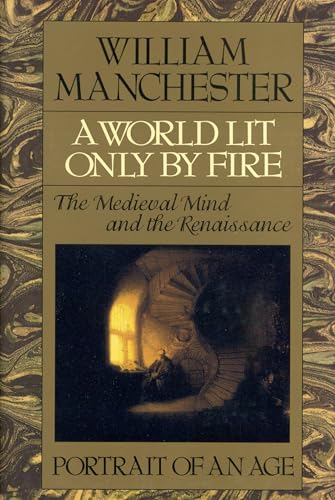
Synopsis
An absorbing history of the Middle Ages from the acclaimed historian William Manchester, author of The Last Lion.
From tales of chivalrous knights to the barbarity of trial by ordeal, no era has been a greater source of awe, horror, and wonder than the Middle Ages. In handsomely crafted prose, and with the grace and authority of his extraordinary gift for narrative history, William Manchester leads us from a civilization tottering on the brink of collapse to the grandeur of its rebirth: the dense explosion of energy that spawned some of history's greatest poets, philosophers, painters, adventurers, and reformers, as well as some of its most spectacular villains.
"Manchester provides easy access to a fascinating age when our modern mentality was just being born." ―Chicago Tribune
"synopsis" may belong to another edition of this title.
About the Author
William Manchester was a hugely successful popular historian and biographer whose books include The Last Lion, Volumes 1 and 2, Goodbye Darkness, A World Lit Only by Fire, The Glory and the Dream, The Arms of Krupp, American Caesar, The Death of the President, and assorted works of journalism.
Reviews
Manchester, temporarily putting aside his rousing Churchill series (The Last Lion), offers a disappointing retread of past histories about the explosive dawn of the modern age. For Manchester, the Middle Ages were a period of unrelieved superstition, corruption, violence, anti-intellectualism, and intolerance. The worst offenders were the Popes, particularly those ruling on the brink of the Protestant Reformation, whose catalogue of sins included assassination plots, simony, and nepotism. Their indulgence in fornication is described here with almost lip- smacking salaciousness (Alexander VI, the Borgia Pope, is pictured as making love with one woman when he suddenly spies her naked daughter, whose ``rhythmic rotation of the hips...so intrigued [him] that he switched partners in midstroke''). Manchester's heroes include Leonardo da Vinci, Luther, and Erasmus; still, in attempting to paint the twilight of an old order in bold colors, he has lost all sense of nuance, acknowledging only in a sentence the Church's role in stabilizing Europe after the Roman Empire collapsed, and picturing the Middle Ages--which produced Aquinas, Roger Bacon, Dante, Chaucer, and the builders of Chartres--as altogether bad. Manchester has not forgotten the skills that, with invective, eloquence, and anecdote, make him a master storyteller. Yet, by his own admission, he did not master any recent scholarship on the early 16th century, which dooms him to retelling the same old stories recounted countless times before. The book Manchester could have written is glimpsed briefly only in the last quarter here, when he transforms Ferdinand Magellan into a paradigm of the tragic hero he celebrated in his works on JFK, Douglas MacArthur, and Churchill. Disheartening: a ``portrait'' painted in simplified strokes and with no perspective. (Maps and 33 b&w illustrations--not seen.) -- Copyright ©1992, Kirkus Associates, LP. All rights reserved.
YA-- An absorbing and readable history, beginning with the collapse of Rome and ending with the redawning of intellectual pursuits in the Renaissance. Manchester's vivid descriptions of the misery and ignorance of the Middle Ages are the background for the second and main section of his book, which he calls the "shattering,"--the collapse of essentially unified thought and the rebirth of the pursuit of knowledge. His last section focuses on Magellan and his historic voyage, described as a primary event in contributing to Western man's changing view of the world. The story of his efforts to obtain backing for his venture is engrossing; the difficulties of the voyage are made real enough to feel.
- Philip D. Winters, Thomas Jefferson Sci-Tech, Fairfax County, VA
Copyright 1993 Reed Business Information, Inc.
Using only secondary sources, Manchester plunges readers into the medieval mind-set in a captivating, marvelously vivid popular history that humanizes the tumultuous span from the Dark Ages to the dawn of the Renaissance. He delineates an age when invisible spirits infested the air, when tolerance was seen as treachery and "a mafia of profane popes desecrated Christianity." Besides re-creating the arduous lives of ordinary people, the Wesleyan professor of history peoples his tapestry with such figures as Leonardo, Machiavelli, Lucrezia Borgia, Erasmus, Luther, Henry VIII and Anne Boleyn. Manchester ( The Arms of Krupp ) devotes much attention to Magellan, whose globe-straddling voyage shattered Christendom's implicit belief in Europe as the center of the universe. His portrayal of the Middle Ages as a time when the strong and the shrewd flourished, while the imaginative, the cerebral and the unfortunate suffered, rings true. Illustrations.
Copyright 1992 Reed Business Information, Inc.
Manchester describes the transition of the medieval mind, "shackled in ignorance, disciplined by fear, and sheathed in superstition," into the Renaissance mind with villains such as Cesare Borgia and Torquemada and heroes such as da Vinci and Magellan. (LJ 4/15/92)
Copyright 1999 Reed Business Information, Inc.
"About this title" may belong to another edition of this title.
Other Popular Editions of the Same Title

Search results for A World Lit Only by Fire: The Medieval Mind and the...

Stock Image
A World Lit Only by Fire The M
Published by
Little, Brown and Company, 1992
ISBN 10: 0316545317
ISBN 13: 9780316545310
Used
Hardcover
Seller: World of Books (was SecondSale), Montgomery, IL, U.S.A.
Seller rating 5 out of 5 stars

Condition: Good. Item in good condition. Textbooks may not include supplemental items i.e. CDs, access codes etc. Seller Inventory # 00100290525
Stock Image
A World Lit Only by Fire The M
Published by
Little, Brown and Company, 1992
ISBN 10: 0316545317
ISBN 13: 9780316545310
Used
Hardcover
Seller: World of Books (was SecondSale), Montgomery, IL, U.S.A.
Seller rating 5 out of 5 stars
Condition: Good. Good condition ex-library book with usual library markings and stickers. Seller Inventory # 00105212965
Stock Image
A World Lit Only by Fire The M
Published by
Little, Brown and Company, 1992
ISBN 10: 0316545317
ISBN 13: 9780316545310
Used
Hardcover
Seller: World of Books (was SecondSale), Montgomery, IL, U.S.A.
Seller rating 5 out of 5 stars
Condition: Acceptable. Item in acceptable condition! Textbooks may not include supplemental items i.e. CDs, access codes etc. Seller Inventory # 00100336146
Stock Image
A World Lit Only by Fire: The Medieval Mind and the Renaissance - Portrait of an Age
Published by
Little, Brown and Company, 1992
ISBN 10: 0316545317
ISBN 13: 9780316545310
Used
Hardcover
Seller: Gulf Coast Books, Cypress, TX, U.S.A.
Seller rating 5 out of 5 stars
hardcover. Condition: Fair. Seller Inventory # 0316545317-4-36391242
Seller Image
A World Lit Only by Fire: The Medieval Mind and the Renaissance - Portrait of an Age
Published by
Little, Brown and Company, 1992
ISBN 10: 0316545317
ISBN 13: 9780316545310
Used
Hardcover
Seller: Zoom Books East, Glendale Heights, IL, U.S.A.
Seller rating 5 out of 5 stars
Condition: acceptable. Book is in acceptable condition and shows signs of wear. Book may also include underlining highlighting. The book can also include "From the library of" labels. May not contain miscellaneous items toys, dvds, etc. . We offer 100% money back guarantee and 24 7 customer service. Seller Inventory # ZEV.0316545317.A
Stock Image
A World Lit Only by Fire: The Medieval Mind and the Renaissance - Portrait of an Age
Published by
Little, Brown and Company, 1992
ISBN 10: 0316545317
ISBN 13: 9780316545310
Used
Hardcover
Seller: BookHolders, Towson, MD, U.S.A.
Seller rating 5 out of 5 stars
Condition: Good. [ No Hassle 30 Day Returns ][ Ships Daily ] [ Underlining/Highlighting: NONE ] [ Writing: NONE ] [ Edition: first ] Publisher: Little, Brown and Company Pub Date: 4/30/1992 Binding: Hardcover Pages: 320 first edition. Seller Inventory # 6725662
Stock Image
A World Lit Only by Fire : The Medieval Mind and the Renaissance - Portrait of an Age
Published by
Little Brown & Company, 1992
ISBN 10: 0316545317
ISBN 13: 9780316545310
Used
Hardcover
First Edition
Seller: Better World Books, Mishawaka, IN, U.S.A.
Seller rating 5 out of 5 stars
Condition: Good. 1st. Former library copy. Pages intact with minimal writing/highlighting. The binding may be loose and creased. Dust jackets/supplements are not included. Includes library markings. Stock photo provided. Product includes identifying sticker. Better World Books: Buy Books. Do Good. Seller Inventory # GRP93584186
Stock Image
A World Lit Only by Fire : The Medieval Mind and the Renaissance - Portrait of an Age
Published by
Little Brown & Company, 1992
ISBN 10: 0316545317
ISBN 13: 9780316545310
Used
Hardcover
First Edition
Seller: Better World Books: West, Reno, NV, U.S.A.
Seller rating 5 out of 5 stars
Condition: Good. 1st. Pages intact with minimal writing/highlighting. The binding may be loose and creased. Dust jackets/supplements are not included. Stock photo provided. Product includes identifying sticker. Better World Books: Buy Books. Do Good. Seller Inventory # GRP102064674
Stock Image
A World Lit Only by Fire: The Medieval Mind and the Renaissance - Portrait of an Age
Published by
Little, Brown and Company, 1992
ISBN 10: 0316545317
ISBN 13: 9780316545310
Used
Hardcover
Seller: HPB-Red, Dallas, TX, U.S.A.
Seller rating 5 out of 5 stars
Hardcover. Condition: Very Good. Connecting readers with great books since 1972! Used textbooks may not include companion materials such as access codes, etc. May have some wear or limited writing/highlighting. We ship orders daily and Customer Service is our top priority! Seller Inventory # S_442865231
Stock Image
A World Lit Only by Fire: The Medieval Mind and the Renaissance - Portrait of an Age
Published by
Little, Brown and Company, 1992
ISBN 10: 0316545317
ISBN 13: 9780316545310
Used
Hardcover
Seller: Half Price Books Inc., Dallas, TX, U.S.A.
Seller rating 5 out of 5 stars
Hardcover. Condition: Very Good. Connecting readers with great books since 1972! Used books may not include companion materials, and may have some shelf wear or limited writing. We ship orders daily and Customer Service is our top priority! Seller Inventory # S_463157560