
Items related to The Killers Within: The Deadly Rise of Drug Resistant...
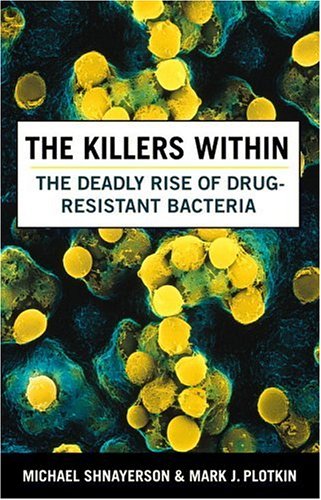
Synopsis
It wasn't too long ago that modern antibiotics seemed to have conquered bacteria. Threatening bacteria, doctors proclaimed, were on their way out.
Not exactly. In THE KILLERS WITHIN, Michael Shnayerson and Mark Plotkin reveal the terrifying truth: that bacteria have evolved, have outwitted doctors, and are now on the ascendancy. Quietly, a medical crisis has been brewing, as laboratories and doctors frantically race to develop new drugs and new means to combat bacteria that, via aggressive evolution, have zigged when medicine zagged. Bacteria that disintegrate your skin; bacteria that clog your lungs; bacteria that result in golf-ball-size abscesses-all these and more make appearances in THE KILLERS WITHIN.
We meet the scientists desperately racing to stay one step ahead. We learn the creepy science of how bacteria work, and why they may be winning. And we see how, ironically, we've created the problem by misusing antibiotics. A book that will be compared to Laurie Garrett's bestselling "The Coming Plague," THE KILLERS WITHIN is a horror story that just happens to be true.
"synopsis" may belong to another edition of this title.
About the Author
Michael Shnayerson is a staff writer at "Vanity Fair" and the author of several books. He lives in New York. Mark Plotkin is one of the world's most renowned ethnobotanists. In 1998, "Time" declared him a "Hero for the Planet."
Reviews
Bacteria preceded human life by millions of years but will they also outlive us? Shnayerson, a staff writer at Vanity Fair magazine, and Plotkin, an ethnobotanist, paint an alarming picture of the crisis posed by antibiotic-resistant bacteria. They focus on the three most common types: enterococci, streptococci and staphylococci. They tell of the deadly S. aureus a particularly virulent strain of staph that has shown up in deadly resistant strains and the infamous "flesh-eating bacteria" (necrotizing fascitis), whose incidence has been on the rise. They explain the myriad factors that have contributed to antibiotic-resistant bacteria and disease, most important among them the overprescription and misuse of the drugs, including the antibiotics fed to livestock to promote growth. Sharing the latest research, the authors suggest that future antibiotics are in the most unlikely places, from shark-bellies and silkmoths to the saliva of the Indonesian Komodo dragon. Shnayerson and Plotkin write in a lively, journalistic style and spotlight many victims, microbiologists and other "faces" behind the statistics, going far to make the copious scientific information accessible to general readers (though some may still be daunted). Yet their alarmist tone may strike many readers as overly sensationalistic and grating. Moreover, many of the facts about antibiotics abuse and drug-resistant bacteria are simply old news, and this book may not drum up much interest in spite of its informative analysis.
Copyright 2002 Cahners Business Information, Inc.
Commenting in 1969 on the success of antibiotics, U.S. Surgeon General William Stewart declared: "We can close the books on infectious diseases." Commenting three decades later on the rapid spread of bacterial resistance to antibiotics, U.S. Surgeon General David Satcher declared: "We are seeing a global resurgence of infectious diseases." Shnayerson and Plotkin (respectively, a staff writer at Vanity Fair and an ethnobotanist serving as president of the Amazon Conservation Team) recount what brought about the resurgence: "The principal cause was overuse--and misuse--of antibiotics." Poor infection control in hospitals and nursing homes is a contributing factor. Is there a way of stopping the march of the bugs? Maybe. The authors explore several possibilities but stop short of predicting that any of them will succeed.
Editors of Scientific American
At first glance, Shnayerson, a Vanity Fair staff writer, and noted ethnobotanist Plotkin (Tales of a Shaman's Apprentice) seem an unlikely pair to be writing a book about antibiotic resistance. Yet the reader quickly becomes engrossed in their tale. The authors provide an extremely readable look at the overuse of antibiotics, the methods bacteria use to develop resistance, the role of antibiotics as animal growth promoters, and the outlook for antibiotics. Drawing on a vast number of interviews with key people in the field, Shnayerson and Plotkin have managed to demonstrate their concern over the future of antibiotics while keeping the scientific background manageable for lay readers. A brief, annotated bibliography and list of web sites adds to the work. An interesting complement to Gerald Grob's The Deadly Truth, which discusses the inevitability of disease, this work also offers readers a riveting update to the section on antibiotics in Laurie Garrett's The Coming Plague. Recommended for public and academic collections.
Tina Neville, Univ. of South Florida at St. Petersburg Lib.
Copyright 2002 Reed Business Information, Inc.
When some bacteria began to develop resistance to penicillin, few physicians worried, because methicillin was available. Now many bacteria are resistant to both antibiotics, and physicians, researchers, and the rest of us really have something to worry about. Schnayerson and Plotkin clearly explain how these changes occurred, and they describe the abuse and misuse of other drugs, how resistance moves from animals to humans (e.g., though agricultural use of antibiotics), and how hygiene failures in hospitals and daycare centers aggravate the situation. They bring to life the work of individual researchers, such as Felix d'Herelle and Patrick Schlievert, and they chastise drug-company publicists and entrepreneurs out for a quick buck for their greed and their failure to accept the lessons of science. They draw on excellent work in Scandinavia and elsewhere, and on such seemingly irrelevant animals as the Komodo dragon, to demonstrate the diverse elements that have been drawn into this area of investigation. They are, however, not optimistic, concluding that "the bugs seem to have figured it [overcoming antibiotics] out." William Beatty
Copyright © American Library Association. All rights reserved
"About this title" may belong to another edition of this title.
Search results for The Killers Within: The Deadly Rise of Drug Resistant...

Stock Image
The Killers Within: The Deadly Rise of Drug-Resistant Bacteria
Published by
Little Brown and Company, 2002
ISBN 10: 0316713317
ISBN 13: 9780316713313
Used
Hardcover
Seller: World of Books (was SecondSale), Montgomery, IL, U.S.A.
Seller rating 5 out of 5 stars

Hardback. Condition: Good. Seller Inventory # 00105350191
Seller Image
The Killers Within: The Deadly Rise of Drug Resistant Bacteria
Seller: Reliant Bookstore, El Dorado, KS, U.S.A.
Seller rating 5 out of 5 stars
Condition: good. This book is in good condition with very minimal damage. Pages may have minimal notes or highlighting. Cover image on the book may vary from photo. Ships out quickly in a secure plastic mailer. Seller Inventory # 56JUHA0007RI_ns
Stock Image
The Killers Within: The Deadly Rise of Drug Resistant Bacteria
Published by
Little, Brown (edition 1), 2002
ISBN 10: 0316713317
ISBN 13: 9780316713313
Used
Hardcover
Seller: BooksRun, Philadelphia, PA, U.S.A.
Seller rating 5 out of 5 stars
Hardcover. Condition: Fair. 1. With dust jacket. The item might be beaten up but readable. May contain markings or highlighting, as well as stains, bent corners, or any other major defect, but the text is not obscured in any way. Seller Inventory # 0316713317-7-1-13_29
Stock Image
The Killers Within: The Deadly Rise of Drug-Resistant Bacteria
Published by
Little Brown and Company, 2002
ISBN 10: 0316713317
ISBN 13: 9780316713313
Used
Hardcover
Seller: World of Books Inc, Montgomery, IL, U.S.A.
Seller rating 4 out of 5 stars

Hardback. Condition: Good. Seller Inventory # CIN0316713317G
Stock Image
The Killers Within: The Deadly Rise of Drug Resistant Bacteria
Seller: ThriftBooks-Dallas, Dallas, TX, U.S.A.
Seller rating 5 out of 5 stars
Hardcover. Condition: Very Good. No Jacket. May have limited writing in cover pages. Pages are unmarked. ~ ThriftBooks: Read More, Spend Less. Seller Inventory # G0316713317I4N00
Stock Image
The Killers Within: The Deadly Rise of Drug Resistant Bacteria
Seller: ThriftBooks-Atlanta, AUSTELL, GA, U.S.A.
Seller rating 5 out of 5 stars
Hardcover. Condition: Good. No Jacket. Pages can have notes/highlighting. Spine may show signs of wear. ~ ThriftBooks: Read More, Spend Less. Seller Inventory # G0316713317I3N00
Stock Image
The Killers Within : The Deadly Rise of Drug-Resistant Bacteria
Published by
Little Brown & Company, 2002
ISBN 10: 0316713317
ISBN 13: 9780316713313
Used
Hardcover
First Edition
Seller: Better World Books, Mishawaka, IN, U.S.A.
Seller rating 5 out of 5 stars
Condition: Good. 1st. Former library copy. Pages intact with minimal writing/highlighting. The binding may be loose and creased. Dust jackets/supplements are not included. Includes library markings. Stock photo provided. Product includes identifying sticker. Better World Books: Buy Books. Do Good. Seller Inventory # GRP73175882
Stock Image
The Killers Within : The Deadly Rise of Drug-Resistant Bacteria
Published by
Little Brown & Company, 2002
ISBN 10: 0316713317
ISBN 13: 9780316713313
Used
Hardcover
First Edition
Seller: Better World Books, Mishawaka, IN, U.S.A.
Seller rating 5 out of 5 stars
Condition: Very Good. 1st. Pages intact with possible writing/highlighting. Binding strong with minor wear. Dust jackets/supplements may not be included. Stock photo provided. Product includes identifying sticker. Better World Books: Buy Books. Do Good. Seller Inventory # 15713131-6
Stock Image
The Killers Within: The Deadly Rise of Drug Resistant Bacteria
Seller: HPB-Emerald, Dallas, TX, U.S.A.
Seller rating 5 out of 5 stars
hardcover. Condition: Very Good. Connecting readers with great books since 1972! Used books may not include companion materials, and may have some shelf wear or limited writing. We ship orders daily and Customer Service is our top priority! Seller Inventory # S_457582813
Stock Image
The Killers Within: The Deadly Rise of Drug Resistant Bacteria
Seller: HPB-Ruby, Dallas, TX, U.S.A.
Seller rating 5 out of 5 stars
hardcover. Condition: Very Good. Connecting readers with great books since 1972! Used books may not include companion materials, and may have some shelf wear or limited writing. We ship orders daily and Customer Service is our top priority! Seller Inventory # S_449569462