
Items related to Pasquale's Nose
Synopsis
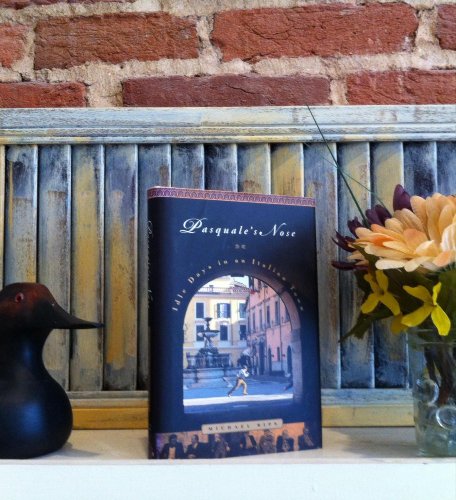
A former criminal lawyer discusses his flight to a small Etruscan village with his wife and new baby, a journey populated by a cast of bizarre characters.
"synopsis" may belong to another edition of this title.
About the Author
Michael Rips is a 5th generation Nebraska native. He currently practices criminal litigation and lives at the Chelsea Hotel in New York City. This is his first book.
Reviews
First-time author Rips, formerly a successful trial lawyer, ran off to the Etruscan village of Sutri with his painter wife and new baby. In Sutri, the likably neurotic author spent day after day in the cafe, reflecting on the notion that he "was unable to produce or even reflect on anything that I or anyone else would consider useful." Seemingly in the throes of a pre-midlife crisis, Rips presents his quirks at face value, sans psychospeak, with hilarious, moving or unsettling effect. In a small, ancient town, one might expect to find citizens repressed by long-standing social mores, an assumption both confirmed and disproved by the many eccentrics: the man who lights his cigarettes with a magnifying glass; an illiterate postman who leaves the villagers to sort their own mail; a blind bootmaker who claims he can make a perfectly sized boot just by looking at a person's foot (he can't, but still keeps his customers); and Pasquale, a terrifying brute with a penchant for smelling feet. Rips warms to Sutri, finding it "an archaic society... that had... forged a collective identity and story and that had a mystical attachment to both." The kindhearted, brutal and idiosyncratic Sutrinis' nonsensical ideas about causality and the author's peculiar, often bleak worldview complement each other perfectly. In tiny, glittering vignettes, Rips paints an extraordinary picture of interwoven sublimity and absurdity.
Copyright 2001 Cahners Business Information, Inc.
Yet another in the proliferation of "I lived abroad" books, this unemotional and self-absorbed narrative explores Rips's stay in Sutri an Italian hill town near Rome where his artist wife finds an available house and studio where she can pursue a new series of paintings. Rips abandons his legal practice to live an indolent life and spends his days drinking coffee in a local cafe while collecting anecdotes about Sutri's citizens. In a town noted for its beans and riding boots, he assembles more than a dozen surreal accounts of the area's most peculiar inhabitants: Aurellio Mezzadonna is reputed to have a cat's paw in place of a hand; Pasquale's nose is enormous and reacts painfully to the odor of feet; and Frank, the shoe storeowner, is a hermaphrodite. There's little mention of Sheila, Rips's wife, and even less of his infant daughter. Almost as an aside, Rips includes the menus of a few meals and relevant recipes. As a whole, the book lacks the wit and warmth of such classics as Peter Mayle's A Year in Provence or Frances Mayes's Under the Tuscan Sun. This is probably results from Rips having lived his entire adult life in hotels. Not recommended. Janet Ross, formerly with Sparks Branch Lib., NV
Copyright 2001 Reed Business Information, Inc.
Excerpt. © Reprinted by permission. All rights reserved.
For as long as I can remember I have suffered from the belief that the place where I am living, however wretched, is preferable to anywhere else, however pleasant-the brown grass here is better than the green grass there. My brown grass that spring was the Riss Restaurant, a purgatorial place where I would sit day after day doing little or nothing, surrounded by others doing less. It was at the Riss that Sheila found me, at the Riss that she suggested that we move to Italy, and at the Riss that I refused to go.
Sheila, an artist, had just given birth to our child. With no reason to believe that I would ever work, she felt compelled to earn money. That's where Italy came in.
Sheila knew of a medieval town at the top of a hill in central Italy. Artists lived there and one of them had a vacant house and studio. The town and studio would inspire her to complete a new series of paintings, which she would sell to support us. As for me, Sheila claimed that the town had two or three coffee shops that were as awful as the Riss.
I began to assemble the excuses for not going. But Sheila didn't need to hear them-she knew them from countless other conversations, all of which ended the same way: I would not leave.
But that afternoon something happened. A sheet of paper taped to the cash register. A sign.
The Riss, which had been open twenty-four hours a day, seven days a week, for seven decades, was closing.
It should not have surprised me-unlike Heaven and Hell, Purgatory was bound by time, subject to decay and oblivion.
Days later we left for Italy.
That Sheila was responsible for the sign on the cash register did not occur to me until it was too late. Copyright (c) 2001 by Michael Rips
"About this title" may belong to another edition of this title.
Search results for Pasquale's Nose

Stock Image
Pasquale's Nose
Published by
Little Brown and Company, 2001
ISBN 10: 0316748005
ISBN 13: 9780316748001
Used
Hardcover
Seller: World of Books (was SecondSale), Montgomery, IL, U.S.A.
Seller rating 5 out of 5 stars

Hardback. Condition: Very Good. Prepare to dive Open this underwater exploration guide and journey to the darkest depths of the oceans. Water covers almost three-fourths of our planers surface, yet many of us have never seen what lies far beneath the waves. Filled with intriguing facts and colorful illustrations, this book examines the history and science of diving, the different ocean zones, and the future of undersea research. Join Gail Gibbons, the master of children's nonfiction, as she takes us 36,000 feet below the surface to reveal the fascinating and incredible life forms that lurk in the deep, dark sea. Seller Inventory # 00105473202
Stock Image
Pasquale's Nose
Published by
Little Brown & Co (edition 1), 2001
ISBN 10: 0316748005
ISBN 13: 9780316748001
Used
Hardcover
Seller: BooksRun, Philadelphia, PA, U.S.A.
Seller rating 5 out of 5 stars
Hardcover. Condition: Very Good. 1. With dust jacket. It's a well-cared-for item that has seen limited use. The item may show minor signs of wear. All the text is legible, with all pages included. It may have slight markings and/or highlighting. Seller Inventory # 0316748005-11-1-29
Seller Image
Pasquale's Nose
Seller: Greenworld Books, Arlington, TX, U.S.A.
Seller rating 5 out of 5 stars
Condition: good. Fast Free Shipping â" Good condition. It may show normal signs of use, such as light writing, highlighting, or library markings, but all pages are intact and the book is fully readable. A solid, complete copy that's ready to enjoy. Seller Inventory # GWV.0316748005.G
Stock Image
Pasquale's Nose
Seller: ThriftBooks-Phoenix, Phoenix, AZ, U.S.A.
Seller rating 5 out of 5 stars
Hardcover. Condition: Very Good. No Jacket. May have limited writing in cover pages. Pages are unmarked. ~ ThriftBooks: Read More, Spend Less. Seller Inventory # G0316748005I4N00
Stock Image
Pasquale's Nose
Seller: ThriftBooks-Atlanta, AUSTELL, GA, U.S.A.
Seller rating 5 out of 5 stars
Hardcover. Condition: Very Good. No Jacket. May have limited writing in cover pages. Pages are unmarked. ~ ThriftBooks: Read More, Spend Less. Seller Inventory # G0316748005I4N00
Stock Image
Pasquale's Nose
Seller: ThriftBooks-Dallas, Dallas, TX, U.S.A.
Seller rating 5 out of 5 stars
Hardcover. Condition: Very Good. No Jacket. Missing dust jacket; May have limited writing in cover pages. Pages are unmarked. ~ ThriftBooks: Read More, Spend Less. Seller Inventory # G0316748005I4N01
Stock Image
Pasquale's Nose
Seller: ThriftBooks-Dallas, Dallas, TX, U.S.A.
Seller rating 5 out of 5 stars
Hardcover. Condition: Very Good. No Jacket. May have limited writing in cover pages. Pages are unmarked. ~ ThriftBooks: Read More, Spend Less. Seller Inventory # G0316748005I4N00
Seller Image
Pasquale's Nose
Seller: -OnTimeBooks-, Phoenix, AZ, U.S.A.
Seller rating 5 out of 5 stars
Condition: good. A copy that has been read, remains in good condition. All pages are intact, and the cover is intact. The spine and cover show signs of wear. Pages can include notes and highlighting and show signs of wear, and the copy can include "From the library of" labels or previous owner inscriptions. 100% GUARANTEE! Shipped with delivery confirmation, if you're not satisfied with purchase please return item! Ships via media mail. Seller Inventory # OTV.0316748005.G
Stock Image
Pasquale's Nose
Seller: Wonder Book, Frederick, MD, U.S.A.
Seller rating 5 out of 5 stars
Condition: Very Good. Very Good condition. Very Good dust jacket. A copy that may have a few cosmetic defects. May also contain light spine creasing or a few markings such as an owner's name, short gifter's inscription or light stamp. Seller Inventory # K13B-02927
Stock Image
Pasquale's Nose
Seller: Wonder Book, Frederick, MD, U.S.A.
Seller rating 5 out of 5 stars
Condition: As New. Like New condition. Like New dust jacket. A near perfect copy that may have very minor cosmetic defects. Seller Inventory # U01B-05586