
Items related to Powder and patch (the transformation of Philip Jettan)
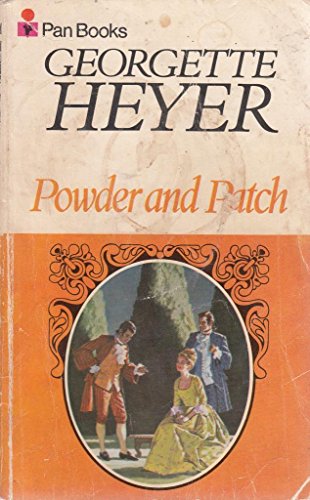
Synopsis
"Georgette Heyer is unbeatable!"
—SUNDAY TELEGRAPH
For her, he would do anything…
Plainspoken country gentleman Philip Jettan won't bother with a powdered wig, high heels, and fashionable lace cuffs, until he discovers that his lovely neighbor is enamored with a sophisticated man-about-town…
But what is it that she really wants?
Cleone Charteris sends her suitor Philip away to get some town polish, and he comes back with powder, patches, and all the manners of a seasoned rake. Does Cleone now have exactly the kind of man she's always wanted, or was her insistence on Philip's remarkable transformation a terrible mistake?
What readers say:
"Charming, charming, charming. And highly readable!"
"Witty dialogue and well-developed storylines—even Jane Austen could do no better."
"Scintillating and very human love story by an author of exceptional talents."
"Ms Heyer's effervescent wit and obvious ability to tell a good and humorous story is already evident, making Powder and Patch an enjoyable and worthwhile read."
"This story sparkles with witty dialogue and wonderful descriptions of costumes and festivities of the 1700s. I re-read it at least once a year and I enjoy it as much as the first time, again and again!"
"synopsis" may belong to another edition of this title.
About the Author
The late Georgette Heyer was a very private woman. Her historical novels have charmed and delighted millions of readers for decades, though she rarely reached out to the public to discuss her works or private life. It is known that she was born in Wimbledon in August 1902, and her first novel, The Black Moth, was published in 1921.
Heyer published 56 books over the next 53 years, until her death from lung cancer in 1974. Heyer's large volume of works included Regency romances, mysteries and historical fiction. Known also as the Queen of Regency romance, Heyer was legendary for her research, historical accuracy and her extraordinary plots and characterizations. Her last book, My Lord John, was published posthumously in 1975. She was married to George Ronald Rougier, a mining engineer, and they had one son together, Richard.
From the Inside Flap
In an 18th century of wit, womanizing and powdered wigs, provincial Philip Jettan runs the risk of irreproachability.
Reviews
This early Heyer novel involves late eighteenth-century society in England and France. Jamie Glover is a marvelous reader! Although much of the text is in French, Glover's narration has so much expression that the listener immediately understands what's happening. Heyer's excellent writing, and Glover's fine delivery keep the listener engaged. D.M.W. (c)AudioFile, Portland, Maine
Excerpt. © Reprinted by permission. All rights reserved.
Excerpt from Chapter One
If you searched among the Downs in Sussex, somewhere between Midhurst and Brighthelmstone, inland a little, and nestling in modest seclusion between two waves of hills, you would find Little Fittledean, a village round which three gentlemen had built their homes. One chose the north side, half a mile away, and on the slope of the Downs. He was Mr Winton, a dull man with no wife, but two children, James and Jennifer. The second built his house west of the village, not far from the London Road and Great Fittledean. He was one Sir Thomas Jettan. He chose his site carefully, beside a wood, and laid out gardens after the Dutch style. That was way back in the last century when Charles the Second was King, and what had then been a glaring white erection, stark-naked and blatant in its sylvan setting, was now, some seventy years later, a fair place, creeper-hung, and made kindly by the passing of the years. The Jettan who built it became inordinately proud of the house. Never a day passed but he would strut round the grounds, looking at the nude structure from a hundred different points of vantage. It was to be the country seat of the Jettans in their old age; they were to think of it almost as they would think of their children. It was never to be sold; it was to pass from father to son and from son to grandson through countless ages. Nor must it accrue to a female heir, be she never so direct, for old Tom determined that the name of Jettan should always be associated with the house.
Old Tom propounded these notions to the whole countryside. All his friends and his acquaintances were shown the white house and told the tale of its owner's past misdemeanours and his present virtue – a virtue due, he assured them, to the possession of so fair an estate. No more would he pursue the butterfly existence that all his ancestors had pursued before him. This house was his anchor and his interest; he would rear his two sons to reverence it, and it might even be that the tradition which held every Jettan to be a wild fellow at heart should be broken at last.
The neighbours laughed behind their hands at old Tom's childishness. They dubbed the hitherto unnamed house ‘Tom's Pride', in good-humoured raillery.
Tom Jettan was busy thinking out a suitable name for his home when the countryside's nickname came to his ears. He was not without humour in spite of his vanity, and when the sobriquet had sunk into his brain, he chuckled deep in his chest, and slapped his knee in appreciation. Not a month later the neighbours were horrified to find, cunningly inserted in the wrought-iron gates of the white house, a gilded scroll bearing the legend, ‘Jettan's Pride'. No little apprehension was felt amongst them at having their secret joke thus discovered and utilised, and those who next waited on Tom did so with an air of ashamed nervousness. But Tom soon made it clear that, far from being offended, he was grateful to them for finding an appropriate name for his home.
His hopeful prophecy concerning the breaking of tradition was not realised in either of his sons. The elder, Maurice, sowed all the wild oats of which he was capable before taking up his abode at the Pride; the other, Thomas, never ceased sowing wild oats, and showed no love for the house whatsoever.
When old Tom died he left a will which gave Maurice to understand that if, by the time he was fifty years of age, he still refused to settle down at the Pride, it was to pass to his brother and his brother's heirs.
Thomas counselled Maurice to marry and produce some children.
‘For damme if I do, my boy! The old man must have lost his faculties to expect a Jettan to live in this hole! I tell ye flat, Maurice, I'll not have the place. 'Tis you who are the elder, and you must assume the – the responsibilities!' At that he fell a-chuckling, for he was an irrepressible scamp.
‘Certainly I shall live here,' answered Maurice. ‘Three months here, and nine months – not here. What's to stop me?'
‘Does the will allow it?' asked Tom doubtfully.
‘It does not forbid it. And I shall get me a wife.'
At that Tom burst out laughing, but checked himself hurriedly as he met his brother's reproving eye.
‘God save us, and the old gentleman but three days dead! Not that I meant any disrespect, y'know. Faith, the old man'ud be the first to laugh with me, stap me if he wouldn't!' He stifled another laugh, and shrugged his shoulders. ‘Or he would before he went crazy-pious over this devilish great barn of a house. You'll never have the money to keep it, Maurry,' he added cheerfully, ‘let alone a wife.'
Maurice twirled his eyeglass, frowning.
‘My father has left even more than I expected,' he said.
‘Oh ay! But it'll be gone after a week's play! God ha' mercy, Maurry, do ye hope to husband it?'
‘Nay, I hope to husband a wife. The rest I'll leave to her.'
Tom came heavily to his feet. He stared at his brother, round-eyed.
‘Blister me, but I believe the place is turning you like the old gentleman! Now, Maurry, Maurry, stiffen your back, man!'
Maurice smiled.
‘It'll take more than the Pride to reform me, Tom. I'm thinking that the place is too good to sell or throw away.'
‘If I could lay my hand on two thousand guineas,' said Tom, ‘anyone could have the Pride for me!'
Maurice looked up quickly.
‘Why, Tom, all I've got's yours, you know very well! Take what you want – two thousand or twenty.'
‘Devilish good of you, Maurry, but I'll not sponge on you yet. No, don't start to argue with me, for my head's not strong enough what with one thing and another. Tell me more of this wife of yours. Who is it to be?'
‘I haven't decided,' replied Maurice. He yawned slightly. ‘There are so many to choose from.'
‘Ay – you're an attractive devil – 'pon my word you are! What d'ye say to Lucy Farmer?'
Maurice shuddered.
‘Spare me. I had thought of Marianne Tempest.'
‘What, old Castlehill's daughter? She'd kill you in a month, lad.'
‘But she is not – dowerless.'
‘No. But think of it, Maurry! Think of it! A shrew at twenty!'
‘Then what do you think of Jane Butterfield?'
Thomas pulled at his lip, irresolute.
‘I'm not decrying the girl, Maurice, but Lord! could you live with her?'
‘I've not essayed it,' answered Maurice.
‘No, and marriage is so damned final! 'Tisn't as though ye could live together for a month or so before ye made up your minds. I doubt the girl would not consent to that.'
"About this title" may belong to another edition of this title.
Search results for Powder and patch (the transformation of Philip Jettan)

Stock Image
Powder and patch (the transformation of Philip Jettan)
Seller: ThriftBooks-Dallas, Dallas, TX, U.S.A.
Seller rating 5 out of 5 stars

Paperback. Condition: Good. No Jacket. Pages can have notes/highlighting. Spine may show signs of wear. ~ ThriftBooks: Read More, Spend Less. Seller Inventory # G0330020633I3N00
Stock Image
Powder and patch (the transformation of Philip Jettan)
Seller: ThriftBooks-Phoenix, Phoenix, AZ, U.S.A.
Seller rating 5 out of 5 stars
Paperback. Condition: Good. No Jacket. Pages can have notes/highlighting. Spine may show signs of wear. ~ ThriftBooks: Read More, Spend Less. Seller Inventory # G0330020633I3N00
Stock Image
Powder And Patch: The Transformation Of Philip Jettan
Published by
Pan Macmillan, United Kingdom, London, 1968
ISBN 10: 0330020633
ISBN 13: 9780330020633
Used
Paperback
Seller: WorldofBooks, Goring-By-Sea, WS, United Kingdom
Seller rating 5 out of 5 stars
Paperback. Condition: Very Good. From the author of THE BLACK MOTH, REGENCY BUCK and A CIVIL CONTRACT, a novel set in 18th-century England, a time of wit, womanizing and powdered wigs, in which the provincial Philip Jettan runs the risk of irreproachability. The book has been read, but is in excellent condition. Pages are intact and not marred by notes or highlighting. The spine remains undamaged. Seller Inventory # GOR004942555
Buy Used
US$ 2.62
US$ 7.49 shipping
Ships from United Kingdom to U.S.A.
Ships from United Kingdom to U.S.A.
Quantity: 1 available
Stock Image
Powder and Patch
Seller: Better World Books Ltd, Dunfermline, United Kingdom
Seller rating 5 out of 5 stars
Condition: Good. Pages intact with minimal writing/highlighting. The binding may be loose and creased. Dust jackets/supplements are not included. Stock photo provided. Product includes identifying sticker. Better World Books: Buy Books. Do Good. Seller Inventory # 8684600-6
Buy Used
US$ 6.26
US$ 6.69 shipping
Ships from United Kingdom to U.S.A.
Ships from United Kingdom to U.S.A.
Quantity: 1 available
Stock Image
Powder and Patch
Seller: Better World Books Ltd, Dunfermline, United Kingdom
Seller rating 5 out of 5 stars
Condition: Good. Former library copy. Pages intact with minimal writing/highlighting. The binding may be loose and creased. Dust jackets/supplements are not included. Includes library markings. Stock photo provided. Product includes identifying sticker. Better World Books: Buy Books. Do Good. Seller Inventory # 9012599-20
Buy Used
US$ 6.26
US$ 6.69 shipping
Ships from United Kingdom to U.S.A.
Ships from United Kingdom to U.S.A.
Quantity: 2 available
Stock Image
Powder and patch (the transformation of Philip Jettan)
Seller: Bank of Books, Ventura, CA, U.S.A.
Seller rating 4 out of 5 stars

paperback. Condition: Acceptable. 1974 Print. A book that has various signs of damaged but is complete. Heavily worn. We have 75,000 books to choose from -- Ship within 24 hours -- Satisfaction Guaranteed! Seller Inventory # mon0000954284
Stock Image
Powder And Patch: The Transformation Of Philip Jettan
Seller: Sell Books, Elland, YORKS, United Kingdom
Seller rating 5 out of 5 stars
paperback. Condition: Good. Our good condition books are generally good for reading but not for gifting or collecting. They could have imperfections such as creasing, fanning, inscriptions, margin notes, yellowing, staining on edge or cover or pages, bumps, scuffs, etc etc (sometimes multiple of these). It's a wide category that encompasses anything that isn't almost-new down to anything that is slightly better than poor. We would NOT recommend gifting Good books - these should be considered reading copies. Our books are dispatched from a Yorkshire former cotton mill. We list via barcode/ISBN so please note that the images are stock images and may not be the exact copy you receive, furthermore the details about edition and year might not be accurate as many publishers reuse the same ISBN for multiple editions and as we simply scan a barcode or enter an ISBN we do not check the validity of the edition data when listing. If you're looking for an exact edition please don't order (at least not without checking with us first, although we don't always have time to check). We aim to dispatch prompty, the service used will depend on order value and book size. We can ship to most countries, see our shipping policies. Payment is via Abe only. Seller Inventory # SBAB-mon0000049030
Buy Used
US$ 3.85
US$ 10.38 shipping
Ships from United Kingdom to U.S.A.
Ships from United Kingdom to U.S.A.
Quantity: 1 available
Seller Image
POWDER AND PATCH
Seller: WF Sandercombe, Burlington, ON, Canada
Seller rating 5 out of 5 stars
Paperback. Condition: Very Good. Later Printing. 160 pp. Light edge and corner wear with an uncreased spine; no interior markings. Book. Seller Inventory # 230663
Stock Image
Powder and patch (the transformation of Philip Jettan)
Seller: Cotswold Internet Books, Cheltenham, United Kingdom
Seller rating 5 out of 5 stars
Condition: Used - Very Good. VG paperback. Reprint. Pages slightly browned. Originally published under the title The Transformation of Philip Jettan. Used - Very Good. VG paperback. Seller Inventory # BOOKS053615I
Buy Used
US$ 4.75
US$ 18.73 shipping
Ships from United Kingdom to U.S.A.
Ships from United Kingdom to U.S.A.
Quantity: 1 available
Seller Image
Powder and Patch A Comedy of Manners
Published by
Pan, England, 1972
ISBN 10: 0330020633
ISBN 13: 9780330020633
Used
Mass Market Paperback
Seller: Caerwen Books, Forrestfield, WA, Australia
Seller rating 5 out of 5 stars
Mass Market Paperback. Condition: Good. Spine is creased & edge worn. Where possible small books will have postage reduced. Seller Inventory # 048110
Buy Used
US$ 5.57
US$ 18.80 shipping
Ships from Australia to U.S.A.
Ships from Australia to U.S.A.
Quantity: 1 available