
Items related to Descartes' Error
Synopsis
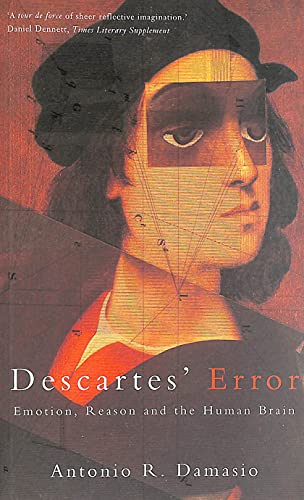
Since Descartes famously proclaimed, "I think, therefore I am," science has often overlooked emotions as the source of a person’s true being. Even modern neuroscience has tended, until recently, to concentrate on the cognitive aspects of brain function, disregarding emotions. This attitude began to change with the publication of Descartes’ Error in 1995. Antonio Damasio—"one of the world’s leading neurologists" ( The New York Times )—challenged traditional ideas about the connection between emotions and rationality. In this wondrously engaging book, Damasio takes the reader on a journey of scientific discovery through a series of case studies, demonstrating what many of us have long emotions are not a luxury, they are essential to rational thinking and to normal social behavior.
"synopsis" may belong to another edition of this title.
From the Back Cover
"Although I cannot tell for certain what sparked my interest in the neural underpinnings of reason, I do know when I became convinced that the traditional views on the nature of rationality could not be correct". Thus begins a book that takes the reader on a journey of discovery, from the story of Phineas Gage, the famous nineteenth-century case of behavioral change that followed brain damage, to the contemporary recreation of Gage's brain; and from the doubts of a young neurologist to a testable hypothesis concerning the emotions and their fundamental role in rational human behavior. Drawing on his experiences with neurological patients affected by brain damage (his laboratory is recognized worldwide as the foremost center for the study of such patients), Antonio Damasio shows how the absence of emotion and feeling can break down rationality. In the course of explaining how emotions and feelings contribute to reason and to adaptive social behavior, Damasio also offers a novel perspective on what emotions and feelings actually are: a direct sensing of our own body states, a link between the body and its survival-oriented regulations, on the one hand, and consciousness, on the other. Descartes' Error leads us to conclude that human organisms are endowed from the very beginning with a spirited passion for making choices, which the social mind can use to build rational behavior.
About the Author
Antonio Damasio is a University Professor, David Dornsife Professor of Neuroscience, Psychology, and Neurology, and director of the Brain and Creativity Institute at the University of Southern California. Damasio's other books include Self Comes to Mind, Looking for Spinoza and The Feeling of What Happens. He has received the Honda Prize, the Prince of Asturias Award for Technical and Scientific Research, and, shared with his wife Hanna, the Pessoa, Signoret, and Cozzarelli prizes. Damasio is a fellow of the Institute of Medicine of the National Academy of Sciences, the American Academy of Arts and Sciences, the Bavarian Academy of Sciences, and the European Academy of Sciences and Arts. He lives in Los Angeles.
"About this title" may belong to another edition of this title.
Search results for Descartes' Error

Stock Image
Descartes' Error: Emotion, Reason and the Human Brain
Seller: AwesomeBooks, Wallingford, United Kingdom
Seller rating 5 out of 5 stars

Paperback. Condition: Very Good. Descartes' Error: Emotion, Reason and the Human Brain This book is in very good condition and will be shipped within 24 hours of ordering. The cover may have some limited signs of wear but the pages are clean, intact and the spine remains undamaged. This book has clearly been well maintained and looked after thus far. Money back guarantee if you are not satisfied. See all our books here, order more than 1 book and get discounted shipping. Seller Inventory # 7719-9780333656563
Buy Used
US$ 17.12
US$ 5.46 shipping
Ships from United Kingdom to U.S.A.
Ships from United Kingdom to U.S.A.
Quantity: 2 available
Stock Image
Descartes' Error: Emotion, Reason and the Human Brain
Seller: Bahamut Media, Reading, United Kingdom
Seller rating 4 out of 5 stars

Paperback. Condition: Very Good. This book is in very good condition and will be shipped within 24 hours of ordering. The cover may have some limited signs of wear but the pages are clean, intact and the spine remains undamaged. This book has clearly been well maintained and looked after thus far. Money back guarantee if you are not satisfied. See all our books here, order more than 1 book and get discounted shipping. Seller Inventory # 6545-9780333656563
Buy Used
US$ 15.81
US$ 9.24 shipping
Ships from United Kingdom to U.S.A.
Ships from United Kingdom to U.S.A.
Quantity: 2 available
Seller Image
Descartes' Error: Emotion, Reason and the Human Brain
Seller: tinyBook, Bath, United Kingdom
Seller rating 5 out of 5 stars
Trade Paperback. Condition: Very good +. Reprint. Pictorial card wraps. xxi, 312. Minor signs of handling, use, but a very sound, clean copy. Seller Inventory # 00006676
Buy Used
US$ 8.04
US$ 31.98 shipping
Ships from United Kingdom to U.S.A.
Ships from United Kingdom to U.S.A.
Quantity: 1 available
Stock Image
Descartes' Error
Seller: Quality Books UK, Derby, DERBY, United Kingdom
Seller rating 3 out of 5 stars

Paperback. Condition: Very Good. Dust Jacket Condition: No Dust Jacket. Seller Inventory # 11890
Buy Used
US$ 14.74
US$ 26.48 shipping
Ships from United Kingdom to U.S.A.
Ships from United Kingdom to U.S.A.
Quantity: 1 available
Stock Image
Descartes' Error
Seller: Webster's Bookstore Cafe, Inc., State College, PA, U.S.A.
Seller rating 5 out of 5 stars
Paperback. Condition: Good. Contains marginalia and/or underlining. Mild general wear. Binding creased but intact. Seller Inventory # mon0000121442