
Items related to My Father's Roses
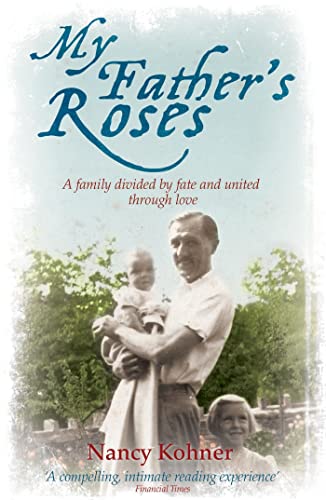
Synopsis
Some families save and others throw away. The Kohners, a Jewish family living in Bohemia at the end of the nineteenth century, threw very little away. A hundred years later their casually assembled archive of over a thousand family letters, hundreds of photos, diaries and notebooks, pieces of verse, invoices, tickets and programmes, tells a unique story.
Like most families, they are as concerned with their own affairs as with world events. Two parents, Heinrich and Valerie and their three children, Franz, Berta and Rudi, write to each other about what matters to them most - a compelling story of love and rivalry, arguments and reconciliations, business, money-making and home.
As history overtakes them, their ordinary lives collide with extraordinary world events. In 1939, Hitler's invasion destroys the world in which they have lived and loved.
Decades later, Rudi's daughter, Nancy Kohner, goes through the archive of letters and diaries and began to reflect on what it means to inherit such a story - words from a lost world. Captivated, amused and often surprised by what she uncovered, in My Father's Roses she revisited, with extraordinarily moving tenderness, her relationship with her father and, through him, a family she never knew.
"synopsis" may belong to another edition of this title.
About the Author
Nancy Kohner spent two decades piecing together her family's history from the suitcases of diaries, letters, and photographs her father brought out of Prague before her death in 2006.
From Publishers Weekly
Kohner, born in England in 1950, grew up with little understanding of her father's earlier life as a Jewish refugee from Czechoslovakia. After his 1987 death, she went through the correspondence, diaries, photographs and other documents he brought from Prague, which spurred her into two decades of research to reconstruct his story. Her odyssey resulted in this poignant portrait of three generations. Many family letters illuminate the narrative, which begins in 1896, when her grandparents met, and ends in the early 1940s, with her 64-year-old grandmother Valerie in Nazi-occupied Prague, writing letters to her sons, aware of her impending doom: We lived such a beautiful, peaceful life. It's a good thing that no one can take away our memories. In 1942, Valerie arrived at the Treblinka death camp. Kohler (who died in 2006) provides an evocative, moving but unsentimental book that captures the commonplace details of ordinary lives torn apart by the darkening cloud of world events. (Jan. 15)
Copyright © Reed Business Information, a division of Reed Elsevier Inc. All rights reserved.
"About this title" may belong to another edition of this title.
Other Popular Editions of the Same Title

Search results for My Father's Roses

Stock Image
My Father's Roses
Seller: WorldofBooks, Goring-By-Sea, WS, United Kingdom
Seller rating 5 out of 5 stars

Paperback. Condition: Very Good. The book has been read, but is in excellent condition. Pages are intact and not marred by notes or highlighting. The spine remains undamaged. Seller Inventory # GOR002973212
Buy Used
US$ 6.50
US$ 7.58 shipping
Ships from United Kingdom to U.S.A.
Ships from United Kingdom to U.S.A.
Quantity: 2 available
Stock Image
My Father's Roses
Seller: AwesomeBooks, Wallingford, United Kingdom
Seller rating 5 out of 5 stars
Paperback. Condition: Very Good. My Father's Roses This book is in very good condition and will be shipped within 24 hours of ordering. The cover may have some limited signs of wear but the pages are clean, intact and the spine remains undamaged. This book has clearly been well maintained and looked after thus far. Money back guarantee if you are not satisfied. See all our books here, order more than 1 book and get discounted shipping. Seller Inventory # 7719-9780340960264
Buy Used
US$ 8.71
US$ 5.58 shipping
Ships from United Kingdom to U.S.A.
Ships from United Kingdom to U.S.A.
Quantity: 2 available
Seller Image
My Father's Roses
Seller: WeBuyBooks, Rossendale, LANCS, United Kingdom
Seller rating 5 out of 5 stars
Condition: Good. Most items will be dispatched the same or the next working day. A copy that has been read but remains in clean condition. All of the pages are intact and the cover is intact and the spine may show signs of wear. The book may have minor markings which are not specifically mentioned. Ex library copy with usual stamps & stickers. Seller Inventory # rev6027518115
Buy Used
US$ 6.83
US$ 7.52 shipping
Ships from United Kingdom to U.S.A.
Ships from United Kingdom to U.S.A.
Quantity: 2 available
Stock Image
My Father's Roses
Seller: Bahamut Media, Reading, United Kingdom
Seller rating 5 out of 5 stars
Paperback. Condition: Very Good. This book is in very good condition and will be shipped within 24 hours of ordering. The cover may have some limited signs of wear but the pages are clean, intact and the spine remains undamaged. This book has clearly been well maintained and looked after thus far. Money back guarantee if you are not satisfied. See all our books here, order more than 1 book and get discounted shipping. Seller Inventory # 6545-9780340960264
Buy Used
US$ 8.70
US$ 9.45 shipping
Ships from United Kingdom to U.S.A.
Ships from United Kingdom to U.S.A.
Quantity: 2 available