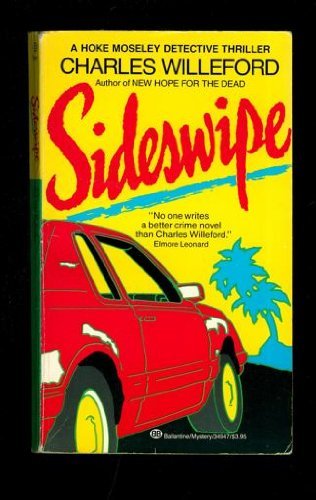
Florida homicide detective Hoke Moseley's life suddenly went to bell one morning. His ex-wife had married a big-time pro ballplayer. His two teenage daughters moved in. And his lieutenant had dumped ever? unsolved murder in Miami on him. So Hoke decided to bail out stretch out on Singer Island, give up police work, and watch the ocean roll.
But trouble wasn't going to let Hoke get away. Not a stone's throw from his laid-back new life, a slick, handsome psychopath was planning his next armed robbery. The heist would suck a curmudgeon retiree into a life of crime, blast a half-dozen people, off the planet, and leave nary a clue behind.
It was a case right up Hoke's alley: weird enough to catch his attention, personal enough to make him mad, and twisted enough to make Hoke forget he didn't want to be a cop...a good guy in a world gone very, very bad.
"synopsis" may belong to another edition of this title.
Charles Willeford was a highly decorated (Silver Star, Bronze Star, Purple Heart, Luxembourg Croix de Guerre) tank commander with the Third Army in World War II. He was also a professional horse trainer, boxer, radio announcer, and painter. Willeford, the author of twenty novels, created the Miami detective series featuring Hoke Moseley, which includes Miami Blues, Sideswipe, The Way We Die Now, and New Hope for the Dead. He died in 1988.
From the Trade Paperback edition.
cide detective Hoke Moseley's life suddenly went to bell one morning. His ex-wife had married a big-time pro ballplayer. His two teenage daughters moved in. And his lieutenant had dumped ever? unsolved murder in Miami on him. So Hoke decided to bail out stretch out on Singer Island, give up police work, and watch the ocean roll.<br><br>But trouble wasn't going to let Hoke get away. Not a stone's throw from his laid-back new life, a slick, handsome psychopath was planning his next armed robbery. The heist would suck a curmudgeon retiree into a life of crime, blast a half-dozen people, off the planet, and leave nary a clue behind.<br><br>It was a case right up Hoke's alley: weird enough to catch his attention, personal enough to make him mad, and twisted enough to make Hoke forget he didn't want to be a cop...a good guy in a world gone very, very bad.
1
Detective-Sergeant Hoke Moseley, Miami Police Department, opened the front door of his house in Green Lakes, looked to the left and to the right. Then, barechested and barefooted, and wearing droopy white boxer shorts, he dashed out to pick up the Miami Herald from the front lawn. At six A.M. there was little need for this modesty. His neighbors were not up, and the eastern sky was barely turning a nacreous gray.
The paper was usually delivered by five-thirty each morning by an angry Puerto Rican in a white Toyota, whose erratic throw from his speeding car never found the same spot on the lawn. The driver was still angry, Hoke thought on those mornings when he stood behind the screen door waiting for the paper, because Hoke had returned the delivery man's stamped, self-addressed Christmas card without including a check or a five-dollar bill as a tip.
In the kitchen, Hoke pulled the slippery transparent cover from the paper, wadded it into a ball, and tossed it into the overflowing grocery bag that served as a garbage receptacle. He read the first paragraph in all of the front-page stories. Another American hostage had been killed by a Shiite skyjacker in Lebanon. The new fare for Metrorail would (perhaps) be a quarter, a half-dollar, or a dollar, but the newest fare system would probably depend on which station the rider used to board the train. An eighteen-year-old Haitian, a recent graduate of Miami-Norland High School, had miraculously managed to obtain an appointment to the U.S. Air Force Academy, and the congressman who had appointed him had just discovered that the boy was an illegal alien and was awaiting deportation at the Krome Detention Center. This item reminded Hoke of the tasteless joke Commander Bill Henderson had told him yesterday in the department's cafeteria.
"How can you tell when a Haitian's been in your back yard?"
"How?"
"Your mango tree's been stripped and your dog's got AIDS."
Hoke hadn't laughed. "That won't work, Bill."
"Why not? I think it's funny."
"No, it doesn't work, because everyone doesn't have a mango tree in his back yard, and not every Haitian has AIDS."
"Most of them have."
"No. I don't have a mango tree and neither do you."
"I mean AIDS. Most Haitians have AIDS."
"Not so. I think the figure's less than one-half of one percent."
"Go fuck yourself, Hoke." Henderson got up from the table and left the cafeteria without finishing his coffee.
Hoke's reaction to Henderson's crummy humor had been another sign, but Hoke hadn't spotted it and neither had Bill Henderson.
Ordinarily, when Bill told one of his jokes, Hoke at least grinned and said, "That's a good one," even when it was an out-of-context gag Bill had written down from the Johnny Carson monologue.
But Hoke hadn't smiled for more than a week, and he hadn't laughed at anything for almost a month.
Hoke sprinkled a liberal helping of Grape-Nuts into a plastic sieve and ran hot water from the tap over the cereal to make it soft enough that he could eat it without putting in his false teeth. When the cereal had softened sufficiently, he dumped it into a bowl and covered it with half-and-half. He then sliced a banana into the cereal, upended a pink packet of Sweet 'n Low over the mixture, and took the bowl and the newspaper out into the Florida room.
The sun porch had open, jalousied windows on three sides, and a hot, damp breeze blew through them from the lake. The Florida room faced a square lake of green milk that had once been a gravel quarry. The backs of all of the houses were toward the lake in this Miami subdivision called Green Lakes. Not all of the homeowners, or renters, had glassed-in porches like Hoke. Some of them had redwood decks in back; others had settled for do-it-yourself concrete patios and barbecue pits; yet all of the houses in Green Lakes had been constructed originally from the same set of blueprints. Except for the different colors they had been painted, and repainted, and the addition of a few carports, there was little discernible difference among them.
Hoke sat at a glass-topped wrought-iron table in a webbed patio chair and then realized that he didn't have a spoon. He returned to the kitchen, got a spoon, sat at the table again, and slowly gummed his Grape-Nuts and chopped bananas as he read the sports section. Ron Fraser, the Miami Hurricanes' baseball coach, who had coached the team to its second win in the college World Series in Omaha, said he might retire in three, maybe four more years, or he might even renegotiate a new contract. It must be hard, Hoke thought, for a sports writer to turn in something every day when there was nothing worthwhile to report.
Hoke then turned to Doonesbury, which was poking fun at Palm Beach for requiring mandatory ID cards for non-resident blue-collar workers on the island. Hoke was overwhelmed instantly with a formless feeling of nostalgia. Palm Beach was right across the inlet from Singer Island, and Singer Island, at the moment, was where Hoke wanted to be. Not in his father's huge four-bedroom house up there, on the Lake Worth intracoastal waterway, but in a hotel or motel room facing the sea where no one could find him and force him to read the fifteen new Incident Reports, with their fifteen attached Supplementary Reports, or "supps" as they were called in the department.
Hoke shook his head to clear it, glanced at the box scores, and noticed that the Cubs had dropped another game to the Mets--three so far in a three-game series. He threw the paper down in disgust. The Cubs, he thought, should be able to beat the Mets every game. What in hell was the matter with them? Every season it happened this way. The Cubs would be three or four games ahead of everybody, and then drop into a mid-season slump, and then down and down they would plummet into the supps, the supps, the supps . . .
The drapes were pulled back suddenly inside the master bedroom by Ellita Sanchez. Hoke turned slightly and waved languidly with his right hand. Ellita, still in her pink shorty nightgown and wearing a purple satin peignoir, smiled broadly and waved back. Then she waddled away from the sliding glass doors toward the bathroom, the one she shared with Hoke's daughters, Sue Ellen and Aileen--and with Hoke when he could find it unoccupied.
The morning had begun, another broiling, typically humid June day in Miami. It was Thursday, but it could just as easily have been a Tuesday or a Friday. The summer days were all alike, hot and blazing, with late-afternoon thundershowers that did nothing to relieve the heat and only added to the humidity. Ellita Sanchez, eight months pregnant and now on indefinite maternity leave from the department, would make a pot of Cuban coffee and bring it out in a Thermos to Hoke. She would have one quick cup with Hoke before returning to the kitchen to fry two eggs, sunny side up, and to toast four slices of Cuban bread that she would slather with margarine. Ellita's doctor had told her not to drink any more coffee until after the baby was born, but she drank the thick black Cuban brew anyway, at least one cup, and more often two.
"My baby," she explained to Hoke, "will be half Cuban, so I don't see how one or two little one-ounce cups of coffee can hurt him before he's born."
Ellita didn't know the father's last name. His first name was Bruce; she had picked him up for a one-night stand (her first, she had told Hoke) and gotten pregnant as a result. Bruce, whoever he was, did not know that he was going to be a father, and he had probably never thought of Ellita again after the two hours he spent with her in his Coral Gables apartment. A blond, blue-eyed insurance salesman twenty-five years old--that was almost all Ellita knew about Bruce. That much, and that he had two black tufted moles one inch below his left nipple. Ellita was thirty-two years old, and she was not only reconciled to having the unplanned baby, she was looking forward to it. If it was a boy, she was going to name him Pepe, after her uncle who had died in one of Castro's prisons; and if it was a girl, she was going to name her Merita, after her aunt, Pepe's wife, who still lived in Cuba. Ellita didn't care whether it was a boy or a girl, just as long as she had a healthy baby. She had prayed that her child would not have any tufted moles beneath its left nipple--in either case--but she was prepared to accept them if that was the will of God.
When her eggs and toast were ready, Ellita would bring her plate out to the glass table and rejoin Hoke. With her knife and fork she would fastidiously cut away the white part surrounding the barely cooked yellow yolks and eat the white part first. Then she would eat the yolks, scooping them up one at a time and shoveling them into her mouth without breaking them. This was the part Hoke could barely stand to watch, the runny yellow yolk oozing through Ellita's strong white teeth. But he couldn't say anything to Ellita about this practice, this disgusting habit, because she paid half the rent and half the utilities on the Green Lakes house. Ellita was Hoke's partner in the Homicide Division, and she would be his active partner again when her maternity leave was over and she came back to work, so Hoke could only give her criticism or suggestions as a police officer. His supervisory status did not extend to the home, to her eating habits, to her sleeping with earrings on, or to her wearing a layer of sprayed musk on top of her overdose of Shalimar perfume.
Hoke did not sleep with Ellita; he never had, and he never would. She was an investigator assigned to him as a junior partner in the Homicide Division, and that was that. But Hoke needed her in the house, and not just because he wouldn't have been able to swing all of the expenses by himself. Ellita had also helped him considerably with his two teenage daughters.
The girls had been l...
"About this title" may belong to another edition of this title.
Seller: HPB-Diamond, Dallas, TX, U.S.A.
Mass Market Paperback. Condition: Very Good. Connecting readers with great books since 1972! Used books may not include companion materials, and may have some shelf wear or limited writing. We ship orders daily and Customer Service is our top priority! Seller Inventory # S_459967961
Seller: HPB Inc., Dallas, TX, U.S.A.
Mass Market Paperback. Condition: Very Good. Connecting readers with great books since 1972! Used books may not include companion materials, and may have some shelf wear or limited writing. We ship orders daily and Customer Service is our top priority! Seller Inventory # S_418327367
Seller: HPB-Ruby, Dallas, TX, U.S.A.
Mass Market Paperback. Condition: Very Good. Connecting readers with great books since 1972! Used books may not include companion materials, and may have some shelf wear or limited writing. We ship orders daily and Customer Service is our top priority! Seller Inventory # S_457958583
Seller: ThriftBooks-Atlanta, AUSTELL, GA, U.S.A.
Unknown. Condition: Fair. No Jacket. Readable copy. Pages may have considerable notes/highlighting. ~ ThriftBooks: Read More, Spend Less. Seller Inventory # G0345349474I5N00
Seller: ThriftBooks-Dallas, Dallas, TX, U.S.A.
Unknown. Condition: Good. No Jacket. Pages can have notes/highlighting. Spine may show signs of wear. ~ ThriftBooks: Read More, Spend Less. Seller Inventory # G0345349474I3N00
Seller: ThriftBooks-Dallas, Dallas, TX, U.S.A.
Unknown. Condition: Fair. No Jacket. Readable copy. Pages may have considerable notes/highlighting. ~ ThriftBooks: Read More, Spend Less. Seller Inventory # G0345349474I5N00
Seller: ThriftBooks-Reno, Reno, NV, U.S.A.
Unknown. Condition: Fair. No Jacket. Readable copy. Pages may have considerable notes/highlighting. ~ ThriftBooks: Read More, Spend Less. Seller Inventory # G0345349474I5N00
Seller: Better World Books, Mishawaka, IN, U.S.A.
Condition: Good. Pages intact with minimal writing/highlighting. The binding may be loose and creased. Dust jackets/supplements are not included. Stock photo provided. Product includes identifying sticker. Better World Books: Buy Books. Do Good. Seller Inventory # 39291595-6
Seller: BASEMENT BOOKS, Albuquerque, NM, U.S.A.
Mass Market Paperback. Condition: Fine. First PB Edition. First PB Edition, 1st Printing. Mass Market PB in illustrated wraps. Fine and unmarked. 279pp. 279 p. Book. Seller Inventory # 042958
Seller: Robinson Street Books, IOBA, Binghamton, NY, U.S.A.
Mass Market Paperback. Condition: Very Good. Prompt Shipment, shipped in Boxes, Tracking PROVIDEDUSED BOOK very good. Seller Inventory # bing6701621