
Items related to Deals with the Devil
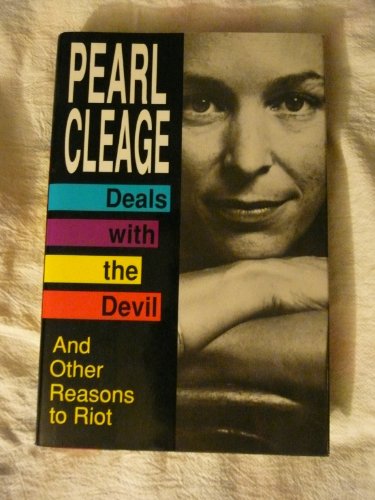
Synopsis
"Pearl Cleage breaks down for sisters all the old rules and unspoken taboos. She tells us the truths our mothers are still afraid to confront, the essential wisdom we need to stay alive. Her book mourns and rages all in one breath."
BEBE MOORE CAMPBELL
Author of YOUR BLUES AIN'T LIKE MINE
Dead-on, to the point, fearless. A third-generation black nationalist feminist, Pearl Cleage recognizes the pure power of telling the uncompromising truth--about African-American life and about the fate of the race in racist America. Whether she's writing about her--and her sisters'--defenition of good brother, or why she's so mad at Miles Davis, DEALS WITH THE DEVIL is filled with Pearl's most provactive, fascinating, and outrageous insights.
"synopsis" may belong to another edition of this title.
From the Inside Flap
Cleage breaks down for sisters all the old rules and unspoken taboos. She tells us the truths our mothers are still afraid to confront, the essential wisdom we need to stay alive. Her book mourns and rages all in one breath."<br><br>BEBE MOORE CAMPBELL<br><br>Author of YOUR BLUES AIN'T LIKE MINE<br><br>Dead-on, to the point, fearless. A third-generation black nationalist feminist, Pearl Cleage recognizes the pure power of telling the uncompromising truth--about African-American life and about the fate of the race in racist America. Whether she's writing about her--and her sisters'--defenition of good brother, or why she's so mad at Miles Davis, DEALS WITH THE DEVIL is filled with Pearl's most provactive, fascinating, and outrageous insights.
Reviews
Cleage, a columnist for the Atlanta Tribune , editor of Catalyst magazine and director of a theater company, offers approximately 40 pointed, colloquial and lively essays rising from an anger that is both feminist and black nationalist. An "outsider by choice as well as historical imperative," Cleage gets nervous when Bill Clinton makes her feel included and argues that America's integrationist dream is a "perverse fantasy" for blacks. Though she attacks Clarence Thomas as "an enemy of our race," she refuses to honor Anita Hill, arguing that Hill's service to the Reagan administration marked her as a "collaborator." Cleage is most forceful when she writes about race and sex. She can no longer celebrate Miles Davis when she learns he beats women, but her arguments that blacks are always right in interracial discussions of race and that "conscious" women are always right in discussions about sexism are certainly debatable. Other topics include Malcolm X, the film Driving Miss Daisy and Cleage's reflections on love, marriage and friends. A worthy voice.
Copyright 1993 Reed Business Information, Inc.
From Atlanta Tribune columnist Cleage, essays that treat sex and politics from an African-American feminist perspective and that are--with minor exceptions--powerful, outspoken, and fluent. Ranging from the hortatory to the reflective, the 36 pieces here make take a principled stand on contemporary issues. In the opening ``Why I Write,'' Cleage announces: ``I am writing to help myself understand the full effects of being black and female in a culture that is both racist and sexist.'' And in succeeding pieces, as she tackles events in Atlanta and elsewhere, she also helps readers understand. In ``The Other Facts of Life,'' ``Mad at Miles,'' ``Good Brother Blues,'' and ``Basic Training,'' Cleage describes and analyzes horrifying instances of black men beating, raping, and murdering black women, and she bravely exhorts her ``sisters'' to reject all excuses for violence, along with the violence itself. In essays such as ``On Redbones'' and ``Fatal Floozies,'' the author brings to bear beautiful memories of her childhood among strong, well-educated black women and men on controversies over skin tones and sexpots; in ``Forgetting to Fuss,'' she compares her reluctant enthusiasm for Bill Clinton with her parents' subdued hopes for JFK (``At our house the much ballyhooed beauty of the new First Lady was greeted with a contemptuous snort...''). Elsewhere, she delineates always thoughtful views of Clarence Thomas (``He is an enemy of our race in particular and of people in general''); Anita Hill (``There is no such thing as a reluctant African-American woman warrior''); and Spike Lee (``His characters are the men we see all the time...the ones who are angry and don't know why'')--as well as Julian Bond, Bret Easton Ellis, Marion Barry, and the film Driving Miss Daisy. A few pieces are disappointingly slight, and two or three may resemble manifestos more than polished essays, but, as a whole, a fresh, gripping, and sane collection. -- Copyright ©1993, Kirkus Associates, LP. All rights reserved.
This no-holds-barred, no-words-minced collection gathers essays and performance pieces written and delivered since 1987 by Cleage, an Atlanta writer ( The Brass Bed and Other Stories , LJ 5/15/91), performance artist, and playwright. Since she is a "third-generation Black Nationalist" writing "to help herself understand the full effects of being black and female in a culture that is both racist and sexist," there is no garden club, country club, or investment club talk. There is, however, "Basic Training" talk: women--and men--are told the sexist and racist facts of life. A significant part of Cleage's focus is upon the pervasiveness in American society of violence against women. In no uncertain terms. she expounds upon the differences between a hero and a "shero." Cleage's comments on Clarence Thomas, Anita Hill, Spike Lee, Malcolm X, pornography, and the U.S. Supreme Court make for stimulating reading. Her voice needs and deserves to be heard: all libraries should ensure that that happens.
- Katherine Dahl, Western Illinois Univ., Macomb
Copyright 1993 Reed Business Information, Inc.
"About this title" may belong to another edition of this title.
Search results for Deals with the Devil

Stock Image
Deals with the Devil: And Other Reasons to Riot
Seller: World of Books (was SecondSale), Montgomery, IL, U.S.A.
Seller rating 5 out of 5 stars

Hardback. Condition: Good. Seller Inventory # CIN0345382781G
Stock Image
Deals with the Devil
Seller: HPB-Ruby, Dallas, TX, U.S.A.
Seller rating 5 out of 5 stars
hardcover. Condition: Very Good. Connecting readers with great books since 1972! Used books may not include companion materials, and may have some shelf wear or limited writing. We ship orders daily and Customer Service is our top priority! Seller Inventory # S_452383139
Stock Image
Deals with the Devil
Published by
Ballantine Books, 1993
ISBN 10: 0345382781
ISBN 13: 9780345382788
Used
Hardcover
Signed
Seller: Wonder Book, Frederick, MD, U.S.A.
Seller rating 5 out of 5 stars
Condition: Very Good. Signed Copy . Very Good dust jacket. Inscribed by author on half title page. Seller Inventory # S18O-00539
Stock Image
Deals with the Devil
Published by
Ballantine Books, 1993
ISBN 10: 0345382781
ISBN 13: 9780345382788
Used
Hardcover
Signed
Seller: Wonder Book, Frederick, MD, U.S.A.
Seller rating 5 out of 5 stars
Condition: Good. Signed Copy . Good dust jacket. Signed by author on title page. Slightly foxed. Seller Inventory # A09OSa-00003
Stock Image
Deals with the Devil: And Other Reasons to Riot
Seller: World of Books Inc, Montgomery, IL, U.S.A.
Seller rating 4 out of 5 stars

Hardback. Condition: Good. Seller Inventory # CIN0345382781G
Seller Image
Deals with the Devil
Seller: Greenworld Books, Arlington, TX, U.S.A.
Seller rating 5 out of 5 stars
Condition: very_good. Fast Free Shipping â" Very Good condition book with a firm cover and clean pages. Shows normal use and some light wear or limited notes markings. A solid, nice copy to enjoy. Seller Inventory # GWV.0345382781.VG
Stock Image
Deals with the Devil
Seller: HPB-Emerald, Dallas, TX, U.S.A.
Seller rating 5 out of 5 stars
hardcover. Condition: Very Good. Connecting readers with great books since 1972! Used books may not include companion materials, and may have some shelf wear or limited writing. We ship orders daily and Customer Service is our top priority! Seller Inventory # S_468586989
Stock Image
Deals with the Devil
Seller: HPB-Diamond, Dallas, TX, U.S.A.
Seller rating 5 out of 5 stars
Hardcover. Condition: Very Good. Connecting readers with great books since 1972! Used books may not include companion materials, and may have some shelf wear or limited writing. We ship orders daily and Customer Service is our top priority! Seller Inventory # S_482310747
Seller Image
Deals with the Devil
Seller: Goodwill of Greater Milwaukee and Chicago, Racine, WI, U.S.A.
Seller rating 5 out of 5 stars
Condition: acceptable. Book is considered to be in acceptable condition. The actual cover image may not match the stock photo. Book may have one or more of the following defects: noticeable wear on the cover dust jacket or spine; curved, dog eared or creased page s ; writing or highlighting inside or on the edges; sticker s or other adhesive on cover; CD DVD may not be included; and book may be a former library copy. Seller Inventory # SEWV.0345382781.A
Stock Image
Deals with the Devil: And Other Reasons to Riot
Published by
Ballantine, New York, 1993
ISBN 10: 0345382781
ISBN 13: 9780345382788
Used
Hardcover
First Edition
Seller: Irolita Books, Aurora, ON, Canada
Seller rating 5 out of 5 stars
Hardcover. Condition: VERY GOOD. Dust Jacket Condition: VERY GOOD. First edition. Light shelfwear. New archival mylar dj cover. 8vo 207 pages. Essays by Atlanta playwright and activist Pearl Cleage on race, gender, politics, and American culture. Additional info or photos on request. Ships in sturdy cardboard packaging, with tracking and insurance. Seller Inventory # 10431
Buy Used
US$ 19.00
US$ 2.50 shipping
Ships from Canada to U.S.A.
Ships from Canada to U.S.A.
Quantity: 1 available