
Items related to The Making of a Mother: Overcoming the Nine Key Challenges--...
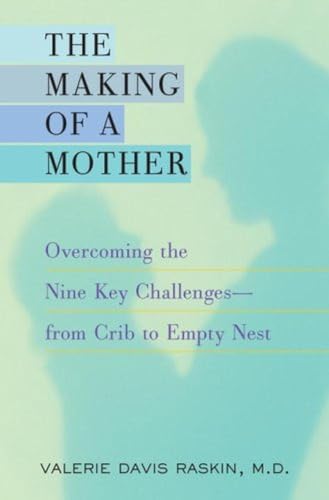
Synopsis
What makes a good mother? Are some women just born naturally maternal, or do mothers discover that part of themselves once they have a child? Now a renowned expert on the subject–and herself a mother of three–addresses the unspoken worries and fears that accompany motherhood and shares the reassuring message that every mother learns “on the job.”
Dr. Valerie Davis Raskin has worked with more than four hundred mothers in twenty years of clinical practice and has discovered that mothering is just as developmental as childhood. Dr. Raskin identifies the nine challenges facing mothers from their child’s infancy to young adulthood, pivotal moments that put mothers to the test time and again–and yet from which they can emerge truly rewarded.
• IDENTITY: How to gain confidence during those overwhelming first months after you’ve given birth or adopted, but don’t yet “feel” like a mother.
• UNLOVING MOMENTS: Every mother’s secret guilt–learn to accept those not-so-precious moments when you don’t like the child you love so dearly.
• HONORING THE FATHER: Tips for helping Dad stop feeling like a third wheel and bond with his child (and receive attention from you!).
• SEPARATION: How to maintain a positive outlook on your child’s milestones, from the first day of preschool to packing him off to sleepaway camp.
• SETTING LIMITS: How to put your foot down, even when your child kicks, screams, or cries.
• IMPERFECT INSTITUTIONS: How to cope when your child does not have the best teacher or the most inspiring coach, or faces a less than fair grading system.
• REVISED DREAMS: Your cute five-year-old in a pink tutu has no rhythm. Your nine-year-old cannot catch a ball. Learn to modify your dreams for your child–and follow your child’s dreams instead.
• ADVERSITY: You can’t keep your child in a plastic bubble, but you can take a deep breath, relax, and be there for her when life gets tough.
• SAYING GOODBYE: Discover the joys of loving your adult child while not living under the same roof.
This wonderfully anecdotal, engaging, and accessible book is nothing less than an essential training manual for mothers of all ages. The bottom line: Just because motherhood is sometimes difficult, confusing, intense, sleepless, and frustrating, doesn’t mean mothers aren’t doing it right!
"synopsis" may belong to another edition of this title.
About the Author
Valerie Davis Raskin, M.D., maintains a private practice in the Chicago area. A former clinical associate professor of psychiatry at the University of Chicago Pritzker School of Medicine, she also co-founded the Pregnancy and Postpartum Treatment Program at the University of Illinois at Chicago College of Medicine. She has been honored by Postpartum Support International for her contributions to increasing awareness of emotional health related to childbearing. She is the author of This Isn’t What I Expected: Overcoming Postpartum Depression, When Words Are Not Enough: The Women’s Prescription for Depression and Anxiety, and Great Sex for Moms: Ten Steps to Nurturing Passion While Raising Kids. She is the mother of a young adult and two teenagers.
Excerpt. © Reprinted by permission. All rights reserved.
Identity
The First Key Challenge
In a sense, a mother has to be born psychologically much as her baby is born physically.
—Daniel N. Stern, M.D., and Nadia Bruschweiler-Stern, M.D., The Birth of a Mother
Cecilia, age thirty-eight, and her husband, Michael, performed six separate home pregnancy tests, each showing the two little pink lines, and still they doubted that she was pregnant. The signs were there: nausea, sensitivity to odors, fatigue, hunger. But they’d been told by Michael’s cancer doctor a dozen years ago that after the experimental chemotherapy he underwent, he was infertile. They had never used birth control, and fourteen years of unprotected sex without a pregnancy seemed to settle the matter.
When they married, they assumed their life would be childless, and they compensated as best they could. They became the aunt and uncle the nieces and nephews love best, the ones with the “fun house.” They filled their life with travel and play. “We’d show up at the family birthday parties dressed to the nines. We’d stop in, but we were always on our way somewhere else for dinner or dancing.” They traveled at the drop of a hat. “Michael would say, ‘Hey, honey, do you want to go to Vegas next weekend?’ and we’d be off.”
In one of those examples that proves Life Isn’t Fair, Cecilia herself got breast cancer six years ago. They caught it so early that she didn’t need chemotherapy, but the surgery removed her milk ducts. When her cancer doctor told her that she’d never be able to breast-feed, she replied, “That’s for sure, Michael can’t have children.” Her cancer, following his, left her with a permanent sense that bad things can and do happen, that you can’t tell yourself “that would never happen to me.”
In some sense, the fact that both were cancer survivors helped them adjust to being infertile—there are worse things than not having a baby. She never spoke of her longing for children to Michael, not wanting him to feel bad or guilty. He didn’t bring it up with her, thinking that she would only feel worse if they dwelled on it.
When the doctor confirmed her pregnancy, they were ecstatic. Their world flipped upside down, and now they love it. The baby is named Jessica, because it translates to “God’s grace,” and that’s how they feel: blessed. They also understand John Lennon’s statement that “Life is what happens when you’re busy making other plans.” They bought their first house a month before they learned she was expecting, and hadn’t even moved yet. The room they’d planned to make into a party room with a deck overlooking a swimming pool was suddenly to become the baby’s room. Cecilia immediately wished she’d considered the school system when picking a home, and began saving for Jessica’s college fund.
Cecilia is a planner, quick on her feet when it comes to shifting directions. She responded to the sea change in her life by becoming an expert. “My sisters laughed at me at my baby shower. My wish list only included things the American Academy of Pediatrics approved. I know what the safest car seat is, what dishes a baby can’t throw off the high chair, and how to try to avoid SIDS.” In general, she likes to be prepared, and she joined countless new-mom chat rooms, read articles, and talked to mothers she respects about what to expect. In this, she’s like her mother, who advises, “You always need a Plan B.” Her husband says she frets too much, suggesting that since Jessica is only four months old, there is no need to stew about where she’s going to high school.
Cecilia attributes her tendencies to be a planner, as well as a worrier, to her childhood. She’s the oldest daughter of three, and her mom and dad suddenly divorced when she was six, because her father had been unfaithful. Her mother, of Mexican descent, moved the family back from a distant suburb into a tight-knit urban Italian community where her former mother-in-law lived, so she could go back to work with the help of her ex-husband’s family (her own mother was deceased). Cecilia grew up feeling the weight of the world on her shoulders. She was often anxious about whether they’d have the rent money when the landlord knocked on the door, and worried that her mother sometimes looked sad. Overwhelmed, her mom lashed out in anger on occasion. As the oldest of three, as soon as Cecilia was ten, she supervised her younger sisters after school until her mom came home from work.
She doesn’t fault her mother, whom she describes as “wonderful.” She experienced her as “devoted,” always making the girls her priority. She recalls that her mother fed them first, eating what remained. If she had some leftover money, she spent it on the girls. She taught them pride: “It doesn’t matter if your clothes are new; it matters if they’re clean and pressed.” She also taught her to be proactive, saying repeatedly, “If there is something in your life you don’t like, you are the only one who can change it.” When her two sisters had children, she appreciated her mother’s devotion with adult eyes, noticing how she gives her all to her grandkids.
When Cecilia became pregnant, she felt confident that she could repeat the best pieces of her mothering without idealizing her mother’s human flaws. She, too, intends to put her daughter’s needs first, and feels certain that she’ll be able to convey to her daughter that she’ll always be taken care of. She is certain that she’ll repeat the maternal dedication she herself experienced growing up.
Her mother wasn’t perfect, and Cecilia wants to do a few things a little differently. She says, “I want Jessica to be a child of her age. I don’t want her to be aware of the pressures that the adults in her life have.” She also rejects the importance her mother placed on appearances. Perhaps culturally driven, in response to stereotypes about Mexican-Americans in those days, her mother was preoccupied with making her girls look pretty all the time. Cecilia says, “Don’t get me wrong. On Easter, Jessica was gorgeous in her little dress and patent leather shoes, but when I buy clothes, I think, ‘Is it comfortable? Is it warm? Will it last?’ ” One of her sisters is just like their mother that way, but Cecilia says, “I don’t obsess about how Jessica looks.”
Cecilia views her mother’s shortcomings through the lens of maturity. She doesn’t fault her mother for being overwhelmed at times. “I’ve got new props* for single moms now. I can’t imagine how I would have been when I was teary and couldn’t sleep and had indigestion if I’d been on my own with no husband, no mother, no money.” She gives her mother credit for wanting to do the best she could by her children, even if she sometimes stumbled. Her heart was always in the right place, and, in her way of thinking, that offsets any mistakes her mom made.
At almost forty, Cecilia entered motherhood with a strong sense of identity as a nonmother. Her work in accounting and bookkeeping is important to her, and she says, “I always try to be the best: the best employee, the best sister, the best wife.” She differentiated herself from her mother long ago: her marriage is thriving, she is financially self-supporting, and knows that she’d never be as broke or helpless as her mom was when her world turned upside down because of her father’s unfaithfulness. When Cecilia became a mother, she was at peace with the ways she’s like her mother
*Slang for proper respect.
(“my kitchen table suffers from mom syndrome—it catches every paper that comes in the house”), and the ways in which she isn’t destined to be like her.
As a childless couple, Cecilia and Michael had their lifestyle well mapped out. They were very free and spontaneous, and yet they don’t miss that existence. “Maybe it’s because we got enough of it. We weren’t in our early twenties, stuck home with a baby while everyone went out and partied. We’d had that, and we feel that Jessica is, literally, a miracle baby.”
Anticipating parenthood, Michael and Cecilia modified parts of who they were pre-baby. In addition to happily giving up the party room, they’ve switched careers. Michael, formerly a freelance construction worker, took a lower paying union job with benefits so that if Cecilia needed to leave her job, they would have his insurance and job security. Just this week, after eight years at one company, she quit to stay home when the friend who was watching Jessica decided to go back to work herself. After visiting numerous infant care centers, Cecilia decided, “I can’t drive up and drop her off with strangers like she’s a package.” She’ll work part-time in the evening when her husband gets home, and downplay other people’s worries about how her career might be adversely impacted when she’s ready to go back full-time. “I’ll cross that bridge when I get there. Right now, I have to watch the cars in the road that are here.” Her identity as a professional conflicted with her identity as a mother. Motherhood easily triumphed, because, as a mom, the most important thing to her is to do what her mom did: be devoted, put the baby first. “We’ll just have to manage on less money.”
Cecilia entered motherhood with a track record of being capable in her former roles. She doesn’t like the feeling of incompetence that comes with new motherhood, and thus she prepared herself with all her energy. “I think I might be the only first-time mom who actually knew when her mucous plug cam...
"About this title" may belong to another edition of this title.
Search results for The Making of a Mother: Overcoming the Nine Key Challenges--...

Stock Image
The Making of a Mother: Overcoming the Nine Key Challenges--from Crib to Empty Nest
Seller: ThriftBooks-Dallas, Dallas, TX, U.S.A.
Seller rating 5 out of 5 stars

Hardcover. Condition: Very Good. No Jacket. Former library book; May have limited writing in cover pages. Pages are unmarked. ~ ThriftBooks: Read More, Spend Less. Seller Inventory # G0345475984I4N10
Stock Image
The Making of a Mother: Overcoming the Nine Key Challenges from Crib to Empty Nest
Seller: World of Books (was SecondSale), Montgomery, IL, U.S.A.
Seller rating 5 out of 5 stars
Hardback. Condition: Good. Seller Inventory # 00105003902
Stock Image
The Making of a Mother : Overcoming the Nine Key Challenges from Crib to Empty Nest
Published by
Random House Publishing Group, 2007
ISBN 10: 0345475984
ISBN 13: 9780345475985
Used
Hardcover
Seller: Better World Books, Mishawaka, IN, U.S.A.
Seller rating 5 out of 5 stars
Condition: Good. Former library copy. Pages intact with minimal writing/highlighting. The binding may be loose and creased. Dust jackets/supplements are not included. Includes library markings. Stock photo provided. Product includes identifying sticker. Better World Books: Buy Books. Do Good. Seller Inventory # 447153-6
Stock Image
The Making of a Mother: Overcoming the Nine Key Challenges from Crib to Empty Nest
Seller: World of Books Inc, Montgomery, IL, U.S.A.
Seller rating 4 out of 5 stars

Hardback. Condition: Good. Seller Inventory # CIN0345475984G
Stock Image
The Making of a Mother: Overcoming the Nine Key Challenges--from Crib to Empty Nest
Seller: Robinson Street Books, IOBA, Binghamton, NY, U.S.A.
Seller rating 4 out of 5 stars
Hardcover. Condition: Very Good. Prompt Shipment, shipped in Boxes, Tracking PROVIDEDVery good in Very good dust jacket. First Edition. Seller Inventory # ware303mg007
Stock Image
The Making of a Mother: Overcoming the Nine Key Challenges--from Crib to Empty Nest
Seller: Redux Books, Grand Rapids, MI, U.S.A.
Seller rating 5 out of 5 stars
Hardcover. Condition: Very Good. Hardcover with dust jacket. Pages are clean and unmarked. Covers show very minor shelving wear. Binding is tight, hinges strong. Dust jacket shows light edge wear. Inscribed to previous owner and signed by author.; 100% Satisfaction Guaranteed! Ships same or next business day! Seller Inventory # 132003030009
Seller Image
The Making of a Mother: Overcoming the Nine Key Challenges From Crib to Empty Nest
Seller: WeBuyBooks, Rossendale, LANCS, United Kingdom
Seller rating 5 out of 5 stars
hardcover. Condition: Good. Most items will be dispatched the same or the next working day. A copy that has been read but remains in clean condition. All of the pages are intact and the cover is intact and the spine may show signs of wear. The book may have minor markings which are not specifically mentioned. Seller Inventory # rev2697549737
Buy Used
US$ 24.79
US$ 8.46 shipping
Ships from United Kingdom to U.S.A.
Ships from United Kingdom to U.S.A.
Quantity: 1 available
Stock Image
The Making of a Mother: Overcoming the Nine Key Challenges--from Crib to Empty Nest
Seller: GoldBooks, Denver, CO, U.S.A.
Seller rating 5 out of 5 stars
Hardcover. Condition: new. New Copy. Customer Service Guaranteed. Seller Inventory # 11O29_68_0345475984