
Synopsis
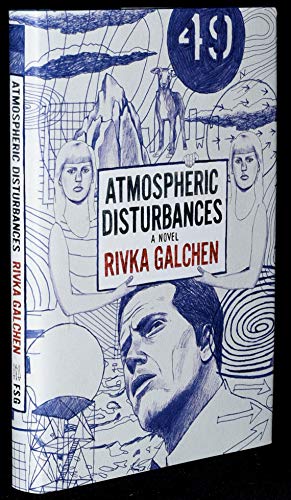
When Dr. Leo Liebenstein’s wife disappears, she leaves behind a single, confounding clue: a woman who looks, talks, and behaves exactly like her—or almost exactly like her—and even audaciously claims to be her. While everyone else is fooled by this imposter, Leo knows better than to trust his senses in matters of the heart. Certain that the original Rema is alive and in hiding, Leo embarks on a quixotic journey to reclaim his lost love.
With the help of his psychiatric patient Harvey—who believes himself to be a secret agent who can control the weather—Leo attempts to unravel the mystery of the spousal switch. His investigation leads him to the enigmatic guidance of the meteorologist Dr. Tzvi Gal-Chen, the secret workings of the Royal Academy of Meteorology in their cosmic conflict with the 49 Quantum Fathers, and the unwelcome conviction that somehow he—or maybe his wife, or maybe even Harvey—lies at the center of all these unfathomables. From the streets of New York to the southernmost reaches of Patagonia, Leo’s erratic quest becomes a test of how far he is willing to take his struggle against the seemingly uncontestable truth he knows in his heart to be false.
Atmospheric Disturbances is at once a moving love story, a dark comedy, a psychological thriller, and a deeply disturbing portrait of a fracturing mind. With tremendous compassion and dazzling literary sophistication, Rivka Galchen investigates the moment of crisis when you suddenly realize that the reality you insist upon is no longer one you can accept, and the person you love has become merely the person you live with. This highly inventive debut explores the mysterious nature of human relationships, and how we spend our lives trying to weather the storms of our own making.
"synopsis" may belong to another edition of this title.
About the Author
Rivka Galchen recieved her MD from the Mount Sinai Shool of Medicine, having spent a year in South America working on public health issues. Galchen recently completed her MFA at Columbia University, where she was a Robert Bingham Fellow. Her essay on the Many Worlds Interpretation of quantum mechanics was published in The Believer, and she is the recipient of a 2006 Rona Jaffe Foundation Writers’ Award. Galchen lives in New York City. This is her first novel.
Reviews
Reviewed by Ron Charles
Rod Serling, strolling through a gallery of distorted portraits, should introduce Rivka Galchen's first novel. Atmospheric Disturbances takes place in the twilight zone of Leo Liebenstein's highly rational but utterly deluded mind. He's a middle-aged psychiatrist confounded by a strange problem: "A woman entered my apartment who looked exactly like my wife," he tells us on the opening page. "Same everything, but it wasn't Rema." This "impostress" or "simulacrum," as he refers to her throughout the novel, looks exactly like his young wife, imitates her Argentine accent perfectly and possesses all her memories and attitudes. But he knows she isn't Rema. "Something was extraordinarily wrong," he explains. "It was just a feeling, that's how I knew." Because he loves her, "obviously and entirely and singularly," he tells us, "I had to go and search for the real Rema."
This sounds weird, of course, and it is -- deliciously so -- but on another level, it's common: After all, lots of people eventually conclude that their spouse isn't the person they once married. What husband, in a petty moment, hasn't shared Leo's cruel appraisal: "It would seem Rema was being played by someone older, or who at least looked older. Someone pretty, but not as pretty." What Galchen has done is play out that sad realization in the mind of a psychotic psychiatrist, a man thoroughly versed in others' delusions but unable to perceive his own.
The result is a steady descent into madness confidently reinforced by the methods and language of science. There are a few diagrams, a formula now and then, and some references that will remind you of things you've forgotten from high school. In fact, if you plot Atmospheric Disturbances on a piece of graph paper -- the kind of pseudo-scientific approach Leo would recommend -- you'll notice a trend line running through recent novels such as Marisha Pessl's Special Topics in Calamity Physics and Samantha Hunt's The Invention of Everything Else. These brilliant young women infuse their stories with the language and tropes of scientific disciplines. They manage to appropriate the mystique of science, producing novels that seem somehow grounded in fundamental laws, even while satirizing the confident function that science plays in modern life.
Galchen received a medical degree with an emphasis in psychiatry at Mount Sinai School of Medicine, a background that allows her to describe Leo's professional life as convincingly as she describes his descent into psychosis. Wandering around New York looking for his "real" wife, Leo challenges our objections in the most self-assured but absurd ways: "Why should I believe, just by fiat, that this woman was Rema, when that ran contrary to the phenomenology?" True to his academic training, he throws himself into systematic research with appropriate "experimental controls." This amounts to sitting in the library and writing random words on notecards: "HERONS," "WOOL PROCESSING," "HERMOCHROMATOSIS." Guffaw if you will, but he won't be dissuaded: "The way I proceeded with my investigation might cause me to lose credibility before mediocre minds," he admits. "I wasn't actually developing the detachment of a disordered psychotic -- I just wanted to concentrate, to stick to the business at hand."
What remains so unsettling, and often funny, about Leo is the way his intelligent observations slip into looniness. This tendency is most dramatically on display during his psychological treatment of a young man with "a fixed magical belief that he had special skills for controlling weather phenomena." In a misguided attempt to limit the man's dangerous behavior, Leo poses as a meteorologist -- Tzvi Gal-Chen, chosen at random from a list of leading scientists. This unorthodox technique appears to work at first, but very quickly Leo is caught in his patient's fantasy and becomes convinced that the real Gal-Chen must have something to do with the disappearance of his wife.
The novel's central, twisted metaphor revolves around Gal-Chen's work with Doppler weather radar. Leo clearly and correctly explains its operative principle as "the change perceived by an observer who is, relative to the wave source, in motion," such as the rising pitch of the sound of an approaching car. "Doppler effect refers to these distorted perceptions," he says, "and Doppler radar's utility relies on savvy interpretations of these distortions that, properly understood, enable a more accurate understanding of the real world." So far, so sane, but then suddenly Leo applies this phenomenon to his perception of his wife: "Let us imagine a source from which a Rema look-alike emerges every second. If the source is stationary, and I am stationary, then every second one of these Remas will pass me by." In one of the novel's innumerable loopy but cerebral moments, Leo announces what he calls the "Dopplerganger effect."
There are other, darker puns and doubles lurking in these pages, though their intention isn't always clear. The second half of the novel, for instance, takes place in Argentina, where the search for someone who has disappeared echoes the country's tragic recent history. And though there's no clue of it in the book, the author's father, who died in 1994, was a meteorologist named Gal-Chen.
All of this is impressively clever, but it's hard to sustain over the course of an entire novel, even a short one like this. Once you've laughed at Leo's psychotic tics a few times, they grow more familiar than funny. But just when the joke seems to have played out, when we've comfortably distanced ourselves from this ridiculous man, Galchen concludes with Leo's quiet, heartbreaking plan for the future. After all his craziness, it's a startling reminder of how ordinary his case is. How many perfectly sane people trudge along, hoping they can learn to love the stranger in the house -- or find the person they married?
Copyright 2008, The Washington Post. All Rights Reserved.
Starred Review. In this enthralling debut, psychiatrist Dr. Leo Liebenstein sets off to find his wife, Rema, who he believes has been replaced by a simulacrum. Also missing is one of Leo's patients, Harvey, who is convinced he receives coded messages (via Page Six in the New York Post) from the Royal Academy of Meteorology to control the weather. At Rema's urging, Leo pretends during his sessions with Harvey to be a Royal Academy agent (she thinks the fib could help break through to Harvey), and once Re- ma and Leo disappear, Leo turns to actual Royal Academy member Tzvi Gal-Chen's meteorological work to guide him in his search for his wife. Leo's quest takes him through Buenos Aires and Patagonia, and as he becomes increasingly delusional and erratic, Galchen adeptly reveals the actual situation to readers, including Rema's anguish and anger at her husband. Leo's devotion to the real Rema is heartbreaking and maddening; he cannot see that the woman he seeks has been with him all along. Don't be surprised if this gives you a Crying of Lot 49 nostalgia hit. (June)
Copyright © Reed Business Information, a division of Reed Elsevier Inc. All rights reserved.
From The Washington Post's Book World/washingtonpost.com Reviewed by Ron CharlesRod Serling, strolling through a gallery of distorted portraits, should introduce Rivka Galchen's first novel. Atmospheric Disturbances takes place in the twilight zone of Leo Liebenstein's highly rational but utterly deluded mind. He's a middle-aged psychiatrist confounded by a strange problem: "A woman entered my apartment who looked exactly like my wife," he tells us on the opening page. "Same everything, but it wasn't Rema." This "impostress" or "simulacrum," as he refers to her throughout the novel, looks exactly like his young wife, imitates her Argentine accent perfectly and possesses all her memories and attitudes. But he knows she isn't Rema. "Something was extraordinarily wrong," he explains. "It was just a feeling, that's how I knew." Because he loves her, "obviously and entirely and singularly," he tells us, "I had to go and search for the real Rema." This sounds weird, of course, and it is -- deliciously so -- but on another level, it's common: After all, lots of people eventually conclude that their spouse isn't the person they once married. What husband, in a petty moment, hasn't shared Leo's cruel appraisal: "It would seem Rema was being played by someone older, or who at least looked older. Someone pretty, but not as pretty." What Galchen has done is play out that sad realization in the mind of a psychotic psychiatrist, a man thoroughly versed in others' delusions but unable to perceive his own.The result is a steady descent into madness confidently reinforced by the methods and language of science. There are a few diagrams, a formula now and then, and some references that will remind you of things you've forgotten from high school. In fact, if you plot Atmospheric Disturbances on a piece of graph paper -- the kind of pseudo-scientific approach Leo would recommend -- you'll notice a trend line running through recent novels such as Marisha Pessl's Special Topics in Calamity Physics and Samantha Hunt's The Invention of Everything Else. These brilliant young women infuse their stories with the language and tropes of scientific disciplines. They manage to appropriate the mystique of science, producing novels that seem somehow grounded in fundamental laws, even while satirizing the confident function that science plays in modern life.Galchen received a medical degree with an emphasis in psychiatry at Mount Sinai School of Medicine, a background that allows her to describe Leo's professional life as convincingly as she describes his descent into psychosis. Wandering around New York looking for his "real" wife, Leo challenges our objections in the most self-assured but absurd ways: "Why should I believe, just by fiat, that this woman was Rema, when that ran contrary to the phenomenology?" True to his academic training, he throws himself into systematic research with appropriate "experimental controls." This amounts to sitting in the library and writing random words on notecards: "HERONS," "WOOL PROCESSING," "HERMOCHROMATOSIS." Guffaw if you will, but he won't be dissuaded: "The way I proceeded with my investigation might cause me to lose credibility before mediocre minds," he admits. "I wasn't actually developing the detachment of a disordered psychotic -- I just wanted to concentrate, to stick to the business at hand." What remains so unsettling, and often funny, about Leo is the way his intelligent observations slip into looniness. This tendency is most dramatically on display during his psychological treatment of a young man with "a fixed magical belief that he had special skills for controlling weather phenomena." In a misguided attempt to limit the man's dangerous behavior, Leo poses as a meteorologist -- Tzvi Gal-Chen, chosen at random from a list of leading scientists. This unorthodox technique appears to work at first, but very quickly Leo is caught in his patient's fantasy and becomes convinced that the real Gal-Chen must have something to do with the disappearance of his wife.The novel's central, twisted metaphor revolves around Gal-Chen's work with Doppler weather radar. Leo clearly and correctly explains its operative principle as "the change perceived by an observer who is, relative to the wave source, in motion," such as the rising pitch of the sound of an approaching car. "Doppler effect refers to these distorted perceptions," he says, "and Doppler radar's utility relies on savvy interpretations of these distortions that, properly understood, enable a more accurate understanding of the real world." So far, so sane, but then suddenly Leo applies this phenomenon to his perception of his wife: "Let us imagine a source from which a Rema look-alike emerges every second. If the source is stationary, and I am stationary, then every second one of these Remas will pass me by." In one of the novel's innumerable loopy but cerebral moments, Leo announces what he calls the "Dopplerganger effect." There are other, darker puns and doubles lurking in these pages, though their intention isn't always clear. The second half of the novel, for instance, takes place in Argentina, where the search for someone who has disappeared echoes the country's tragic recent history. And though there's no clue of it in the book, the author's father, who died in 1994, was a meteorologist named Gal-Chen. All of this is impressively clever, but it's hard to sustain over the course of an entire novel, even a short one like this. Once you've laughed at Leo's psychotic tics a few times, they grow more familiar than funny. But just when the joke seems to have played out, when we've comfortably distanced ourselves from this ridiculous man, Galchen concludes with Leo's quiet, heartbreaking plan for the future. After all his craziness, it's a startling reminder of how ordinary his case is. How many perfectly sane people trudge along, hoping they can learn to love the stranger in the house -- or find the person they married?
Copyright 2008, The Washington Post. All Rights Reserved.-- Copyright © AudioFile, Portland, Maine
*Starred Review* We often use weather to describe ourselves: she has a sunny disposition; he is rather chilly. But for Galchen, meteorological metaphors are veritable wormholes into the unconscious. In her funny, sad, and ingenious first novel, New York psychiatrist Leo keeps his patient, Harvey, who believes that he is a special agent for the Royal Academy of Meteorologists, grounded by claiming that he, too, works for the meteorologists. For verisimilitude’s sake, Leo says his contact is Tzvi Gal-Chen, an actual member of the actual academy. Harvey improves, but Leo becomes increasingly bewildered. It seems that Rema, his enigmatic Argentine wife, has disappeared and a simulacrum has taken her place. Perhaps Gal-Chen’s work with Doppler weather radar can help, or is Leo thinking of the doppelgänger effect? As her unmoored analyst searches for Rema in Argentina, Galchen––a Borgesian writer armed with a medical degree and a Rona Jaffe Foundation Award and intent on a rapprochement between art and science––pays poetic tribute to her late father, the real-life meteorologist Tzvi Gal-Chen, and considers our myriad “errors of interpretation.” Witty, tender, and conceptually dazzling, Galchen’s metaphysical tale of longing, grief, love, and the volatility of the self gracefully charts the tempestuous weather of the human psyche. --Donna Seaman
"About this title" may belong to another edition of this title.
Other Popular Editions of the Same Title

Search results for Atmospheric Disturbances: A Novel

Seller Image
Atmospheric Disturbances: A Novel
Published by
Farrar, Straus and Giroux, 2008
ISBN 10: 0374200114
ISBN 13: 9780374200114
Used
Hardcover
Seller: Greenworld Books, Arlington, TX, U.S.A.
Seller rating 5 out of 5 stars

Condition: good. Fast Free Shipping â" Good condition. It may show normal signs of use, such as light writing, highlighting, or library markings, but all pages are intact and the book is fully readable. A solid, complete copy that's ready to enjoy. Seller Inventory # GWV.0374200114.G
Stock Image
Atmospheric Disturbances
Published by
Farrar, Straus & Giroux, 2008
ISBN 10: 0374200114
ISBN 13: 9780374200114
Used
Hardcover
First Edition
Seller: Better World Books, Mishawaka, IN, U.S.A.
Seller rating 5 out of 5 stars
Condition: Good. 1st Edition. Pages intact with minimal writing/highlighting. The binding may be loose and creased. Dust jackets/supplements are not included. Stock photo provided. Product includes identifying sticker. Better World Books: Buy Books. Do Good. Seller Inventory # 2293850-6
Stock Image
Atmospheric Disturbances
Published by
Farrar, Straus & Giroux, 2008
ISBN 10: 0374200114
ISBN 13: 9780374200114
Used
Hardcover
First Edition
Seller: Better World Books, Mishawaka, IN, U.S.A.
Seller rating 5 out of 5 stars
Condition: Very Good. 1st Edition. Pages intact with possible writing/highlighting. Binding strong with minor wear. Dust jackets/supplements may not be included. Stock photo provided. Product includes identifying sticker. Better World Books: Buy Books. Do Good. Seller Inventory # 4594050-6
Stock Image
Atmospheric Disturbances
Published by
Farrar, Straus & Giroux, 2008
ISBN 10: 0374200114
ISBN 13: 9780374200114
Used
Hardcover
First Edition
Seller: Better World Books, Mishawaka, IN, U.S.A.
Seller rating 5 out of 5 stars
Condition: Good. 1st Edition. Former library copy. Pages intact with minimal writing/highlighting. The binding may be loose and creased. Dust jackets/supplements are not included. Includes library markings. Stock photo provided. Product includes identifying sticker. Better World Books: Buy Books. Do Good. Seller Inventory # 2293851-6
Seller Image
Atmospheric Disturbances: A Novel
Published by
Farrar, Straus and Giroux, 2008
ISBN 10: 0374200114
ISBN 13: 9780374200114
Used
Hardcover
Seller: Off The Shelf, Antonia, MO, U.S.A.
Seller rating 5 out of 5 stars
Condition: good. The item shows wear from consistent use, but it remains in good condition and works perfectly. All pages and cover are intact including the dust cover, if applicable . Spine may show signs of wear. Pages may include limited notes and highlighting. May NOT include discs, access code or other supplemental materials. Seller Inventory # 4WILKM00P5E4
Stock Image
Atmospheric Disturbances: A Novel
Published by
Farrar, Straus and Giroux, 2008
ISBN 10: 0374200114
ISBN 13: 9780374200114
Used
Hardcover
Seller: ThriftBooks-Atlanta, AUSTELL, GA, U.S.A.
Seller rating 5 out of 5 stars
Hardcover. Condition: Very Good. No Jacket. Former library book; May have limited writing in cover pages. Pages are unmarked. ~ ThriftBooks: Read More, Spend Less. Seller Inventory # G0374200114I4N10
Stock Image
Atmospheric Disturbances: A Novel
Published by
Farrar, Straus and Giroux, 2008
ISBN 10: 0374200114
ISBN 13: 9780374200114
Used
Hardcover
Seller: ThriftBooks-Atlanta, AUSTELL, GA, U.S.A.
Seller rating 5 out of 5 stars
Hardcover. Condition: Very Good. No Jacket. May have limited writing in cover pages. Pages are unmarked. ~ ThriftBooks: Read More, Spend Less. Seller Inventory # G0374200114I4N00
Stock Image
Atmospheric Disturbances: A Novel
Published by
Farrar, Straus and Giroux, 2008
ISBN 10: 0374200114
ISBN 13: 9780374200114
Used
Hardcover
Seller: ThriftBooks-Dallas, Dallas, TX, U.S.A.
Seller rating 5 out of 5 stars
Hardcover. Condition: Very Good. No Jacket. May have limited writing in cover pages. Pages are unmarked. ~ ThriftBooks: Read More, Spend Less. Seller Inventory # G0374200114I4N00
Stock Image
Atmospheric Disturbances: A Novel
Published by
Farrar, Straus and Giroux, 2008
ISBN 10: 0374200114
ISBN 13: 9780374200114
Used
Hardcover
Seller: ThriftBooks-Atlanta, AUSTELL, GA, U.S.A.
Seller rating 5 out of 5 stars
Hardcover. Condition: Good. No Jacket. Pages can have notes/highlighting. Spine may show signs of wear. ~ ThriftBooks: Read More, Spend Less. Seller Inventory # G0374200114I3N00
Stock Image
Atmospheric Disturbances: A Novel
Published by
Farrar, Straus and Giroux, 2008
ISBN 10: 0374200114
ISBN 13: 9780374200114
Used
Hardcover
Seller: ThriftBooks-Reno, Reno, NV, U.S.A.
Seller rating 5 out of 5 stars
Hardcover. Condition: Very Good. No Jacket. May have limited writing in cover pages. Pages are unmarked. ~ ThriftBooks: Read More, Spend Less. Seller Inventory # G0374200114I4N00