
Items related to Endgame: The Betrayal and Fall of Srebrenica
Synopsis
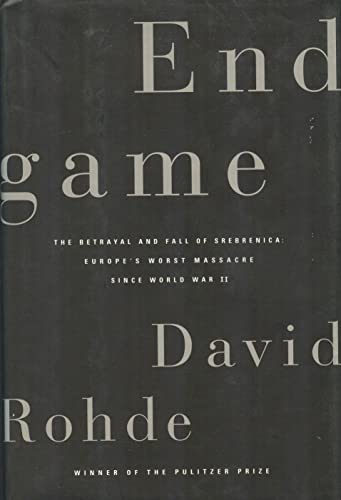
Presents an account of the recent history of the Bosnian village of Srebrenica, the site of a massacre of five thousand Muslims two years after being declared a UN "safe haven" in 1993, written by the first reporter on the scene.
"synopsis" may belong to another edition of this title.
Reviews
Returning to the subject that has already earned him a Pulitzer Prize, journalist Rohde brings keen analysis and powerful convictions to the harrowing story of Srebrenica's fall and its victims. For almost two years, Rohde has been intimately involved in trying to uncover the truth about Srebrenica's missing Muslims, many of whom (at least 5,000 men and boys) are believed to have perished in mass executions conducted by Bosnian Serbs. After locating mass graves and credible survivors, the journalist was briefly taken prisoner by Bosnian Serbs. Endgame offers a day-to-day account of events leading up to the enclave's fall on July 16, 1995. Rohde manages his material with the hand of a novelist, describing settings and atmosphere, developing characters, highlighting the horror of events. Among the various individuals we meet are Muslim civilians (men and women), two Dutch UN peacekeepers, a Bosnian Serb policeman, and a number of soldiers. Readers feel the acute humiliation and frustration of Dutch peacekeepers who are ordered to surrender to advancing Bosnian Serbs, the arrogance of Bosnian Serb general Ratko Mladic, and the fury and callousness of the executioners. Rohde carefully lays out his analysis and conclusions about the two central mysteries of Srebrenica's capture. First he raises the question of the massacre itself. Convinced that it happened, Rohde specifies the nature of its significance: the largest massacre in Europe since WW II, ``the intensity of its bloodletting,'' and ``the international community's role in the tragedy.'' Finally, Rohde gives a useful account of the many explanations of why Srebrenica fell, including the varied conspiracy theories about secret deals involving every conceivable party, from the authorities in Sarajevo to the Bosnian Serbs to UN officials. While the evidence is not conclusive, the atmosphere of connivance (and Western inaction) comes through clearly. A passionate account, and an important addition to the growing library of books about the Bosnian catastrophe. -- Copyright ©1997, Kirkus Associates, LP. All rights reserved.
Srebrenica, a small city in eastern Bosnia, is the latest shameful name to emerge from the tragic disintegration of the former Yugoslavia. Pulitzer Prize-winning journalist Rohde (Christian Science Monitor, New York Times) investigated the massacre of 7000 Muslims in Srebrenica in July 1995 and was subsequently arrested by the Bosnian Serbs. Here he tells the story of the massacre and its aftermath through the eyes of seven people who were there: two Serbian soldiers, two Dutch peacekeepers, and three Muslim civilians. This is an effective way to depict a gruesome and infuriating event. Rohde argues that the fall of Srebrenica could have been prevented, but he is ultimately unable to explain the "collective failure" of the United States, the United Nations, and NATO in stopping the massacre. His investigation is carefully documented by over 300 footnotes. This is an important and revealing book for most public and academic libraries.?Thomas A. Karel, Franklin & Marshall Coll. Lib., Lancaster, Pa.
Copyright 1997 Reed Business Information, Inc.
Nearly two years after Srebrenica's fall, New York Times reporter Rohde--whose award-winning Christian Science Monitor stories first brought wide attention to the slaughter by the Bosnian Serb army of thousands of civilians from what had been a UN-sponsored "safe area" for Bosnian Muslims--expands his analysis of that tragic battle and its bloody aftermath. The events of 10^-16 July_ 1995 are seen through the eyes of two Muslim civilians and a Muslim soldier, a Bosnian Serb policeman and a Bosnian Croat soldier who fought with the Serbs, and two Dutch peacekeepers. Rohde also traces the impact of waffling U.S., European, and UN policies. He challenges the "propaganda, mistrust, and rumor [that] sparked and fueled the war in Bosnia and played an insidious role in Srebrenica," sadly concluding that "Karadzic and Mladic ordered the manhunt and mass execution of Srebrenica's men because they wanted to, because they could and because they were confident that no one would ever hold them accountable for it. In hindsight, they appear to have been right." Mary Carroll
"About this title" may belong to another edition of this title.
Search results for Endgame: The Betrayal and Fall of Srebrenica

Stock Image
Endgame The Betrayal and Fall
Published by
Farrar Straus & Giroux (T), 1997
ISBN 10: 0374253420
ISBN 13: 9780374253424
Used
Hardcover
Seller: World of Books (was SecondSale), Montgomery, IL, U.S.A.
Seller rating 5 out of 5 stars

Condition: Very Good. Item in very good condition! Textbooks may not include supplemental items i.e. CDs, access codes etc. Seller Inventory # 00109047536
Seller Image
Endgame: The Betrayal and Fall of Srebrenica
Seller: -OnTimeBooks-, Phoenix, AZ, U.S.A.
Seller rating 5 out of 5 stars
Condition: very_good. Gently read. May have name of previous ownership, or ex-library edition. Binding tight; spine straight and smooth, with no creasing; covers clean and crisp. Minimal signs of handling or shelving. 100% GUARANTEE! Shipped with delivery confirmation, if you're not satisfied with purchase please return item! Ships USPS Media Mail. Seller Inventory # OTV.0374253420.VG
Stock Image
Endgame: The Betrayal and Fall of Srebrenica
Seller: More Than Words, Waltham, MA, U.S.A.
Seller rating 5 out of 5 stars
Condition: Good. . . All orders guaranteed and ship within 24 hours. Before placing your order for please contact us for confirmation on the book's binding. Check out our other listings to add to your order for discounted shipping. Seller Inventory # WAL-B-6b-002313
Stock Image
Endgame: The Betrayal and Fall of Srebrenica
Seller: HPB-Diamond, Dallas, TX, U.S.A.
Seller rating 5 out of 5 stars
hardcover. Condition: Very Good. Connecting readers with great books since 1972! Used books may not include companion materials, and may have some shelf wear or limited writing. We ship orders daily and Customer Service is our top priority! Seller Inventory # S_475215234
Stock Image
Endgame: The Betrayal and Fall of Srebrenica
Seller: Housing Works Online Bookstore, New York, NY, U.S.A.
Seller rating 5 out of 5 stars
Condition: Very Good. Minimal wear to cover. Pages clean and binding tight. shelf wear. bumped edges. Hardcover. Seller Inventory # BQ1-02456
Stock Image
Endgame: The Betrayal and Fall of Srebrenica
Published by
Farrar Straus & Giroux, New York, 1997
ISBN 10: 0374253420
ISBN 13: 9780374253424
Used
Hardcover
First Edition
Seller: shadowandstregabooks, Skokie, IL, U.S.A.
Seller rating 4 out of 5 stars

Hardcover. Condition: Good. Dust Jacket Condition: Good. 1st Edition. Book is in Good condition. Minor rubbing to top and bottom spine and one bumped corner. Pages are clean with no writing or underlining. D/J is in Good condition with rubbing at the bottom. Book is bound in black with titles in gilt on spine. Many maps included. Author received the Pulitzer Prize for his 1996 reporting on the conflict in Srebrenica. This book tells the harrowing full story. Stated First Edition. Seller Inventory # 000338
Stock Image
End Game : The Betrayal and Fall of Srebrenica: Europe's Worst Massacre since the Holocaust
Published by
Farrar, Straus & Giroux, 1997
ISBN 10: 0374253420
ISBN 13: 9780374253424
Used
Hardcover
First Edition
Seller: Better World Books, Mishawaka, IN, U.S.A.
Seller rating 5 out of 5 stars
Condition: Good. 1st Edition. Former library copy. Pages intact with minimal writing/highlighting. The binding may be loose and creased. Dust jackets/supplements are not included. Includes library markings. Stock photo provided. Product includes identifying sticker. Better World Books: Buy Books. Do Good. Seller Inventory # 4011551-6
Stock Image
Endgame: The Betrayal and Fall of Srebrenica
Seller: HPB Inc., Dallas, TX, U.S.A.
Seller rating 5 out of 5 stars
hardcover. Condition: Very Good. Connecting readers with great books since 1972! Used books may not include companion materials, and may have some shelf wear or limited writing. We ship orders daily and Customer Service is our top priority! Seller Inventory # S_477141393
Stock Image
Endgame: The Betrayal and Fall of Srebrenica
Published by
Farrar Straus & Giroux (T), 1997
ISBN 10: 0374253420
ISBN 13: 9780374253424
Used
Hardcover
Seller: Lot O'Books, Norfolk, VA, U.S.A.
Seller rating 4 out of 5 stars
Hardcover. Condition: Very Good. ***VERY GOOD CONDITION***CLEAN PAGES***EX-LIBRARY stamps stickers/marked out name, moderate edge wear, stamp on top/side/bottom,sticker remained on side of book & on inside of title page. We specialize in non-fiction books. Follow us on Facebook and Instagram. Seller Inventory # mon0000042785
Stock Image
Endgame The Betrayal And Fall Of Srebrenica, Europe's Worst Massacre Since World War II
Published by
Farrar, Straus and Giroux, 1997
ISBN 10: 0374253420
ISBN 13: 9780374253424
Used
Hardcover
First Edition
Seller: Willis Monie-Books, ABAA, Cooperstown, NY, U.S.A.
Seller rating 5 out of 5 stars
Hardcover. Condition: Very Good. Dust Jacket Condition: Very Good. First Edition. Seller Inventory # 154407